Frizz-prone hair is often the reason heatless curls either look soft and expensive or wake up fluffy, uneven and crushed. This Kitsch Satin Heatless Curling Set review looks at whether the satin-covered rod is genuinely gentler on texture that puffs up easily, and where it falls short compared with smaller rollers, curl ribbons and heated tools. The set’s appeal is simple: you wrap slightly damp or dry-prepped hair around a cushioned rod, secure the ends, sleep or wait, then unwrap into bends without direct heat.
In brief
- Best suited to: medium to long hair that holds a bend but becomes frizzy with rougher fabrics, high heat or over-brushing.
- Less ideal for: very short layers, heavy blunt cuts, tightly coiled hair worn in its natural shrinkage pattern, or anyone who needs strong root lift.
- Main advantage: the satin surface creates less friction than many foam or fabric curlers, so the finish can look smoother with the right prep.
- Main limitation: one large rod gives a loose, ribbon-like curl pattern rather than defined ringlets, and damp hair can frizz if it is wrapped too wet.
- Verdict: a strong heatless option for frizz-prone lengths, but not a miracle fix for humidity, dry ends or poor sectioning.
What you actually get from the Kitsch set
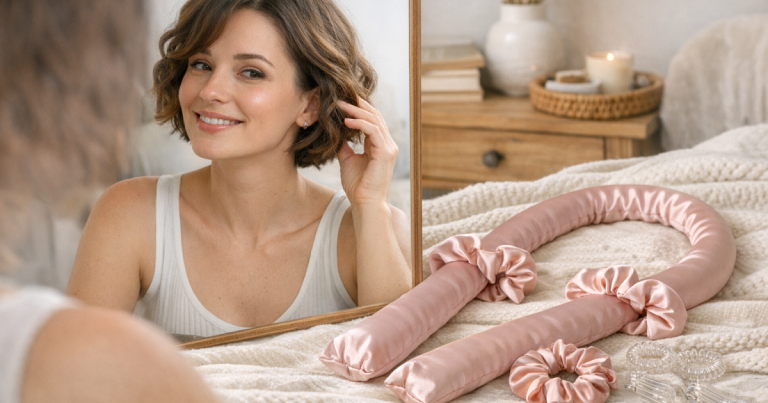
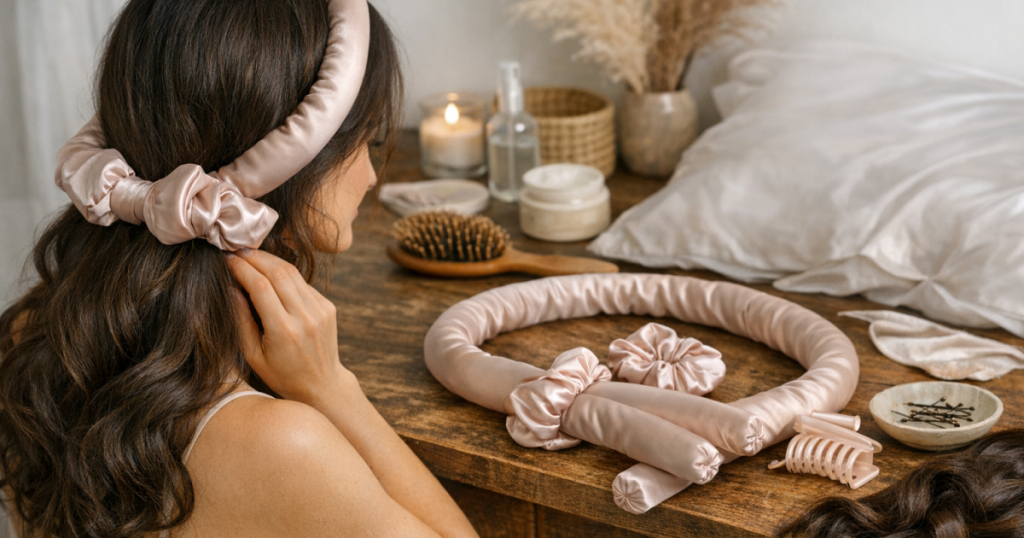
The Kitsch Satin Heatless Curling Set is a satin-covered heatless curling rod designed to sit over the top of the head while the hair is wrapped around each side. It is usually sold with securing accessories such as scrunchies or a clip, although exact pack contents can vary by retailer, so it is worth checking the product listing before ordering from a GB stockist.
The rod is soft enough for overnight use, but it still creates a central shape that you need to sleep around. If you already struggle with bulky curlers, the comfort level will depend on your sleeping position. Side sleepers often find this style easier than a head full of rollers because the bulk is concentrated at the crown and sides rather than all over the scalp.
The satin finish is the key reason this set is interesting for frizz-prone hair. Satin does not repair the hair fibre, but it can reduce friction while the hair is setting. Less rubbing means fewer roughened ends, fewer flyaways from overnight movement and a smoother release when you unwrap the hair in the morning.
Does satin really help frizz-prone hair?
Yes, but only within limits. Frizz is usually a mix of dryness, raised cuticle, humidity, mechanical friction and styling disruption. Satin mainly tackles the friction part. That is useful if your curls normally look good for the first few minutes, then turn fluffy after you sleep, brush or remove rough-textured curlers.
Where satin will not do the whole job is on hair that is already very dry, heavily lightened or porous. In that case, the smoother fabric helps, but your prep matters just as much. A gentle wash routine, enough conditioner and a small amount of leave-in or smoothing cream can make a bigger difference than the curler fabric alone. If your ends are heat-stressed or splitting, it is worth looking at whether your cleansing routine is helping or worsening the problem; our review of shampoo choice for heat-damaged ends is a useful next step.
The Kitsch rod performs best when hair is dry or only barely damp. Wet hair wrapped tightly around a satin rod can take a long time to dry, especially on thick or low-porosity hair. If it is still damp when you remove the rod, the curl may drop quickly and the surface can puff up.
How the curl pattern looks
This is not a small-barrel ringlet tool. The curl shape is soft, loose and more blow-dry-inspired than tonged. On long layers, it can create a polished bend through the mid-lengths and ends, with a face-framing sweep if you wrap away from the face. On one-length hair, the result can be more of a wave than a curl.
For frizz-prone hair, that looser finish can be a positive. Defined tight curls often need more separation, and separation can create frizz if the hair is dry or brushed through aggressively. With this set, you can usually shake the curls out gently with your fingers and leave the surface relatively intact.
The trade-off is hold. If your hair is silky, fine or very straight, the curls may look beautiful at first but soften by lunchtime unless you use a light hold product before wrapping. Avoid loading the hair with heavy oils before setting, as that can make the bend slip out and flatten the roots.
Hair-type guidance
Fine or flat hair
Fine hair can use this set, but root volume is the weak point. Because the rod sits close to the scalp and the hair is wrapped downwards, the top can become smooth rather than lifted. Use the smallest amount of styling product, keep the roots dry, and start the wrap slightly away from the scalp if you want more movement. For more root-focused ideas, see our guide to fine hair styling tools for volume and damage control.
Medium-density wavy hair
This is the easiest match. Hair that already has a bend tends to take the rod shape well, and the satin helps keep the surface from roughening overnight. Wrap in clean sections, keep tension even, and let the curls cool into shape before touching them too much in the morning.
Thick or coarse hair
Thick hair needs smaller sections and more setting time. If you wrap too much hair around the rod at once, the outer layer may curl while the inner section stays loose or damp. A smoothing cream through the ends can help, but avoid making the hair wet. For very dense hair, this set gives a soft bend rather than a salon-level bouncy blowout.
Curly and coily textures
On naturally curly or coily hair, this tool is better for stretching or reshaping pre-smoothed lengths than defining curls from scratch. If the hair is wrapped while too wet, or if the natural curl pattern is disturbed without enough slip, frizz can increase. It may work nicely on blow-dried or banded hair when you want a softer wave, but it is not the most precise option for curl-by-curl definition.
Short hair and layers
Short layers are the main challenge. Hair needs enough length to wrap securely around the rod and stay put. Face-framing pieces can slip out, and jaw-length cuts may end up with flicks rather than cohesive curls. If your hair is above the shoulders, compare this shape with our Invisibobble heatless curling set for short hair, which may be more relevant depending on your cut.
How to use it for the smoothest finish
- Start with almost-dry hair: slightly flexible hair sets better than soaking wet hair and is less likely to frizz as it dries.
- Add slip to the ends: a pea-sized amount of lightweight leave-in or smoothing cream through the last few centimetres can help dry ends wrap neatly.
- Wrap away from the face: this usually gives the most flattering, blow-dry-style movement around the front.
- Keep tension steady: loose wrapping creates patchy bends; overly tight wrapping can flatten the top and feel uncomfortable.
- Do not brush immediately: separate with fingers first, then use a wide-tooth comb only if you want a softer wave.
If your biggest issue is waking up with crushed roots rather than frizzy ends, technique matters as much as the curler. The way you position the rod, part the hair and secure the sides can make or break the result; our guide to sleeping in heatless curlers without flattening roots goes deeper on that problem.
Where it beats heated styling, and where it does not
The obvious advantage is damage control. No direct heat means less risk of the dryness and brittle ends that can make frizz worse over time. For anyone trying to reduce straightener, wand or hot brush use, this set is a realistic weeknight alternative rather than a complicated styling project.
It also suits low-effort routines. Once you learn your sectioning pattern, wrapping takes only a few minutes. The finish can look more relaxed than a curling wand, which is useful if you prefer soft movement over obviously styled curls.
However, heated tools still win for speed, precision and stronger hold. If you need a defined curl pattern for an event, or your hair drops every style quickly, a heatless rod may not give the same reliability. The Kitsch set is more of a hair-health-friendly habit tool than a full replacement for every styling occasion.
Pros and drawbacks
- Pros: gentle satin surface, no direct heat, comfortable compared with many multi-roller sets, good for loose waves, helpful for reducing friction-related frizz.
- Drawbacks: limited root lift, less effective on very short hair, can slip on silky layers, may not dry thick hair if wrapped damp, produces a loose curl rather than tight definition.
Closing judgement
The Kitsch Satin Heatless Curling Set review verdict is straightforward: it is one of the better heatless curlers for frizz-prone hair if your goal is smoother, softer bends with less mechanical roughening. The satin surface is genuinely useful, and the single-rod design is simpler than sleeping in multiple rollers.
It is not the answer to every frizz problem, though. If your hair is very dry, your ends need trimming, or you wrap hair while too wet, the result can still look fluffy. It works best as part of a low-friction routine: smooth prep, careful wrapping, satin or silk accessories, and minimal brushing after release.
FAQ
Can you use the Kitsch set on wet hair?
It is better on dry or barely damp hair. Wet hair can take too long to dry around the rod, which can leave curls weak, uneven or frizzy when unwrapped.
Will it stop frizz completely?
No. Satin reduces friction, but it will not fix dryness, humidity swelling or damaged ends. It helps most when frizz is caused by rubbing, rough curlers or over-handling.
Is it comfortable enough to sleep in?
Most people will find it more comfortable than lots of separate rollers, but it still depends on how you sleep. Side sleepers usually adapt better than people who move around heavily at night.
Does it work on short hair?
It can work on longer bobs, but very short layers may slip out or form flicks rather than full curls. Shorter hair often needs smaller, more targeted heatless tools.
What should I use after removing it?
Use fingers first, then a tiny amount of lightweight oil or serum on the ends if needed. Avoid heavy brushing unless you want a much softer, brushed-out wave.