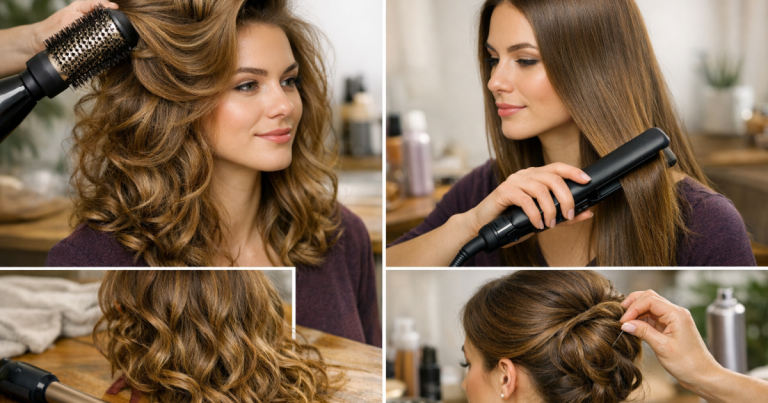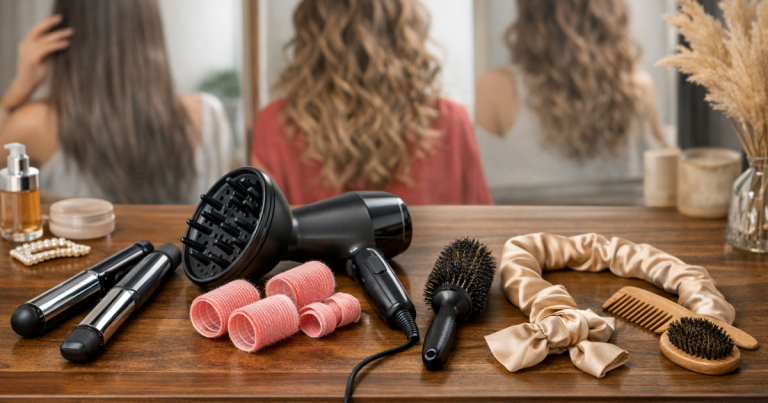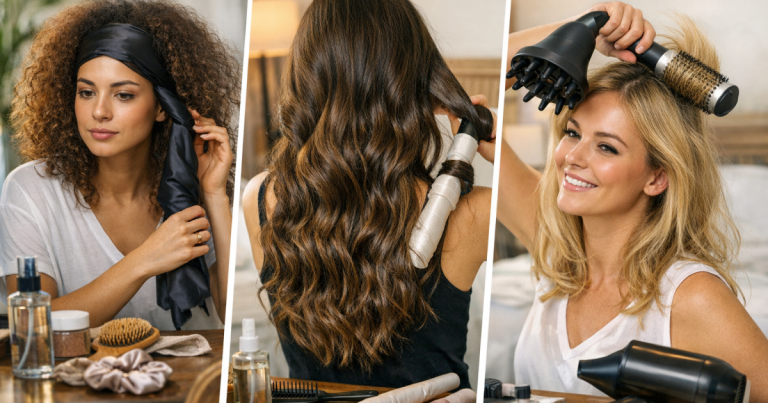
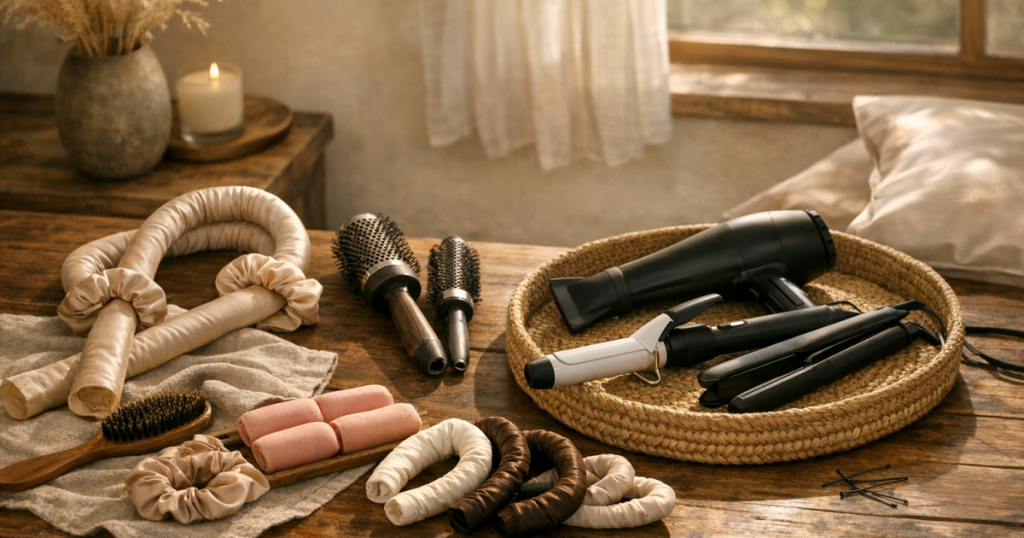
The fastest route to a style that lasts is matching the tool to both your goal and your texture. That is the practical value of styling tools by hair type: a fine bob, dense waves and fragile curls do not need the same tension, heat or drying time. Start with the finish you want, then choose the gentlest tool that can realistically get you there at home.
For a deeper category-by-category overview, the wider at-home styling tool guide is a useful next step. This guide focuses more tightly on goals: volume, smoothness, curls, waves, definition, refresh days and lower-heat routines.
In brief
- Fine hair usually needs lift, light tension and minimal product build-up rather than heavy heat or large clamps.
- Thick hair benefits from stronger airflow, wider plates, larger barrels or section-friendly tools that reduce repeated passes.
- Curly and coily hair needs tools that respect the curl pattern: diffusers, wide-tooth combs, detangling brushes and low-tension smoothing methods.
- Damaged, bleached or colour-treated hair is usually better served by heatless shaping, lower-temperature tools and protective prep.
- Short hair needs precision: smaller brushes, narrow straighteners, mini rollers and secure clips matter more than oversized multi-stylers.
Start with the styling goal, not the tool drawer
Most disappointing styling results come from choosing the most impressive-looking tool rather than the one that solves the actual problem. If your hair drops within an hour, you may need root lift and setting time, not a hotter curler. If your ends look fluffy, the issue may be cuticle smoothing and moisture balance rather than a stronger straightener.
Think in goals:
- Volume: root lift, crown shape, movement through the lengths.
- Smoothness: reduced frizz, polished ends, less puffiness.
- Curls: defined bends, bounce, shape memory.
- Waves: softer texture, undone movement, less uniformity.
- Definition: curl clumps, controlled coils, tidy fringe or face-framing pieces.
- Refresh: second-day revival without fully washing or restyling.
For volume: rollers, round brushes and root-friendly airflow
Volume is rarely about blasting the hair everywhere. It comes from drying or setting the roots in the direction you want them to sit. Fine and flat hair tends to respond well to Velcro rollers, a lightweight round brush or a hot brush used at the roots only. The key is cooling time: hair sets as it cools, so removing rollers too early often leads to collapse.
Thick hair needs more structure. Large Velcro rollers can add lift at the crown, but they work best when the hair is almost dry and sectioned neatly. A powerful hair dryer with a concentrator nozzle can help direct the roots upwards before a brush or roller locks in shape. For long, dense hair, oversized rollers give a softer blow-dry effect, while smaller rollers create more noticeable bounce.
Short hair usually needs smaller tools. A compact round brush, mini rollers or a narrow hot brush can lift the crown without making the sides too wide. Clips are more important here than many people realise, because clean sectioning stops the shorter layers from slipping into the wrong direction while they cool.
For smoothness: choose controlled tension over repeated passes
Smooth hair is not the same as flat hair. The best result usually comes from enough tension to align the cuticle, plus a finish that suits your density. Fine hair can look limp if it is over-straightened, so a paddle brush blow-dry or a straightener used mainly through the mid-lengths and ends may be enough.
Thick, coarse or frizz-prone hair often needs sectioning and patience. A straightening brush can soften bulk, but a traditional straightener gives more control at the roots and hairline. A tool such as the ghd Platinum+ Styler is a recognisable example of a premium straightener, but always verify current features, suitability and retailer information before choosing any heated tool.
Curly and coily textures should be smoothed with care. If your goal is a stretched style rather than a pin-straight finish, a blow-dry brush attachment, paddle brush technique or tension blow-dry may be less aggressive than repeated straightener passes. Always work in manageable sections and avoid dragging through knots; a detangling brush is a better starting point than using a hot tool to force hair into shape.
For curls: match barrel size, heat level and hair resilience
Curling tools are where hair type makes a huge difference. Fine hair can take a curl quickly but lose it just as fast, so smaller sections, a lighter styling product and pinning the curl while it cools often matter more than increasing heat. A satin heatless curling rod is also a strong option for fine hair because it creates shape without flattening the roots as much as heavy overnight rollers can.
Medium-density hair is usually the most flexible. Curling wands, tongs, heatless rods and soft rollers can all work, depending on whether you want uniform curls or a looser wave. A tool like the BaByliss Curl Secret is a known automatic curler example, but automatic tools are not ideal for every hair type; check hair length guidance, section size instructions and tangle-prevention advice before use.
Thick hair needs smaller sections and longer setting time. Heatless curls can still work, but the hair may need to be slightly damp rather than wet, and fully dry before removal. If the hair is too damp overnight, the curl may feel soft at first and then drop quickly. For dense hair, two heatless rods or a combination of rods and clips can give better distribution than wrapping everything around one central piece.
For waves: less perfection, more placement
Waves are often easier to wear than polished curls because they do not need every section to match. For fine hair, a heatless robe-belt method or satin curling rod can create soft bends with minimal stress. The trick is to keep the wrap loose enough that the result looks modern, not crimped or overly tight.
For thick or long hair, larger-barrel tongs, jumbo rollers or plait-based heatless methods can create movement without shrinking the length too much. Heated rollers, such as Remington Proluxe Heated Rollers, are a familiar example of a set-based option for bounce and shape, but current set contents and heat settings should always be checked before buying.
Curly hair can use wave styling differently. Rather than forcing the whole head into a uniform S-wave, many curl types look better with selected pieces softened around the face while the natural curl pattern remains intact elsewhere. This avoids the common problem of overworking curly hair until it becomes frizzy rather than styled.
For curly and coily definition: tools that support the pattern
Definition starts before styling. Wet or damp detangling, even product distribution and minimal disruption while drying all make a difference. A wide-tooth comb, a flexible detangling brush and a diffuser are often more useful than a curling wand if your goal is curl quality rather than a completely new shape.
The Denman D3 Original Styler is a well-known brush used by many people for styling and defining curls, though technique matters enormously. Some curl patterns love the tension; others separate too much and lose volume. If your curls become stringy, try using the brush only for product distribution, then scrunch and diffuse instead.
For coily hair, shrinkage is not a styling failure; it is part of the texture. Choose tools based on whether you want maximum definition, stretched length or protective shaping. A diffuser can enhance definition, banding can stretch without heat, and a silk hair wrap helps preserve the result overnight by reducing friction.
For refresh days: revive the style without starting again
Second-day styling should be lighter than wash-day styling. Fine hair may need dry shampoo at the roots, a quick blast of cool air and a few rollers through the crown. Thick hair may need misting, smoothing cream on the ends and targeted reshaping around the front. Curly hair often responds best to water, a small amount of leave-in product and gentle scrunching rather than brushing through the whole style.
Clips are underrated for refresh days because they hold the hair while product dries or shape resets. If slipping is a constant frustration, this review of reliable sectioning clips explains what makes grip, hinge strength and hair density compatibility worth checking.
When heatless is the better choice
Heatless styling is not automatically better for every occasion, but it is often the smarter default for fragile hair, regular styling routines and overnight preparation. A satin heatless curling rod, Velcro hair rollers and a silk hair wrap can all reduce reliance on daily hot tools. They also give the hair time to set, which can make styles last longer than a rushed morning curl.
The trade-off is predictability. Heatless methods depend on how damp the hair is, how tightly it is wrapped, how long it stays in place and whether your hair holds shape easily. If your hair is very straight and resistant, heatless waves may need styling product and a longer set. If your hair is porous or damaged, avoid sleeping with hair that is too wet, as it can stretch, frizz or feel rough by morning.
How to match tool to hair type
Fine or flat hair
Prioritise lightweight lift: Velcro rollers, small round brushes, root clips, low-tension curling methods and light hold products. Avoid heavy oils before styling, oversized hot brushes that flatten the roots, and too many smoothing passes.
Thick or dense hair
Prioritise section control: strong clips, wider brushes, larger rollers, efficient airflow and tools that can work through smaller sections patiently. Dense hair often fails because sections are too large, not because the tool is weak.
Curly hair
Prioritise definition and low disruption: diffusers, wide-tooth combs, detangling brushes, silk wraps and selective heat only where needed. Avoid brushing dry curls unless your aim is a deliberately brushed-out finish.
Coily hair
Prioritise moisture retention, gentle detangling and shape preservation. Satin or silk accessories, careful sectioning and low-manipulation stretching methods are often more useful than daily hot styling.
Short hair
Prioritise precision. Mini straighteners, compact round brushes, small rollers and secure clips usually work better than large multi-tools that cannot reach the root or shape shorter layers cleanly.
Damaged or colour-treated hair
Prioritise lower stress. Use heatless shaping more often, keep heated styling targeted, and consider supportive products such as an argan oil hair treatment on the ends when it suits your hair. Check that any treatment is compatible with your colour, extensions or scalp needs.
What people usually ask
Do expensive tools always style better?
No. Better tools can offer smoother plates, more consistent heat or improved usability, but technique and suitability matter just as much. A well-chosen roller set can outperform an expensive tool if your real goal is root lift and bounce.
Can one tool work for every hair goal?
A versatile tool can cover several looks, but no single option is perfect for every texture and finish. If you style often, it is usually more useful to own a small group of complementary tools: one for drying, one for shaping, one for setting or preserving.
What should I check before buying a heated tool in the UK?
Check the plug type, voltage suitability, heat controls, warranty terms, retailer returns policy and whether the tool suits your hair length and density. Product features change, so verify current details rather than relying on older descriptions.
Final thoughts
The best tool is the one that achieves your styling goal with the least unnecessary effort. Fine hair needs lift without weight. Thick hair needs sectioning and control. Curly and coily hair need definition, moisture respect and shape preservation. Damaged hair needs gentler routines and fewer repeated heat passes.
When product mentions appear on the site, the affiliate disclosure explains how editorial recommendations and affiliate links are handled. The practical rule remains simple: choose the tool that fits your hair, your goal and the amount of styling you will genuinely do.