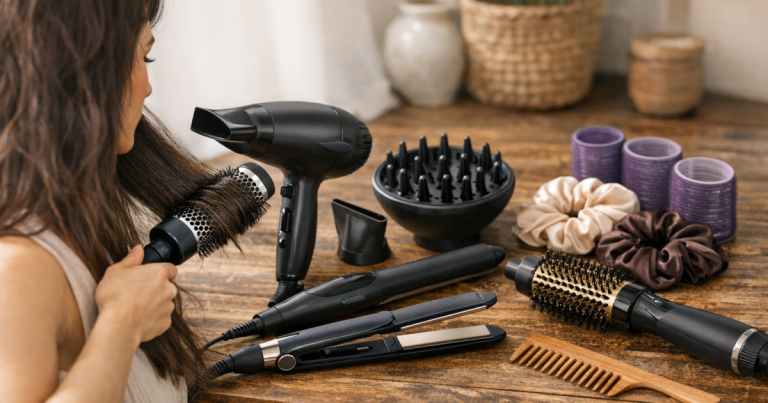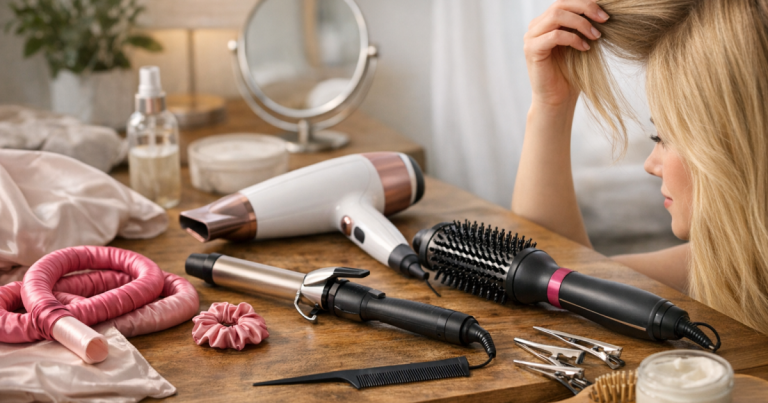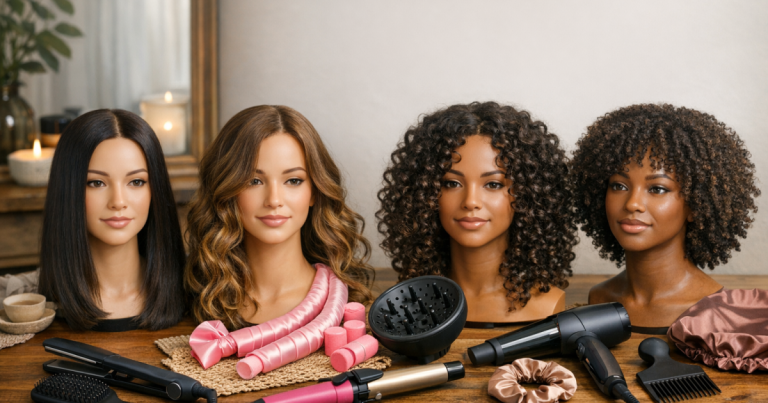
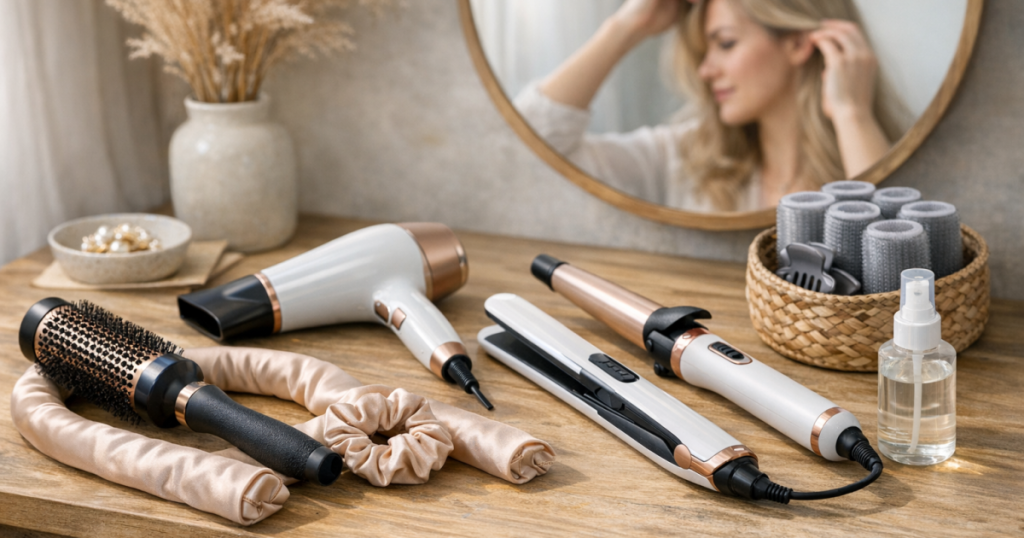
Fine hair can look airy, glossy and expensive when the tool choice is right, but it can also collapse quickly when styling adds too much weight, heat or tension. The most useful fine hair styling tools are not necessarily the strongest or most expensive ones. They are the ones that lift at the root, shape without roughening the cuticle and let you control heat before the hair goes limp, frizzy or over-smoothed.
At a glance
- Fine hair usually needs lift first, smoothing second and heavy hold last.
- Root volume comes from controlled airflow, rollers, clips and brush placement rather than aggressive backcombing.
- Heat control matters because fine strands often respond quickly and can lose bounce if they are overworked.
- Heatless tools are especially useful for adding body because they let hair cool and set without repeated passes from hot tools.
- The right tool changes depending on whether your fine hair is straight, wavy, curly, coily, colour-treated, oily at the roots or prone to frizz.
Why fine hair needs a different tool strategy
Fine hair describes the diameter of each strand, not necessarily how much hair you have overall. You can have fine, dense hair that looks full until it is weighed down, or fine, sparse hair that needs careful root support to avoid looking flat. This is why generic volume advice can be misleading: the same round brush, hot tool or cream that gives body to medium hair may make fine hair look polished for ten minutes and then flat for the rest of the day.
Before changing tools, separate three questions: are your strands fine, is your density low, and is your pattern straight, wavy, curly or coily? If you are not sure, start with the site’s guide to identifying your real hair type before choosing styling tools. Fine hair decisions become much easier once you know whether you are solving for root collapse, limp lengths, frizz, weak curl formation or heat sensitivity.
The core principle is simple: fine hair benefits from shape that is built in layers. A light detangle, a directional dry, a cooling or setting stage and minimal finishing product usually works better than one heavy styling step at the end.
Volume tools that lift without making hair fluffy
For fine hair, volume should come from lift and set rather than rough texture alone. Too much teasing, dry brushing or high-speed airflow can create an expanded look at first, but it often turns into flyaways and tangled ends by evening.
Root clips
Root clips are one of the simplest ways to create lift while hair dries. Place them where the hair naturally collapses, usually around the crown, parting and front hairline. They work best on damp hair that has been gently combed into the direction you want it to sit. For fine waves or curls, clips can also stop the roots from drying stuck to the scalp while the lengths form their pattern.
Velcro rollers
Velcro rollers are useful when you want height and a soft bend rather than a tight curl. Fine hair often responds well to larger rollers at the crown and smaller ones near face-framing pieces, but the right size depends on your hair length and the finish you want. Use them when the hair is mostly dry or freshly blow-dried, then let the hair cool fully before removing. Pulling them out too soon is one of the quickest ways to lose the lift you just created.
Heated rollers
Heated rollers can be a good middle ground between a full blow-dry and a curling tong. They are not automatically better for fine hair, but they can help set shape with less direct pulling than repeated tong passes. A recognisable example is BaByliss Thermo-Ceramic Rollers; if you are considering this type of tool, check the current roller sizes, heat settings and clips included rather than assuming every set suits short, layered or fragile hair equally.
Heatless curling rods
A satin heatless curling rod or similar soft overnight tool can add bend and body without relying on direct heat. Fine hair can mark easily, so wrap with gentle tension rather than pulling tightly. If your hair slips out, try slightly damp hair or a very light setting mist, but avoid soaking the hair before bed because fine strands can dry into uneven bends rather than smooth waves.
The Kitsch Satin Heatless Curling Set is a well-known example of the category. As with any soft heatless tool, check the rod thickness, fastening method and whether the shape suits your haircut before assuming it will create the same wave pattern on every hair length.
Hold starts before hairspray
Fine hair does not usually need the heaviest hold product; it needs shape that has been allowed to cool, dry or set properly. If you spray soft hair that has not been structured, you often get stiffness without lasting volume.
A better sequence is to style in the direction you want the hair to fall, let it cool or dry in that position, then use a light finishing layer only where movement drops first. For many people, that means the crown, fringe, front sections or the underside of the lengths rather than coating the whole head.
- For fine straight hair, use rollers or a round brush to lift the root, then avoid brushing all the movement out before leaving the house.
- For fine wavy hair, use a wide-tooth comb only before styling, then scrunch or clip while drying so the wave does not get stretched flat.
- For fine curly hair, choose tools that support clumping rather than separating every strand. A diffuser, microfibre towel or root clips can matter more than a brush.
- For fine coily hair, gentle detangling and section control are key. Avoid tools that stretch the pattern so much that the finished style loses fullness.
If the finish you want is more about shine, definition or frizz control than pure volume, the tool balance changes. The site’s guide to matching styling tools to frizz, shine and definition is useful when your hair is fine but not simply flat.
Heat control: where fine hair routines often go wrong
Fine hair often styles quickly, which can be both a benefit and a risk. If you keep applying heat after the hair has already taken shape, you may remove the bounce you were trying to create. The aim is not to avoid heat completely unless you want to; it is to use the lowest effective approach for your hair’s condition, pattern and desired finish.
Hair dryers
A dryer with controllable airflow and heat settings is usually more useful than one that only feels powerful. For fine hair, the important checks are whether you can reduce heat, direct airflow accurately and use a cool shot to set the shape. Concentrator nozzles help smooth straight or blow-dried styles, while diffusers are more relevant for waves and curls that lose definition under direct airflow.
Premium dryers can make sense for some routines, but only if the attachments and controls match the way you actually style your hair. For a more detailed look at heat, airflow and at-home styling trade-offs, read the site’s Dyson Supersonic Hair Dryer review.
Straighteners and smoothing tools
Fine hair can become overly flat when straighteners are used from root to tip with strong tension. If you like a sleek finish, try smoothing the mid-lengths and ends while keeping a little root lift intact. Curving the tool slightly at the ends can also stop fine hair from looking pressed down.
If you are considering a premium straightener such as Cloud Nine The Original Iron, verify the current temperature options, plate size and suitability for your hair length. Manual heat control can be helpful for fine hair, but the tool still needs to glide cleanly and be used in small, deliberate sections rather than repeatedly passed over the same area.
Curling tongs and wands
Fine hair can take curl quickly and drop quickly. A smaller barrel may create longer-lasting bend, while a larger barrel usually gives softer movement, but haircut, length and hair condition affect the result. The most important habit is to let each curl cool in shape before touching it. Brushing hot curls is a common reason volume disappears within minutes.
Matching tools to common fine-hair scenarios
Fine hair with oily roots
Choose tools that lift the root without spreading oil through the lengths. Root clips, rollers at the crown and a targeted blow-dry around the parting can help. Avoid overbrushing from scalp to ends once roots are oily, as this can make the whole style look heavier.
Fine hair with dry or colour-treated ends
Keep heat focused on shaping rather than repeatedly polishing the same pieces. A wide-tooth comb, soft brush, satin wrap or heatless rod can reduce unnecessary friction. Ends that look thin often need less styling tension, not more smoothing.
Fine wavy hair that falls straight
Use tools that allow the wave to set while the hair is drying. Scrunching with a towel, clipping the roots and using a diffuser on controlled settings can preserve movement. Brushing after drying may make the hair look smoother, but it can also pull out the shape.
Fine curls that lack volume at the crown
Focus on drying position. Diffusing with the head tilted, lifting sections gently at the roots and clipping the crown can stop curls drying flat. Avoid heavy brush styling once curls have begun to form unless your goal is a stretched blow-dry finish.
Small checks before adding another tool
Another tool is not always the missing piece. Fine hair routines often improve when the existing tools are used more precisely. Before changing your kit, check these details:
- Does your dryer have a lower heat option that you actually use, or do you default to the hottest setting?
- Are you letting rollers, curls or blow-dried sections cool before brushing them out?
- Is your brush creating tension at the root, or only smoothing the surface?
- Are your styling products heavier than your tools can overcome?
- Is your comb or brush breaking up waves and curls before they have had time to set?
- Are you using the same routine on wash day and day two, even though fine hair often behaves very differently after roots settle?
For many fine-hair routines, the biggest upgrade is not a dramatic new gadget. It is a more intentional combination: gentle detangling, directional drying, root support, a cooling stage and light finishing control.
Common mistakes with fine hair tools
- Using high heat to chase volume, then wondering why the hair looks flat and shiny rather than lifted.
- Choosing a smoothing brush when the real issue is lack of root structure.
- Using heavy tension from root to tip and removing all natural body.
- Brushing out curls or rollers before they are cool.
- Applying too much finishing product because the tool stage did not create enough shape.
- Assuming fine hair always needs tiny sections; sometimes medium sections keep a softer, fuller finish.
Common questions
Are heatless tools better for fine hair?
They can be, especially for adding body without repeated heat. The result depends on hair length, dampness, wrapping tension and how long the hair is left to set.
Should fine hair use a round brush or rollers?
A round brush is better for active shaping during a blow-dry. Rollers are better for letting lift cool and set after drying. Many fine-hair routines use both, but not always on the same day.
What heat setting should fine hair use?
Use the lowest effective heat for your hair and tool, following the manufacturer’s instructions. Fine, coloured, fragile or previously heat-styled hair usually needs a more cautious approach than strong, untreated hair.
Why does my fine hair lose volume so quickly?
Common reasons include heavy product, roots drying flat, brushing out the set too early, oily roots, high humidity or using tools that smooth the hair more than they lift it.
Can fine curly hair use brushes?
Yes, but timing matters. Brushes can help with detangling and styling wet curls, while brushing dry fine curls often separates the pattern and reduces fullness.
Main lessons
Fine hair looks its best when tools create shape without overloading the strand. Start with root lift, choose heat settings and airflow you can control, and let styles cool or set before finishing. For straight hair, that may mean rollers and careful smoothing. For waves and curls, it may mean clips, diffusing and less brushing once the pattern forms. The right routine is not about using more force; it is about giving fine strands structure before they have a chance to collapse.