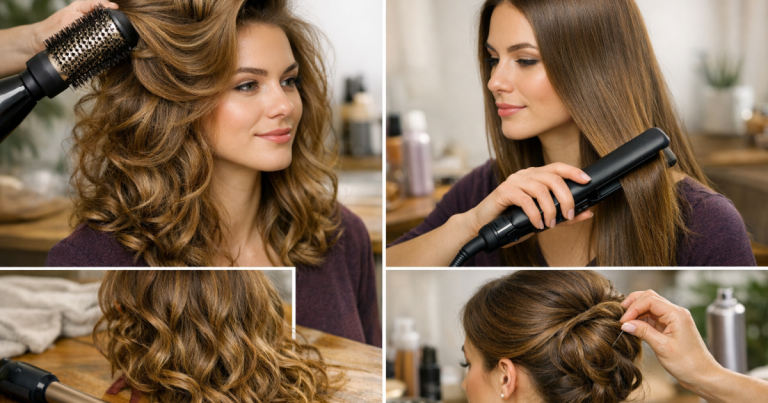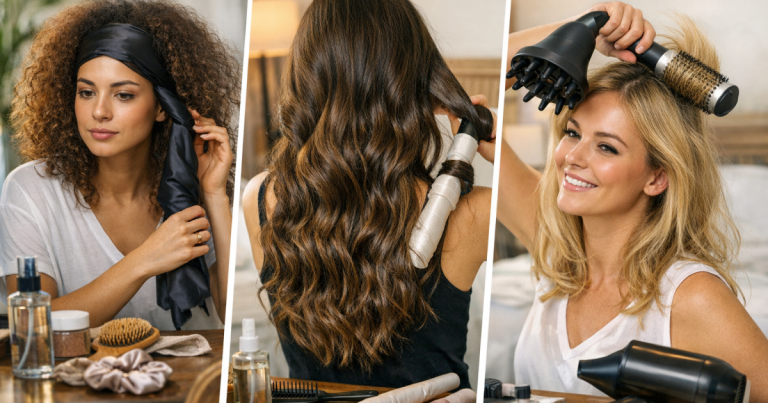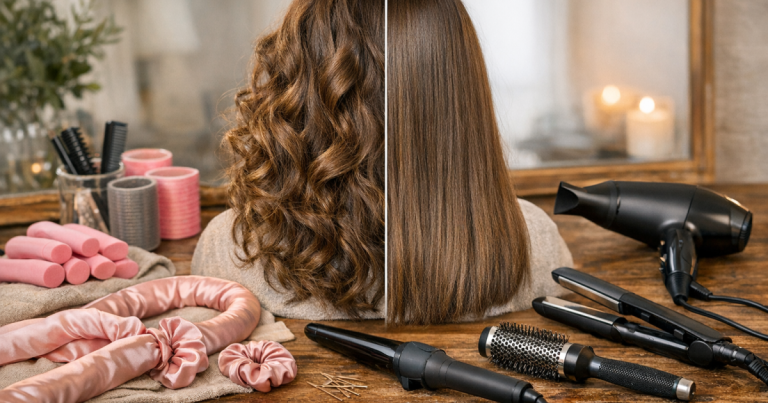
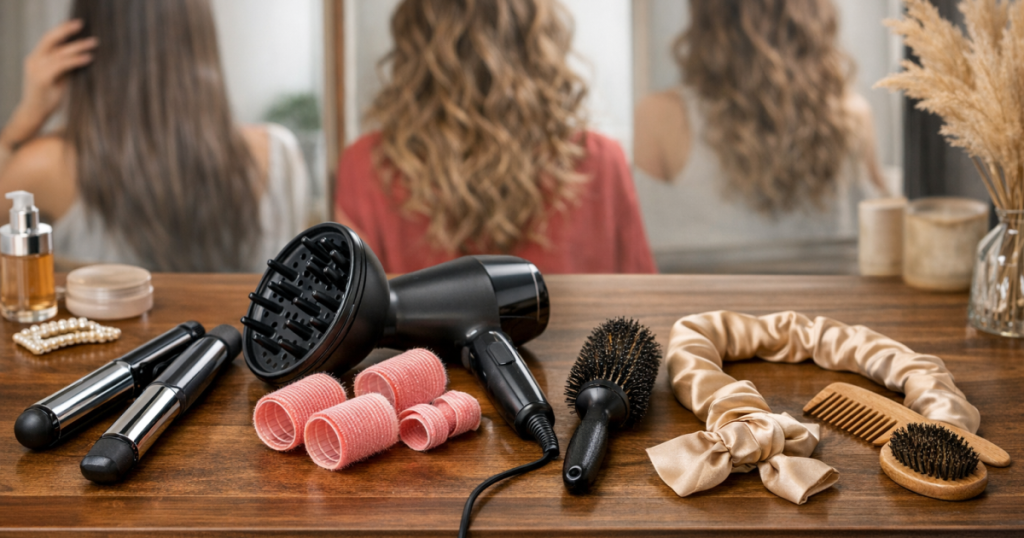
The same haircut can look glossy, airy or undone depending on the tool you reach for. That is why it helps to choose tools by finish, not just by the label on the box. A straightener, hot brush, diffuser, roller set or heatless rod can all be “right”, but only if the finish matches your hair’s texture, density, length and tolerance for heat.
The short version
- For a polished finish: prioritise smoothing, tension and controlled heat. Straighteners, hot brushes, round brushes and sleek blow-dry tools are the usual route.
- For a textured finish: choose tools that add bend, grip or lift without making every section identical. Curling wands, diffusers, rollers and heatless rods are useful here.
- For a natural finish: work with your existing wave, curl, kink or straightness. A diffuser, wide-tooth comb, soft brush, satin wrap or low-tension heatless method often gives the most believable result.
- For fine hair: avoid heavy tools and aggressive smoothing if you want body. Too much polish can make roots collapse.
- For thick or coarse hair: sectioning, preparation and tool surface matter more than rushing with higher heat.
Why finish changes the tool decision
Most people start with a tool category: straightener, curler, hot brush, diffuser. A better starting point is the surface you want the hair to have when you are finished. Polished hair reflects more light because the outer surface is smoother and the direction of the hair is more controlled. Textured hair looks more broken-up, with bends, lift or separation. Natural hair looks least “done”, even when it has been carefully shaped.
This distinction matters because two tools can create the same basic shape but a completely different mood. A curling wand can make soft brushed-out waves, defined ringlets or loose texture depending on section size, direction and finishing. A hot brush can smooth hair into a salon-style curve, but on the wrong hair type it can also stretch out texture and flatten the roots. Heatless rollers can give expensive-looking volume or, if placed too low, leave the crown looking limp.
When you want a polished finish
A polished finish is smooth, controlled and intentional. It does not have to mean poker-straight hair; it can be a curved blow-dry, a tucked-under bob, soft waves with a glossy surface or sleek hair with movement at the ends.
The tools that support polish tend to create tension. Straighteners, smoothing brushes, round brushes and hot brushes help align the hair surface. A tool such as the Revlon One-Step Volumiser Plus is an example of a hot air brush category many people use for a blow-dried look at home, while premium multi-stylers such as the Dyson Airwrap i.d. sit in a different part of the market and should be assessed for your hair length, styling patience and preferred attachments rather than assumed to suit everyone.
Best approach by hair type
- Fine hair: keep the roots lifted before smoothing the lengths. A polished finish can quickly become flat if every section is pulled downwards. Smaller sections and lighter finishing product usually work better than repeated passes.
- Thick hair: polish comes from controlled sectioning. Work in manageable layers and avoid smoothing only the top layer, which can leave the underneath bulky.
- Curly or wavy hair: decide whether you want to soften the pattern or fully smooth it. A polished wave needs less tension than a sleek straight finish.
- Short hair: compact hot brushes, mini straighteners and narrow plates give more control around the hairline, fringe and nape.
Heat protection, dry hair preparation and realistic pass control matter with any heated smoothing tool. If your polished styles tend to lose lift quickly, the issue may be technique rather than the tool itself; the guidance on fine hair styling tools for volume, hold and damage control is especially useful for avoiding that overly sleek, collapsed look.
When texture is the goal
Textured hair is not simply “messy hair”. Good texture has shape, air and a bit of irregularity. The aim is movement rather than a perfectly uniform curl pattern. This is where curling wands, clamp irons, rollers, diffusers and heatless rods all have a place.
A wand such as the ghd Curve Creative Curl Wand is a recognisable example of a tapered curling wand category, but the broader lesson is more important than the brand: tapered or medium-barrel tools often suit undone waves because they avoid one identical curl from root to tip. Velcro rollers can add airy lift at the crown and curtain fringe, while soft heatless rods can create a looser bend with less day-to-day heat exposure.
How to keep texture modern rather than crunchy
- Alternate curl direction around the face and crown so the shape does not merge into one solid wave.
- Leave the very ends slightly softer if you prefer a relaxed, lived-in finish.
- Let curls or waves cool fully before brushing or separating them.
- Use your fingers, a wide-tooth comb or a soft brush depending on how much separation you want.
- Avoid loading fine hair with heavy oils before styling; add softness after the shape is set.
Texture is also where hold and finish can clash. A strong-hold product may keep waves in place but make the hair look stiff. A soft cream may look beautiful for the first hour but drop quickly on slippery hair. If you are not sure whether your hair needs smoothing, shape or lift first, the guide to choosing between frizz control, definition and volume gives a clearer order of priorities.
When a natural finish looks best
A natural finish means the hair still looks like your hair. It may be smoother, more defined or more lifted than when you woke up, but it should not look forced into a completely different texture. This finish is particularly useful if you are growing out layers, reducing heat use, refreshing curls between washes or trying to make a style last without restyling from scratch.
For natural waves and curls, a diffuser can encourage shape without dragging the pattern flat. For coils and tighter curls, low-tension styling, careful detangling and product distribution are often more important than a high-heat tool. A brush such as the Denman D3 Original Styler is often discussed for curl styling, but suitability depends on your curl pattern, density and how much definition versus volume you prefer.
Natural does not mean doing nothing
The most natural-looking styles are often lightly engineered. A silk hair wrap can reduce friction overnight. A satin heatless curling rod can reshape face-framing pieces without making the whole head look curled. A small amount of argan oil hair treatment can soften dry-looking ends, provided it is used sparingly and kept away from roots that collapse easily.
For straight hair, a natural finish might mean using a hot brush only through the mid-lengths and ends, leaving the roots with their normal movement. For wavy hair, it may mean diffusing to 80 or 90 per cent dry, then air-drying the rest so the finish is less set. For curly hair, it may mean refreshing the outer layer rather than disturbing the whole shape.
Match the finish to your real hair, not your inspiration photo
Inspiration photos are useful for direction, but the tool choice has to respect the hair you actually have. Fine, silky hair may not hold large heatless waves without help from rollers, grip or setting time. Dense hair may need smaller sections and more drying time before any tool can create a lasting finish. Bleached or colour-treated hair may look polished faster but also show dryness more clearly if over-smoothed.
- If your hair goes limp: choose root-lifting methods before smoothing. Rollers, a lightweight hot brush technique or heatless crown lift may be better than straightening from the root.
- If your hair expands or frizzes: start with moisture balance and smoothing preparation, then choose a tool. Texture without control can read as frizz rather than movement.
- If your curls lose definition: avoid tools that stretch the curl too much. Diffusing, finger coiling and selective refreshing often keep the finish more natural.
- If your ends look dry: a polished finish may exaggerate the issue. Softer waves, a trim or a light finishing treatment can look more flattering than forcing a glassy result.
Common tool mistakes that change the finish
The wrong finish often comes from small technique choices rather than a bad tool. Brushing curls too early turns definition into puff. Using a hot brush from wet roots to ends without enough lift can flatten fine hair. Wrapping every wand section in the same direction can make textured waves look too formal. Overusing straighteners on the surface only can create a smooth top layer with bulky, unfinished underneath.
Heatless styling has its own finish rules. A rod placed too low creates bends through the lengths but no root lift. Rollers removed before the hair is fully set may drop before you leave the house. Sleeping on curlers without protecting the crown can flatten volume, even if the lengths look pretty. For overnight styling, the advice on sleeping in heatless curlers without flattening roots is a useful next step.
Common questions
Can one tool create polished, textured and natural finishes?
Sometimes, yes. A straightener can smooth, bend or lightly wave the hair, and a hot brush can polish or add relaxed movement. The difference comes from section size, tension, direction and how much you brush out afterwards.
Which finish is easiest for fine hair?
Soft texture or a natural lifted finish is often easier than high polish. Very sleek styles can make fine hair look thinner, so keep movement at the roots and avoid heavy finishing products.
Is heatless styling better for a natural finish?
It can be, especially when you want gentle bends, overnight shaping or less heat exposure. Heatless methods still need good placement and enough setting time, otherwise the result can look uneven or flat at the crown.
How do I choose between a diffuser and a curling wand?
Use a diffuser when you want to enhance your existing wave or curl pattern. Use a curling wand when you want to impose a new bend, even out awkward sections or create more deliberate texture.
What should I do if my finish looks good at first but drops quickly?
Check whether the hair was fully dry, allowed to cool or set, and supported with the right level of hold. Dropping is often caused by moisture, sections that are too large or products that are too heavy for your hair type.
Why it matters
The easiest way to choose tools by finish is to name the result before you style: glossy and controlled, airy and textured, or believable and natural. From there, the tool decision becomes much clearer. Polished hair needs smoothing and tension. Textured hair needs bend, separation and hold. Natural hair needs support without overworking the pattern you already have.
That small shift prevents wasted effort and makes your styling routine feel less random. Instead of buying another tool because your current one “doesn’t work”, you can ask whether it is being used for the wrong finish, on the wrong section size or with the wrong preparation for your hair type.