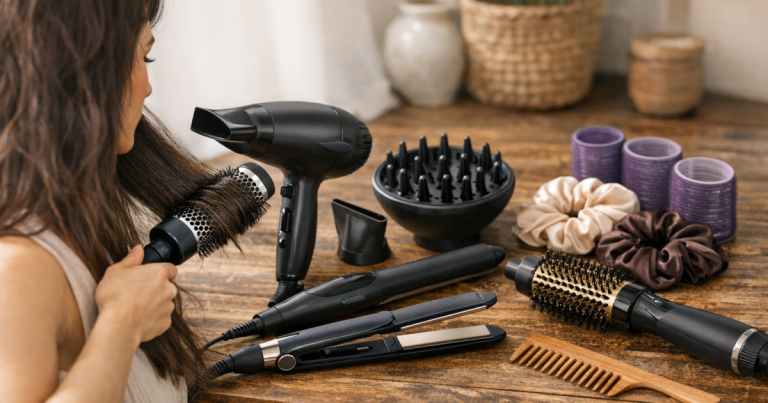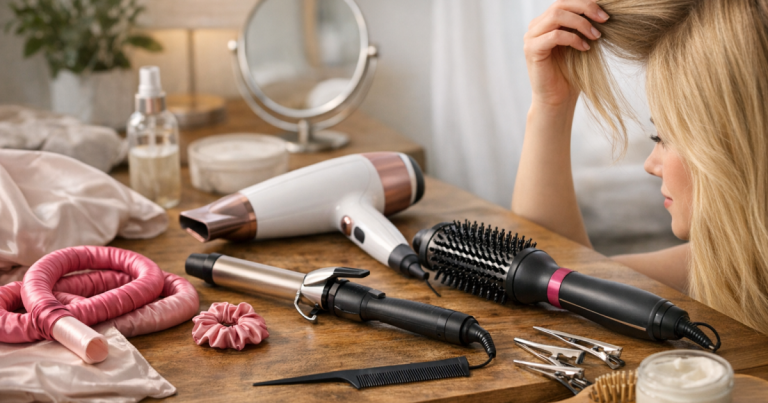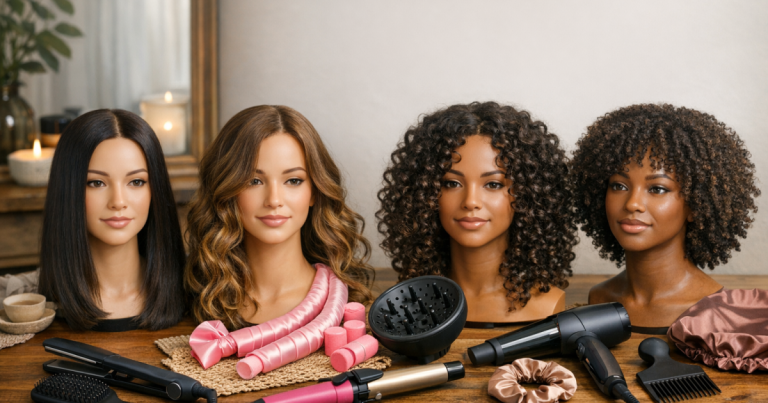
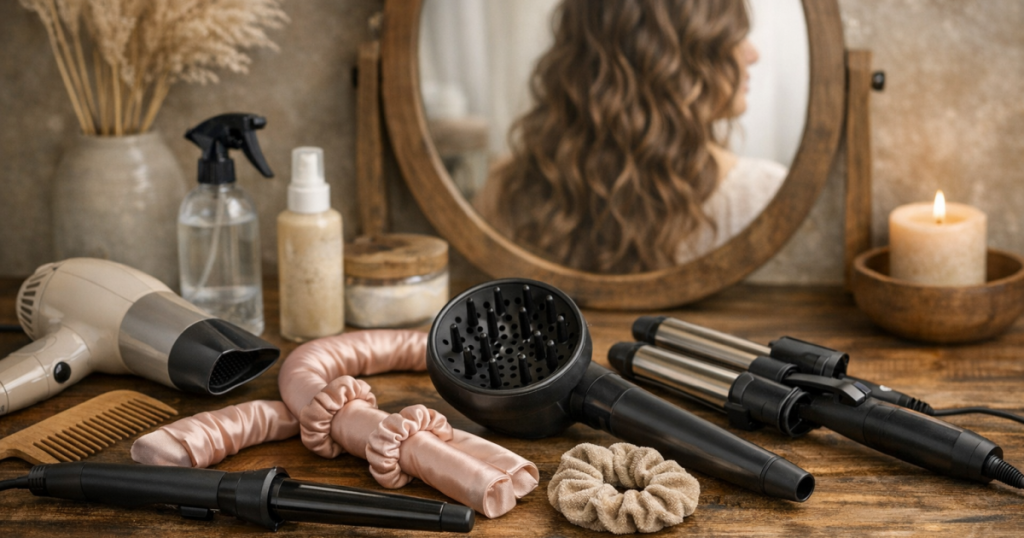
If your waves collapse by lunchtime, puff up after drying or look stringy when you add product, the issue is often the tool mix rather than your hair itself. The right tools for wavy hair should support your natural bend, remove excess water gently, reduce roughness and add lift without stretching the pattern flat.
For this guide, wavy hair means a 2A, 2B or 2C pattern: visible bends or S-shapes, usually less springy than curls, but more shape-prone than straight hair. If you are unsure where your hair sits, start by using our guide to identify your hair type before choosing tools, because density, porosity and strand width matter just as much as the wave pattern.
The useful answer
Wavy hair usually needs three things from styling tools: clumping for definition, gentle drying for frizz control and root support for volume. A single tool rarely solves all three. Most successful routines use a small set: a wide-tooth comb or wet brush for even distribution, a microfibre towel or hair wrap for controlled water removal, a diffuser or air-dry support for shape, and heatless shaping tools when you want a more polished wave.
The main mistake is treating waves like either straight hair or curly hair. Straight-hair tools can smooth the wave out too much. Curl-focused tools can sometimes create too much product tension, shrinkage or heaviness. Wavy hair sits in the middle: it benefits from structure, but it still needs movement.
- For definition: choose tools that encourage sections to form together rather than breaking the wave into fluffy strands.
- For frizz: reduce friction, avoid aggressive towel-drying and use tools that keep the cuticle lying smoother.
- For volume: lift at the roots without over-brushing the lengths once the wave has started to set.
How wave type changes the tool choice
2A waves: soft bends that fall flat easily
2A hair often looks almost straight when wet, then develops light bends as it dries. Heavy tools and heavy product application can pull this pattern flat. For this hair type, the most useful kit is light-touch: a wide-tooth comb in the shower, a microfibre towel for blotting, root clips while drying and large Velcro rollers if the goal is airy movement around the crown and face.
A brush can be useful before styling, but repeated brushing after product goes in can separate the wave. If your hair is fine as well as wavy, use tools that add lift before the lengths dry completely, rather than trying to create volume once everything has set.
2B waves: clearer S-shapes with a frizz-prone surface
2B waves tend to show more obvious shape through the mid-lengths, but the top layer can look fuzzy in damp UK weather. This pattern usually responds well to controlled clumping: comb through conditioner, apply styling product evenly, then scrunch with a smooth towel or wrap. A product such as Only Curls Microfibre Hair Towel is the type of tool to consider if a standard cotton towel leaves the surface rough or halo-like.
For 2B hair, definition and frizz control often improve when you stop touching the hair too much as it dries. Tools should help you set the shape early, then leave it alone.
2C waves: stronger bends that can behave like loose curls
2C hair may form deeper S-shapes, ringlet-like pieces or a mix of waves and loose curls. It usually needs more deliberate sectioning than 2A hair, but still has to avoid being overloaded. A styling brush can help create organised clumps when used on wet, conditioned hair. A brush such as Denman D3 Original Styler is a recognisable example of a tool people use for tension and shaping, though you should check whether the firmness and row layout suit your density and comfort level.
Diffusing can also be helpful for 2C waves because air-drying may leave the roots flat while the ends expand. The aim is not to blast the hair into place; it is to support the pattern while moisture leaves gradually.
Tools that help definition without making waves stiff
Definition comes from clumping: strands gathering into larger, smoother wave sections. The best tools for this are the ones that distribute water and product evenly without shredding the pattern.
- Wide-tooth comb: useful in the shower or immediately after washing, particularly when conditioner gives slip. It helps detangle without creating too much tension.
- Wet detangling brush: helpful for thicker or knot-prone waves, but use it before scrunching rather than after the shape has started to form.
- Styling brush: useful for ribboning or defining front pieces, especially on 2B and 2C hair. It can be too flattening for very fine 2A hair if overused.
- Satin heatless curling rod: good when you want more uniform bends overnight, particularly on hair that loses shape between washes.
- Velcro rollers: more about lift and soft bend than wave clumping. They work best around the crown, fringe area and face-framing sections.
For product distribution, a lightweight curl cream, mousse or gel can be applied before scrunching, but the tool still matters. A gel such as Bouclème Curl Defining Gel is one real example in the category; the key checks are hold level, texture, residue and whether it suits your strand thickness. Wavy hair often prefers a lighter layer with good distribution over a large amount concentrated on the outer surface.
Frizz control is mostly about friction and timing
Frizz on wavy hair is not always damage. It can come from disturbed clumps, rough water removal, humidity, brushing at the wrong stage or using a dryer without enough directional control. The tool routine should therefore reduce unnecessary movement.
Start by replacing rubbing with blotting. A microfibre towel, cotton T-shirt or silk hair wrap can help absorb water while keeping the surface smoother. If your hair becomes puffy as soon as you towel-dry it, this is usually the first tool change to make.
Next, consider when you detangle. Wavy hair often behaves better when detangled wet with slip, then left alone. Dry brushing can be useful before washing or before a heatless overnight set, but brushing dry waves during the day usually turns definition into volume and frizz. For a deeper explanation of tool choices by finish, use our guide to matching tools to frizz, shine and definition.
Diffusing can either reduce frizz or create it, depending on technique. Use a diffuser attachment or diffuser-style dryer to cradle sections rather than pushing hair around. A tool such as Bellissima Diffon Supreme is an example of a dedicated diffuser-style option; before choosing any dryer or attachment, verify heat settings, weight, compatibility with your routine and how easy it is to position around the roots.
Volume needs root support, not just bigger hair
Wavy hair can be full through the sides but flat at the crown, which makes the overall shape look triangular or heavy. Volume tools work best when they target the roots without breaking up the lengths.
- Root clips: place them at the crown while hair is damp to stop roots drying flat against the scalp.
- Large Velcro rollers: use on the top layers or fringe area for lift and a soft bend, not tight curls.
- Diffuser positioning: dry roots gently with the head tilted or sections lifted, then let the lengths settle.
- Silk or satin overnight wrap: helps preserve lift and reduce friction while sleeping, especially if waves flatten overnight.
- Lightweight brush-out tool: a wide-tooth comb or fingers can soften a cast or separate waves without creating too much fluff.
The balance is important. If you chase maximum volume with aggressive brushing, you may lose definition. If you chase perfect definition with heavy product and no root lift, the hair can look flat. The most wearable wavy routines usually sit between the two. Our styling goal matrix is useful when you need to decide whether lift, shape, smoothness or hold should lead your routine.
Heatless tools for waves that need more shape
Heatless styling is particularly useful for wavy hair because it can refine an uneven pattern without repeatedly using straighteners or curling tongs. The key is matching the tool to the finish you want.
A satin heatless curling rod gives more uniform bends, especially through the front and mid-lengths. It works well when natural waves are present but inconsistent. For softer, bouncier lift, Velcro rollers are better around the crown and face. For frizz control rather than shape change, a silk hair wrap is often more useful than any curling tool because it protects the wave pattern overnight.
Preparation matters. Hair should usually be dry or only slightly damp for overnight shaping, because overly wet hair may not dry fully by morning and can lose its set. Apply only a small amount of product before wrapping unless your hair is coarse or very porous. In the morning, remove tools gently, let the sections relax, then separate with fingers rather than brushing straight away.
Key checks before changing your routine
Before adding more tools, work out which problem is actually bothering you. Wavy hair can look undefined, frizzy and flat at the same time, but one change often affects all three.
- If waves are stringy: you may be using too much product, too little water during application or tools that create overly small sections.
- If waves are fluffy: reduce towel friction, avoid dry brushing and set the shape earlier while hair is still wet enough to clump.
- If roots are flat: add lift while drying rather than relying on texturising after the hair is fully dry.
- If ends look shapeless: try heatless shaping on the lower lengths or use a diffuser to support the pattern as it dries.
- If the top layer frizzes: check whether your towel, pillowcase or brush is roughening the surface.
Also factor in hair density. Fine, low-density waves need lightweight tools and minimal handling. Thick waves often need stronger detangling, more sectioning and longer drying time. Colour-treated or highlighted waves may need gentler friction control because rough handling can make the surface look dull even when the wave pattern is good.
Things readers ask
Should wavy hair be brushed wet or dry?
Most wavy hair is easier to shape when detangled wet with conditioner or styling product for slip. Dry brushing is better before washing or before a deliberate heatless set, because it can separate natural waves and create frizz.
Is a diffuser worth using on wavy hair?
Yes, if your waves fall flat while air-drying or become fluffy before they set. A diffuser helps support the pattern and lift the roots, but it should be used gently rather than as a high-force drying shortcut.
Do Velcro rollers work on naturally wavy hair?
They can work very well for root lift, fringe shaping and soft face-framing movement. They are less useful for creating even definition through the full length, where a heatless curling rod or careful diffusing may be better.
Why does my wavy hair look good wet but frizzy when dry?
Wet hair clumps easily because water holds strands together. As it dries, friction, touching, humidity or uneven product distribution can break those clumps apart. A smoother towel, less handling and better product distribution usually help.
Can wavy hair use curl tools?
Yes, but use them selectively. Curl brushes, gels and diffusers can suit 2B and 2C waves, while fine 2A hair may need lighter handling so the pattern is not stretched flat or weighed down.
In brief
Wavy hair styling is about balance: enough structure to define the bend, enough smoothness to control frizz and enough lift to stop the roots collapsing. Start with gentle detangling, controlled water removal and a drying method that protects clumps. Add heatless shaping or root-lifting tools only where they solve a specific problem.
If your routine feels unpredictable, change one tool at a time. Swap the towel before changing every styling product. Add root clips before buying a stronger dryer. Try overnight satin shaping before assuming your waves need heat. Small, targeted changes usually give wavy hair a more natural result than a complicated routine.