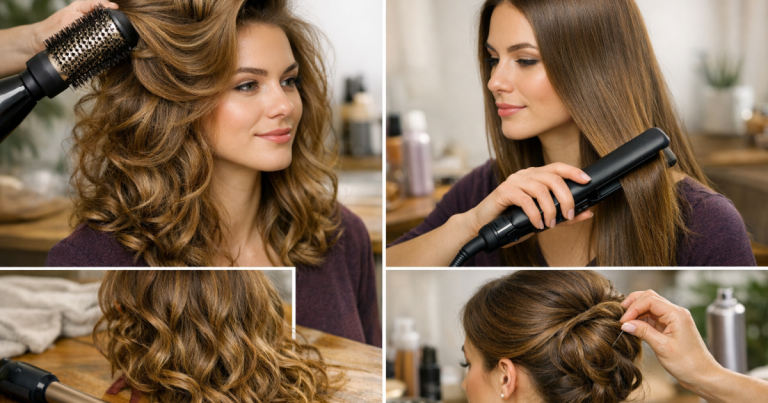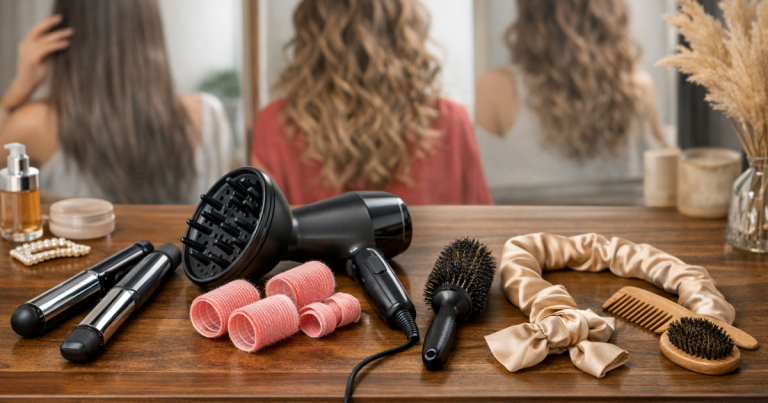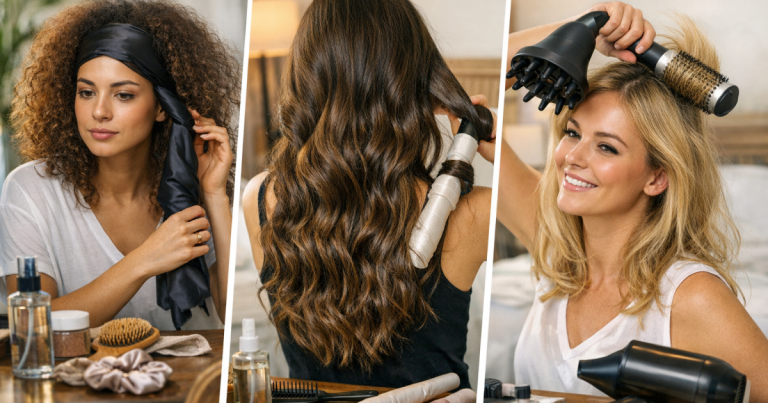
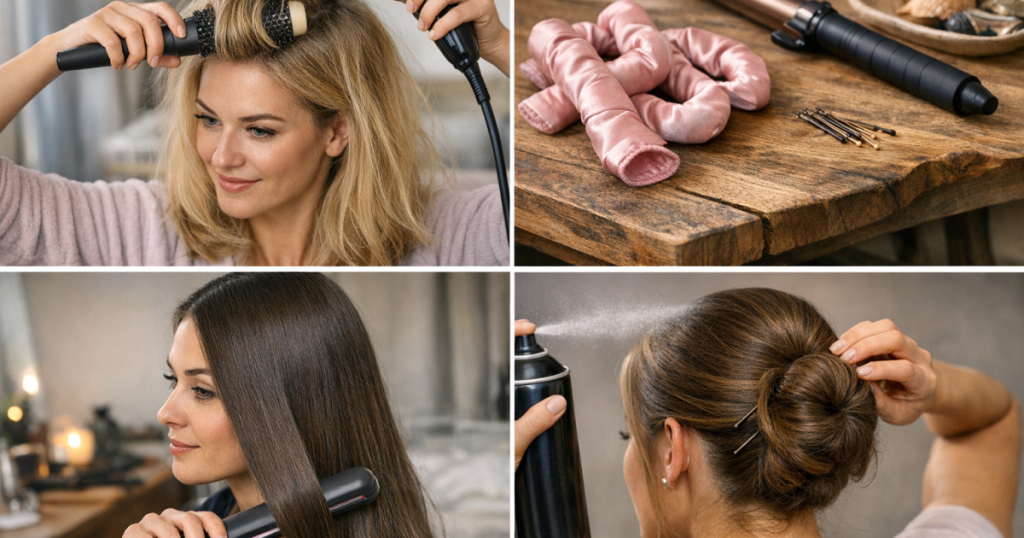
Most styling frustration comes from asking one tool to do four different jobs. A styling goal matrix separates the result you want — lift, shape, smoothness or hold — from the hair type you have and the time you can realistically spend. That makes tool choice less emotional: a roller that gives root lift is not failing because it will not create glassy smoothness, and a straightener that polishes ends is not designed to build airy volume at the crown.
The point is not to own every styling tool. It is to understand what each tool is actually good at, then build a smaller, more useful routine around your natural texture, density and tolerance for heat.
The short version
- Choose lift when your hair looks flat at the roots, collapses quickly or needs more body around the crown.
- Choose shape when you want waves, curls, bend, flicks, movement or a more deliberate silhouette.
- Choose smoothness when frizz, puffiness, rough ends or uneven surface texture are the main issue.
- Choose hold when your style looks good at first but drops, separates or loses control within a few hours.
- Fine hair usually needs lightweight lift and flexible hold; thick hair often needs sectioning, smoothing and control before the final shape will last.
Start with the result, not the tool
Many at-home routines begin with the tool: straighteners, rollers, a hot brush, a curling wand, a dryer brush or a heatless curler. That sounds logical, but it can lead to mismatches. The same person might buy Velcro rollers for volume, then feel disappointed when they do not smooth frizz. Someone else might use a straightener for sleekness, then wonder why the finished style feels flat.
A better approach is to name the styling problem first. Is the hair too flat, too shapeless, too fluffy or too short-lived? Once that is clear, the styling goal matrix works as a filter. It shows whether your routine needs root support, directional shaping, surface polishing, stronger set or a combination of two goals.
Hair type matters because the same goal behaves differently on different textures. Before you decide which goal to prioritise, it is worth taking a clear look at density, strand thickness, wave pattern and porosity. If you are not sure where your hair sits, the guide on how to identify your hair type before buying styling tools is a useful starting point.
Goal one: lift
Lift is about making the roots and upper lengths look more awake. It is not the same as making hair big all over. Good lift gives space at the scalp, stops the crown looking stuck down and helps a style feel fresher between washes.
When lift should be your priority
- Your hair looks clean but still lies flat at the roots.
- Your fringe or face-framing layers separate quickly.
- Your curls or waves have volume through the ends but no height at the top.
- Your blow-dry looks good for an hour, then drops close to the head.
Fine hair usually needs lift from low-weight methods: root drying, small sections, Velcro rollers placed at the crown, lightweight mousse or a gentle set while the hair cools. Too much oil, heavy cream or dense brush tension can make the roots collapse before the style has a chance to settle.
Thick hair often needs more structure. The weight of the mid-lengths can pull down root volume, so lift depends on sectioning, drying the roots properly and allowing each section to cool in the direction you want it to sit. For naturally curly or coily hair, root lift can come from clipping, diffusing technique or careful stretching rather than brushing everything smooth.
Goal two: shape
Shape is the outline of the style: loose waves, defined curls, curved ends, bouncy layers, a turned-under bob, a flicked fringe or a soft bend through the mid-lengths. It is where heated and heatless tools are most visibly different, because some create an instant set while others rely on time, dampness and tension.
What creates shape
- Direction: whether the hair is wrapped away from the face, under, over or vertically.
- Section size: smaller sections tend to create more defined shape; larger sections create softer movement.
- Moisture level: heatless methods usually need hair that is dry enough not to become limp, but slightly pliable enough to set.
- Cooling or setting time: shape lasts better when hair has time to settle before it is brushed out.
For long straight or softly wavy hair, a satin heatless curling rod, rollers or a round-brush blow-dry can all create shape, but the finish will differ. A heatless rod tends to give a soft, continuous wave pattern. Velcro rollers create bounce and curvature, especially around layers. A curling wand gives more deliberate bend but uses direct heat.
For textured hair, shape is often less about forcing a new pattern and more about defining what is already there. A wide-tooth comb, a styling brush used on wet hair, curl cream, gel and careful drying can help curls clump more evenly. If frizz and definition are both part of the issue, the deeper guide to matching tools to frizz, shine and definition explains how those goals overlap.
Goal three: smoothness
Smoothness means the surface of the hair reflects light evenly and the outer layer looks controlled. It does not have to mean poker-straight hair. Smooth waves, polished curls and sleek coils can all be smooth when the surface is aligned and the ends look considered.
When smoothness matters most
- Your hair expands in damp weather.
- The top layer looks fuzzy even when the style underneath is fine.
- Your ends look rough or uneven after styling.
- Your hair tangles easily and loses shine as the day goes on.
Smoothness usually starts before the final styling step. Detangling gently, using the right amount of leave-in product, drying in organised sections and avoiding repeated rough brushing all make a difference. A straightener can polish, but it should not be expected to fix poor preparation on its own.
Fine hair needs smoothness without being flattened. That often means using a light detangling spray, a soft brush or comb, controlled airflow and minimal finishing product. Thick, coarse or high-density hair usually needs more tension and patience: wider sections may look quicker, but they often leave the underlayers puffy. Curly hair needs smoothness through hydration, clumping and drying method rather than simply pressing the texture down.
Heatless smoothness is possible, but it is more subtle. A silk hair wrap, satin pillowcase, careful brushing, overnight wrapping or a low-tension set can reduce friction and help the cuticle lie flatter. It will not replicate the same finish as direct heated plates, but it can make day-to-day hair look calmer with less effort.
Goal four: hold
Hold is the part people often notice last. A style can have lift, shape and smoothness at 8am, then look tired by lunch. That does not always mean the tool was wrong. It may mean the hair was not set, supported or finished in a way that suits its weight and texture.
Signs your routine lacks hold
- Curls become loose bends within a few hours.
- Root volume disappears quickly even without rain or humidity.
- Smooth hair becomes fluffy at the hairline and ends.
- Your style only lasts when you use more heat than you would like.
Hold can come from product, technique or timing. Mousse, light hairspray, gel, styling cream and texture spray all behave differently, so the aim is not to use the strongest product by default. Fine hair usually benefits from airy support that does not coat the strands. Thick hair may need more product distribution through sections, not just a mist over the top. Curly hair often needs a cast from gel or mousse, then gentle scrunching once fully dry.
Heatless styling relies heavily on hold. If hair is too wet, it may dry into limpness. If it is too dry, it may not take the shape. If it is removed too early, the set can drop before it stabilises. The most reliable heatless results usually come from slightly damp or product-prepped hair, consistent wrapping tension and enough setting time.
How the goals combine in real routines
Most people are not chasing only one goal. The trick is to identify the lead goal and the supporting goal. If you try to maximise all four at once, the routine can become heavy, time-consuming or contradictory.
- Lift plus hold: best for flat fine hair, soft fringes, crown volume and blow-dries that collapse. Prioritise root prep, cooling time and light finishing products.
- Shape plus smoothness: useful for waves, bobs, layered cuts and heatless curls that need polish. Prioritise detangling, even sections and gentle finishing.
- Smoothness plus hold: helpful for thick, frizz-prone or humid-weather hair. Prioritise preparation, controlled drying and products that resist puffiness without stiffness.
- Lift plus shape: good for bouncy layers and soft movement. Use rollers, a round brush or a heatless curler in sections that support the haircut rather than wrapping everything the same way.
A common mistake is pairing tools that fight each other. Heavy oils before root lift can flatten the crown. Brushing out heatless curls too soon can remove shape before hold has formed. Using high heat to smooth every day can make the finish look polished short term while leaving the hair harder to manage over time.
Hair-type clues that change the plan
Fine, low-density hair usually needs restraint. The routine should avoid heavy layers of product and oversized sections that do not create enough root support. Lightweight rollers, careful blow-drying and flexible hold tend to work better than dense creams or repeated passes with hot tools. For more detail, the site’s guide to fine hair styling tools for volume, hold and heat control gives a closer breakdown.
Thick hair needs time and organisation. The biggest issue is often not lack of tool power, but uneven styling: the top looks done while the underneath stays damp, bulky or undefined. Smaller sections, better detangling and allowing the hair to fully dry or cool can matter more than adding another tool.
Wavy hair sits between categories. It may need shape enhancement in some areas and smoothing in others. Brushing when dry can create puffiness, while too much cream can pull out the wave. A mixed routine often works best: define when wet, dry with care, then use rollers or a heatless set only where the shape needs help.
Curly and coily hair tends to prioritise definition, smoothness and hold before lift. Once the curl pattern is set and dry, volume can be added carefully at the roots. Starting with volume too early can break up clumps and create frizz instead of fullness.
What people usually ask
Can one tool cover lift, shape, smoothness and hold?
Some tools can support more than one goal, but none does everything equally well. A dryer brush may lift and smooth; rollers may lift and shape; a straightener may smooth and bend. Hold still depends on prep, setting time and finishing.
Should I choose heatless styling if my main goal is hold?
Heatless styling can hold well when the hair is prepped correctly and left to set long enough. It is less reliable if the hair is very damp, very heavy or removed before it is fully dry.
Why does my hair look smooth but flat?
You are probably prioritising surface control over root support. Use lighter products near the scalp, dry the roots in the direction you want them to sit and add lift before smoothing the ends.
Why do my curls look good at first then become fluffy?
The shape may be forming, but the hold and smoothness are not strong enough. Try more even product distribution, avoid touching while drying and wait until the style is fully set before separating.
Is frizz always a smoothness problem?
Not always. Frizz can come from dryness, broken curl clumps, brushing, humidity, damage or lack of hold. The fix depends on whether the hair needs hydration, definition, sealing or a different drying method.
Main lessons
Good styling starts with a clear goal. Lift needs root support. Shape needs direction and setting. Smoothness needs surface control. Hold needs structure that lasts after the tool is put away. Once you know which result matters most, it becomes much easier to decide whether your routine needs rollers, a heatless curler, a dryer, a brush, a comb, a finishing product or simply better sectioning.
The most useful routines are rarely the most complicated. Pick the lead goal, add one supporting goal and judge every tool by whether it helps that specific combination on your actual hair type. That is how at-home styling becomes more consistent, less heat-dependent and less driven by trial and error.