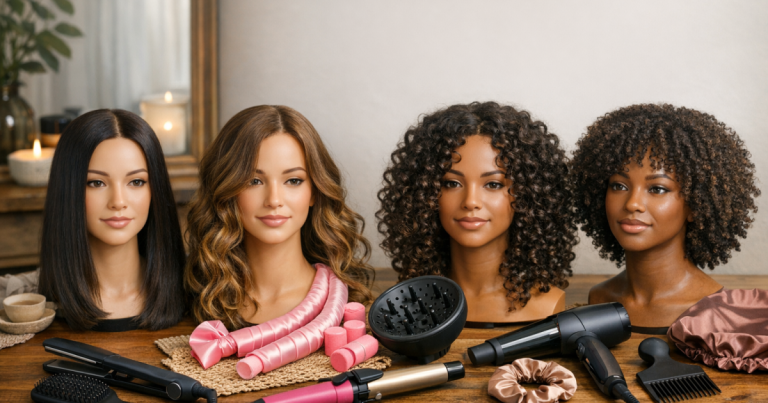
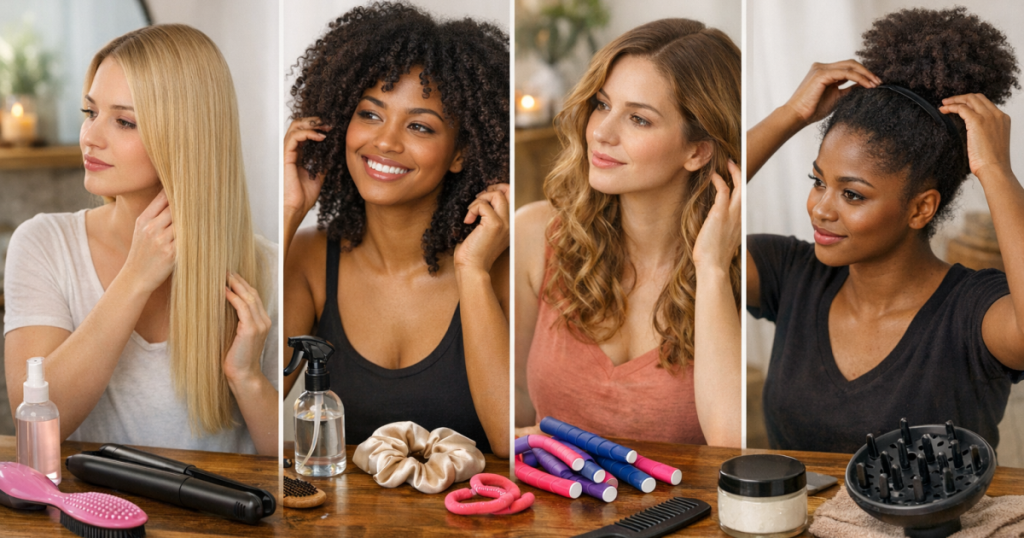
A style that glides into place on one head can spring back, puff out or collapse on another, and that is where hair type and hold become more than styling jargon. Slip, stretch and shrinkage explain why the same brush, roller, curling rod or finishing product can behave completely differently on fine, thick, straight, wavy, curly or coily hair.
The useful part is that these traits are observable. Once you can spot them, you can change your prep, section size, drying time and tool choice instead of blaming your technique every time a style refuses to last.
The short version
- Slip is how easily strands glide past each other, through fingers, through a brush or around a styling tool.
- Stretch is how much hair elongates under tension before returning, staying stretched or snapping.
- Shrinkage is how much textured hair contracts as it dries or returns to its natural pattern.
- Hold is how well a style keeps its shape against movement, humidity, weight, friction and time.
- Hair type affects all four, but condition, porosity, density and styling method matter as much as curl pattern.
Slip: why some hair glides and some hair grips
Slip is often mistaken for softness, but they are not identical. Hair can feel soft yet still tangle easily if the cuticle is raised, the ends are worn or the curl pattern naturally interlocks. Hair with good slip lets fingers, combs and tools move through with less snagging. Hair with low slip grips itself, which can be useful for updos and heatless sets, but more challenging for detangling and smooth finishes.
Fine straight hair often has high slip because the strands are narrow and lie close together. That can make sleek styling easier, but it can also mean clips slide out, curls drop and headbands move. Coarse, wavy, curly and coily hair may have less natural slip because bends and spirals create more contact points between strands. This gives styles more grip, but it also means rough brushing can cause frizz, breakage or disrupted curl clumps.
For at-home styling, slip affects how you section and prepare the hair. Low-slip hair usually benefits from smaller sections, patient detangling from the ends upwards, and a smoother surface before wrapping around heatless curling rods or rollers. High-slip hair may need cleaner sectioning, firmer anchoring and lighter finishing products so the style does not slide out. If detangling is the weak point in your routine, our Tangle Teezer The Original Detangling Hairbrush review looks at where a flexible detangling brush can help and where hair type still matters.
Stretch: the difference between bounce and fragility
Stretch shows how the hair fibre responds to tension. Healthy hair usually stretches a little and then returns. Overly dry or damaged hair may snap quickly. Overly softened or compromised hair may stretch too far and feel limp, gummy or unable to hold structure. This matters because most styling methods use some tension, whether you are blow-drying with a brush, smoothing the roots, wrapping hair around a satin rod or sleeping in a heatless set.
Straight and gently wavy hair can show stretch less dramatically because the strand is already elongated. Curly and coily hair often has more visible stretch because the natural shape contracts and lengthens. This does not automatically mean it is stronger. A tight curl can look bouncy but still be fragile if it has colour damage, heat damage, dryness or mechanical wear from brushing.
Fine hair needs careful tension because individual strands can be delicate, even when the overall head of hair looks dense. Thick hair can tolerate a firmer set in some cases, but it also takes longer to dry and can place more weight on curls or waves. Bleached, highlighted or heat-styled hair needs the gentlest approach because damaged fibres often lose reliable elasticity. For a deeper look at repair claims and heat-related weakness, see the K18 Leave-In Molecular Repair Mask review for heat damage.
Shrinkage: not a problem, but a styling variable
Shrinkage is most obvious on curly and coily hair, but the principle applies to waves too. Hair appears shorter as it dries, contracts or returns to its pattern. High shrinkage can make a twist-out, roller set or heatless curl look much tighter than expected once fully dry. Low shrinkage can make the same method look looser, longer or less defined.
Rather than treating shrinkage as something to fight, use it as a planning tool. If your hair shrinks a lot, larger sections or larger heatless rods may still finish smaller than they look during setting. If your waves barely shrink, you may need more deliberate wrapping, better drying time or a stronger setting base to create visible shape. Shrinkage also affects root volume: tight curls can lift away from the scalp as they contract, while long, dense waves may stretch downward under their own weight.
The key is to judge the finished style only when the hair is genuinely dry. Removing rollers or rods too early often creates a fluffy, unstable result because the strand has not settled into its new shape. This is especially true for dense hair, low-porosity hair that resists drying, and coily hair set in chunky sections.
Hold: why the same style lasts all day on one person and one hour on another
Hold is not just about hairspray or mousse. It is the combined effect of strand width, density, curl pattern, porosity, weight, scalp oil, humidity and friction. Fine hair may take a curl quickly but lose it because the strand has little internal weight to maintain shape. Thick hair may hold a wave beautifully once fully set, but can drop if the section was too large or still damp inside. Curly and coily hair can hold shape strongly, yet lose definition if the surface becomes frizzy or the curl clumps are separated too aggressively.
Porosity changes hold too. High-porosity hair may absorb products quickly and feel dry again, which can lead to frizz and uneven definition. Low-porosity hair may repel water and product at first, so styles can sit on the surface rather than setting evenly. Neither is better; they simply need different timing and amounts. High-porosity hair often needs controlled moisture and smoothing. Low-porosity hair often needs lighter layers and enough drying time before styling is disturbed.
How different hair types tend to behave
Fine straight hair
Fine straight hair usually has plenty of slip and limited natural grip. It can look smooth quickly, but curls, waves and accessories may drop or slide. Avoid overloading the roots, use smaller amounts of styling product, and create shape with firm but not crushing tension. Heatless curls often work better when the hair is slightly damp rather than wet, because fine hair can collapse if it dries too flat against the tool.
Fine wavy hair
Fine waves often sit between two problems: too much brushing removes the pattern, while too much product makes the hair stringy. Slip is moderate, shrinkage is usually gentle, and hold can be fragile. Work with light layers, scrunching, soft clips and minimal handling once the wave pattern has formed.
Thick wavy hair
Thick waves can look full and expensive when the shape is controlled, but they can also become triangular, puffy or heavy. Slip varies depending on condition and coarseness. The main challenge is drying time. Use smaller sections for heatless styling and allow more time than you think, because damp inner layers are a common reason waves fall unevenly.
Curly hair
Curly hair has visible shrinkage, natural grip and a strong response to tension. It can hold sets well, but only if the curl clumps are respected. Brushing after styling can turn definition into volume very quickly, which may be perfect for a fluffy finish but frustrating if you wanted polished curls. Choose your first goal before styling: definition, volume or stretch.
Coily hair
Coily hair often has high shrinkage, lower slip and excellent shape memory, but it can be more fragile at bends in the strand. Gentle detangling, moisture balance and section control matter more than forcing the hair into a finish. Heatless methods can be very effective, but the set needs enough time and the take-down should be slow, with minimal separation at first.
What to adjust before changing tools
When a style fails, it is tempting to assume the tool is wrong. Sometimes it is, but technique often needs adjusting first. Before replacing a brush, roller or heatless curler, check these variables:
- Starting dampness: Fine hair usually needs less water; dense or textured hair may need more even hydration but longer drying time.
- Section size: Smaller sections create more control, more drying access and more consistent tension.
- Product weight: Oils and heavy creams can soften hold on fine hair, while too little conditioning can leave textured hair frizzy and resistant.
- Root direction: The way hair dries at the root affects lift, kinks, stretch and how polished the final shape looks.
- Friction: Pillowcases, scarves, hoods and collars can loosen smooth styles or rough up curl definition.
- Order of priorities: A style designed for maximum volume will not behave like one designed for sleekness.
If you are trying to balance lift, wave formation and smoothness in one routine, the decision tree in deciding whether volume, waves or sleekness comes first is a useful next step.
Common questions
Does more shrinkage mean healthier hair?
Not always. Shrinkage can show elasticity and a strong curl pattern, but hair can shrink and still be dry, damaged or fragile. Judge health by elasticity, breakage, shine, feel and how the hair behaves when handled gently.
Why does my hair feel slippery but still refuse to hold curls?
High slip can make hair smooth and easy to brush, but it can also reduce grip. Fine, silky or freshly conditioned hair may need lighter prep, smaller sections and stronger anchoring during heatless styling.
Can damaged hair have too much stretch?
Yes. Hair that stretches excessively and does not spring back may be compromised. Reduce tension, avoid aggressive brushing, and focus on strengthening and gentle styling until the fibre feels more stable.
Why does my heatless set look good at night but fluffy by morning?
The hair may not be fully dry, the sections may be too large, or friction may be disturbing the surface. Dense, curly and coily hair often needs smaller sections and a slower take-down for a neater result.
Is hold mainly about curl pattern?
No. Curl pattern matters, but density, strand width, porosity, product weight, humidity and drying time all influence the final result. The link between hair type and hold is strongest when you look at all of these together.
The big picture
Slip tells you how easily hair moves. Stretch tells you how it handles tension. Shrinkage tells you how much the natural pattern contracts. Hold tells you whether the final shape can survive real life. Once you read those signals by hair type, styling becomes less random.
The best at-home routines are rarely about copying someone else’s exact method. They come from matching your tool, section size, moisture level and finishing approach to the way your own hair behaves. That is what turns heatless styling, brushing and everyday shaping from trial and error into a repeatable routine.