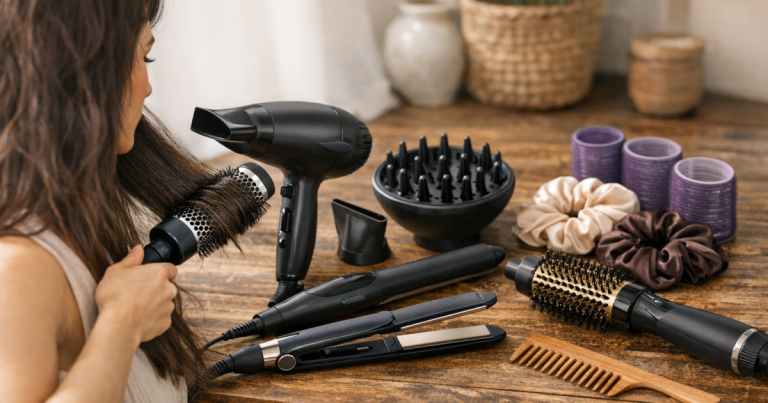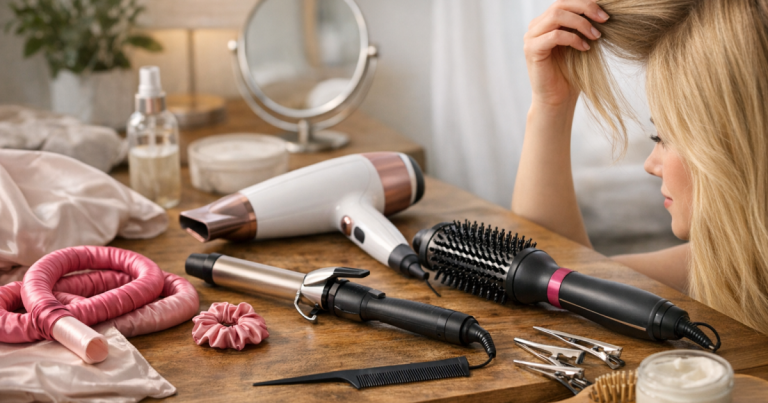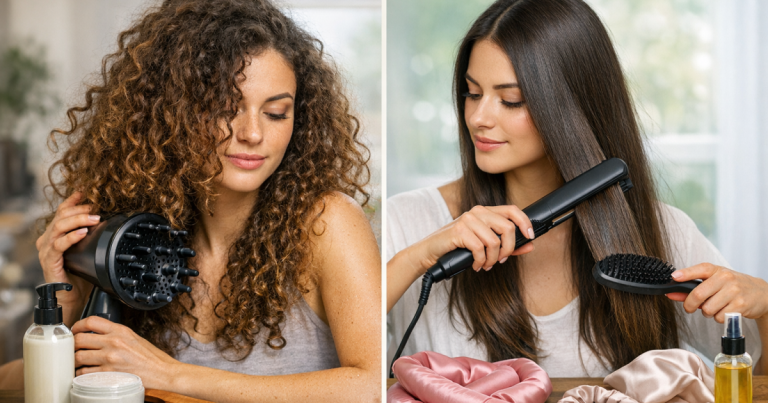
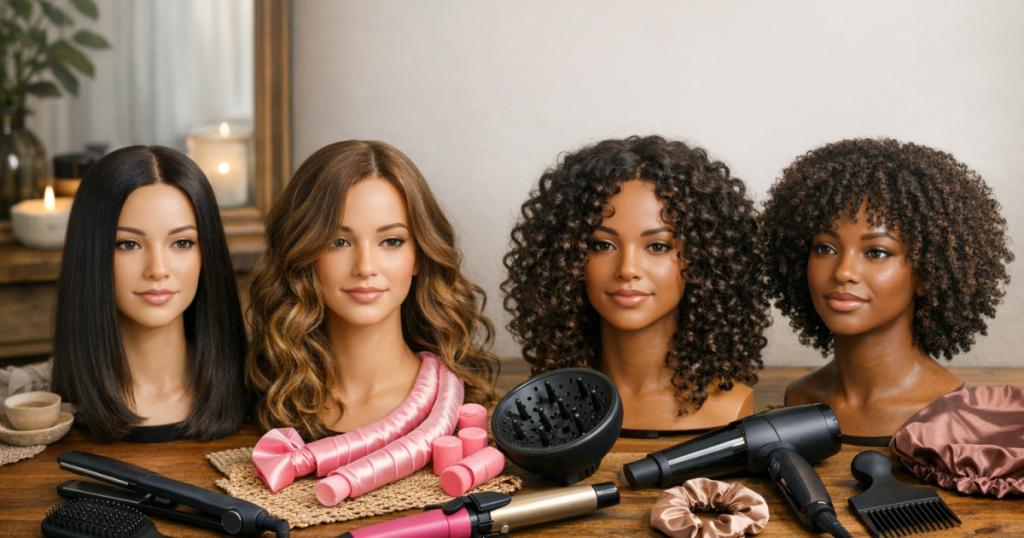
Curl pattern is useful because it tells you how hair naturally bends, resists tension and holds shape. Type 1 to 4 hair covers straight, wavy, curly and coily patterns, but the right styling tool also depends on density, porosity, length and how much heat your hair can comfortably tolerate.
The big picture
The most reliable tool routine starts with what your hair already wants to do. Straight hair often needs root lift and grip. Wavy hair needs shape without flattening. Curly hair needs definition with controlled drying. Coily hair needs gentle tension, moisture retention and tools that do not snag.
- Use curl pattern to decide the tool category: brush, roller, diffuser, heatless rod, wrap, comb or heated styler.
- Use density to decide tool size and sectioning: fine hair usually needs smaller, lighter sections; dense hair needs more deliberate parting.
- Use porosity to decide prep: some hair needs more water and slip, while some needs lighter products to avoid collapse.
- Use lifestyle to decide finish: polished, stretched, bouncy, wash-and-go, overnight or low-maintenance.
Why curl pattern is only the starting point
The Andre Walker-style hair typing system is helpful, but it is not a full diagnosis of your hair. Two people can both have 2C waves and need completely different tools because one has fine, low-density hair and the other has thick, coarse hair. The pattern describes the shape; it does not fully describe weight, surface condition, elasticity or how easily a style drops.
That is why tool choice should answer three practical questions. Does the tool add shape, protect existing shape or smooth the surface? Does it rely on heat, tension, drying time or product grip? And does it match the amount of handling your hair can take before it frizzes, stretches or snaps?
Type 1: straight hair that needs lift, bend or polish
Type 1 hair ranges from very fine and sleek to thicker straight hair with natural body. The main styling challenge is usually not definition; it is getting shape to stay. Fine straight hair can look limp if tools are too heavy, while coarse straight hair can resist bends unless the section is controlled.
Tools that usually make sense
- Velcro rollers for root lift, crown height and a soft bend through the ends.
- A lightweight round brush for blow-dry shape, if your hair tolerates heat styling.
- A silk hair wrap or smooth scrunchie method for preserving a straight blow-dry overnight.
- Heatless curling rods for soft waves, especially when used on slightly damp or product-prepped hair.
- A detangling brush with flexible teeth for everyday grooming without rough pulling.
For flat, fine straight hair, the biggest mistake is using a large, heavy tool and expecting it to create volume at the root. Smaller rollers, narrower sections and less product usually work better. If air-drying leaves your lengths clean but your roots collapsed, the techniques in air-drying fine hair without it looking flat are a useful next step.
Type 2: wavy hair that needs support, not force
Type 2 hair sits between straight and curly, so it is easily over-styled. Too much brushing can blur the wave; too much product can make it stringy; too much heat can turn it fluffy rather than shaped. The best tools encourage the wave pattern without stretching it flat.
Useful tool pairings
- A microfibre towel or soft cotton T-shirt for blotting and scrunching without roughing up the cuticle.
- Clips at the root while drying to stop the crown from drying flat.
- A wide-tooth comb for detangling in the shower or before styling, rather than aggressive brushing after waves form.
- A diffuser on low airflow for encouraging bend while reducing the temptation to keep touching the hair.
- Loose heatless rods or soft rollers for more even waves when natural pattern is inconsistent.
Wavy hair often benefits from a hybrid routine: light prep, minimal brushing, then either diffusing or heatless setting. If your waves drop quickly, the cause may be too much moisture, not enough hold, sections that are too large or removing the tool before the hair is fully dry.
Type 3: curly hair that needs definition and controlled drying
Type 3 curls form loops or spirals, so styling tools should protect curl families rather than separate every strand. The aim is usually definition, volume or elongation, depending on the day. A tool that is brilliant for clumping curls may feel too controlling if you prefer a bigger, softer finish.
Tools that can help curls keep their shape
- A wide-tooth comb for detangling with conditioner or styling slip.
- A curl brush for shaping clumps, used with care and enough product to avoid pulling.
- A diffuser for setting curls while maintaining natural spring.
- Soft sectioning clips for lifting roots and keeping wet curls organised.
- A satin or silk wrap for reducing friction while you sleep.
A brush such as the Denman D3 Original Styler is often used for controlled curl styling, but it is not automatically right for every curl type. Check whether your hair likes tension and clumping; if brushing breaks curls into frizz, finger-coiling selected front pieces or using a wide-tooth comb may be gentler.
For Type 3 hair, tool timing matters as much as the tool itself. Detangle when hair has slip, style while damp enough to form clumps, and avoid repeatedly touching curls as they dry. If you want more volume, disturb the cast or fluff the roots only after the curls have set.
Type 4: coily hair that needs gentle tension and moisture retention
Type 4 hair includes tight coils, zig-zag patterns and densely packed textures. Shrinkage is normal, and it is not a problem to fix unless you personally want a stretched finish. Tool choice should prioritise low-friction handling, controlled sectioning and reduced mechanical stress.
Tools that support coily textures
- A wide-tooth comb or detangling brush used in sections with plenty of slip.
- Soft scrunchies, sectioning clips and satin accessories that do not roughen the surface.
- Heatless stretching methods such as banding, twists, braid-outs or threading-style approaches.
- A hooded dryer or diffuser setup where controlled drying helps set twists, rods or wash-and-go styles.
- Flexible rods or satin-covered rollers for shape without direct heat on the strand.
A detangling option such as Tangle Teezer The Ultimate Detangler can be useful for some textured routines, but technique matters: work in manageable sections, start at the ends, and use the tool only when the hair has enough slip. For very fragile, colour-treated or tightly coiled hair, fingers plus a wide-tooth comb may give more control.
Where porosity, density and length change the answer
Porosity affects how quickly hair absorbs water and product, which changes how tools behave. Low-porosity hair may take longer to dry around heatless rods or rollers, so removing tools too soon can leave a limp result. High-porosity hair may dry fast but lose moisture and shape unless the prep gives enough hold and smoothness. For a fuller explanation, see choosing styling tools for high vs low porosity hair.
Density affects section size. Low-density hair can be overwhelmed by too many large rollers or heavy accessories. High-density hair usually needs more clips, more sections and more drying time. Length also changes tool choice: short hair may need smaller rollers or finger styling, while long layers need tools that shape the mid-lengths without leaving the ends flat.
Heatless, heated or mixed: which route fits your pattern?
Heatless tools are usually most useful when you can give the hair enough time to dry or cool into shape. Satin heatless curling rods, soft rollers, braids, twists and wraps work well when the tool suits the curl pattern and the hair is not overloaded. They are also helpful for preserving condition when you style often.
Heated tools can be useful for speed, polish or resistant hair, but they should not be treated as the only way to create shape. Straight and wavy hair may use heat for lift or bend; curly and coily hair may use controlled drying to set definition, stretch roots or smooth selected areas. The trade-off is always the same: faster results versus the risk of dryness, roughness or shape loss if heat is overused.
A mixed routine is often the most realistic. You might air-dry or diffuse most of the hair, then refine a few front pieces. Or you might use heatless rods overnight and smooth the roots in the morning. The goal is not to prove one method is superior; it is to reduce unnecessary manipulation while still getting a finish you will actually wear.
Different explanations when a style does not last
When a style falls out, the tool is not always the problem. Hair may be too wet, too dry, too coated, too clean, too heavy with product or set in sections that are too large. Humid weather, soft water, hard water, recent colour, smoothing treatments and layered cuts can all change how your pattern behaves.
If heatless curls look promising at first but lose shape before the day is over, the issue is often drying time, tension or product balance rather than the curl pattern itself. The troubleshooting steps in fixing heatless curls that drop by lunchtime are especially relevant if your hair forms a curl but refuses to hold it.
Helpful questions
Can one person have more than one curl type?
Yes. It is common to have looser sections at the crown, tighter pieces around the nape or straighter face-framing hair. Choose tools for the most delicate or least cooperative areas, not just the dominant pattern.
Should I brush curls and coils when they are dry?
Usually only when you want to intentionally separate, fluff or restyle. For definition, many curly and coily routines work better when detangling happens with water, slip and section control.
Are heatless tools better for every hair type?
They can reduce heat exposure, but they still need the right tension, drying time and surface texture. A poorly fitted heatless tool can flatten roots, create dents or fail to hold.
Why do my waves look better on some wash days?
Small changes in product amount, drying time, weather and how much you touch the hair can alter wave formation. Wavy hair is particularly sensitive to being over-brushed or over-conditioned.
Do I need different tools if my hair is colour-treated?
You may need gentler detangling, lower friction accessories and more careful heat habits. Colour-treated hair can feel more porous, so watch for dryness, tangling and styles dropping sooner than usual.
What stands out
Curl pattern gives you the first clue, but it should not make the whole decision. Type 1 hair often needs lift and staying power, Type 2 needs wave support, Type 3 needs definition without over-handling, and Type 4 needs gentle sectioning with moisture-conscious styling. The most effective at-home routine is the one that respects your pattern, your hair’s condition and the amount of time you realistically have.
If a tool repeatedly fails, do not assume your hair is impossible to style. Change one variable at a time: section size, dampness, product amount, drying method or overnight protection. That is usually more useful than buying another tool that repeats the same mismatch.