Getting heatless curling ribbons to work on thick hair is less about wrapping tighter and more about controlling section size, dampness and drying time. Dense hair can look beautifully waved on the surface while staying too soft underneath, so the setup needs to help every layer set evenly.
The aim is a comfortable wrap that holds its shape overnight or for several hours, without pulling at the roots or leaving bulky, half-dried bends. With the right prep, thick hair can get soft, wearable curls rather than stretched-out waves by lunchtime.
The short version
- Start on dry or almost-dry hair; thick hair that is too wet may not set fully.
- Use smaller sections than you think, especially around the back and underneath.
- Wrap with smooth, even tension rather than pulling hard at the scalp.
- Secure the ends firmly so heavy hair does not unwind while you sleep.
- Leave the ribbon in longer than fine hair would need, then separate curls with fingers only at first.
Why thick hair needs a different ribbon method
Thick hair has more weight, more internal layers and often a longer drying time. That changes how a ribbon curler behaves. If the sections are too large, the outside of the section takes the curl while the inside stays straighter. If the hair is too damp, the surface may dry into a wave but the mid-lengths and ends can remain limp or frizzy.
The root area is another common frustration. A single central ribbon can give pretty lengths but leave the crown flat, particularly on long, heavy hair. If root lift is your main aim rather than curl through the ends, it is worth reading about choosing tools by styling goal, because rollers, clips or a different placement may suit that result better.
Ribbon curls usually work best on thick hair when they are treated as a setting method, not a quick fix. The more dense your hair is, the more important it becomes to section cleanly, let each section dry before release and avoid overloading the hair with product.
What to use before you start
You do not need a complicated kit, but the right supporting items make the method easier. A satin or silk-feel ribbon is usually kinder on the cuticle than a rougher fabric, and a longer ribbon is more practical if your hair sits below the shoulders or feels bulky when wrapped.
- A smooth curling ribbon: sets the shape without direct heat. Real examples include the Kitsch Satin Heatless Curling Set and the Mermade Hair Heatless Curls Kit, but always check the length, fastening method and fabric feel before choosing one.
- Detangling brush or wide-tooth comb: thick hair needs to be smooth before wrapping, otherwise tangles become creases.
- Light hold product: mousse, styling cream or a flexible spray can help, but use less than you would for a heated tool.
- Clips: useful for keeping the back sections separate while you wrap the front.
- Soft scrunchies: better than tight elastics for securing the ends without dents.
If your hair is very long, the ribbon length matters more than the brand name. A ribbon that is too short forces you to wrap the ends too tightly or stack hair on top of hair, which can create uneven bends. For a closer look at long-hair fit and wrapping comfort, the RobeCurls heatless curling headband review for long hair is a useful next read.
Step-by-step: setting the ribbon on thick hair
1. Prep with controlled moisture
Start with hair that is dry or around 90% dry. For thick hair, damp does not mean freshly washed and towel-dried; it means barely cool to the touch, with no wet patches underneath. If your hair takes hours to dry naturally, set the ribbon on dry hair and mist each section lightly instead.
Apply a small amount of styling product through the mid-lengths and ends, then brush it through. Avoid heavy oils or rich creams at this stage unless your hair is very coarse and dry, because too much slip can make the curls drop before they have properly formed.
2. Create a clean centre placement
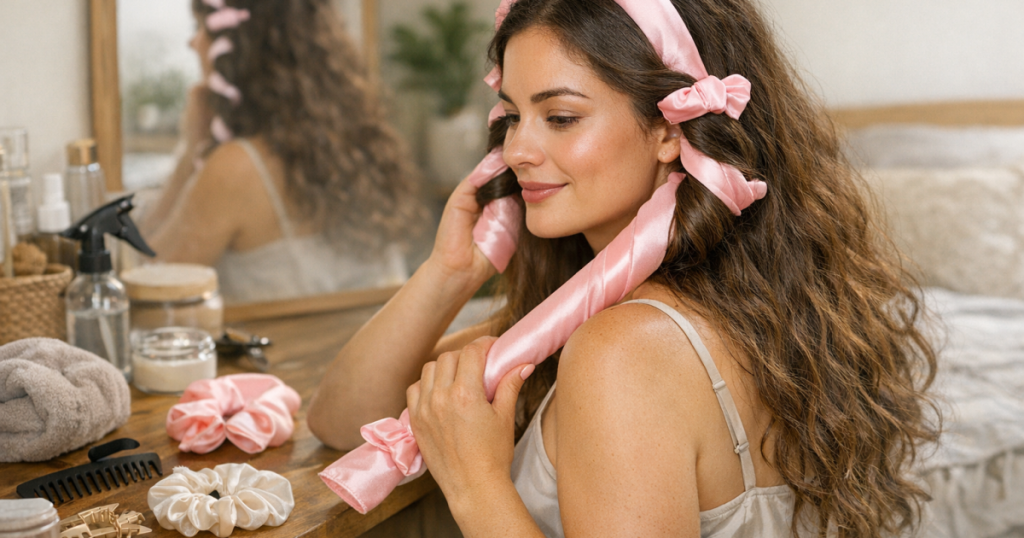
Place the middle of the ribbon over the crown like a headband. Clip it in place if it slides. On thick hair, secure placement matters because the weight of the wrapped sections can drag the ribbon backwards or pull it towards one side.
If you want balanced curls, part the hair neatly down the middle at the back as well as the front. This stops one side stealing extra density from the other, which is a common reason one side looks bouncier than the other after release.
3. Work in smaller sections
Take a front section around 2 to 4 cm wide, depending on your density. Wrap it away from your face around the ribbon, then add another small section to it before wrapping again. This is similar to a rope braid effect, but the ribbon acts as the shape guide.
For very thick hair, do not keep adding large pieces all the way down. Smaller, repeated additions help the curl form through the inner layers. Around the back, use a mirror or feel for even sections with your fingers so you do not end up with a chunky patch that refuses to curl.
4. Keep the tension smooth, not tight
The wrap should feel secure, not scalp-tight. Pulling too firmly can flatten the roots, make sleeping uncomfortable and create harsh ridges near the face. Smooth tension gives a more polished result because each section lies evenly against the ribbon.
If your hair is coarse or resistant, resist the urge to twist harder. Instead, reduce the section size and add a little more setting time. Thick hair responds better to consistent contact with the ribbon than to force.
5. Secure the ends properly
The ends are where thick hair often escapes. Once you reach the bottom, wrap the last few centimetres neatly and secure with a soft scrunchie. If the ends are layered, tuck the shortest pieces under the longer ones before fastening.
For extra hold, twist the wrapped side into a loose bun and secure it low, but keep it comfortable. If the bun is too tight, it can create a bend at the nape rather than a smooth curl pattern.
6. Let it set for long enough
Thick hair usually needs more time than fine hair. Overnight is often the easiest option, but several daytime hours can work if the hair started almost dry. The key test is not the clock; it is whether the wrapped hair feels completely dry and cool-free before you take it down.
If your roots get oily quickly, try setting from mid-length down and leaving the root area looser. If your ends dry out, mist only the ends before wrapping and keep product lightweight.
How to remove the ribbon without losing the curl
Do not pull the ribbon straight out. Remove the scrunchies first, then gently unwind each side in the opposite direction of the wrap. Let the curl tubes drop into your hands rather than dragging them apart.
Once both sides are released, wait a minute before separating. Thick hair can puff up quickly if it is disturbed too much. Use your fingers to split each curl into two or three pieces, then shake lightly at the roots. A wide-tooth comb can soften the look, but use it only if you want waves rather than defined curls.
Finish with a small amount of flexible hairspray if your hair is heavy or naturally straight. If your hair is textured, wavy or has mixed curl patterns, separate less and focus on placing the curls where they sit best. Readers with multiple textures through one head of hair may also find this guide to styling tools for mixed-texture hair helpful.
Adjustments by thick hair type
- Thick, straight hair: use smaller sections, a touch of mousse and a longer setting time. Straight dense hair often needs structure more than moisture.
- Thick, wavy hair: wrap with your natural wave direction where possible, and avoid brushing after release unless you want a looser finish.
- Thick, coarse hair: smooth with a light cream before wrapping, but keep the roots product-light to avoid heaviness.
- Thick, layered hair: start with smaller front sections and tuck short pieces carefully so they do not flick out.
- Long, dense hair: consider splitting each side into two wrapped sections if one ribbon becomes overloaded.
Fixes for common problems
The curls drop too quickly
The hair was probably too damp, too heavily sectioned or too product-laden. Next time, begin drier, use narrower sections and let the set cool into shape before touching it. A light hold product usually works better than a heavy smoothing product for longevity.
The roots look flat
Place the ribbon slightly higher on the crown and avoid pulling the first wrap downwards. You can also clip the front roots upwards while the ribbon sets. If lift is the main goal, combine ribbon curls with a few crown rollers rather than expecting one ribbon to do everything.
The back is straighter than the front
This usually means the back sections were too large or not wrapped with enough contact. Divide the back more deliberately, even if it takes longer. For dense hair, the back often needs the most attention because it has the most weight.
The ends flick out
Mist the ends lightly, smooth them around the ribbon and secure with a soft scrunchie close to the end of the wrap. Layered ends may need to be tucked under a longer section before fastening.
Common questions
Should thick hair be wet for ribbon curls?
No. Thick hair should be dry or nearly dry. Hair that is too wet can stay damp inside the wrap, which leads to weak curls, frizz or an uneven set.
Can I use one ribbon if my hair is very dense?
Yes, but it may not give the most even result. If the ribbon feels overloaded, split your hair into smaller working sections or use two ribbons so the back and underneath layers get enough contact.
How do I stop heatless curling ribbons on thick hair from feeling uncomfortable overnight?
Keep the wrap low behind the ears, avoid scalp-tight tension and use soft scrunchies at the ends. A smooth pillowcase can also reduce pulling while you sleep.
Why are my curls tighter on one side?
One side is usually wrapped with smaller sections or stronger tension. Part the hair evenly at the back and try to mirror the section size and wrapping direction on both sides.
Do ribbon curls work on short thick hair?
They can, but very short layers may spring out of the wrap. Hair that sits around the shoulders or longer is usually easier to secure around a ribbon.
Main points
Heatless ribbon curls can work beautifully on thick hair, but density changes the rules. Start drier, wrap smaller, secure the ends carefully and give the style enough time to set all the way through.
If your first attempt looks loose or uneven, adjust one thing at a time: section size, moisture level, product amount or setting time. Thick hair often needs a little trial and refinement, but once the balance is right, a ribbon can create soft curls with far less stress on the lengths than daily hot styling.