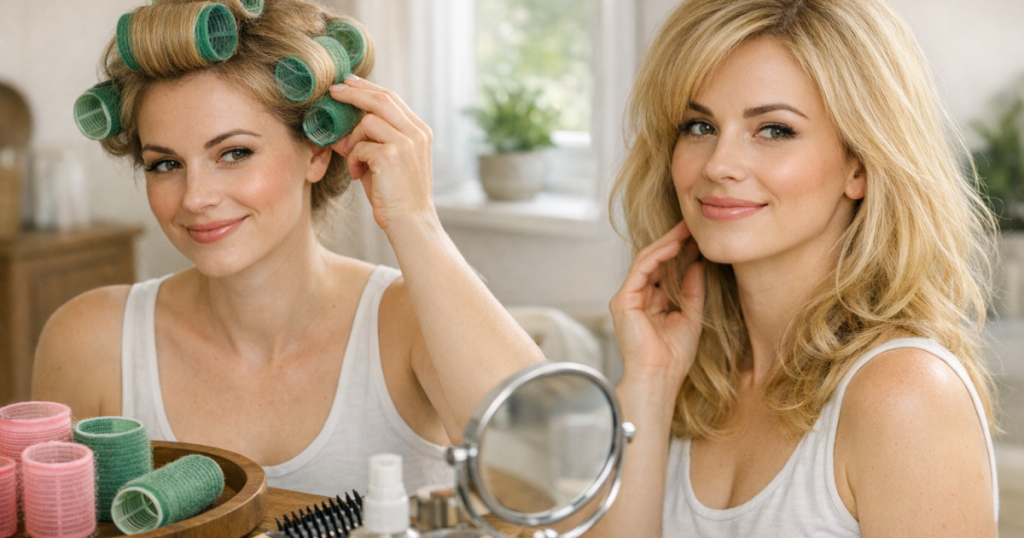
Fine hair can look polished in the mirror and flat again by lunchtime, which is why Velcro rollers for fine hair work best as a root-lift method rather than a full curl routine. The trick is to use the right section size, a little tension and enough setting time so the lift holds without needing heavy product. Done well, they give soft volume, a smoother fringe and a rounder crown without making the lengths look over-styled.
The short version
- Use rollers on dry or almost-dry hair, not soaking wet hair.
- Apply a light root spray or mousse sparingly before rolling; avoid oils and rich creams at the roots.
- Lift each section up and slightly forward before rolling to create height at the base.
- Use larger rollers for soft crown volume and medium rollers for shorter layers, fringes and face-framing pieces.
- Leave them in until the roots feel fully cool and set, then remove gently without tugging.
Why Velcro rollers work so well on fine hair
Fine hair usually lacks diameter rather than movement, so it can collapse when overloaded with hot tools, thick styling creams or too much hairspray. Velcro rollers, also called self-grip rollers, create lift by holding the hair away from the scalp while the shape sets. They do not need to create a tight curl to be useful; the main benefit is height, bend and a more airy silhouette.
The grip matters. The tiny hooks on the roller hold the outer layer of hair in place, which means you can get shape without clips on many hair types. However, very silky, freshly conditioned or slippery fine hair may still need a lightweight clip to stop the roller from sliding. If your hair struggles to hold any shape, it is worth pairing this method with the broader advice in our guide to fine hair styling tools, especially if you are deciding when to use heatless methods and when a heated tool is more realistic.
What you need before you start
You do not need a complicated kit, but having two roller sizes makes the result more natural. A familiar example of this tool type is Denman Self Grip Hair Rollers, though the exact brand matters less than choosing a smooth, clean roller that grips without snagging.
- Large rollers, around 40–50 mm: best for crown lift, soft bend and longer top sections.
- Medium rollers, around 25–35 mm: useful for fringes, shorter layers and hair around the temples.
- Sectioning clips: helpful if your hair is very silky or layered.
- A tail comb or dressing brush: useful for neat sections and gentle back-brushing if needed.
- Light root product: choose a fine mist, mousse or volumising spray rather than a waxy or oily product.
Skip heavy leave-in conditioner at the roots before rolling. Fine hair can still need moisture through the ends, but volume comes from keeping the base light, clean and slightly textured.
Step-by-step: the fine-hair roller routine
1. Start with hair that is nearly dry
Velcro rollers work best when fine hair is dry or about 90% dry. If hair is wet, the roller can become heavy, the roots can dry flat, and the finished shape may look stringy rather than lifted. After washing, rough-dry with your fingers or let your hair air-dry until only a trace of moisture remains. If you are refreshing second-day hair, lightly mist the roots with water or a volumising spray instead of soaking the lengths.
2. Add product only where you need support
Fine hair usually needs less product than you think. Apply a small amount of root-lifting mousse or spray along the parting, crown and front hairline, then comb it through lightly. Avoid coating the full length unless your hair is very flyaway. Too much product can make the rollers stick, drag or leave the finished style looking separated.
3. Section according to the roller width
Take a section that is no wider than the roller and not much thicker than 1–2 cm. If the section is too wide, the edges will not set evenly. If it is too thick, the middle will stay flat and the roller may slide out. For the crown, create three or four horizontal sections from the front hairline back towards the crown. For a fringe or face-framing layer, use narrower sections so the shape sits neatly.
4. Overdirect the section for more root lift
This is the step that makes the biggest difference. Lift the section straight up from the scalp, then pull it slightly forward before placing the roller at the ends. Smooth the ends around the roller first, then roll down towards the scalp with steady tension. When the roller sits at the base, the roots should be lifted rather than lying in their natural direction.
For crown volume, roll backwards away from the face. For curtain fringes, roll the front sections away from the face on each side. For a smoother blow-dry effect, keep the sections clean and the tension even. For a more casual texture, use slightly staggered sections and avoid making the parting too perfect.
5. Let the shape set properly
Leave the rollers in for 10–25 minutes, depending on how easily your hair takes shape. Fine, freshly washed hair may need longer than second-day hair because it is softer and more slippery. If you use a hairdryer, use gentle airflow and avoid blasting the rollers around. Let the hair cool completely before removing them; cool hair holds shape better than warm hair.
Velcro rollers are not usually the best tool to sleep in because they can tug, flatten at the base or roughen the surface of fine hair. If your routine needs to happen overnight, the technique is different, and our guide to sleeping in heatless curlers without flattening roots is a better next step.
6. Remove without unravelling the volume
Do not pull the rollers straight down. Hold the hair at the root with one hand and gently unwind or slide the roller out in the direction it was rolled. If it catches, pause and loosen a small section rather than forcing it. Fine hair can frizz or stretch when pulled, and rough removal can undo the smoothness you have just created.
7. Finish with fingers, not a heavy brush
Once all rollers are out, let the hair settle for a minute. Use your fingers to lift the roots and place the front pieces. If you need more polish, use a soft brush only on the surface, not from root to tip. A light mist of flexible hairspray can help, but keep it moving and spray from a little distance so the hair does not become stiff or damp.
Adjusting the method for your hair type
- Fine straight hair: focus on the crown and front hairline rather than rolling every section. Too many rollers can make straight fine hair look puffy at the top and thin through the ends.
- Fine wavy hair: use rollers at the roots only, then let the mid-lengths keep their natural bend. Brushing everything smooth first may remove too much texture.
- Fine hair with layers: use medium rollers on shorter pieces so the ends wrap securely. Large rollers can slip out of layered hair if the section is too short.
- Fine highlighted or heat-weakened hair: keep tension gentle and avoid removing rollers roughly. A detangling brush before styling helps, but do not over-brush after the rollers come out.
- Oily fine roots: use a tiny amount of dry shampoo before rolling, then brush out any powdery residue. The aim is grip, not a matte coating.
Common mistakes that flatten the result
- Using sections that are too large: the roller cannot support the root, so the shape drops quickly.
- Rolling wet hair: fine hair may dry slowly around the roller and end up limp rather than lifted.
- Adding too much styling cream: rich products weigh down the exact area you are trying to lift.
- Removing rollers too soon: if the root is still warm or damp, the volume will not last.
- Brushing through immediately: this can turn soft lift into static or remove the bend altogether.
How to make the volume last longer
For fine hair, longevity is more about preparation than piling on hairspray at the end. Start with a clean scalp, use light product, and give the rollers enough time. If your roots collapse quickly, try rolling only the top layer and crown rather than the full head. Concentrating the lift where it is visible often looks fresher than creating volume everywhere.
Think about your preferred finish too. For a polished look, keep sections uniform and smooth the ends carefully around the roller. For a textured look, alternate the direction of a few face-framing sections. For a natural finish, use rollers only where your hair tends to fall flat. If you are still working out what result suits your hair, our guide to choosing tools by finish explains the difference between smooth, undone and low-effort styling.
Questions people ask
Can I use Velcro rollers on freshly washed fine hair?
Yes, but freshly washed fine hair is often softer and more slippery. Use a light root product, dry the hair almost fully, and leave the rollers in longer than you would on second-day hair.
Are Velcro rollers for fine hair better than a hot brush?
They are better for low-heat root lift and soft volume, while a hot brush gives more smoothing and shape through the lengths. If your main issue is flat roots, rollers are usually the gentler first step.
Why do my rollers get stuck?
The section may be too thick, the ends may not be wrapped smoothly, or your hair may have too much product in it. Remove the roller slowly in the same direction it was rolled, supporting the root as you go.
Should I use hairspray before or after rolling?
Use flexible hairspray after removing the rollers. Spraying before rolling can make fine hair sticky, harder to unwind and more prone to snagging.
How many rollers do I need for volume only?
For root lift, you may only need 4–8 rollers across the crown, parting and front hairline. Full-head rolling is optional and can be too much for very fine or short hair.
Final thoughts
Velcro rollers are at their best when you treat them as a precision volume tool, not a full styling shortcut. On fine hair, the winning formula is light product, small clean sections, upward tension and patience while the shape sets. Start with the crown and front pieces, refine the roller size as you learn how your hair responds, and keep the finish soft so the volume looks natural rather than forced.