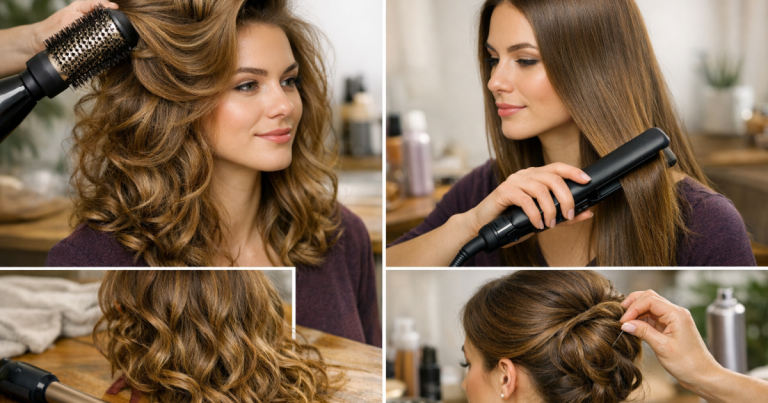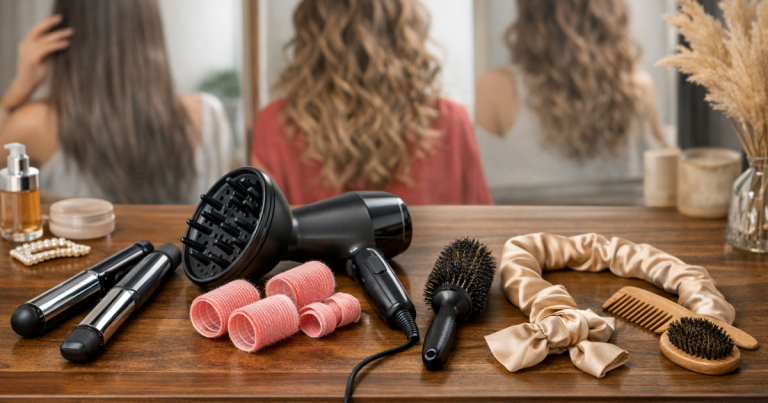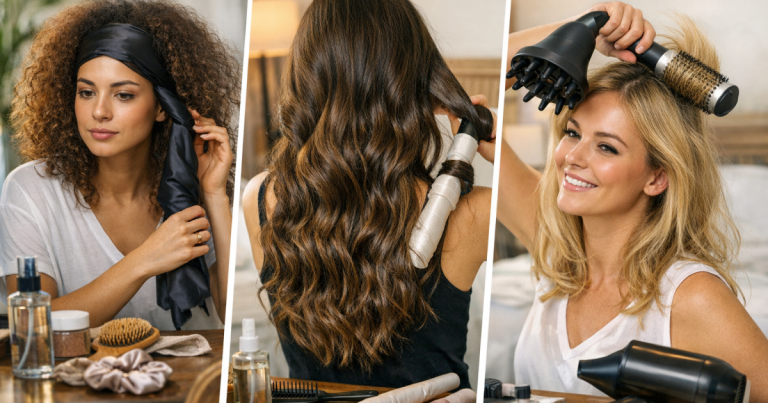
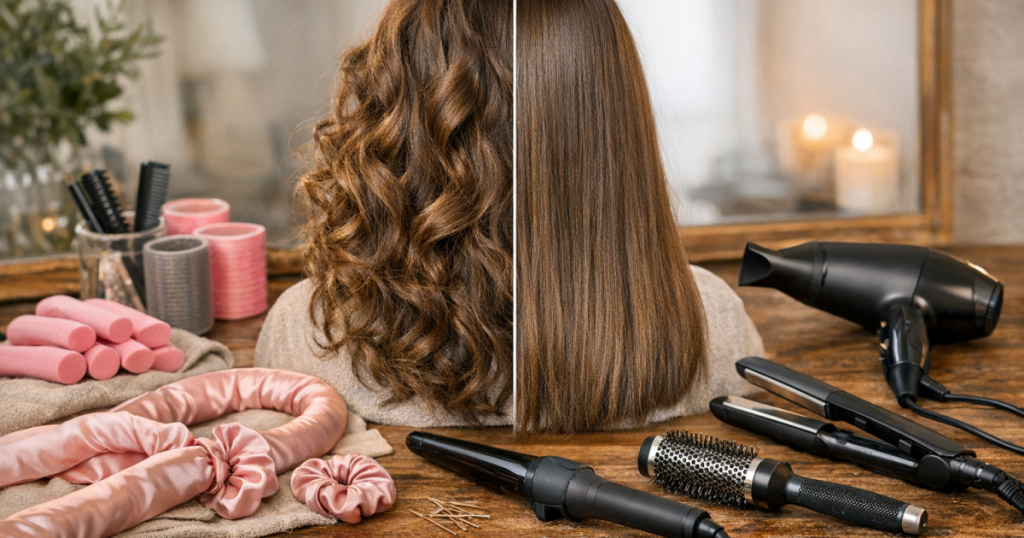
Choosing the right hair styling tools is less about owning every gadget and more about matching shape, tension, drying method and set time to the finish you want. Curls need controlled wrapping, bounce needs lift at the root, smoothness needs tension and surface polish, and lasting hold usually comes from prep plus cooling or setting time, not just the tool itself.
The quickest way to narrow your kit is to start with the result: defined curl, loose bend, airy volume, sleek finish or a style that lasts beyond the first hour. From there, your hair type decides whether heatless setting, hot tools, air styling or brush tension will do the cleanest work.
At a glance
- For curls: use a curling wand, curling tong, flexi rods, a satin heatless curling rod, foam rollers or an air styler barrel, depending on how much definition and heat exposure you want.
- For bounce: use Velcro rollers, heated rollers, a round brush, a hot brush or a blow-dry brush to create lift and a curved finish.
- For smoothness: use a paddle brush with a dryer, a concentrator nozzle, a straightener, a smoothing brush or a silk wrap for overnight protection.
- For lasting hold: focus on prep, section size, dry hair, cool-down time, clips, pins, setting spray and the right level of product for your hair density.
If you are unsure whether a heated or heatless route fits your finish, the differences are clearer when you look at the end result rather than the trend. The breakdown on heatless versus heated styling for your desired finish is a useful next step if you are deciding between speed, softness, definition and damage control.
Tools that create curls
Curl-making tools work by forcing hair into a curve and holding it there until the hair cools, dries or sets. The tighter the wrap and the smaller the section, the more defined the curl. The wider the tool or looser the wrap, the softer and more brushed-out the result.
For defined curls
A curling tong or wand is the most direct route to polished curl definition because it applies heat while the hair is wrapped. It suits hair that drops quickly, thick hair that needs stronger shaping, or anyone wanting a consistent curl pattern for an event. The trade-off is heat exposure, so the condition of your hair and your heat-protection routine matter.
Heatless tools can also create proper curls, but they rely on dampness, product, tension and time rather than heat. A satin heatless curling rod tends to give softer, elongated curls, while foam rollers and flexi rods can create more compact ringlets if the sections are small enough. For layered hair, place shorter front pieces carefully so they do not spring out halfway through the set.
For soft waves and bends
Loose waves need less clamp and more wrap control. Large rollers, a curling wand with larger sections, robe-style rods and air styler barrels all work well when you want movement rather than a tight curl. The finish is usually more relaxed on long hair and more bouncy on shoulder-length cuts because the curl has less weight pulling it down.
For naturally wavy or curly hair, the goal may be curl refinement rather than curl creation. A diffuser, hooded dryer attachment, curl clips and a gentle detangling brush can help preserve the natural pattern while encouraging even drying. Avoid over-brushing once the shape is set, because that can turn definition into frizz.
Tools that create bounce and root lift
Bounce comes from lift at the roots and a rounded bend through the lengths. It is not the same as curl. A style can be straight but bouncy, or wavy but flat at the crown. The best tools for bounce are the ones that lift the hair away from the scalp while it dries, heats or cools.
Rollers for volume
Velcro rollers are especially useful after a blow-dry because they hold warm sections in a lifted shape while they cool. They work well at the crown, fringe and face-framing layers, but they need smooth, detangled sections to avoid snagging. For fine hair, use fewer, larger sections and keep product light. For thick hair, smaller sections usually give better root support.
Heated rollers, such as Remington Proluxe Heated Rollers, can add curve and volume together. They are useful when you want a softer, brushed-out finish rather than tonged curls. Before choosing any roller set, check the roller sizes, clip style and whether your hair length can wrap securely around the barrel.
Brushes and air stylers for lift
A round brush and dryer give the most custom control because you can target the root, mid-length and ends separately. This is ideal for curtain fringes, layered cuts and styles that need the ends to flick under or away from the face. A hot brush or blow-dry brush is easier for many people at home, though very wet or very dense hair often needs rough-drying first.
An air styler such as BaByliss Hydro-Fusion Air Styler can be useful for smoothing and shaping at the same time, provided the attachment suits your hair length and density. The key check is grip: if the brush head cannot hold your section with tension, you will get softness but not much lift.
Tools that create smoothness
Smoothness is created by alignment. The cuticle lies flatter when hair is dried or styled with even tension, consistent direction and minimal rough handling. That is why a basic dryer can give a sleek result with the right brush, while a premium tool can still leave frizz if sections are too large or hair is not fully dry.
For a sleek blow-dry
A paddle brush with a dryer is good for longer hair that needs smooth movement rather than curled ends. A concentrator nozzle helps direct airflow down the hair shaft, while sectioning clips stop damp hair from collapsing into already-smoothed areas. This approach suits medium to thick hair especially well because it gives control without pressing the hair completely flat.
For coarse, porous or frizz-prone hair, prep matters as much as the tool. Leave-in conditioner, a smoothing cream or a humidity-resistant styling spray can help, but the amount should be adjusted to density. If your hair absorbs product quickly or repels water at first, read the guide to high versus low porosity hair and styling tools before blaming the tool.
For a straighter finish
Straighteners give the most compressed, polished smoothness because heat and plates apply direct pressure. They suit sleek styles, stubborn kinks and finishing work around the hairline, but they are not always the best first step for volume. If you want smoothness with body, blow-dry first, then use straighteners only where needed.
Smoothing products can support the finish. Color Wow Dream Coat Supernatural Spray is a well-known example of a humidity-focused styling spray, but as with any product, check the usage instructions, heat requirements and whether it suits your hair texture before relying on it for an important style.
Overnight smoothness is a different goal. A silk or satin wrap protects the surface of the hair from friction while you sleep, helping preserve a blow-dry, stretched curls or a roller set. A product such as Silke London Hair Wrap is one recognisable option; the main things to verify are fit, comfort and whether it stays secure on your hair volume overnight.
Tools and techniques that help hold last longer
Lasting hold is not created by one miracle tool. It comes from building a shape, letting it set and avoiding anything that weighs it down too soon. The same roller set can last all day on one person and drop in minutes on another because hair texture, porosity, product amount and drying time all change the outcome.
For fine hair
Fine hair often needs grip before styling, but not weight. Mousse, light setting spray or texture mist can help curls and volume hold, while heavy oils and rich creams can flatten the result. Smaller sections usually hold better, but too many tiny curls can look overworked, so choose section size based on the finish you want.
If fine hair falls quickly after heatless curls, the issue is often starting too wet, using too much product or removing the tool before the hair is fully dry. The step-by-step advice on prepping fine hair for long-lasting heatless curls covers the balance between moisture, grip and set time.
For thick, dense or heavy hair
Thick hair needs section control. Large pieces may look styled on the outside while the inner layers stay damp, warm or unset. For curls, use smaller sections and allow full cooling before brushing out. For bounce, clip each lifted section while it cools. For smoothness, work from the underneath layers upwards so the top section is not doing all the visual work.
For curly, coily or textured hair
Hold often comes from respecting the existing pattern rather than fighting it. Diffusers, hooded dryer attachments, curl clips, flexi rods and satin wrapping can all support shape without repeatedly stretching the hair. If you want a smoother set, detangle gently, apply product evenly and keep tension consistent so the finished shape looks intentional rather than pulled unevenly.
Matching the tool to the finish
- Big, soft curls: large rollers, a heatless curling rod, wide-barrel tongs or air styler barrels. Best for medium to long hair that can wrap fully around the tool.
- Tighter curls: smaller tongs, flexi rods, foam rollers or pin curls. Best when hair needs more defined shape or drops easily.
- Root lift: Velcro rollers, round brushes, hot brushes and clips at the crown. Best for flat roots, fringes and layered cuts.
- Sleek lengths: dryer with paddle brush, concentrator nozzle, straighteners or smoothing brush. Best when the goal is polish rather than curl.
- Longer hold: setting clips, cool shot, hooded drying, mousse, light hairspray and overnight protection. Best when your style looks good at first but collapses quickly.
Once you understand which tool creates which effect, hair styling tools become easier to judge. You do not need every device in the cupboard; you need the one that creates the missing part of your style, whether that is root lift, bend through the ends, surface smoothness or enough set time to make the shape last.
FAQ
What tool gives curls without making hair look too done?
Use a heatless curling rod, large foam rollers or large sections around a wand, then let the curls cool or dry fully before brushing them out. The softer finish comes from larger sections and gentle separation.
Why does my hair look smooth but flat?
You may be using too much downward tension or straightening from the root. Add lift first with rollers, a round brush or clips at the crown, then smooth only the lengths and ends.
Are Velcro rollers better than heated rollers for bounce?
Velcro rollers are best for setting lift after a blow-dry, while heated rollers add more shape by warming the section. Fine hair may prefer Velcro; heavier hair may need heat plus cooling time.
What helps curls last overnight?
Let the style set fully before bed, avoid heavy finishing products, and protect the shape with a silk or satin wrap, loose pineapple or soft scrunchie. Do not sleep on hair that is still damp unless the set is designed to dry overnight.
Can one tool create curls, bounce and smoothness?
Some multi-stylers can do all three, but usually with compromises. A round brush or air styler is versatile, but very sleek finishes, tight curls and strong root lift often need different techniques.
Why it matters
The best styling result usually comes from choosing for the finish, not the hype around the tool. Curls need wrap and set, bounce needs lift and cooling, smoothness needs tension and direction, and hold needs the right prep for your hair type. Once those basics are clear, your routine becomes simpler, more repeatable and much easier to adapt between heatless days and polished blow-dry days.