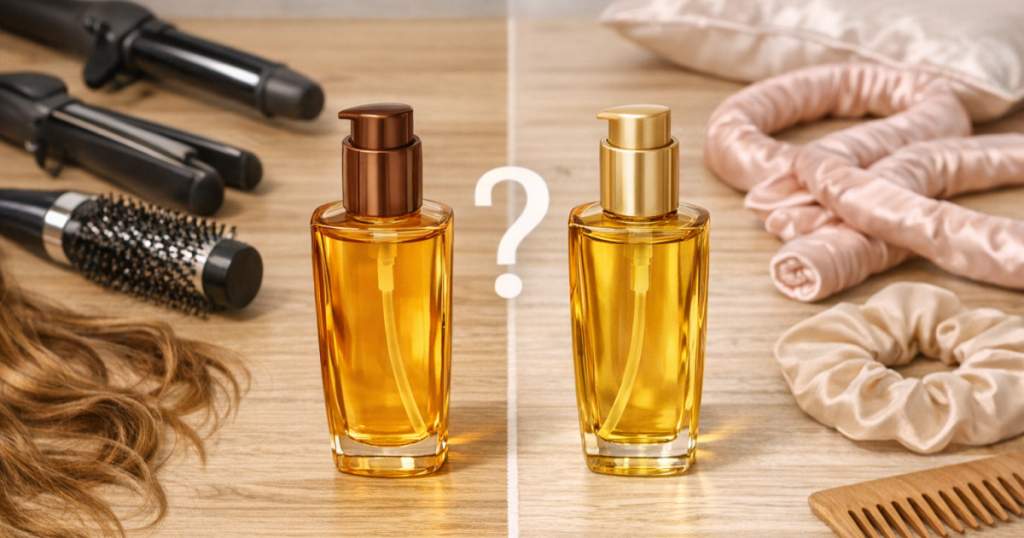
If you have seen L’Oreal Elvive Extraordinary Oil listed next to L’Oréal Paris Elvive Extraordinary Oil, the frustrating answer is that they are usually not two meaningfully different hair oils. The difference is more often about how a retailer writes the brand name than a true head-to-head between separate formulas.
That does not mean every listing is safe to treat as identical. The Elvive Extraordinary Oil family can appear in different packaging, seller formats and regional listings, and marketplace pages sometimes blur the line between the standard oil, richer variants, travel-size listings or older stock imagery. If your hair is fine, bleached, thick, curly or frizz-prone, the important question is not just what the bottle is called; it is whether the exact product page matches the finish you want.
In brief
- L’Oréal Paris is the broader beauty brand; Elvive is the haircare range. Some UK retailers shorten the name to L’Oréal Elvive, while others write L’Oréal Paris Elvive.
- For most shoppers, the two names point to the same product family rather than rival oils.
- The real checks are the variant name, ingredients list, ml size, seller, packaging image and intended hair type.
- Fine hair should prioritise a lightweight finish and careful dosing; thick, coarse or porous hair can usually tolerate a little more product on the mid-lengths and ends.
- Do not use the name alone to decide. Compare the live listing details before buying, especially on marketplace pages.
Why the two names look different
The confusion comes from brand hierarchy. L’Oréal Paris is the consumer beauty brand name, Elvive is the haircare line, and Extraordinary Oil is the product family. A retailer may write the full name as L’Oréal Paris Elvive Extraordinary Oil, while another trims it to L’Oréal Elvive Extraordinary Oil for space, search or catalogue consistency.
On a supermarket shelf or high-street beauty site, that shortened wording is usually harmless. On a marketplace page, it needs a closer look because third-party sellers can group similar-looking products under one title. You might see a title that says one thing, a main image that suggests another and a product description copied from a different variant. That is where mistakes happen.
For hair results, the exact name matters less than the role the product is meant to play. A finishing oil can add slip, reduce the look of dry ends and soften flyaways, but it will not create the same result as a styler, brush, roller or heat tool. If you are trying to separate shine from hold or smoothness from shape, our guide to how lift, shape, smoothness and hold differ is useful before you add another product to your routine.
Side-by-side: what are you actually comparing?
This is not a classic comparison where one product is clearly the budget option and the other is the premium upgrade. It is a naming comparison, so the fairest way to decide is to compare the listing evidence rather than assuming the titles tell the whole story.
- L’Oréal Elvive Extraordinary Oil: Often a shortened retailer title. It may refer to the same Elvive Extraordinary Oil product family, but you need to confirm the variant and bottle shown.
- L’Oréal Paris Elvive Extraordinary Oil: Usually the fuller brand-and-range wording. It is clearer from a branding perspective, but it still needs the same checks if you are shopping online.
- Most important difference: Not the word Paris. The meaningful difference is whether the listing is for the same variant, size and seller condition.
- Best use case for either name: Smoothing the look of dry ends, adding shine and giving hair more slip before or after styling, depending on the directions on the bottle.
- Main risk: Buying a variant that is too rich for your hair, using too much, or mistaking a finishing oil for a product that provides hold.
The checks that matter before you buy
1. Match the full product name, not just the first line
Look beyond the page title. Check the bottle image, the product description and the listed range name. If one listing says Extraordinary Oil but the image shows a different Elvive product, pause. Haircare listings can be updated unevenly, and an image mismatch is a sensible reason to choose a clearer page.
2. Check the variant and hair-type wording
Extraordinary Oil can be presented in ways that appeal to different hair needs, such as dry hair, dull lengths or richer nourishment. Avoid assuming every gold-toned Elvive oil is the same. If your hair is fine or easily weighed down, wording around richness and nourishment deserves more attention than it would for coarse, porous or very dry ends.
3. Compare the ingredients list on the retailer page
The ingredients list is the best clue when two listings look almost identical. You do not need to become a cosmetic chemist, but you should check whether both pages show the same ingredient order and whether either page looks incomplete. If you have known sensitivities, fragrance preferences or scalp issues, do not rely on the shortened name alone.
4. Confirm the size in ml and the seller
Two bottles can look similar while being sold in different sizes or bundles. Compare the ml size shown on the page and check whether the seller is the retailer itself or a marketplace seller. This matters when you are comparing value, delivery reliability and whether the product is likely to arrive in the packaging shown.
5. Read recent UK reviews with your hair type in mind
Reviews are most helpful when the reviewer mentions hair type. A five-star review from someone with thick, bleached hair may not translate to very fine, straight hair. Look for comments about greasiness, softness, frizz, scent, bottle pump control and whether the oil made hair easier to brush through.
Which hair types are most likely to like it?
Both name versions point towards the same kind of styling support: shine, slip and smoother-looking ends. That makes the oil useful for many routines, but the amount and placement make a big difference.
Fine or flat hair
Fine hair can benefit from a tiny amount on the ends, but it is also the hair type most likely to look oily quickly. Start lower than you think, keep it away from the roots and use it as a finishing touch rather than a full-length coating. If your main issue is lack of volume, a hair oil will not replace rollers, a root-lifting routine or a lightweight styling approach.
Medium hair with dry ends
This is probably the easiest match. If your hair is not very fine but your ends look dull after washing or heat styling, a small amount can make the lengths look more polished. It is particularly useful when ends separate, snag or look matte even after conditioning.
Thick, coarse or porous hair
Thicker hair can usually take a little more oil, especially through the mid-lengths and ends. The main watch-out is distribution. Apply in sections or warm the product between your hands so one area does not get overloaded. If your hair often overwhelms lighter styling products, you may also find our guide to styling tools that cope with thick and coarse hair helpful alongside product choice.
Curly and wavy hair
For waves and curls, oil can help with shine and frizz polish, but it is not the same as a curl cream, gel or mousse. Use it lightly to finish dry curls or to soften the look of crunchy styling product once hair is fully dry. If you need definition and hold, pair it with a product designed for curl structure rather than expecting oil to do that job alone.
Bleached, highlighted or heat-styled hair
Colour-treated and heat-styled ends often look rough before the rest of the hair does. An oil can improve the look and feel of those ends, but it cannot repair split ends or reverse damage. Use it as cosmetic support and combine it with gentler styling habits, regular trims and a wash routine that does not leave lengths stripped.
Where the oil fits in a styling routine
The most common mistake is treating hair oil as a one-product fix. It is better understood as a finishing or slip product. That means it can make hair look smoother, but it does not set a curl, hold a wave, lift a root or replace heat protection unless the exact bottle directions say it is designed for that use.
Before styling, a tiny amount may help detangling and reduce friction on the lengths, depending on the instructions. After styling, it can add shine and soften the look of dry tips. On non-wash days, it can refresh ends that look fluffy, but applying too much over old product can make hair feel coated.
If you are choosing between an oil and a mask rather than between two near-identical names, that is a different decision. A mask is usually a rinse-out conditioning step, while an oil is generally a leave-in finishing or smoothing step. For that comparison, see our comparison of L’Oréal Elvive Extraordinary Oil and Garnier Ultimate Blends Hair Mask.
When the Paris-labelled version is the safer choice
Choose the L’Oréal Paris-labelled listing when it gives you clearer product information. A fuller title, consistent bottle images, a complete ingredients list and a reputable seller make it easier to know what you are buying. The word Paris itself is not a performance upgrade, but a well-built listing reduces uncertainty.
This is especially useful if you are buying for a specific purpose, such as smoothing bleached ends before using a hot brush, taming halo frizz after air-drying or adding shine to thick hair after heatless curls. The more specific your goal, the less you want a vague listing.
When the shortened L’Oréal Elvive name is fine
A shortened name is usually fine when every other detail matches. If the bottle image, variant, ml size, ingredients list and seller all line up, there is no reason to reject the listing simply because it does not include Paris in the title. Many retailers shorten long beauty names, and Elvive is a recognisable range in its own right.
This is where L’Oreal Elvive Extraordinary Oil can be the same sensible buy under a shorter retail title. The deciding factor is not the wording alone; it is whether the listing gives you enough confidence that the oil is the correct version for your hair.
Common mistakes that lead to disappointing results
- Using too much on fine hair. One heavy application can make clean hair look lank, even if the oil itself is not wrong for you.
- Applying it too close to the roots. Most people get the best cosmetic result by concentrating on the ends and outer frizzy areas.
- Expecting hold. Oil can soften and polish, but it will not lock in curls or keep a bouncy blow-dry lifted.
- Ignoring build-up. If your hair starts to feel dull or coated, reduce the amount and make sure your shampoo routine is cleansing the lengths properly.
- Buying from an unclear listing. A vague marketplace title can be riskier than a slightly longer retailer listing with accurate photos and details.
Alternatives if the oil is not quite right
If your hair becomes greasy quickly, consider whether a lighter leave-in cream used only on the ends might suit better than an oil. L’Oréal Paris Elvive Dream Lengths No Haircut Cream is one recognisable example to compare, but check the current product directions and ingredients before assuming it will suit your routine.
If your hair is very dry and needs softness before styling rather than shine at the end, a conditioning mask may make more sense. Garnier Ultimate Blends Hair Food Banana 3-in-1 Hair Mask is a familiar high-street option, but it plays a different role from a finishing oil, so compare it as a wash-day conditioning step rather than a direct styling replacement.
If your issue is frizz from styling technique, product choice is only one part of the answer. Hair can look puffy when it is over-brushed, dried against its natural pattern or loaded unevenly with product. In that case, the oil may help the final finish, but technique will still decide whether the result looks sleek or separated.
The practical decision
If the two listings show the same bottle, variant, ml size, ingredients and seller quality, treat L’Oréal Elvive Extraordinary Oil and L’Oréal Paris Elvive Extraordinary Oil as the same product family under different naming styles. Buy the clearer listing rather than the shortest title.
For fine hair, choose only if you are comfortable using a very small amount on the ends. For medium hair with dry lengths, it is a straightforward smoothing and shine option. For thick, coarse, porous or heat-styled hair, it can be a useful finishing step, but it will work best alongside the right tool, brush or heatless method rather than replacing them.
The bottom line: do not pay extra or change your choice just because one title includes Paris. Do choose the listing that proves exactly what you are getting.
Quick Buying Links
L'Oreal Elvive Extraordinary Oil
If you have seen L'Oreal Elvive Extraordinary Oil listed next to L’Oréal Paris Elvive Extraordinary Oil, the frustrating answer is that they are usually not two meaningfully different hair oils.
L'Oreal Paris Elvive Extraordinary Oil
Worth considering if its strengths better match your needs.
Things readers ask
Is L’Oréal Paris the same as L’Oréal Elvive?
L’Oréal Paris is the wider beauty brand, while Elvive is one of its haircare ranges. Retailers may shorten L’Oréal Paris Elvive to L’Oréal Elvive, so the wording alone does not prove a different formula.
Can I use Extraordinary Oil before heat styling?
Only use it before heated tools if the current bottle directions say that use is suitable. If you need heat protection, check for a product specifically labelled for that purpose rather than assuming any oil will do the job.
Will it make fine hair greasy?
It can if you use too much or apply it near the roots. Fine hair usually needs a very small amount on the ends, applied after styling or only where hair looks dry.
Is it better than a repairing shampoo?
It does a different job. An oil gives cosmetic smoothness and shine, while a shampoo supports the wash routine. If your lengths are heat-damaged, our L’Oréal Elvive Dream Lengths Shampoo review may help you compare wash-day support with finishing products.
Should curly hair use it instead of gel?
No. Oil can soften the look of frizz and add shine, but gel or mousse is usually better for curl hold and definition. Use oil sparingly as a finishing step once the curl shape is already set.