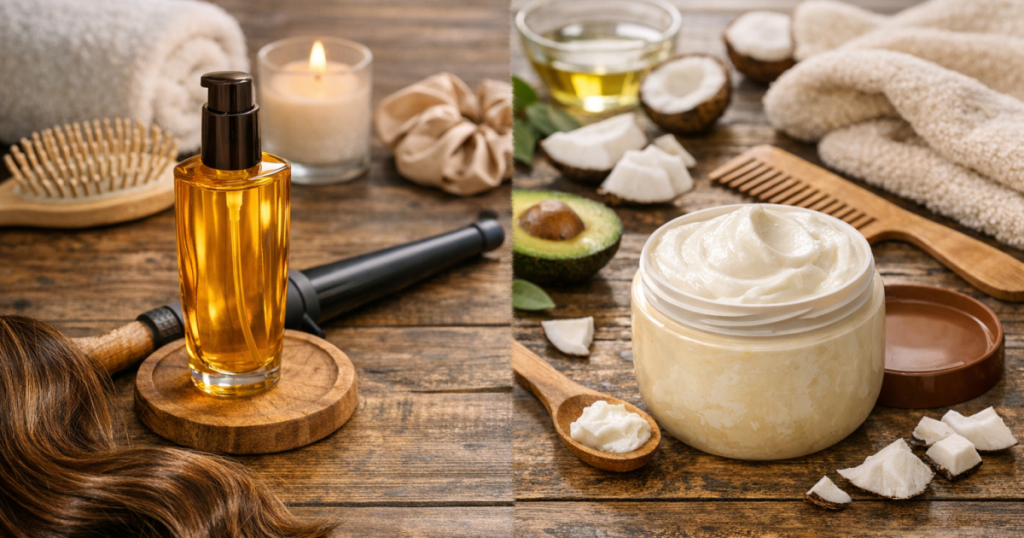
Choosing between a leave-in oil and a rinse-out mask is not really about which one sounds more nourishing; it is about timing, texture and the finish you want after styling. L’Oreal Elvive Extraordinary Oil vs Garnier Ultimate Blends Hair Mask is a useful comparison because one is a finishing and softening step, while the other is a deeper conditioning step you rinse away before styling begins.
If your ends look fluffy after blow-drying, straightening or heatless curls, the oil is the more immediate fix. If your hair feels rough, thirsty or difficult to detangle before you style it, the mask is usually the better wash-day choice.
The big picture
L’Oreal Paris Elvive Extraordinary Oil is a lightweight hair oil used in small amounts on damp or dry hair, mainly through the mid-lengths and ends. It is best judged as a smoothing, shine-boosting and finishing product rather than a full repair treatment. It can make hair feel softer and look more polished, but using too much can weigh down fine hair or make roots look greasy.
Garnier Ultimate Blends Hair Food Banana 3-in-1 Dry Hair Mask is one recognisable example from the wider Garnier Ultimate Blends mask family. These masks are typically used on wash day to soften, condition and improve slip before styling. Some pots in the range are labelled as multi-use, so check the exact variant and instructions before treating every Garnier mask in the same way.
The simplest distinction is this: L’Oreal Elvive Extraordinary Oil helps with the look and feel of hair after or around styling; Garnier Ultimate Blends Hair Mask helps prepare the hair so styling is easier in the first place.
Best choice by hair goal
- For instant shine: choose the L’Oreal oil, applied sparingly to the ends after styling.
- For dry, tangly hair: choose the Garnier mask on wash day, then style once the hair has been rinsed and dried as normal.
- For fine hair: the oil is useful only in tiny amounts; the mask may suit better if you rinse thoroughly and avoid the roots.
- For thick hair: the mask gives more overall softness, while the oil is handy for finishing bulky ends.
- For curls and waves: the mask can improve slip and softness; the oil can reduce a dry-looking cast on ends, but it may disturb definition if overused.
- For heatless styling: the mask supports a smoother base, while the oil is better for adding polish once the curls or waves are set.
Side-by-side comparison
- Product type: L’Oreal Elvive Extraordinary Oil is a leave-in oil. Garnier Ultimate Blends Hair Mask is primarily a conditioning mask, with exact usage depending on the variant.
- When you use it: the oil works before, during or after styling depending on your routine and the label directions. The mask is usually a wash-day step before final styling.
- Main benefit: the oil gives shine, softness and a more dressed finish. The mask gives conditioning, detangling help and a softer base.
- Best area of the hair: both are usually safest through mid-lengths and ends. Roots are the risky area for flatness, especially on fine or low-density hair.
- Risk if overused: the oil can look greasy or separate the hair. The mask can leave hair limp if too much residue remains or if it is too rich for your hair type.
- Styling compatibility: the oil is useful for smoothing finished straight styles, waves and ponytails. The mask is better before blow-drying, diffusing, roller sets or heatless curls because it improves manageability.
What L’Oreal Elvive Extraordinary Oil does well
The L’Oreal oil is strongest when hair is already styled but needs a more expensive-looking finish. A small amount through the ends can reduce the appearance of frizz, add slip to dry tips and make a straightened or blow-dried style look more polished. It is also useful on second-day hair when the ends look dull but the roots are still fresh.
It suits medium, thick, coarse or colour-treated hair particularly well because those hair types often need extra softness at the ends. On long hair, it can make a brushed-out wave or heatless curl pattern look less fluffy. On short hair, it needs a much lighter touch because there is less length between the product and the scalp.
The main drawback is dosage. Oils are easy to overapply, and a little too much can undo volume quickly. If your aim is height at the crown, keep the oil away from the first few centimetres of hair and apply it after you have created your shape. For more guidance on matching product finish to styling tools, the comparison on choosing tools by polished, textured or natural finish is a useful next step.
What Garnier Ultimate Blends Hair Mask does well
The Garnier mask is better when the problem starts before styling: roughness after shampooing, tangles that make brushing harder, or ends that dry into a puffy shape. A mask gives hair more conditioning time than a quick rinse-through conditioner, which can make styling feel easier and reduce the temptation to keep passing a hot tool over the same section.
It is the more sensible choice for hair that feels dry rather than simply looks dull. If your hair catches on a brush, frizzes as it dries or loses shape because the ends are dehydrated, a mask can give a better foundation. Curly, wavy and thick hair often benefits from this kind of wash-day softness, although the exact result depends on the variant and how thoroughly it is rinsed.
The trade-off is that masks are not always ideal right before a volume-heavy style. If your hair is fine, silky or easily flattened, a rich mask can make roots collapse faster, even if you only apply it to the lengths. Use less than you think, keep it away from the scalp, and rinse carefully. If root lift is your biggest struggle, the advice on fine hair styling tools, volume and damage control will help you balance conditioning with hold.
Hair-type guidance
Fine or low-density hair
Fine hair can use either product, but it needs restraint. The oil should be applied as a tiny amount to the ends only, ideally after styling rather than before. Rub it well between your palms first so you do not deposit one heavy patch. The Garnier mask can work when hair is dry or knotty, but it should be used less often than on thick hair and rinsed thoroughly.
If your hair goes flat easily, the mask is better reserved for days when you are wearing a smoother style rather than chasing maximum lift. The oil is better for a final touch on ends, not for all-over softness.
Medium, thick or coarse hair
Thicker hair has more room for both products. The Garnier mask can soften the bulk of the hair before styling, while the L’Oreal oil can tidy the surface afterwards. This pairing makes sense if your style looks good when first dried but expands or loses smoothness through the day.
For thick hair, the mask is the better first purchase if your hair feels dry after washing. The oil is the better first purchase if your hair already feels conditioned but lacks shine once styled.
Curly and wavy hair
For curls and waves, the mask helps most with slip and softness. That matters before detangling, diffusing or setting heatless curls, because rough ends can make the finished pattern look uneven. The oil is useful once the style is dry, but it should be applied carefully so it does not break up clumps too much.
If you sleep in a curling rod or soft rollers, avoid loading the hair with oil beforehand, as it can make some hair types drop faster. A better approach is to condition well on wash day, set the hair when it has the right level of dryness for your method, then use a trace of oil only on the ends after removing the curlers. For root-friendly overnight styling, see how to sleep in heatless curlers without flattening roots.
Bleached, highlighted or heat-styled hair
Hair that is regularly lightened or heat-styled often needs both conditioning and cosmetic smoothing. The Garnier mask can make wash day gentler by improving slip, which may reduce tugging during detangling. The L’Oreal oil can then help the ends look less dry after straightening, curling or blow-drying.
Neither product should be treated as a substitute for careful heat habits. If you use straighteners, curling wands or hot brushes, keep passes controlled, avoid repeatedly styling the same section, and use any heat-protection product according to its own label.
Which works better before styling tools?
Before a hot brush, straightener, curling wand or diffuser, the Garnier mask is usually more useful as part of the previous wash. It helps create smoother, more manageable hair before you start. The oil can be helpful too, but it is more product-sensitive: too much before heat styling can make fine hair collapse or make the finish look separated.
For sleek straight styles, use the mask when hair feels rough, then add a small amount of oil only after the style is complete. For bouncy blow-dries, be cautious with both: over-conditioning can reduce hold, and oil can soften the shape. For heatless curls, the mask is a better base product, while oil is a finishing touch.
Texture, finish and day-to-day practicality
The oil wins for speed. It takes seconds, fits into a morning routine and can rescue ends that look dry after brushing. It is also easier to control on non-wash days because you can decide exactly where it goes.
The mask wins for deeper preparation. It takes more time because it belongs in the wash routine, but it addresses the feel of the hair more comprehensively. If your hair is consistently difficult to style, that preparation often matters more than a glossy finish at the end.
There is also a difference in commitment. With the oil, a mistake is visible quickly but can sometimes be brushed out or absorbed through the day. With a mask, using too much or choosing a variant that is too rich may affect the whole style until your next wash.
Buying and usage checks before you choose
- Check the exact Garnier variant: Ultimate Blends includes different masks, and Hair Food pots are not all aimed at the same hair concern.
- Read the use instructions: some masks are rinse-out only, while some multi-use pots give more than one application method.
- Consider fragrance: both ranges can be noticeably scented, so smell matters if you are sensitive to strong hair products.
- Match product to your styling goal: shine and polish point towards the oil; softness and detangling point towards the mask.
- Start with less: both products perform better when built up gradually, especially on fine, short or freshly washed hair.
Main lessons
Choose L’Oreal Elvive Extraordinary Oil if your hair is generally in decent condition but needs shine, smoother ends and a more polished finish after styling. It is the better option for quick touch-ups, sleek looks, brushed-out waves and second-day dryness at the ends.
Choose Garnier Ultimate Blends Hair Mask if your hair feels dry, rough, knotty or hard to style from the start. It is the better wash-day product for improving softness and manageability, especially on thick, wavy, curly or processed hair.
If you are torn between the two, decide where the problem appears. If the issue is visible after styling, start with the oil. If the issue appears as soon as you wash, detangle or dry your hair, start with the mask. Many routines can use both, but not in heavy amounts: mask on wash day, oil as a small finishing step on the ends.
Quick Buying Links
L'Oreal Elvive Extraordinary Oil
L'Oreal Elvive Extraordinary Oil vs Garnier Ultimate Blends Hair Mask is a useful comparison because one is a finishing and softening step, while the other is a deeper conditioning step you rinse away before styling begins.
Garnier Ultimate Blends Hair Mask
L'Oreal Elvive Extraordinary Oil vs Garnier Ultimate Blends Hair Mask is a useful comparison because one is a finishing and softening step, while the other is a deeper conditioning step you rinse away before styling begins.
FAQ
Can I use L’Oreal Elvive Extraordinary Oil and Garnier Ultimate Blends Hair Mask together?
Yes. Use the mask during your wash routine, rinse as directed, then use a very small amount of oil on dry or nearly dry ends after styling. Avoid layering both heavily on fine hair.
Which is better for frizz?
For surface frizz after styling, the oil is usually more effective. For frizz caused by dryness, tangles or rough ends, the mask may help more because it improves the hair before styling.
Will the Garnier mask make fine hair greasy?
It can make fine hair feel heavy if used too generously or too close to the scalp. Apply mainly to lengths and ends, choose the variant carefully, and rinse thoroughly.
Is the L’Oreal oil a heat protectant?
Do not assume it replaces a dedicated heat protectant. Check the current product label for approved uses, and use a separate heat-protection spray if your styling routine needs one.
Which should I pack for a weekend away?
The oil is usually more practical because it is quick and works on dry ends. Pack the mask only if you know you will wash your hair and need extra conditioning before styling.