Thick hair asks more from a multi-styler than a glossy demo usually shows. The Dyson Airwrap vs Shark FlexStyle decision mainly comes down to airflow control, barrel behaviour, drying patience and how much smoothing you need before you even start curling.
Both tools can style dense hair well, but neither is magic. If your hair holds water for ages, swells in humidity, or needs section-by-section tension to look polished, the better choice is the one that fits your real routine: rough-dry, smooth, curl, cool, then leave the house without having to redo everything with straighteners.
What to know first
For thick hair, the Shark FlexStyle is usually the stronger value pick if you want one tool to dry, brush-smooth and add shape without paying Dyson-level prices. The Dyson Airwrap is the more refined option if you prioritise controlled airflow, a smoother finish, a lighter-feeling styling experience and less tugging on long or frizz-prone hair.
The important distinction is that thick hair is not one hair type. A lot depends on whether your hair is high-density but fine, coarse and wavy, porous and frizz-prone, or curly with a strong natural pattern. A dense head of fine hair may need volume without collapse; coarse thick hair usually needs tension and smoothing first; thick curls need a tool that does not blast the curl pattern into fluff.
If you are still narrowing down tool categories rather than choosing between these two, the goal and hair-type styling guide is a useful next step before committing to a premium multi-styler.
At a glance: the thick-hair comparison
Dyson Airwrap
- Best suited to thick hair that needs a smoother, more controlled finish rather than maximum blasting power.
- Strongest when hair is pre-dried properly and worked in neat sections.
- Often more comfortable for long styling sessions because the airflow feels refined and the attachments are designed for controlled shaping.
- Better for people who want soft bends, bouncy layers, face-framing movement and polished ends.
- Less ideal if you expect wet-to-finished styling on very dense hair in a hurry.
Shark FlexStyle
- Best suited to thick hair where speed, versatility and value are priorities.
- Useful if you want a dryer-style tool plus brush and curling attachments in one kit.
- Can be excellent for root drying, volume and smoothing before you curl or flick the ends.
- More dependent on technique if your hair is coarse, frizz-prone or resistant to holding a curl.
- Attachment bundles vary, so check the exact UK set before buying.
In short: the Dyson Airwrap i.d. multi-styler and dryer feels more premium and controlled; the Shark FlexStyle Air Styling & Drying System feels more practical and price-conscious. For thick hair, that trade-off matters more than brand prestige.
Drying thick hair: speed versus control
Drying is where thick hair exposes the biggest difference between a salon-style promise and a normal weekday morning. With either tool, you will get better results if you rough-dry or pre-dry until the hair is damp rather than dripping. For very dense hair, starting too wet usually means tired arms, uneven roots and curls that drop because too much moisture is still inside the section.
The Shark FlexStyle has an obvious advantage if you want a tool that behaves more like a compact hair dryer before it becomes a styler. Its convertible shape makes it useful for rough-drying roots and lengths before switching attachments. That is helpful for thick hair because the drying stage often takes longer than the styling stage.
The Airwrap is not weak, but it rewards patience. Its airflow is designed for styling as much as drying, so it tends to feel more controlled around the face, crown and ends. On thick hair, that can mean less puffiness and better direction, especially if your hair becomes wide or fluffy when blasted too aggressively.
Best drying choice for thick hair: Shark if speed and wet-to-damp practicality matter most; Dyson if you are willing to pre-dry carefully and want a calmer, smoother path into styling.
Smoothing and frizz control
Thick hair often needs smoothing before curling. If you wrap a frizzy, half-dried section around a barrel, the curl may form, but the finish can still look rough. This is where brush attachments, airflow direction and section tension become more important than the curl barrel itself.
The Dyson is generally the more elegant option for a polished blow-dry look. Its smoothing attachments and airflow control are particularly useful on thick hair that has surface frizz, halo frizz or slightly uneven texture through the top layers. It can help coax the cuticle into a neater direction without the clamp pressure of straighteners.
The Shark can also smooth well, especially with the right brush attachment, but it may feel more forceful. That can be a positive if your hair is dense and slow to dry, but less ideal if your top layer frizzes easily. For coarse hair, you may need to work in smaller sections and maintain steady tension rather than expecting one quick pass to do the job.
For thick, wavy hair that you like to wear smooth with a bend at the ends, both can work. Dyson has the edge for a softer, sleeker finish. Shark has the edge if you want to dry and shape without spending premium-tool money.
Curls, waves and staying power
Air-styled curls on thick hair are different from curls made with a traditional wand. They tend to look softer, more blown-out and less clamped. That is beautiful if you like expensive-looking movement, but disappointing if you expect tight ringlets that last for two days without product or pinning.
The Airwrap barrels are known for creating smooth, airy curls and face-framing shape. On thick hair, they work best when each section is not too large, the hair is slightly damp rather than wet, and the curl is cooled before being released or disturbed. If your hair is long and heavy, you may need smaller sections than you think.
The FlexStyle curl attachments can create a very similar type of air-wrapped curl, but the result depends heavily on section size, moisture level and how resistant your hair is. On dense hair, it is tempting to take larger sections to save time; that is usually why the curl drops quickly. Keep sections slim enough for airflow to reach the whole piece.
If curl longevity is your main issue, neither tool should be judged alone. Use a light heat protectant that does not make hair slippery, consider a flexible mousse on damp lengths, and let curls cool completely. Thick hair holds shape better when it is properly dried inside the section, not just hot on the outside.
Attachments and styling workflow
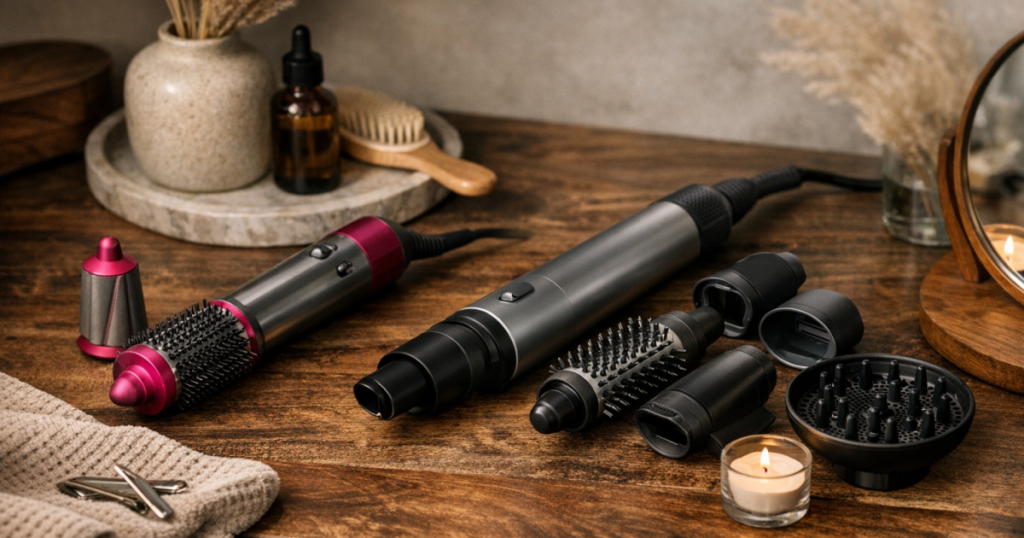
Attachment choice is not just a nice extra for thick hair; it changes the whole routine. A round brush can build root lift and bend. A paddle-style brush can stretch and smooth. Curl barrels create movement. A concentrator or dryer mode helps remove the bulk of moisture before you start trying to polish the shape.
Dyson attachment sets vary by model and retailer, so check the current UK bundle rather than assuming every box includes the same combination. The newer Airwrap range has become more personalised, but the practical question is still simple: will you actually use the smoothing dryer, barrels and brushes in the order your hair needs?
Shark FlexStyle bundles also vary, and this is particularly important for thick hair. Some sets are better for curly or coily hair, some focus on blow-dry brushes, and some are aimed at curling and volume. Before you buy, confirm the exact attachments, because a cheaper bundle is not always better value if it lacks the brush you would use every wash day.
For thick hair, the most useful workflow is usually: rough-dry roots, smooth or stretch the lengths, then curl or shape the final style. Trying to skip straight to barrels from wet hair is the most common reason people feel disappointed with both tools.
Thick hair types: which one suits which texture?
High-density fine hair
If you have lots of hair but each strand is fine, the Dyson often makes more sense. Fine thick hair can collapse under heavy products and look frizzy if airflow is too aggressive. The Airwrap gives a lighter, more controlled finish, though you still need to avoid oversized sections.
Coarse, straight or slightly wavy hair
The Shark is a strong contender here because coarse hair often needs decisive drying and tension before it behaves. Use the dryer mode first, then a brush attachment, then barrels only once the hair is mostly dry. Dyson gives a more polished result, but Shark may feel more efficient if your priority is getting through a lot of hair.
Thick wavy hair with frizz
Dyson has the advantage for smoother, softer waves, particularly around the face and top layer. Shark can still work well, but technique matters: smaller sections, good tension and a cool finish help prevent the blown-out shape from expanding.
Curly or coily thick hair
Neither tool replaces a dedicated textured-hair routine. If you want to stretch curls, smooth roots or create a blowout before styling, the attachment set becomes crucial. Look closely at the brush options, comb-style attachments where available, and whether the tool suits your preferred level of stretch. If preserving curl definition is the goal, a diffuser routine or heatless method may be a better match than air-wrapped barrels.
Handling, weight and real-life usability
Thick hair takes time, so ergonomics matter. A tool that feels fine for a five-minute fringe refresh can become annoying during a full wash-day blowout. Think about how long your hair takes to section, dry and shape, not just how the tool looks in a short video.
The Dyson feels refined and balanced, which helps when you are working around the back of the head. The attachments are easy to understand once you know your sequence, and the airflow does not feel as chaotic as some dryer-brush tools. For people with long thick hair, that controlled feel can make the routine less tiring.
The Shark is versatile, but the experience depends on which mode and attachment you are using. Its rotating design is clever because it can act more like a dryer at the start and a styler afterwards. That makes it practical for dense hair, though some users may prefer the Dyson’s more polished attachment feel.
Do not overlook sectioning. For thick hair, strong clips can make more difference than an extra attachment you rarely use. If your clips slide out while you style, our Scunci No-Slip Grip Hair Clips review is worth reading before blaming the styler for uneven results.
Cost, value and what to verify before buying
The Dyson Airwrap sits firmly in the premium bracket in the UK, while the Shark FlexStyle is usually positioned as the more affordable alternative. Exact prices change by retailer, bundle, colourway and promotion, so it is better to compare the live UK price against the attachments you will genuinely use.
Value is not only about the cheapest checkout total. If the Dyson saves you from needing a separate smoothing tool, dryer brush or curling wand, it may justify the spend for some thick-hair routines. If you mainly need a capable dryer-styler that can handle volume, roots and occasional curls, the Shark may be the smarter buy.
Before purchasing either, verify the attachment bundle, warranty terms, returns policy, plug type for UK use and whether replacement attachments are available. If you buy through editorial links, it is also sensible to understand how recommendations are funded; the site’s affiliate disclosure explains this clearly.
Where the Dyson Airwrap vs Shark FlexStyle choice gets trickier
The difficult middle ground is thick hair that is both long and frizz-prone. Long hair adds weight, so curls drop faster. Frizz-prone hair needs smoothing before shaping. Dense hair needs time for airflow to penetrate. That combination can make any air styler feel slower than expected.
Choose Dyson if your frustration is finish: puffiness, fuzzy ends, uneven face-framing pieces or styles that look almost right but not polished. Its biggest strength is control. It is not the fastest answer for every thick-haired person, but it is the one more likely to give a soft salon-style finish when used patiently.
Choose Shark if your frustration is time and budget: taking ages to get from wet to dry, wanting fewer separate tools, or needing one flexible system for smoothing, volume and curls. It offers a lot of function for the money, and for many thick-hair routines, that matters more than the final few degrees of polish.
Straight answers
Will either tool fully replace straighteners on thick hair?
Not always. If you want glass-straight, high-tension sleekness on coarse thick hair, straighteners may still give a flatter result. These tools are better for blow-dry smoothness, movement, volume and soft curls rather than pin-straight styling.
Do air-wrapped curls last on thick hair?
They can, but preparation matters. Hair should be damp rather than wet, sections should be small enough for airflow to reach, and each curl should cool before brushing out. Very long, heavy hair may need styling product or pinning while it cools.
Is Shark automatically better because it is cheaper?
No. It may be better value, but not automatically better for your hair. If you care most about a refined finish, smooth top layers and controlled styling, Dyson may still be the better fit. If you care most about versatility for less money, Shark is hard to ignore.
The practical recommendation for thick hair
For most thick-haired shoppers, Shark FlexStyle is the more sensible first choice if budget, drying speed and attachment versatility are your priorities. It handles the practical reality of dense hair well: you can dry roots, smooth lengths, build volume and add curls without buying a separate premium system.
Dyson Airwrap is the better upgrade if you already know you like air styling and want a softer, more polished finish. It is particularly appealing for thick hair that becomes fluffy with aggressive airflow, for long layered cuts that need controlled shaping, and for people who will actually take the time to section properly.
If your hair is very dense, coarse or curl-resistant, be realistic with both. Neither tool removes the need for sectioning, pre-drying and cooling. The best result usually comes from treating the styler as part of a routine, not a shortcut around one.
Bottom line: choose Shark for value and practical power; choose Dyson for control and finish. For thick hair, the winner is not the tool with the biggest name, but the one that matches how much hair you have, how much smoothing you need, and how much time you are willing to spend on each wash day.
Quick Buying Links
Dyson Airwrap
The Dyson Airwrap vs Shark FlexStyle decision mainly comes down to airflow control, barrel behaviour, drying patience and how much smoothing you need before you even start curling.Both tools can style dense hair well, but neither is magic.
Shark FlexStyle: Best for Thick Hair?
Worth considering if its strengths better match your needs.