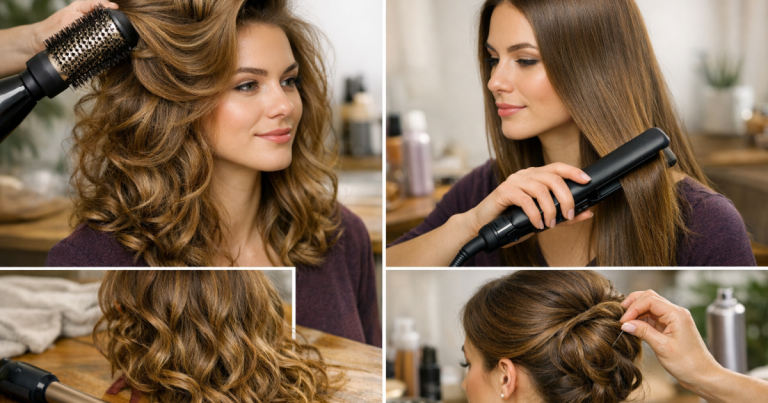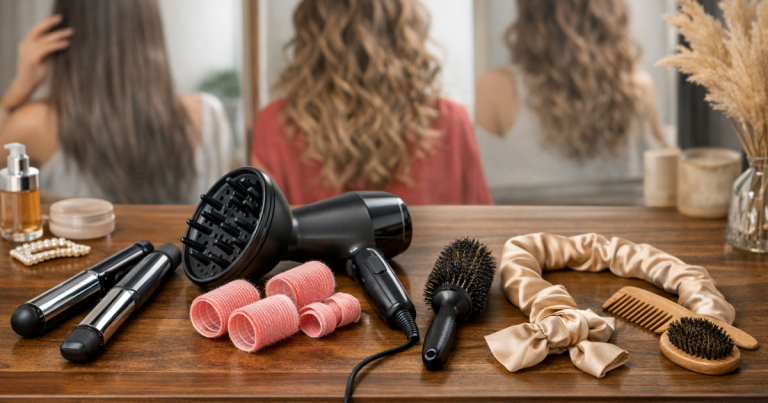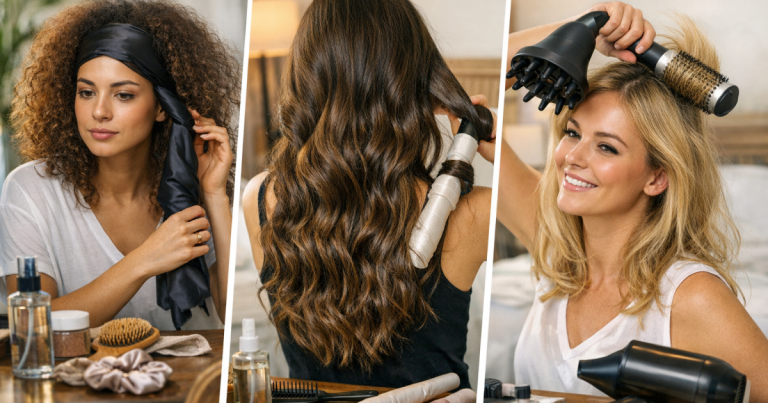
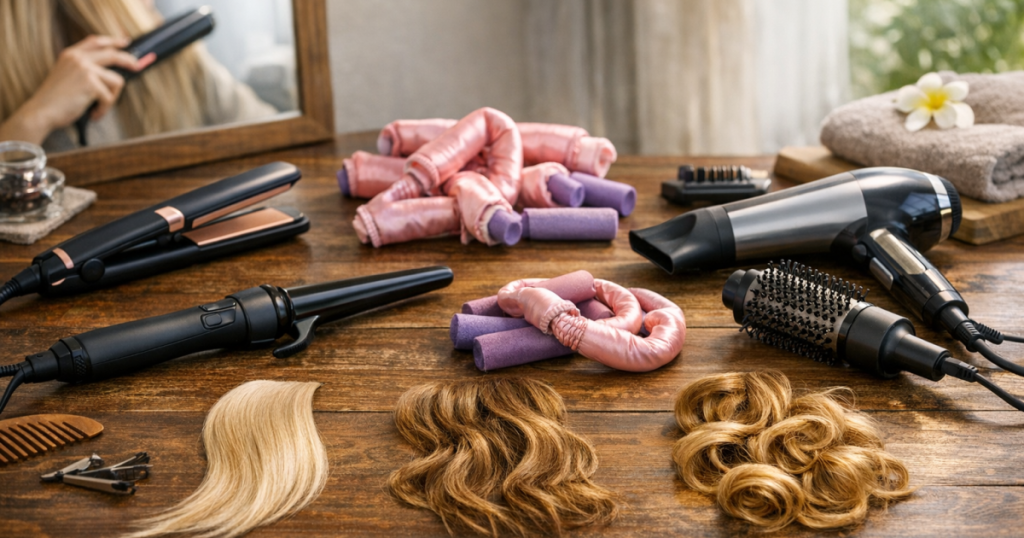
Choosing between straighteners, curlers, rollers and dryers is easier when you start with the finish you want, not the tool that looks most impressive. The right hair styling tools should reduce effort, suit your texture and leave your hair looking intentional rather than overworked. A sleek bob, soft bend, bouncy root lift and defined wave all need different levels of tension, airflow, heat and time.
The simplest way to decide is to ask what your hair struggles with most: shape, smoothness, volume, drying time, frizz or hold. Once you know that, the tool category becomes much clearer.
What to know first
- Straighteners are best for sleekness, polish, sharp bends and controlled finishing on hair that needs tension.
- Curlers and wands are best for deliberate curls, waves and shape that starts from the mid-lengths or ends.
- Rollers are best for root lift, bounce, soft curves and a more heatless or lower-heat routine.
- Dryers are best when your main challenge is drying time, frizz control, volume at the roots or setting the foundation of your style.
- Brushes and combs matter too, because detangling and tension affect the final result before any hot tool touches your hair.
If you are not fully sure whether your hair is fine, coarse, curly, wavy, low density or high density, start with identifying your hair type before choosing styling tools. It prevents the common mistake of buying for someone else’s texture rather than your own.
Straighteners: best for smoothness, precision and control
Straighteners make the most sense when your goal is a polished finish with controlled direction. They are useful for smoothing fluffy ends, refining a fringe, straightening a bob, bending face-framing pieces or creating a modern soft wave with a flatter, less ringlet-like shape.
They work by combining heat with firm tension, so they suit hair that responds well to being pulled smooth. Fine hair can use them for a quick finish, but it usually needs a light hand and minimal passes. Thick, coarse or naturally textured hair may need more sectioning and careful prep to avoid a rushed, uneven result.
A premium straightener such as the ghd Platinum+ Styler is a familiar example of the category, but the real decision is not only brand-led. Check the plate width, edge shape, temperature approach, grip, weight and how easily it glides through your hair. Narrower plates can feel better for fringes, short hair and waves, while wider plates may be more efficient on long or dense hair.
Choose straighteners if you want:
- A sleek, smooth or glassy finish.
- More control over frizz-prone ends.
- Sharp styling around shorter layers or face-framing pieces.
- A tool that can also create bends or loose waves with practice.
Think twice if:
- Your main goal is root volume, because straighteners can flatten the crown.
- Your hair is very fragile or already heat-stressed.
- You prefer soft, airy movement rather than a polished finish.
Curlers and wands: best for defined shape and repeatable waves
Curlers, tongs and wands are designed for shape. They are a better fit than straighteners when you want a consistent curl pattern, more visible bend or waves that look intentionally styled rather than just smoothed.
The key difference is the type of curl. A clamp tong can create a more uniform, dressed curl, while a wand often gives a softer, more relaxed result because the ends can be left looser. Larger barrels usually create waves and movement, while smaller barrels create tighter curls. Always check the actual barrel size and heat options before buying rather than assuming one curler will do every look.
Hair type matters here. Fine hair can lose curl quickly, so it often benefits from light product support, smaller sections and letting curls cool before brushing out. Thick or coarse hair may need more time per section, but too much heat can still make the finish stiff or dry. Naturally curly hair may use a curler only to refine uneven pieces rather than restyle the whole head.
Choose a curler if you want:
- Defined curls, brushed-out waves or a more dressed finish.
- Control over curl direction and placement.
- Shape through the mid-lengths and ends rather than only at the roots.
- A repeatable look for events, layered cuts or longer hair.
Think twice if:
- You mainly want lift at the crown.
- Your hair drops quickly and you dislike using styling product.
- You want a very low-effort morning routine; heatless methods or rollers may be easier to repeat.
Rollers: best for volume, bounce and softer styling
Rollers are underrated because they do not always look dramatic while they are in the hair, but they can make a big difference to shape and movement. Velcro rollers, foam rollers, satin heatless rods and heated rollers all create curve by setting the hair in a rounded position. The finish is usually softer than a wand and less sleek than straighteners.
For fine or flat hair, rollers can be the smartest route to lift because they encourage height without dragging the roots down. Large rollers at the crown can add airy volume; smaller rollers can create more bend through layers. For medium to thick hair, rollers work best when sections are not too bulky, otherwise the inner hair may not set properly.
Heatless rollers and satin curling rods are helpful if you are trying to reduce hot-tool use. They are not a perfect substitute for a tong if you want crisp, controlled curls, but they can create soft waves, bend and morning shape with less daily heat exposure. The trade-off is time: heatless styling usually needs longer setting time and a bit of trial and error with section size.
Choose rollers if you want:
- Root lift, bounce and soft movement.
- A more gentle routine with lower heat or no heat.
- Volume on fine, medium-density or layered hair.
- A blow-dry effect without doing a full round-brush blow-dry every time.
Think twice if:
- You want pin-straight hair.
- You need highly defined spiral curls.
- Your hair is very short and cannot wrap securely around the roller.
Dryers: best for the foundation of the style
A dryer is not just for getting hair from wet to dry. It sets the direction of the roots, controls how much frizz appears before finishing, and decides whether your style starts with lift or flatness. If your hair looks good straight after washing but collapses later, your drying method may be more important than your finishing tool.
A concentrator nozzle, diffuser or smoothing attachment can change the result significantly, so check what is included with the model you are considering. A premium dryer such as the Dyson Supersonic Hair Dryer is one recognisable example, but suitability still depends on your hair length, density, styling patience and preferred finish. For a closer look at how a high-end dryer behaves in a real routine, the site’s premium dryer review is a useful next step.
Fine hair often needs airflow that can lift roots without blasting the lengths into frizz. Thick hair usually needs efficient drying, but also section control so the surface does not become rough. Wavy and curly hair often benefits from diffusing, lower disruption and a product routine that supports definition.
Choose a dryer if you want:
- Faster drying before styling.
- Better root direction and overall shape.
- Frizz control before straightening, curling or rolling.
- Volume from the beginning of the routine, not just at the end.
Think twice if:
- Your hair air-dries well and your main issue is only second-day shape.
- You dislike sectioning or using attachments.
- You already have a dryer that works well and your missing result is curl, bend or hold.
Match the tool to the finish, not the trend
The most reliable way to choose is to name the finish first. “I want my hair to look smooth” points to a different tool from “I want my roots to lift” or “I want my waves to stay visible by evening”. This is where many people end up with the wrong purchase: they buy the tool that creates a beautiful result on someone else, but their own hair needs a different type of support.
For a broader framework, use styling goals for volume, smoothness and hold to separate the result you want from the product category you think you need.
- For sleekness: start with a good dryer technique, then use straighteners only where you need extra polish.
- For waves: use a curler for definition, rollers for softness or a straightener for a flatter, editorial bend.
- For root lift: prioritise a dryer, round brush technique or rollers rather than straighteners.
- For frizz control: improve drying and detangling first, then choose a finishing tool.
- For low-heat styling: try Velcro rollers, satin rods, wrapping methods or overnight setting before defaulting to hot tools.
Hair-type guidance that changes the decision
Fine or low-density hair
Fine hair is usually more affected by weight, heat and tension. Rollers can add lift without pressing the hair flat, while a dryer can help create volume at the roots. Straighteners should be used sparingly because too many passes can make fine hair look limp. Curlers can work well, but smaller sections and cooling time matter if your hair drops quickly.
Thick or high-density hair
Thick hair often needs efficiency and section control. A dryer may be the most important tool because it reduces the work your straightener or curler has to do later. Wider straighteners can be useful for long, dense hair, while curlers need enough time and consistent sectioning to create an even result.
Wavy hair
Wavy hair can go sleek, tousled or defined depending on the routine. A diffuser helps preserve natural movement, rollers add bounce, and a curler can refine uneven sections. Straighteners are useful for polish, but they can erase the natural texture you may actually want to keep.
Curly and coily hair
For curly and coily hair, the starting point is usually definition, moisture feel and shrinkage control rather than simply “straight or curled”. A diffuser can support curl pattern, while a straightener creates a very different finish that needs careful prep and sectioning. Curlers may be used to refine individual pieces, and rollers can stretch or shape depending on size and technique.
When one tool is not enough
Many good at-home routines use two tools rather than one all-purpose answer. A dryer can create the base, rollers can set volume, and a straightener or curler can refine only the visible pieces. This is often healthier-looking than relying on one hot tool to force the whole style into place.
For example, if your hair is frizzy and flat, a straightener alone may smooth the frizz but worsen the flatness. A dryer with root-lifting technique plus a few rollers at the crown may create a better balance. If your curls drop, a curler alone may not solve it unless the hair is fully dry, properly sectioned and allowed to cool before brushing.
If your main concern is the finish rather than the tool itself, matching tools to frizz, shine and definition can help you decide whether the issue is heat, tension, product, drying method or setting time.
Things readers ask
Should I buy a straightener or a dryer first?
Choose a dryer first if your hair takes ages to dry, gets frizzy before styling or lacks root direction. Choose straighteners first if your hair already dries fairly well but needs polish, smoothing or sharper shape at the ends.
Are rollers better than curlers for fine hair?
Often, yes, if the goal is volume and bounce rather than defined curls. Fine hair can collapse under too much heat or product, while rollers can build lift more gently, especially at the crown.
Can one tool do everything?
Some tools are versatile, but no single tool gives the best sleekness, volume, curls, drying and low-heat styling all at once. A simple routine built around your main finish usually works better than chasing an all-in-one promise.
Do I need heat if I want waves?
No. Heat can create faster, more defined waves, but satin rods, braids, buns and rollers can create softer waves with more setting time. The result depends on hair length, texture, dampness and how long the hair is left to set.
Why does my hair look good at first, then drop?
The most common reasons are sections that were too large, hair that was not fully dry, not enough cooling or setting time, heavy product, or choosing a tool that creates the wrong type of shape for your texture.
Key takeaways
Choose straighteners for smoothness and precision, curlers for deliberate shape, rollers for volume and softer movement, and dryers for the foundation of almost every at-home style. Your hair type should decide the balance: fine hair often needs lift and gentleness, thick hair needs section control, wavy hair needs definition without disruption, and curly or coily hair needs a routine that respects natural pattern and finish.
The best choice is not the most powerful-looking tool or the one trending on social media. It is the tool that solves the problem you see in the mirror most often: flat roots, frizzy lengths, undefined waves, slow drying, limp curls or a finish that does not last.