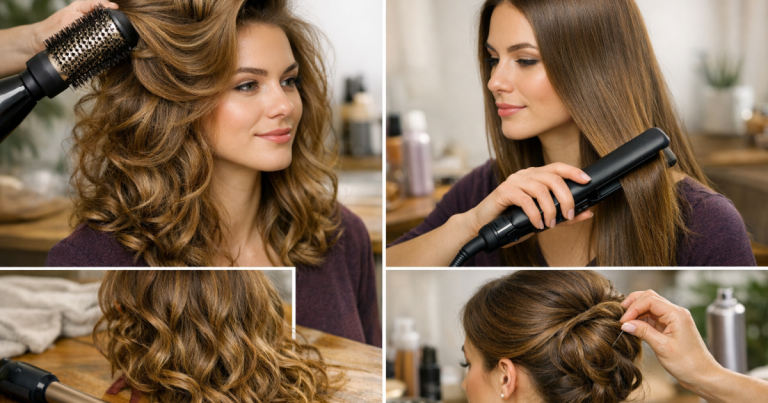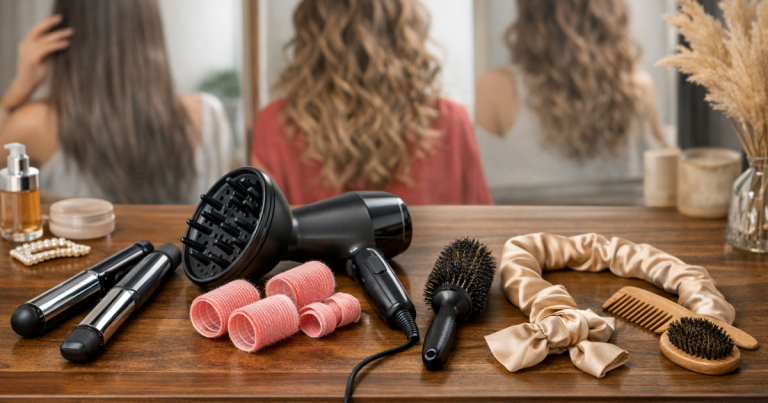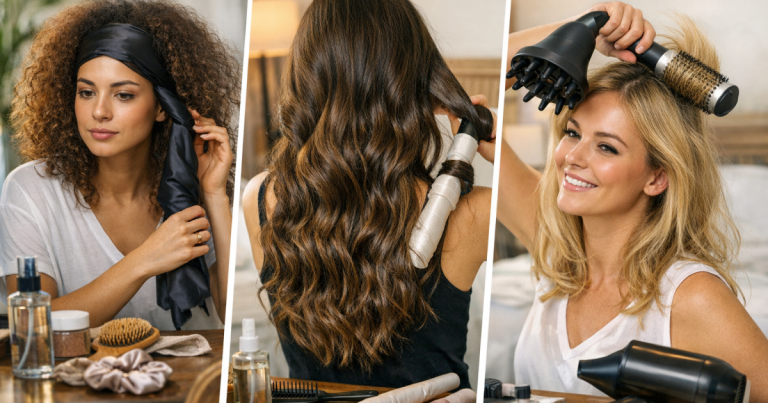
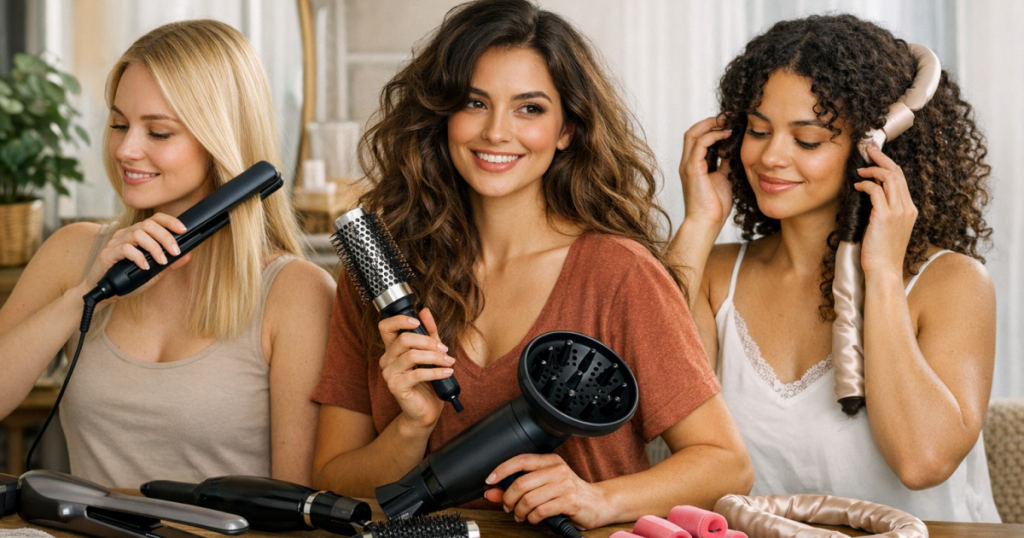
Choosing the right tool is much easier when you match styling goals and hair type before you start. Fine hair that collapses by lunchtime, curls that shrink after drying and thick hair that refuses to bend all need different levels of grip, tension and drying support. The aim is not to force your hair into a trend, but to choose the route that gives the finish you want with the least friction.
What to know first
- Volume usually needs lift at the root, light tension and tools that do not overload the hair.
- Waves need either moulding time, controlled heat or overnight setting, depending on how easily your hair holds shape.
- Sleekness needs smoothing, section control and enough tension to align the cuticle without flattening hair you wanted to keep full.
- Hold depends on texture, porosity, humidity, product weight and whether the hair has been set while warm, damp or dry.
The most useful starting point is your hair’s behaviour, not its label alone. Straight, wavy, curly and coily hair can each be fine, medium or coarse; low, medium or high density; and healthy, colour-treated or heat-weakened. For a deeper breakdown of why some hair slips, stretches, shrinks or holds shape better than others, read how hair type affects slip, stretch, shrinkage and hold.
Start with the finish you want, then adjust for texture
A styling goal sounds simple until hair type gets involved. A smooth blow-dry on low-density fine hair can turn limp if the brush is too large or the product too rich. The same goal on thick, coarse hair may need smaller sections, more drying time and a smoothing layer before the brush even touches the hair.
Think of each goal as a combination of shape, root behaviour and surface finish. Volume is not just height; it is lift that survives movement. Waves are not just bends; they need a pattern that does not drop out or puff up. Sleekness is not just straightness; it is a smoother surface with controlled ends and fewer flyaways.
If you regularly want more than one finish, choose the order carefully. Root volume before waves gives a softer, lifted finish, while smoothing before waves can make bends look polished but less airy. If you often feel torn between bounce, bends and a glassier finish, it helps to decide whether volume, waves or sleekness comes first before choosing the tool.
Fine or low-density hair: prioritise lift without drag
Fine hair is easily overwhelmed by heavy tension, large tools and rich styling products. The main challenge is usually keeping root lift while avoiding fluffy ends or a visible kink where a tool has clamped too firmly.
For volume, lightweight root lifting works better than aggressive backcombing. Velcro rollers can help if the hair is fully dry or almost dry, but sections should not be too wide or the root will not lift properly. A hot air brush can create soft bounce, but it should be used with moderate tension rather than pulling the hair flat from root to tip.
For waves, fine hair often responds well to heatless methods because the hair can set into shape without being compressed. A satin curling rod or soft overnight curler is usually better than heavy foam rollers if your hair dents easily. For a recognisable example, Kitsch Satin Heatless Curling Set is the type of soft heatless tool many readers compare with more structured curlers, though the right choice depends on hair length, layer placement and how securely your hair stays wrapped overnight.
For sleekness, fine hair needs control rather than force. A paddle brush, detangling brush or straightener can work, but the section size matters. Very large sections can leave uneven texture underneath, while repeated passes can make the hair look flat and tired. Focus on smoothing the surface and ends rather than pressing every strand completely flat.
Thick or high-density hair: sectioning matters more than tool size
Thick hair can look as though it needs the biggest tool available, but oversized tools often skim the surface and leave the underneath unfinished. The real difference comes from sectioning. Smaller, cleaner sections allow brushes, rollers and heatless curlers to shape the hair more evenly.
For volume, thick hair often needs root direction. Lifting hair upwards while drying, setting crown sections in rollers or clipping the roots while they cool can create a more believable lift than trying to puff up the whole head. If the hair is heavy, volume placed only at the crown may look more refined than volume through every layer.
For waves, dense hair usually needs either longer setting time or stronger section control. Heatless curling rods can work well, but too much hair wrapped around one rod may create a loose outer bend and an unfinished centre. Multiple rods, plaits or smaller twisted sections can produce a more even result.
For sleekness, thick hair benefits from tools that can maintain consistent contact with the hair. A straightener such as ghd Original Hair Straightener is a familiar example of the straightener category, but the technique matters as much as the tool: detangle first, work in narrow sections and use a comb or brush to guide the hair smoothly before each pass. Readers should also check the tool’s suitability for their hair thickness, texture and usual styling routine rather than assuming one straightener suits every head of hair.
Wavy hair: decide whether you want definition or polish
Wavy hair can sit in an awkward middle ground. It may lose shape if brushed too much, but it can also look uneven if left entirely alone. The best tool depends on whether your goal is natural definition, softer waves or a smoother blow-dry.
For defined waves, avoid tools that stretch the pattern too much while the hair is damp. A wide-tooth comb, gentle detangling brush used before styling, microfibre towel and heatless wave method can help preserve the pattern. Styling cream or mousse should be light enough to avoid dragging the wave down.
For polished waves, you may need a two-step approach: smooth first, then bend. A hot air brush can soften frizz and shape the ends, while a large curling rod or overnight wrap can add movement. If your waves puff up around the mid-lengths, the issue is often uneven drying rather than a lack of styling effort. The technique in using a hot air brush on frizz-prone hair is especially relevant if your finish turns airy instead of smooth.
Curly and coily hair: preserve shape before adding control
Curly and coily hair usually has more natural shape to work with, but it can also have more shrinkage and a greater need for moisture balance. The wrong tool can stretch out definition in one area and leave another area too compact, which makes the final shape feel uneven.
For volume, focus on placement. Root clips, diffusing, gentle picking at the roots and pineapple-style overnight protection can create lift without breaking up curl clumps too early. Volume created by rough brushing is rarely the same as intentional fullness; it often turns into frizz before the style has settled.
For elongated waves or a softer stretched shape, heatless bands, large rods or wrap methods can be useful, but the hair should be prepared carefully. Too much product can prevent the hair from drying fully, while too little can make the set lose definition. If your hair shrinks strongly, allow more drying or setting time than you would for looser textures.
For sleekness, tension and hydration control are key. Detangling should happen gently, usually with conditioner or slip, before any smoothing tool is used. A brush alone will not create a sleek finish if the hair is dry, tangled or unevenly stretched first. The smoother the preparation, the less force the finishing tool needs.
Damaged, bleached or heat-weakened hair: reduce repetition
Hair that feels rough, stretchy, brittle or overly porous can struggle to hold a style evenly. Some sections may grip too quickly, while others go limp. The priority is to reduce repeated passes, avoid harsh tugging and choose methods that set the hair with less mechanical stress.
For volume, avoid heavy teasing if the hair already snaps easily. Soft rollers, root clips and gentle blow-drying can create lift with less friction. For waves, heatless styling is often the kinder route, provided the hair is not wrapped so tightly that it pulls overnight. For sleekness, preparation matters more than pressure: detangle slowly, smooth in small sections and stop once the finish is tidy rather than chasing absolute perfection.
Repair-focused products can support the routine, but they should not be treated as a licence to over-style. A product such as K18 Leave-In Molecular Repair Hair Mask is one recognisable example in the bond-building and repair category; readers should follow the brand’s usage directions and judge results by how their own hair feels over time.
Tool matching by goal
If you want root volume
- Fine hair: try small Velcro rollers, root clips or a light hot air brush technique.
- Thick hair: use smaller sections and set the crown while the roots cool or dry.
- Curly hair: lift at the roots after the curl pattern has formed, not while clumps are still fragile.
- Damaged hair: avoid aggressive backcombing and choose low-tension lift.
If you want waves
- Fine hair: use soft heatless rods or loose overnight wraps that will not dent the hairline.
- Dense hair: divide the hair into more sections so the centre of each wrap sets properly.
- Wavy hair: keep preparation light to avoid flattening the natural pattern.
- Curly or coily hair: stretch or set carefully, allowing enough time for the shape to dry or settle.
If you want sleekness
- Fine hair: smooth the surface without crushing all root lift.
- Thick hair: work in controlled sections so the underneath matches the top layer.
- Frizz-prone hair: dry evenly before finishing, as half-damp areas tend to puff later.
- Textured hair: detangle with slip first so smoothing does not become pulling.
Helpful questions
Can one tool cover volume, waves and sleekness?
Sometimes, but there is usually a compromise. A hot air brush can add lift and polish, while heatless rods can create waves with less heat. Very sleek finishes and strong root volume usually need different techniques.
Why does my hair look good at first but drop quickly?
The most common reasons are sections that were too large, hair that was not fully dry or cooled before release, product that was too heavy, or a tool that did not suit your hair’s density and texture.
Should fine hair avoid heatless curlers?
No, but it needs lighter tension and softer materials. Fine hair can dent or flatten easily, so loose wrapping, smaller sections and a comfortable overnight setup usually work better than bulky rollers.
Is sleek styling always bad for curls?
Not necessarily. Problems usually come from repeated high-tension styling, rough detangling or skipping preparation. Occasional sleek styles can be managed more gently when the hair is moisturised, detangled and styled in controlled sections.
What stands out
The best styling routine starts with the result you want, then adapts to how your hair behaves in real life. Fine hair needs lift without weight, thick hair needs section control, wavy hair needs a choice between definition and polish, and curly or coily hair needs shape preservation before smoothing or stretching. Once you understand that, choosing between rollers, rods, brushes, straighteners and heatless alternatives becomes far less random.