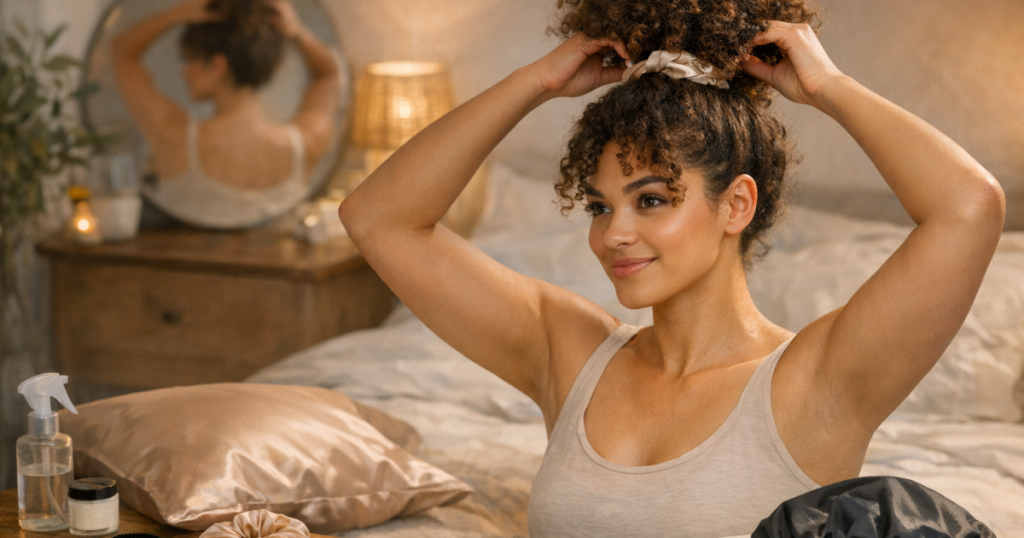
If your curls look good on wash day but wake up squashed, the pineapple curly hair overnight method is usually the simplest fix. It lifts the curl pattern away from your shoulders and pillow so the canopy keeps more air, shape and root height. The trick is not just putting your hair up; it is choosing the right placement, tie tension and cover for your curl type.
In brief
- Use a loose satin or silk scrunchie, not a tight elastic, so the roots are gathered rather than pulled flat.
- Place the ponytail high and slightly forward on the crown, so you are not lying directly on the curls.
- For long, dense or coily hair, split the pineapple into two sections if one big bundle drags the roots down.
- Add a satin scarf, bonnet or silk pillowcase to reduce friction around the hairline and ends.
- In the morning, release the hair first, then let it settle before fluffing or refreshing.
What the pineapple method actually protects
The pineapple method is a loose, high ponytail designed for curly, wavy and coily hair. Instead of compressing the curls between your head and pillow, it moves most of the length to the top of your head. This helps preserve the curl pattern through the mid-lengths and ends while keeping the roots from being rubbed flat overnight.
It is not meant to create new curls, and it will not fix hair that was overloaded with product before bed. Think of it as a preservation technique: it protects the styling work you have already done, whether your routine is wash-and-go, diffused curls, twist-out, braid-out or a heatless set.
The main trade-off is tension. Too loose, and the pineapple slips out. Too tight, and it stretches the front sections, dents the crown and flattens the very volume you were trying to save.
Before bed: set your hair up for less flattening
Start with hair that is fully dry. Even slightly damp curls can dry in the stretched position overnight, leaving the roots limp and the ends uneven. If your wash day ran late, use a diffuser on a low or medium airflow until the roots are dry to the touch, then let the lengths cool before putting your hair up.
If your curls feel dry or frizzy at the ends, smooth a tiny amount of lightweight oil or serum over the outer layer before pineappling. Keep it away from the roots unless your scalp and curl pattern can handle it; oil at the crown can make volume collapse by morning. For more control with oil placement before heat styling or smoothing, the same light-handed principle applies in this guide to using hair oil without greasiness.
Your scrunchie matters more than it seems. A smooth satin or silk option is kinder to curls than a standard hair elastic because it spreads pressure over a wider area. Slip Silk Scrunchies are a recognisable example of the type of soft, low-friction tie that works well for this technique, but the key features to check are softness, stretch and a secure hold without tight wrapping.
Step by step: how to pineapple curls overnight
1. Flip or gather without combing through
Bend forward slightly and let your curls fall towards the top of your head. Use your hands only; do not brush through the curl pattern. If flipping fully forward makes your roots go wild, keep your head upright and gently scoop the lengths upwards instead.
2. Position the base high and forward
A good pineapple sits on the top of the head, not at the back of the crown. Aim for the spot where the hair will not be crushed when you lie on your pillow. For many people, that means slightly forward of the crown, almost where a messy topknot would sit.
3. Secure it loosely
Wrap the scrunchie once if your hair is thick or textured enough to hold. Wrap it twice only if the first loop slips out. The goal is a loose fountain shape, not a tight ponytail. You should be able to slide a finger under the scrunchie without tugging.
4. Let the ends fall naturally
Do not twist the lengths into a bun unless your hair is very long and needs extra containment. A bun can crush the outer curl layer and create bends at the ends. Letting the curls spill forward keeps the shape softer and easier to revive.
5. Add a protective surface
Use a satin scarf, a bonnet or a silk pillowcase to reduce friction. A scarf is good for keeping the hairline neat. A bonnet is often better for dense curls, coils and longer lengths because it contains the ends without pressing them into a knot. Only Curls Satin Sleep Turban is one example of a soft overnight cover; check that any turban or bonnet has enough room for your hair density so it does not squash the pineapple down.
Adjust the method for your curl type
Loose waves and soft curls
Loose waves can stretch easily, so keep the pineapple very relaxed. If a high ponytail pulls the front pieces straight, try a mini pineapple with only the top layers gathered, leaving the underneath loose on a silk pillowcase. In the morning, mist lightly with water or a curl refresher and scrunch upwards rather than raking through.
Classic curly hair with medium density
This hair type usually responds best to the standard single pineapple. The biggest risk is a visible dent where the scrunchie sat. To avoid that, use a larger scrunchie and do not twist it too many times. If the canopy loses bounce, flip your head upside down for a few seconds in the morning and shake at the roots with your fingertips.
Thick, long or heavy curls
If one pineapple pulls backwards, creates root tension or flops heavily to one side, split your hair into two loose pineapples: one high at the front and one behind it. This distributes the weight and stops the front roots being dragged flat. The same principle of sectioning to preserve lift is useful with other heatless methods too, particularly if you are working through heatless curling ribbons on thick hair without flat roots.
Coily and tightly textured hair
Coily hair may prefer a pineapple that is more of a loose gather than a ponytail. Avoid forcing all sections into one tight point if that stretches the perimeter or causes tension at the hairline. A large bonnet over loosely lifted hair can be more protective than a scrunchie-only method, especially for tighter coils, fragile ends or styles you want to preserve for several days.
Mixed-texture curls
If the front is looser, the crown is tighter or one side drops faster than the other, treat each area differently. You might pineapple the top and back, clip a looser fringe section separately, and tuck fragile ends into a bonnet. For broader styling decisions, this guide to tools for mixed-texture hair is a useful next step.
How to stop the pineapple crushing volume
- Keep the base loose: root lift disappears when the scrunchie pulls the hair too tightly upwards.
- Move the pineapple forward: if it sits too far back, you will sleep on the base and flatten the crown.
- Use two pineapples for heavy hair: one oversized bundle can drag down thick or long curls.
- Avoid wet roots: damp roots dry into the shape they are held in, which can mean flat patches by morning.
- Protect the hairline: a scarf can stop shorter face-framing curls from frizzing or sticking out.
- Do not over-refresh before bed: too much water, cream or gel can soften your hold and make curls collapse overnight.
The morning release
Take the scrunchie out before you do anything else. Let your hair fall for a minute or two, because curls often look stretched or oddly positioned straight after release. Resist the urge to fix everything immediately.
Once the hair has settled, lift the roots with your fingertips or a wide-tooth pick. Work from underneath, not over the top of the curl canopy. If the ends need revival, mist your hands rather than spraying the whole head, then scrunch the drier areas. For frizz around the hairline, smooth a pea-sized amount of leave-in or curl cream over your palms and glaze lightly.
If your crown still looks flat, change the method the next night rather than adding more product in the morning. The base may need to sit further forward, the scrunchie may be too tight, or your hair may need two smaller pineapples instead of one.
Common mistakes that make curls look squashed
- Using a normal elastic: it can create dents and roughen the cuticle, especially on fragile curls.
- Sleeping on cotton pillowcases: cotton can increase friction, which encourages frizz and disrupts curl clumps.
- Making a tight topknot: this contains the hair but often crushes curl shape and stretches the roots.
- Pineappling very short layers: if layers keep falling out, use a scarf or bonnet instead of forcing them into the ponytail.
- Ignoring your parting: if you want a centre or side part in the morning, gently place the front section before covering your hair.
When a pineapple is not the best overnight option
The pineapple method is popular because it is quick, but it is not the answer for every curl routine. Very short curls may do better with a satin bonnet alone. Fine waves can lose shape if gathered too tightly. Long curls that tangle easily may need loose sectioning or a heatless styling tool instead of a single high ponytail.
Use your styling goal as the deciding factor. If you mainly want root volume, keep the hair lifted and loose. If you want curl preservation, focus on reducing friction. If you want a more deliberate set, a curling ribbon, roller or wrap may be more consistent. For a broader way to match your method to the result you want, see choosing tools by styling goal.
Common questions
Can you pineapple short curly hair?
Yes, but it may work better as a partial pineapple. Gather only the longer top layers and protect the shorter underneath sections with a satin bonnet or pillowcase.
Should curly hair be wet or dry before pineappling?
Dry is usually better. Damp roots and lengths can stretch while you sleep, then dry into a flatter shape by morning.
Why does my pineapple leave a dent?
The tie is probably too tight, too narrow or wrapped too many times. Switch to a larger satin or silk scrunchie and secure it with less tension.
Is a bonnet better than a pineapple?
For some curl types, yes. Dense, coily, short or fragile hair may keep its shape better in a roomy bonnet, while longer curls often benefit from using both together.
How do I keep volume at the crown overnight?
Place the pineapple high and slightly forward, keep the base loose, and make sure the roots are completely dry before bed. If your hair is heavy, use two loose sections.
Main lessons
To pineapple curly hair without crushing volume, think lift, looseness and low friction. The best version is not the tightest or neatest one; it is the one that keeps your roots relaxed, your ends protected and your curl pattern away from the pillow. Adjust the placement and number of sections to your hair density, then refine the morning refresh so you revive the shape without overloading it.