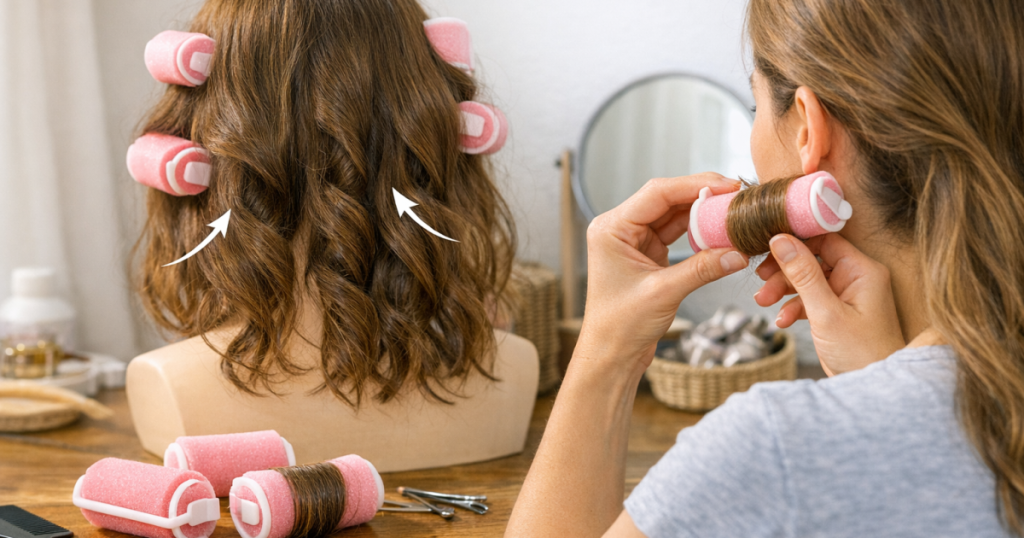
Foam rollers are brilliant for soft heatless curls, but they can leave obvious creases when the hair is wrapped too tightly, the ends are folded, or the clip sits in the wrong place. The easiest way to use foam rollers without dents is to treat them less like a tight curler and more like a setting tool: smooth section, gentle tension, clean wrap, secure lightly.
The goal is not to clamp the hair into shape. It is to let lightly damp or prepped hair dry around the roller with enough control to form a curl, but not so much pressure that the roller, hinge or band stamps a line into the finished style.
The short version
- Start with hair that is dry or only very slightly damp; wet hair is more prone to creasing and uneven drying.
- Use smaller sections than you think, especially around the crown and face.
- Keep the ends flat against the roller before you roll upwards.
- Do not pull hard at the root; gentle tension gives a softer, cleaner set.
- Position the clip, hinge or fastening away from the most visible surface of the curl.
- Let the rollers cool, dry or set fully before removing them.
Why foam rollers leave dents
Dents usually come from pressure points. Foam rollers are soft, but the fastener is not always invisible once the hair has dried around it. If the clip presses into the outside of a curl, or the elastic is stretched across a visible section, the hair can set with a bend rather than a smooth curve.
Section size matters too. A large chunk of hair wrapped around a small roller creates bulk, and bulky hair needs more tension to stay in place. That tension can flatten the top layer and leave a ridge near the root or mid-lengths. Fine hair shows these marks quickly because it compresses easily, while thick hair can dent when the roller is overfilled or slept on heavily.
Hair condition also changes the result. Heat-damaged or porous ends can fold instead of wrapping cleanly, so they create little fish-hook bends at the bottom of the curl. If your ends feel rough or grabby, a smoother wash-and-care routine can make roller sets behave better; for damaged lengths, our L’Oréal Elvive Dream Lengths Shampoo review covers what to consider when your ends need extra slip and softness.
Step 1: prep the hair so it can set smoothly
Foam rollers work best on hair that has some flexibility but is not wet. For most hair types, that means dry hair misted very lightly with water or setting spray, or hair that is around 90–95% dry after washing. If your hair takes a long time to dry, go drier rather than wetter. Sleeping on damp, densely rolled hair is one of the quickest ways to wake up with dents and limp patches.
Brush or comb through each section before rolling. A detangling brush is useful if your hair knots at the ends, while a wide-tooth comb is gentler for curls and waves. If you use styling product, keep it light: too much mousse, gel or heavy cream can make the hair set sharply around every pressure point.
Step 2: choose the right section size
A neat section should be narrower than the roller and thin enough to dry all the way through. As a rough guide, take sections around 2–4 cm wide for shorter layers and around 4–6 cm wide for longer, medium-density hair. Very thick hair usually needs more sections, not more tension.
Fine hair
Use slightly larger rollers and smaller amounts of hair per roller. Fine hair can take a curl quickly, but it also dents easily, so avoid stretching the fastening tightly across the section. If your main aim is lift rather than curl, you may find self-grip rollers easier at the crown; this tutorial on using Velcro rollers for volume on fine hair is a good next step.
Thick or long hair
Use more rollers and keep each section flat. If a section feels like a rope rather than a ribbon, it is too big. Thick hair often dents when the roller is packed too full and then secured tightly to stop it slipping.
Curly or frizz-prone hair
Smooth the section with your fingers or a comb before wrapping, but do not brush out your natural pattern aggressively if that causes frizz. A tiny amount of lightweight serum or leave-in on the ends can help them wrap cleanly, but avoid coating the roots.
Step 3: wrap the ends first, without folding them
The ends decide whether the curl looks polished or crimped. Hold the section out from the head, place the roller under the last few centimetres of hair, and spread the ends flat across the foam. If the ends spring away, use an end paper or a small piece of tissue to hold them smooth while you begin rolling.
Roll slowly for the first turn. This is where most dents begin. If the ends bunch up, stop and redo the wrap rather than hoping it will disappear later. Once the ends are secure, roll upwards with steady, light tension.
Step 4: secure the roller where the mark will not show
Foam rollers often have a plastic clip, bar, hinge or built-in fastener. The fastening should sit underneath the curl or to the side, not pressed across the outermost surface that will be visible when the curl drops. Around the hairline, angle the fastening away from the face.
At the crown, do not squash the roller flat against your scalp. Leave a little softness at the root so the hair is curved rather than sharply bent. If you want volume, roll the section upwards and slightly over-directed before securing gently. If you want a looser bend, roll lower and keep the root relaxed.
Step 5: sleep on them without crushing the shape
If you are wearing foam rollers overnight, comfort and placement matter as much as technique. Avoid placing large rollers directly where your head presses into the pillow. For many people, that means using smaller rollers at the nape, larger rollers through the top, and leaving a small gap around the sides if you sleep on one side.
A silk or satin scarf, bonnet or pillowcase can reduce friction and stop rollers dragging out of position. If root volume is your main struggle, the way you arrange your rollers before bed makes a big difference; our guide to sleeping in heatless curlers without flattening roots has more detail on overnight placement.
Removing foam rollers cleanly
Do not pull the rollers straight down. Unfasten first, then unwind each curl in the same direction it was rolled. If the curl feels stuck, pause and loosen the outer layer with your fingers rather than tugging.
Once all rollers are out, let the curls sit for a few minutes before styling. This helps the shape settle. Then separate with fingers, not a brush, unless you want a brushed-out vintage wave. For softer modern texture, rub a tiny amount of lightweight oil or serum between your palms and skim over the ends only.
Quick troubleshooting checks
- Dent near the root: you rolled too tightly, clipped too close to the scalp, or slept directly on the roller.
- Line through the curl: the fastening sat on the visible side of the hair. Turn it underneath next time.
- Hooked ends: the ends were folded or dry and rough. Smooth them flat before the first turn.
- Flat top, curly ends: the roller started too low or the root section was too heavy.
- Frizz instead of curl: the hair was too wet, under-smoothed, or disturbed before fully set.
- Curls drop quickly: sections were too large, hair was not fully set, or you used too little hold for your hair type.
Questions people ask
Should foam rollers go in wet or dry hair?
Slightly damp or dry hair with a light mist usually works best. Wet hair can take too long to dry inside the roller and is more likely to set with dents.
How tight should foam rollers be?
They should feel secure, not stretched. If the scalp pulls or the foam compresses hard, the roller is too tight and may leave a mark.
Can you fix dents after removing the rollers?
Often, yes. Mist the dent lightly with water, smooth it with your fingers, and reshape the curl around your hand. For stubborn dents, a brief reset with a larger roller can soften the line.
Are foam rollers better than Velcro rollers for avoiding dents?
Foam rollers are better for overnight curls because they are softer. Velcro rollers are often better for daytime root lift, but they can snag if removed roughly.
Why do my ends look crimped after foam rollers?
The ends were probably tucked unevenly or folded during the first wrap. Use smaller sections, smooth the last few centimetres carefully, and consider end papers for layered or damaged ends.
Main lessons
Smooth foam-roller curls come from light control rather than tight wrapping. Keep the hair mostly dry, work in clean sections, wrap the ends flat, and move the fastening away from the visible surface of the curl. Fine hair needs gentle tension and fewer pressure points; thick hair needs more rollers and smaller sections; frizz-prone hair needs extra smoothing before the first turn.
If dents keep appearing in the same place, do not change everything at once. Adjust one thing on your next set: section size, fastening position, dampness level or sleeping placement. That makes it much easier to spot what your hair responds to.