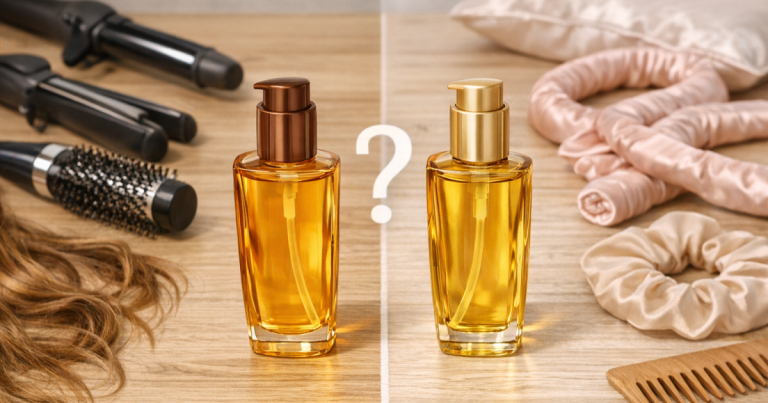
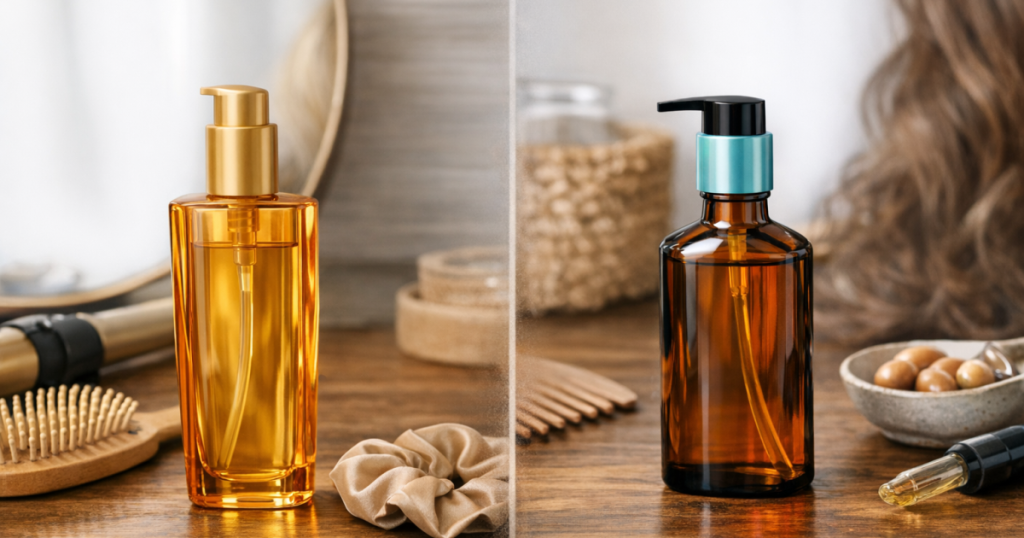
Choosing between two shine oils sounds simple until one leaves fine ends limp and the other disappears into dense lengths. For most UK shoppers, L’Oreal Elvive Extraordinary Oil vs Moroccanoil Treatment Oil comes down to texture, finish, budget and whether you want a lightweight everyday smoother or a richer salon-style treatment.
Both can soften the look of dry ends, add slip and make styled hair look more polished. Neither is a repair treatment in the bond-building sense, and neither replaces a good conditioner or heat protectant. The difference is how they sit on the hair: L’Oreal feels more like an easy, flexible finishing oil for regular use, while Moroccanoil has a more substantial, salon-polished feel that can be brilliant on hair that can handle richness.
In brief
- Choose L’Oreal Elvive Extraordinary Oil if your hair is fine to medium, easily weighed down, or you want a lower-commitment oil for daily smoothing.
- Choose Moroccanoil Treatment Oil if your hair is medium to thick, coarse, colour-treated or regularly blow-dried and you like a glossy, more dressed finish.
- Use either mainly on lengths and ends, not the scalp, unless your hair type and washing routine tolerate oil very well.
- Go slowly with amount: one small pump or a few drops can be plenty on fine hair, while thick or coily hair may need more in sections.
- Check the current UK label before buying if you avoid specific silicones, fragrance, colourants or nut-derived ingredients.
Side-by-side snapshot
- Main product: L’Oreal Paris Elvive Extraordinary Oil is typically the more everyday, accessible-feeling option for smoothing and shine.
- Main product: Moroccanoil Treatment is the more premium-feeling option, known for a richer finish and argan-oil-led positioning.
- Texture feel: L’Oreal tends to suit lighter layering; Moroccanoil tends to feel more substantial, so placement matters more.
- Best styling moment: L’Oreal is easy after washing, before air-drying or as a final frizz smoother; Moroccanoil works especially well before or after a polished blow-dry.
- Risk of heaviness: higher with Moroccanoil on very fine or low-density hair, higher with either oil if applied near the roots.
- Value judgement: L’Oreal makes sense if you use oil casually and often; Moroccanoil makes sense if you notice a visible difference from richer salon-style finishing products.
How they feel in real routines
L’Oreal Elvive Extraordinary Oil
L’Oreal Elvive Extraordinary Oil is the easier product to slot into a low-effort routine. It suits people who want smoother ends after washing, a little more shine before leaving the house, or extra slip when detangling the lower lengths. On long hair, it can be helpful when the ends look older, drier or more porous than the roots.
The main advantage is flexibility. You can use a small amount on damp hair before air-drying, add a touch after styling, or smooth it over a ponytail to reduce flyaways. It is less likely to feel like a big styling commitment, which is useful if you alternate between heatless curls, loose waves, straightened styles and simple updos.
The trade-off is that it may not feel rich enough for very coarse, very dry or high-density hair unless layered with a more moisturising leave-in underneath. If your hair drinks up product quickly, L’Oreal can make the surface look neater without giving the plush, coated feeling some people want from a treatment oil.
Moroccanoil Treatment Oil
Moroccanoil Treatment Oil is better thought of as a styling treatment with a more pronounced finish. It is popular for blow-dried hair because it can make lengths look smoother, shinier and more expensive-looking when used sparingly. On medium, thick, coarse or colour-treated hair, that richer feel can be exactly what stops the ends looking fluffy.
The original version is not always the easiest match for fine hair. If your hair collapses quickly, looks stringy with leave-in products, or needs volume at the crown, apply it only to the last few centimetres first. Moroccanoil also offers Moroccanoil Treatment Light, which many fine or lighter-haired shoppers compare with the original, but you should still judge by your own density and porosity rather than the product name alone.
The fragrance is also part of the experience. Some people love the salon-like scent; others prefer a subtler oil. If scented products tend to linger strongly on your hair, test before committing to a full-size bottle.
Which hair types get the best result?
Fine or low-density hair
L’Oreal is usually the safer starting point because it is easier to use in tiny amounts without making the hair look separated. Apply it to damp ends, comb through, then reassess once dry. Fine hair often needs shine without softness turning into flatness, so avoid layering oil over heavy conditioner, rich masks and smoothing creams in the same routine.
Moroccanoil can still work, but treat it as a finishing product rather than an all-over leave-in. Warm the smallest amount between your palms and skim it over the ends only. If your style needs lift, set the roots first and oil later.
Medium, thick or coarse hair
Moroccanoil has the edge when hair needs more control. It can make thick blow-dries look sleeker and reduce the puffy finish that appears after brushing out waves. L’Oreal still works well for day-to-day shine, but you may need to section thick hair so the oil reaches the under-layers rather than sitting on the top surface.
If your hair is dense and long, product distribution matters as much as the product itself. Compact tools, small brushes and rushed application can leave some areas over-oiled and others dry; the same logic applies when choosing stylers for heavy lengths. For a broader tool match-up, the guide to choosing tools by styling goal is a useful next step.
Curly, coily and mixed-texture hair
Both oils can add shine and reduce surface frizz, but neither should be expected to define curls on its own. Curly and coily hair usually needs water-based moisture, hold and shape first; oil is better as the final seal or shine layer. Moroccanoil may suit thicker curls and stretched styles, while L’Oreal can be easier on looser curls that lose bounce with heavy products.
For mixed-texture hair, apply by zone rather than treating the whole head the same. Drier, coarser sections may need more oil; silkier or lower-density areas may need almost none. If your textures behave differently around the crown, nape and front hairline, the comparison on styling tools for mixed-texture hair pairs well with this kind of product decision.
Bleached, coloured or heat-styled hair
Colour-treated and heat-styled hair often looks duller at the ends, so both oils can improve the finish. Moroccanoil is more likely to give that smooth, glossy blow-dry effect, while L’Oreal is easier for frequent top-ups between washes. If your hair is very porous, apply oil after a leave-in conditioner rather than expecting oil alone to soften roughness.
Before straightening, keep oil placement controlled. Too much product can make the hair look greasy once heat compresses it, and oil is not the same as a heat protectant. For a step-by-step approach, use the guide on using hair oil before straightening without greasiness.
Heatless styling, rollers and overnight curls
For heatless routines, L’Oreal is generally easier because it gives slip without making hair too coated. A little through the ends before a satin curling rod, loose plait or bun can reduce friction and help the finished wave look softer. Use less than you think you need; too much oil can make heatless curls drop faster, especially on fine or straight hair.
Moroccanoil can work beautifully after heatless styling, once the curl pattern is already set. Rub a small amount over your palms, then gently separate waves or curls. This is often better than applying a richer oil before wrapping, because the hair keeps more grip while setting.
Pros and trade-offs
L’Oreal Elvive Extraordinary Oil: strengths
- Easy to use in small amounts on fine to medium hair.
- Works well as a regular shine and smoothing step.
- Useful for long ends, ponytails, air-dried hair and quick restyling.
- Less intimidating if you are new to hair oils.
L’Oreal Elvive Extraordinary Oil: limitations
- May not feel rich enough for very coarse or very dry hair.
- Can still weigh hair down if applied too close to the roots.
- Finish may be more subtle than a premium salon oil.
Moroccanoil Treatment Oil: strengths
- Gives a more polished, glossy finish on hair that can take richness.
- Pairs well with blow-dries, smoothed waves and colour-treated lengths.
- Can make coarse or dense ends look more controlled.
- A small amount can be enough, so careful application matters.
Moroccanoil Treatment Oil: limitations
- Can feel too heavy on very fine, sparse or easily flattened hair.
- The scent may be too noticeable for fragrance-sensitive routines.
- Usually feels like the bigger investment, so it is worth checking whether your hair benefits from the richer finish.
What to remember before you buy
If your hair is fine, soft, straight, lightly wavy or prone to looking greasy, start with L’Oreal Elvive Extraordinary Oil. It is the more forgiving option for everyday smoothing, and it is easier to adjust without ruining volume. It also makes sense if you use oils mainly on wash day, after heatless styling, or to refresh dry-looking ends before tying your hair up.
If your hair is medium to thick, coarse, frizz-prone, colour-treated or often blow-dried, Moroccanoil Treatment Oil is the stronger candidate. It gives a more noticeable polished finish and can make styled hair look smoother for longer, provided you keep it away from the roots and apply in controlled amounts.
The fairest verdict is not that one is universally better. L’Oreal is better for lightness, flexibility and frequent use; Moroccanoil is better for richness, gloss and a salon-style finish. Match the oil to your density, styling method and tolerance for fragrance, then adjust the amount before judging the formula.
Quick Buying Links
L'Oreal Elvive Extraordinary Oil
For most UK shoppers, L'Oreal Elvive Extraordinary Oil vs Moroccanoil Treatment Oil comes down to texture, finish, budget and whether you want a lightweight everyday smoother or a richer salon-style treatment.
Moroccanoil Treatment Oil
For most UK shoppers, L'Oreal Elvive Extraordinary Oil vs Moroccanoil Treatment Oil comes down to texture, finish, budget and whether you want a lightweight everyday smoother or a richer salon-style treatment.
Questions people ask
Can I use these oils on wet and dry hair?
Yes, both can be used on damp or dry hair. Damp application helps with slip and softness; dry application is better for shine, flyaways and finishing. Start with less on dry hair because excess product shows faster.
Which is better for frizz?
Moroccanoil is usually stronger for a polished, controlled finish on thick or coarse frizz-prone hair. L’Oreal is better when frizz is mild or your hair gets weighed down easily.
Do either of them repair damaged hair?
They can make damaged ends look smoother, but they do not rebuild hair in the way a dedicated bond-building or strengthening routine aims to. Use them as cosmetic finishers alongside conditioning care.
Will hair oil make heatless curls fall out?
It can if you use too much before setting the hair. For fine hair, apply oil after removing the curler or rollers. For thicker hair, a tiny amount on the ends before wrapping may help reduce dryness.
Which one should I pack for travel?
Choose the one your hair cannot easily replace. Fine hair may get more use from L’Oreal because it is versatile; thick or blow-dried hair may prefer Moroccanoil because the finish is more distinctive.