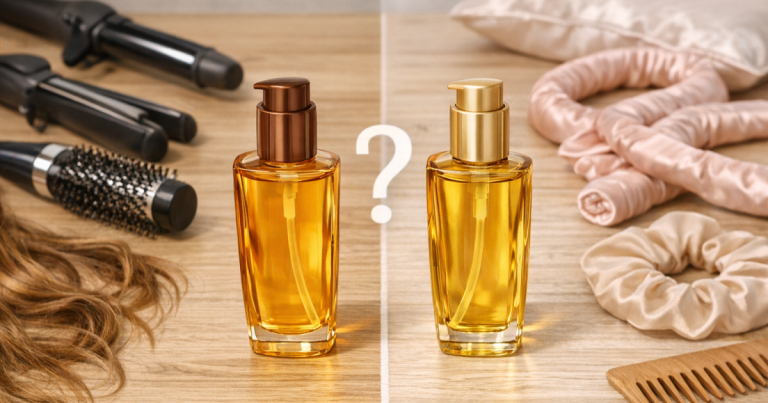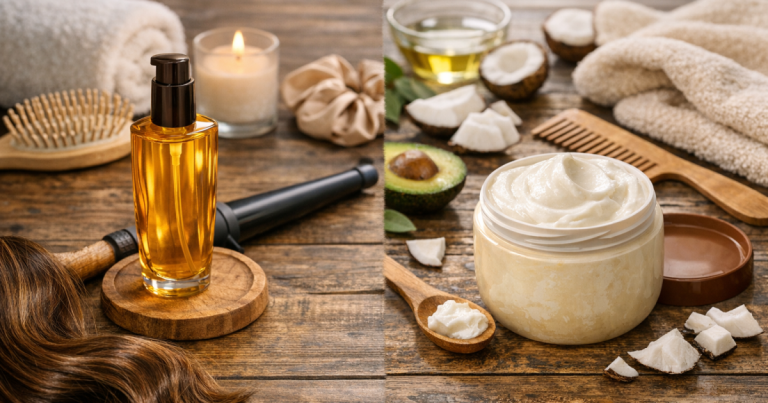
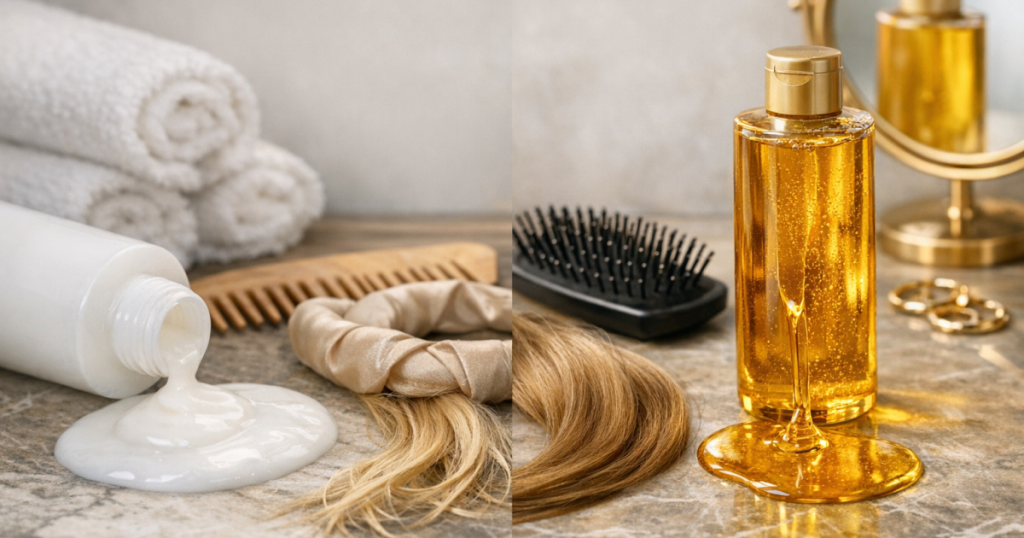
When hair feels rough after styling but also looks flat when you add richer products, the choice is not as simple as shampoo versus oil. Olaplex No.4 vs L’Oreal Elvive Extraordinary Oil is really a question of where your routine needs help: cleansing and bond-care support at wash stage, or instant slip, shine and frizz softening once hair is dry or nearly dry.
Both can be useful in an at-home styling routine, but they solve different problems. One belongs in the shower and affects how your hair behaves from the first cleanse. The other sits at the finishing stage, where it can make heatless curls, smooth blow-dry results or second-day lengths look more polished without changing your wash routine.
The short version
Choose Olaplex No.4 Bond Maintenance Shampoo if your main issue is hair that feels weakened, over-processed, brittle, tangly after washing or hard to style because the lengths lack resilience. It is the more logical first choice when your routine has been built around frequent heat styling, colouring, bleaching or repeated mechanical stress.
Choose L’Oréal Paris Elvive Extraordinary Oil if your hair is fundamentally manageable but needs more gloss, slip and frizz control after styling. It is the more immediate fix for dry-looking ends, fluffy heatless curls, flyaway-prone layers and lengths that look better with a smoother finish.
If your hair needs both repair support and shine, start with the product that addresses the stage where your routine currently falls apart. If hair feels poor straight after washing, start with shampoo. If hair washes well but looks unfinished after styling, start with oil.
Where each product fits in your styling routine
- Product type: Olaplex No.4 is a rinse-out shampoo used during cleansing. L’Oréal Elvive Extraordinary Oil is a leave-in finishing or pre-styling oil used in small amounts on lengths and ends.
- Main job: Olaplex No.4 is aimed at maintaining the feel of compromised hair while cleansing. L’Oréal Elvive Extraordinary Oil is aimed at adding shine, softness and a smoother look.
- Best timing: Olaplex is a wash-day decision. L’Oréal oil is a styling-stage decision and can be adjusted day by day.
- Most noticeable result: Olaplex is more about how hair feels over a routine; the oil is more about how hair looks immediately after application.
- Risk if mismatched: Olaplex may feel unnecessary if your hair is already healthy and simply lacks gloss. Oil can look heavy if used too close to the roots or applied too generously on fine hair.
Best choice by hair concern
For heat-styled, coloured or bleach-lightened hair
Olaplex No.4 is the stronger match if your hair has been through regular straightening, curling tongs, colour services or lightening. A shampoo cannot undo damage in a single wash, and it is worth being realistic about that, but a repair-focused cleanser makes more sense than adding shine oil over hair that still feels rough and fragile after every wash.
If you already use tongs or straighteners less often and are trying to rebuild a gentler routine, the shampoo is the better foundation. It pairs neatly with heatless styling because smoother, more resilient lengths tend to wrap, set and release more predictably. For a deeper single-product assessment, see our Olaplex No.4 Bond Maintenance Shampoo review for heat-styled hair.
For dull, dry-looking ends that need instant polish
L’Oréal Elvive Extraordinary Oil is the more obvious choice when your hair is not snapping or feeling seriously stressed, but the finished style looks a bit matte, fluffy or separated. It can be useful after heatless curls because curls often need a little slip at the ends, especially on layered hair that expands as the day goes on.
The key is dosage. Fine hair may need only a very small amount worked through the ends, while thicker hair can usually tolerate more through the mid-lengths. If you want more detail on finish, feel and heaviness, our L’Oréal Elvive Extraordinary Oil review looks at how it behaves on smoother and drier lengths.
For frizz after heatless curls
If your curls form well but the surface looks fuzzy, the oil usually gives the faster visible improvement. Smooth a small amount between your palms first, then glaze over the outer layer and scrunch lightly into the ends. Avoid dragging fingers through the full curl pattern, as that can loosen the shape you worked to create overnight.
If the frizz starts before you even style, Olaplex No.4 may be the better first step. Hair that feels coarse, swollen or rough after washing often needs a better wash-day base before a finishing oil can look truly polished.
For fine, flat hair
Fine hair needs the most careful decision. Olaplex No.4 may be a better buy if your strands are fragile from colour or heat, but it should still be followed with a conditioner that suits your hair weight. L’Oréal Elvive Extraordinary Oil can work on fine hair, but only if applied sparingly and kept away from the roots.
If your biggest complaint is flatness rather than damage or dryness, neither product should be treated as a volume product. In that case, decide whether your first styling goal is lift, wave or smoothness before adding more hair care. Our guide to choosing whether volume, waves or sleekness comes first can help you avoid products that accidentally work against your style.
For thick, coarse or high-density hair
Thicker hair often benefits from both products, but not for the same reason. Olaplex No.4 can support a more controlled wash routine if the hair has been coloured, lightened or heat styled. L’Oréal Elvive Extraordinary Oil can then add the surface polish that thick hair often needs, particularly at the ends where dryness shows first.
On dense hair, the oil is usually easiest to control when applied in sections. Work through the lower lengths first, then use the tiny amount left on your hands over the top layer. This gives shine without making the crown look coated.
What matters most before you buy
1. The problem stage: wash day or finish
The simplest way to compare these products is to identify when your hair disappoints you. If it feels wrong as soon as it is rinsed, towel-dried or detangled, the issue starts at wash day. That points towards Olaplex No.4, or at least towards reviewing your shampoo and conditioner routine before buying more finishing products.
If your hair feels fine after washing but looks dry, puffy or unpolished once styled, the problem is likely at the finish stage. That points towards L’Oréal Elvive Extraordinary Oil because it can be layered into an existing routine without changing your cleanse.
2. Your tolerance for product feel
Olaplex No.4 rinses away, so it is less about how much product you can feel on dry hair. The oil remains on the hair, which means amount and placement matter much more. If you dislike any coated feeling, use oil only on the last few centimetres of hair or reserve it for days when your ends look visibly dry.
For very fine or low-density hair, a finishing oil can be the difference between glossy and limp. For thick or coarse hair, using too little may simply disappear. This is why the same product can receive very different reactions from different hair types.
3. Curl preservation and touchability
Heatless curls need enough smoothness to reduce frizz, but not so much slip that the curl drops quickly. Olaplex No.4 can help create a more balanced base if your hair is stressed and rough. L’Oréal Elvive Extraordinary Oil can make curls look more expensive at the end, but over-application may soften the hold.
If your curl pattern is delicate, apply oil after the curl has been released and shaped. Do not rake it through from root to tip. For waves, use a light glazing motion. For tighter heatless curls, press the oil into the ends and any visibly dry pieces.
4. Budget and replacement frequency
Prices vary by retailer, bottle size, offers and availability in the UK, so compare the current cost per use rather than only the shelf price. Shampoo is used every wash, while a finishing oil can last longer because only a small amount is needed. That does not automatically make the oil better value; it depends on whether it actually solves the problem you care about.
If your hair is damaged and you keep buying shine products to hide the roughness, a better wash-day product may be the more sensible investment. If your hair is already in decent condition and you simply want a more polished finish, the oil may give you a more noticeable day-one result.
Pros and trade-offs
Olaplex No.4 Bond Maintenance Shampoo
- Pros: Best suited to stressed, colour-treated or heat-styled hair; fits neatly into a repair-focused wash routine; does not leave a styling-layer feel on dry hair.
- Trade-offs: It is not a finishing product, so it will not replace a shine oil or smoothing serum; results are less instantly visual than applying oil to dry ends.
- Best pairing: A conditioner or mask that suits your hair weight, plus a light finishing product only where needed.
L’Oréal Elvive Extraordinary Oil
- Pros: Gives faster visible shine; useful for dry-looking ends and frizz; easy to add to heatless curls, blow-dried hair or second-day styles.
- Trade-offs: Can weigh down fine hair if overused; does not replace cleansing, conditioning or a damage-focused routine; placement matters.
- Best pairing: A balanced wash routine and careful application through mid-lengths and ends, not the scalp.
Can you use both?
Yes, and many people will get the most balanced result from using both types of product. The sensible order is shampoo first, conditioner or mask if needed, then oil only after drying or styling. Think of Olaplex No.4 as part of the base routine and L’Oréal Elvive Extraordinary Oil as the finishing step.
Using both does not mean using more of everything. If your shampoo and conditioner already leave hair soft, use less oil. If your hair is thick, highlighted or porous, you may need a little more oil on the ends than someone with fine, untreated hair. The goal is flexible, touchable hair rather than a heavily coated finish.
Common questions
Which is better for damaged hair?
Olaplex No.4 is the better match if damage is the main issue, especially where hair feels weak, rough or difficult to detangle after washing. L’Oréal Elvive Extraordinary Oil can improve the look of damaged ends, but it is more of a cosmetic finishing step.
Which is better for heatless curls?
L’Oréal Elvive Extraordinary Oil is usually more noticeable after curls are released because it can soften frizz and add shine. Olaplex No.4 is useful earlier in the routine if your hair is too rough or stressed to set smoothly.
Will the oil make fine hair greasy?
It can if too much is applied or if it is placed near the roots. Fine hair should start with a tiny amount on the very ends, then add more only if the hair still looks dry.
Is Olaplex No.4 enough on its own?
For most people, no shampoo is the whole routine. Olaplex No.4 should still be followed with a suitable conditioner, and you may still want a light finishing product if your ends need shine or frizz control.
Which should I buy first if I am cutting down on heat?
Buy Olaplex No.4 first if your hair feels compromised from previous heat styling. Buy L’Oréal Elvive Extraordinary Oil first if your heatless styles form well but need a smoother, glossier finish.
What to remember
Pick Olaplex No.4 Bond Maintenance Shampoo if your hair needs help before styling even begins: roughness after washing, colour-related stress, brittle lengths or a generally weakened feel. It is the more strategic choice for rebuilding a better wash-day foundation.
Pick L’Oréal Elvive Extraordinary Oil if your routine is already working but your finished hair lacks shine, softness or control. It is the more immediate styling upgrade, particularly for dry ends, fluffy waves and heatless curls that need polish without brushing them out.
If you are undecided, look at the timing of the problem. Hair that feels bad after washing needs a wash-day rethink. Hair that only looks unfinished after styling needs a finishing product. That distinction will save you from buying a repair shampoo when you need shine, or layering on oil when your routine needs a stronger base.
Quick Buying Links
Olaplex No.4 Bond Maintenance Shampoo
The other sits at the finishing stage, where it can make heatless curls, smooth blow-dry results or second-day lengths look more polished without changing your wash routine.The short versionChoose Olaplex No.4 Bond Maintenance Shampoo if your main issue is hair that feels weakened, over-processed, brittle, tangly after washing or hard to style because the lengths lack resilience.
L'Oreal Elvive Extraordinary Oil
Olaplex No.4 vs L'Oreal Elvive Extraordinary Oil is really a question of where your routine needs help: cleansing and bond-care support at wash stage, or instant slip, shine and frizz softening once hair is dry or nearly dry.Both can be useful in an at-home styling routine, but they solve different problems.