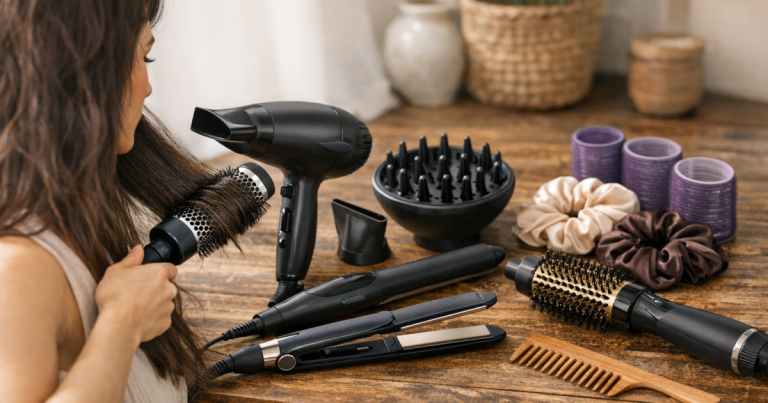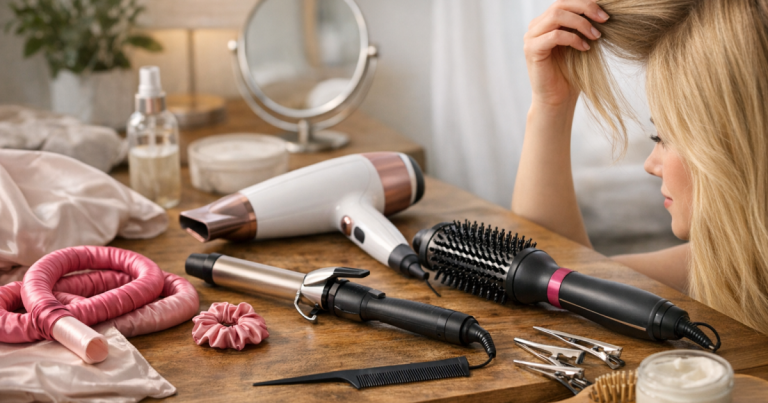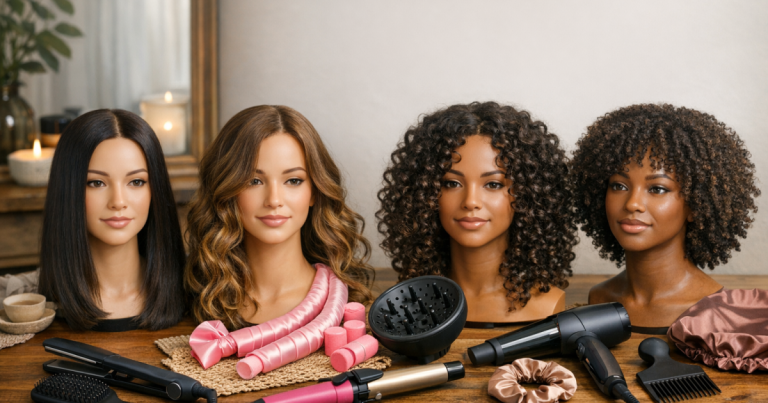
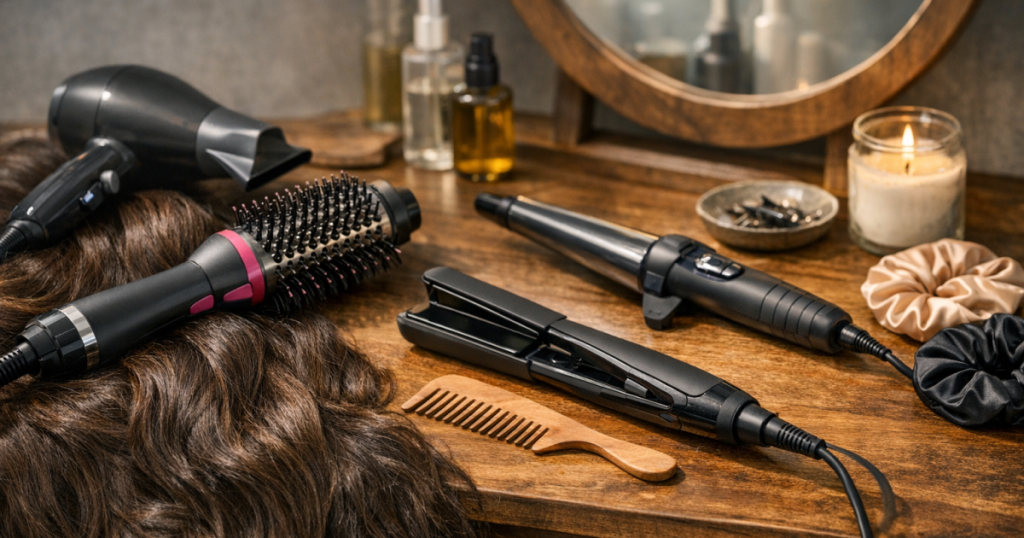
When dense hair takes ages to dry, puffs up after brushing or refuses to hold a smooth shape, thick hair styling tools can make the difference between a rushed finish and a style that lasts. The key is not simply choosing the hottest or biggest tool. Thick hair needs airflow, section control, detangling support and enough surface area to work efficiently without repeatedly passing over the same pieces.
Thick hair can mean high density, coarse individual strands, abundant curls, or a mix of all three. That matters because a tool that smooths dense straight hair may flatten waves, and a brush that glides through loose waves may disturb tight curls. If you are not sure whether your main issue is density, strand thickness, texture or porosity, start with this guide to identifying your hair type before choosing styling tools.
The short version
- For drying time, prioritise strong airflow, a concentrator or diffuser attachment, and sectioning clips rather than relying on high heat alone.
- For smoothing, use tools that create tension without ripping through the hair: paddle brushes, mixed-bristle brushes, wide-tooth combs and controlled straighteners can all have a role.
- For control, match the tool to the finish: sleek, bouncy, defined curls, stretched roots or heatless volume.
- Thick curly and coily hair usually benefits from detangling in sections, styling on damp hair and using a diffuser or heatless setting method rather than aggressive brushing when dry.
- Thick fine hair exists too: it can look full but collapse at the roots, so lighter tools and root-focused volume often work better than heavy smoothing products.
Why thick hair behaves differently
Dense hair holds more water after washing, so drying can feel slow even when the surface looks nearly dry. The underneath layers, roots and nape area often stay damp longest. That is why many people with thick hair end up over-drying the outer layer while the inner sections remain humid, which can lead to swelling, frizz and a style that drops quickly.
Weight is another factor. Long, thick hair can pull out waves and curls, while short thick hair can expand sideways if the cut and styling method do not work together. Coarser strands may need more smoothing tension; finer strands in high density may need airflow and lift without too much product or compression.
Porosity changes the picture as well. Low-porosity thick hair may resist water and styling products at first, then take a long time to dry once saturated. Higher-porosity thick hair may absorb moisture quickly but lose smoothness faster in damp weather. The best tool routine recognises these differences rather than treating all thick hair as one category.
Drying tools: faster does not have to mean harsher
For thick hair, a good drying routine starts before the dryer is switched on. Squeeze out excess water with a soft towel or hair wrap, detangle gently, apply any styling product evenly, then work in sections. This reduces the temptation to blast the same area repeatedly.
A hair dryer for thick hair should be judged by how manageable it feels over a full drying session, not only by headline claims. Check the weight in your hand, the attachment fit, the heat and speed options, the length of the cable for your dressing table or mirror setup, and whether the controls are easy to adjust while sectioning. A concentrator nozzle helps direct airflow for smoothing, while a diffuser is better for curls and waves that need definition.
For readers weighing up whether a premium dryer is worth it against a heatless routine, the comparison between the Kitsch Satin Heatless Curling Set and Dyson Supersonic Hair Dryer is useful because it looks at routine fit rather than assuming every upgrade solves the same problem.
Drying by texture
- Thick straight hair: rough-dry until damp, then use a concentrator with a paddle or round brush to smooth the surface and direct the ends.
- Thick wavy hair: avoid over-brushing once waves are forming. Use a diffuser for shape or a concentrator only at the roots if you want a smoother blow-dry.
- Thick curly hair: detangle when conditioned or damp, apply styling product in sections, then diffuse with minimal touching to reduce frizz.
- Thick coily hair: sectioning is essential. Stretching, diffusing or air-drying methods should preserve moisture and avoid unnecessary manipulation once the style is set.
Detangling and prep tools that make styling easier
Thick hair styling often fails because the prep stage is rushed. If knots, shed hair and uneven product distribution are left in place, the dryer or hot tool has to work harder later. A wide-tooth comb is useful for working through conditioner, separating curls and reducing clumping without over-brushing. A flexible detangling brush can help on dense hair, but it should be used in sections from ends to roots rather than dragged from the scalp down.
The Tangle Teezer The Ultimate Detangler Thick & Curly is a recognisable example of a brush designed for denser textures, though readers should still check whether the bristle flexibility suits their curl pattern and scalp sensitivity. For a firmer styling brush, the Denman D4 Classic Styling Brush is often used for defining and controlling curls or blow-drying sections, but it may not suit everyone as a daily detangler.
For smoothing rather than detangling, a mixed-bristle brush can help polish the surface of dense straight or stretched hair. The Mason Pearson Popular Bristle & Nylon Hair Brush is a well-known example, but it is not automatically the right choice for every thick hair type, particularly if brushing dry disrupts your curl pattern.
Smoothing tools: tension, surface area and fewer passes
Smoothing thick hair is about controlled tension. Too little tension leaves the cuticle looking rough; too much can cause breakage or flatten the finish. Paddle brushes cover more surface area for straight and softly wavy hair, while round brushes create bend at the ends. For very dense hair, smaller sections usually give a better finish than trying to pull a large piece smooth in one go.
Straighteners can be useful when you want a sleek result, but they should not be the default for every thick-hair problem. Wide plates may feel faster on long straight hair, while narrower plates can give more control around the hairline, layers and shorter pieces. Check temperature control, plate glide, edge shape and how easily the tool reaches the roots without snagging. The aim is to reduce repeated passes, not to use more heat because the hair is thick.
If your main goal is shine, frizz reduction or curl definition rather than simply making the hair straighter, this breakdown of matching styling tools to frizz, shine and definition gives a more targeted way to think about results.
Control tools for volume, shape and hold
Control does not always mean flattening thick hair. Often, it means placing volume where you want it and reducing bulk where you do not. Velcro rollers can lift heavy roots while the lengths cool into shape. Heatless curling rods can create a softer wave pattern overnight, though very dense hair usually needs smaller sections and slightly damp, not wet, hair. Silk wraps or satin accessories can help preserve a blow-dry, braid-out or roller set by reducing friction while sleeping.
For thick hair that expands during the day, the control step may be more about finishing than styling. A small amount of lightweight oil or serum on the ends can soften the look, but heavy application near the roots can make dense hair feel coated. Argan oil treatments can work well for some coarse or dry textures, but fine dense hair may prefer a lighter touch.
Which tool fits which thick-hair goal?
- Faster wash-day drying: absorbent towel wrap, sectioning clips, dryer with suitable concentrator or diffuser.
- Sleek blow-dry: concentrator nozzle, paddle brush or round brush, clips for clean sections.
- Defined curls: wide-tooth comb, curl-friendly detangling brush, diffuser, minimal dry brushing.
- Root lift: rollers, root clips, round brush or dryer brush used carefully at the crown.
- Overnight shape: satin heatless curling rod, braids, buns or rollers, depending on the wave pattern wanted.
- Lower-friction maintenance: silk wrap, satin pillowcase, gentle detangling tool and refresh spray if your texture responds well to water.
Where thick hair advice often goes wrong
The most common mistake is assuming thick hair is strong enough to tolerate anything. Dense hair can hide damage because the overall shape still looks full, but the ends may become rough, split or uneven if the same sections are brushed and heated repeatedly. Another mistake is using heavy products to force smoothness. That can reduce frizz temporarily but leave the hair dull, coated or difficult to restyle.
There is also a difference between thick hair and coarse hair. Someone can have lots of fine strands, which looks thick but reacts badly to heavy creams and high tension. Someone else may have fewer strands that are coarse and resistant, needing more smoothing support but less overall bulk management. This is why hair-type matching matters more than choosing a tool labelled for thick hair without checking the actual routine.
Tool overlap can be confusing, too. A dryer brush, round brush and straightener can all smooth, but they do it differently. Rollers, curling wands and heatless rods can all create bend, but they vary in finish and effort. If you are trying to simplify your kit, the guide to choosing between straighteners, curlers, rollers and dryers helps separate what each tool is actually for.
A realistic routine for dense hair
A balanced routine for thick hair usually has three stages: prepare, shape, preserve. Preparation includes removing excess water, detangling in sections and distributing product evenly. Shaping is where you choose between a smooth blow-dry, diffused curls, stretched roots, rollers or a heatless set. Preservation is what happens after styling: cooling fully before touching, sleeping on lower-friction fabric, and refreshing with as little disruption as possible.
For busy mornings, a full restyle may not be realistic. Thick hair often responds better to a planned wash-day style and light maintenance than daily tool use. That might mean diffusing curls properly once, then refreshing the hairline and crown. Or it might mean blow-drying smooth, then using rollers only at the top the next day. Thick hair styling tools are most effective when they support the routine you can actually repeat.
Common questions
Is a powerful hair dryer always better for thick hair?
Not always. Strong airflow can help, but comfort, attachments, heat control and how well you can section the hair matter just as much. A dryer that feels too heavy or awkward may slow you down.
Should thick hair be brushed wet or dry?
It depends on texture. Straight and loose wavy thick hair may tolerate gentle damp detangling. Curly and coily hair is usually easier to detangle with conditioner or styling product and can lose definition if brushed dry.
Are heatless tools effective on very thick hair?
Yes, but section size is crucial. Very thick hair often needs smaller sections, even tension and enough drying or setting time. Hair should usually be slightly damp rather than wet for overnight styling.
Why does my thick hair go frizzy even after straightening?
The inner layers may still hold moisture, the sections may have been too large, or the hair may need better prep before heat. Humidity, porosity and product build-up can also affect how long a smooth finish lasts.
Do thick curls need different tools from thick straight hair?
Usually, yes. Thick curls need definition and low disruption, so diffusers, wide-tooth combs and curl-friendly brushes are often more useful than smoothing brushes designed for straight blow-dries.
Key takeaways
Thick hair needs a tool routine built around drying time, smoothing and control rather than heat alone. Start by understanding whether your hair is dense, coarse, curly, fine-but-abundant or highly porous. Then choose tools that reduce effort: sectioning clips, the right brush or comb, a dryer attachment that suits your texture, and heatless or finishing tools that help the style last.
The best result is not always the sleekest or fastest one. It is the routine that gets your thick hair dry, shaped and manageable without unnecessary passes, rough brushing or product overload.