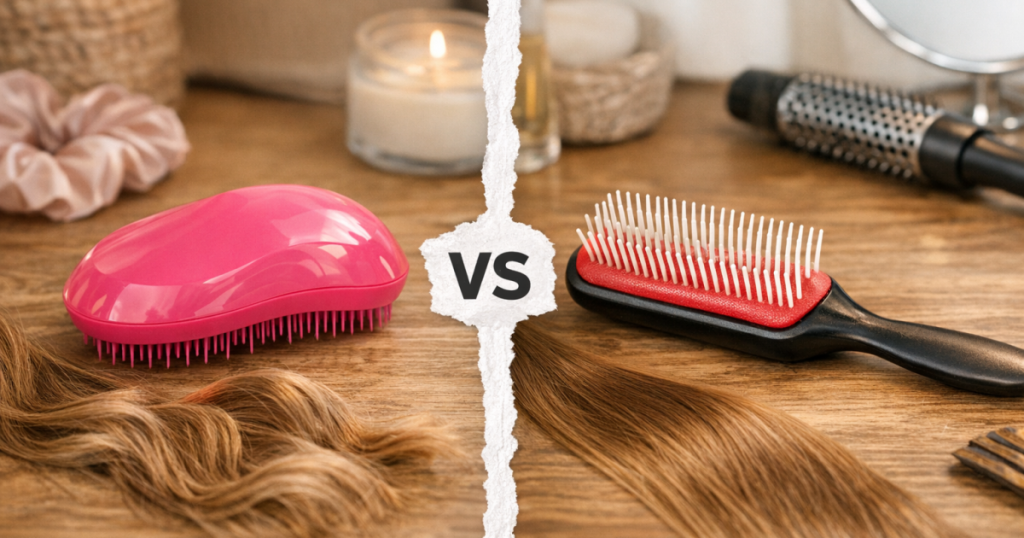
Choosing between Tangle Teezer vs Denman D3 is really a choice between gentle detangling and controlled styling. Both brushes have loyal followings, but they solve different problems: one is made to ease through knots with minimal drama, while the other is better known for creating tension, shape and definition.
If your routine starts with wet hair, conditioner and a battle with tangles, the Tangle Teezer The Original Detangler Brush is likely to feel more forgiving. If your priority is curl clumping, smoother sections, or more control while styling, the Denman D3 Classic Styling Brush may earn its place more quickly.
At a glance
- Choose Tangle Teezer The Original Detangler Brush if your main issue is knots, fragile-feeling lengths, children’s hair, or quick detangling before air drying, heatless curls or protective styling.
- Choose Denman D3 Classic Styling Brush if you want more styling tension, curl definition, smoother sections, or a brush that helps shape hair rather than simply untangle it.
- For fine, easily weighed-down hair, the Tangle Teezer usually feels lighter and less forceful.
- For wavy, curly and some coily routines, the Denman D3 can be excellent, but only when used with enough slip and the right section size.
- For very knot-prone hair, detangle first, then style. The Denman D3 is not the brush to yank through matted lengths.
What each brush is actually designed to do
The Tangle Teezer The Original Detangler Brush is a palm-held detangling brush with flexible teeth designed to bend through knots rather than pull them straight out by force. It is most useful when hair needs gentle separation: after washing, before applying styling products, before putting hair into a heatless curling rod, or before smoothing hair into a low bun or ponytail.
The Denman D3 Classic Styling Brush is a styling brush first. Its rows of pins and cushioned base create more grip and tension than a soft detangler. That tension is exactly why curl-focused routines often use it to encourage curl clumps, define waves, smooth frizz-prone sections and direct the hair into a more intentional shape.
That difference matters. A detangling brush should reduce tugging; a styling brush should help place the hair. If you expect one tool to do both equally well, you may end up disappointed. For a broader view of matching tools to pattern and behaviour, the straight, wavy, curly or coily hair tool guide is a useful next step.
Side-by-side comparison
- Main job: Tangle Teezer is primarily for detangling; Denman D3 is primarily for styling, shaping and defining.
- Grip on the hair: Tangle Teezer has a lighter, more flexible feel; Denman D3 gives more tension and control.
- Best moment in the routine: Tangle Teezer suits the wash-day detangle stage; Denman D3 suits the product-distribution and styling stage.
- Curl behaviour: Tangle Teezer can separate hair without much shaping; Denman D3 can encourage more obvious clumps when used correctly.
- Smoothing: Tangle Teezer smooths gently; Denman D3 smooths more deliberately because it has more grip.
- Learning curve: Tangle Teezer is straightforward; Denman D3 takes more technique, particularly on curls and coils.
- Risk of overdoing it: Tangle Teezer can over-separate textured hair if used too much after styling; Denman D3 can cause tugging if used on dry knots or sections without enough slip.
Detangling performance: which is kinder on knots?
For pure detangling, the Tangle Teezer is the easier recommendation. Its flexible teeth make it more suitable for working through everyday tangles without creating the same level of drag as a firmer styling brush. It is especially useful on fine to medium hair, hair that tangles at the nape, and lengths that feel delicate after colouring or frequent styling.
It still needs sensible technique. Start at the ends, work upwards in small sections, and add conditioner, leave-in spray or water where needed. No brush can make rushed detangling completely damage-proof, particularly on hair that is already dry, stretched or chemically processed.
The Denman D3 can detangle lightly, but that is not where it shines. On knotty hair, its stronger tension can make small tangles feel bigger. For curls and coils, it is usually better used after the hair has already been loosened with fingers, a wide-tooth comb or a dedicated detangling brush. If you are building a low-tug wash-day kit, the Cricket Ultra Smooth Wide Tooth Comb review is worth reading alongside this comparison.
Curl definition and shape: where the Denman D3 pulls ahead
The Denman D3 is popular in curly and wavy routines because it can help group strands into more defined sections. When used with leave-in conditioner, curl cream or gel, the brush can smooth the surface of each section and encourage hair to fall into neater clumps. The result depends heavily on your texture, haircut, product choice and technique, but the styling control is the point.
For loose waves, the Denman D3 can add polish but may also flatten volume if you use too much tension from root to tip. For curls, it can create springier-looking sections when you brush away from the scalp and let the hair reform. For tighter coils, it can work on small, well-lubricated sections, but it may feel too grippy if the hair is dense, dry or not fully detangled first.
The Tangle Teezer can still be useful for textured hair, but more as a preparation tool. It helps distribute conditioner and remove tangles before styling. Once curl cream or gel is in, repeated brushing with a detangler can break up clumps and create fluff, so timing matters.
Smoothing, volume and everyday styling
If you want a sleek ponytail, a smoother fringe area, or more control before using Velcro hair rollers, the Denman D3 has the advantage because it gives firmer direction. It can help pull hair into a cleaner section and reduce surface puff when paired with the right amount of styling product.
If you want soft, low-effort smoothing without compressing the hair too much, the Tangle Teezer feels easier. It is useful for refreshing hair before a loose plait, brushing through lengths before a silk wrap, or preparing hair for overnight heatless styling. It will not create the same shaped finish as a Denman, but it is less likely to make fine hair feel overworked.
For volume, neither brush is a magic answer. A brush can prepare and place the hair, but lift usually comes from your drying method, rollers, root direction, product choice and how much tension you apply. If your end goal is the bigger question, compare the finish you want first with how to build a styling routine around your desired finish.
Hair-type guidance
Fine or fragile-feeling hair
The Tangle Teezer is usually the safer starting point because it feels lighter through the lengths. Fine hair can snap when brushed aggressively, so flexible teeth and smaller sections are helpful. The Denman D3 can still be useful for smoothing, but use it sparingly and avoid dragging it through dry tangles.
Medium-density straight hair
Either brush can work, but they play different roles. Use the Tangle Teezer for fast detangling after washing or before styling. Choose the Denman D3 if you want more tension for a neater ponytail, shaped layers, or smoother sections before blow-drying with a separate dryer.
Wavy hair
The Denman D3 can be a strong option if your waves need help forming more consistent clumps. Use it on wet or damp hair with product, then scrunch rather than continuing to brush. The Tangle Teezer is better when your waves tangle easily but lose shape if over-brushed.
Curly hair
The Denman D3 is often the more exciting styling tool for curls because it can create definition and control. It works best on properly detangled, wet, product-coated sections. The Tangle Teezer is better at the earlier stage: removing knots, spreading conditioner and preparing the hair without too much tension.
Coily or very dense hair
Be selective. The Tangle Teezer may help with detangling if used in small sections with plenty of slip, though some very dense textures may prefer fingers or a wide-tooth comb first. The Denman D3 can define small sections beautifully for some coily routines, but it can also feel too forceful if the section is too large or the hair is not saturated enough.
Pros and trade-offs
Tangle Teezer The Original Detangler Brush
- Pros: Gentle feel, easy to use, good for wet detangling, useful before heatless styling, suitable for many fine and medium hair routines.
- Trade-offs: Less styling tension, less control for shaping curls, may over-separate textured hair if used after styling products have started to set.
Denman D3 Classic Styling Brush
- Pros: Better control, strong curl-definition potential, useful for smoothing sections, good for styling with creams and gels.
- Trade-offs: Not the gentlest choice for knots, needs more technique, can flatten roots or pull too much if used heavily.
Which brush makes more sense for your routine?
Buy the Tangle Teezer The Original Detangler Brush if your biggest frustration is getting from washed hair to manageable hair without tugging. It is the more universal first brush, especially for fine, straight, wavy or knot-prone hair. It also fits well into heatless routines because smooth, detangled lengths wrap more evenly around rods, rollers and soft overnight styles.
Buy the Denman D3 Classic Styling Brush if your hair is already reasonably easy to detangle and you want more control over the finished look. It makes the most sense for wavy and curly routines where definition, product distribution and section control matter. It is also the better choice if your current brush leaves your styled hair fluffy rather than shaped.
If your budget or storage space only allows one, choose based on the problem that happens earliest in your routine. Knots come first, so severe tangling points towards Tangle Teezer. Shape comes later, so definition and smoothing point towards Denman D3. For many textured-hair routines, the most practical answer is not either-or: detangle with the Tangle Teezer, then style selected sections with the Denman D3.
Quick Buying Links
Tangle Teezer The Original Detangler Brush
If your routine starts with wet hair, conditioner and a battle with tangles, the Tangle Teezer The Original Detangler Brush is likely to feel more forgiving.
Denman D3 Classic Styling Brush
If your priority is curl clumping, smoother sections, or more control while styling, the Denman D3 Classic Styling Brush may earn its place more quickly.
Helpful questions
Can the Denman D3 damage curls?
It can cause unnecessary pulling if used on dry, tangled or under-conditioned hair. On wet, detangled hair with enough slip, it is better used as a styling brush to form clumps and smooth sections.
Is the Tangle Teezer better for children’s hair?
For many children, yes, because the flexible teeth tend to feel less forceful on everyday knots. Work slowly from the ends upwards and use a detangling spray or conditioner when hair is stubborn.
Can I use either brush with a hair dryer?
Check the exact product version before using direct heat. Some brushes are not intended to be used like heat-styling brushes, so follow the brand’s care and usage instructions for your specific model.
Which brush is better for frizz?
For frizz caused by tangles and rough brushing, Tangle Teezer may help. For frizz caused by poor curl grouping or lack of styling control, Denman D3 is often more useful.
Do I need both brushes?
Not always. Straight or fine hair may only need the Tangle Teezer. Wavy, curly or coily hair that needs both gentle detangling and deliberate shaping may benefit from owning both.