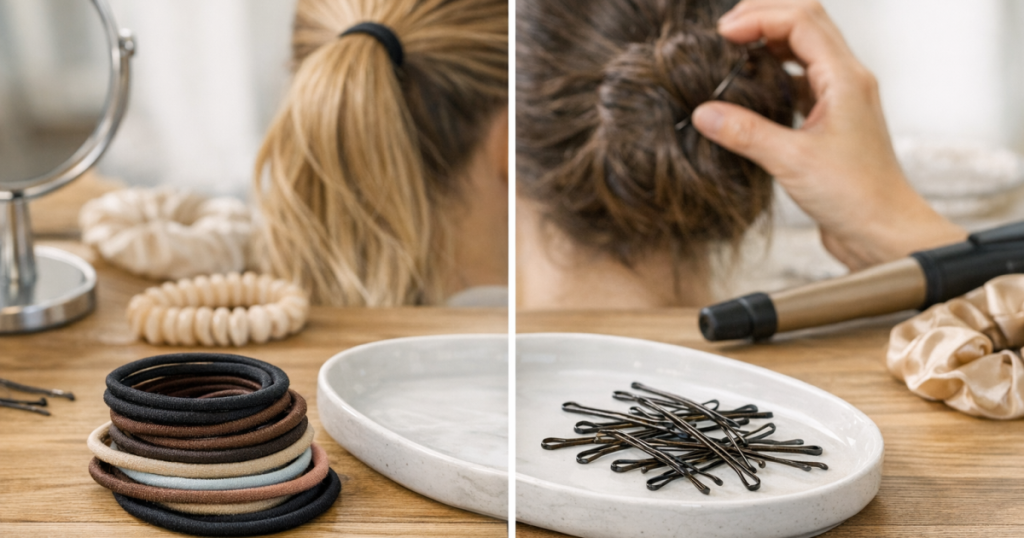
A clean ponytail, a secure bun or a tucked-away fringe can be the difference between hair that behaves and hair that needs constant fixing. When comparing Goody vs Conair, the real question is not which accessory is universally better, but which one solves your styling problem with the least tension, slipping and faff.
Goody Ouchless Hair Ties and Conair Bobby Pins are both small, inexpensive styling staples, but they work in very different ways. One gathers and anchors a larger section of hair; the other pins, hides and controls smaller sections. For at-home styling, especially if you rotate between heatless curls, quick updos and practical day-to-day looks, the best choice often depends on hair density, texture and the style you are trying to hold.
At a glance
Goody Ouchless Hair Ties are the stronger everyday option for ponytails, loose buns, gym hair, plaits and quick sectioning. They suit people who want one accessory that can gather most or all of the hair without snagging on removal. Conair Bobby Pins are better for detail work: securing face-framing pieces, pinning a roll, hiding flyaways, supporting a bun and locking small sections into place.
If your hair regularly falls out of clips or pins, a hair tie will usually give more reliable all-over hold. If your ponytail looks too tight, leaves dents or pulls at the scalp, bobby pins can help you create softer, more distributed support instead of relying on one tight elastic. For heatless routines, the two are often complementary rather than rivals: ties create the base, pins refine the shape.
How the two accessories actually work
Goody Ouchless Hair Ties
Goody Ouchless Hair Ties are designed as snag-reducing elastics for tying hair without a metal join. The appeal is straightforward: they stretch, wrap and grip enough hair to create a ponytail, bun base or secured braid. The “ouchless” idea matters most when you remove them, because a rough join or overly tight elastic can catch on individual strands.
They are not completely damage-proof, especially if used very tightly on wet, fragile or chemically processed hair. Still, compared with harsher elastics, they are a sensible everyday choice for anyone who needs practical hold without wanting to treat every ponytail like a high-tension slick-back.
Conair Bobby Pins
Conair Bobby Pins are small metal pins designed to grip hair between two prongs. They are useful for anchoring sections close to the scalp, securing tucked styles and adding invisible support where a tie would be too bulky. They are also handy for styling corrections: pinning a fringe, fixing a loose curl, hiding a shorter layer or keeping a bun from collapsing on one side.
The trade-off is that bobby pins depend heavily on placement. Push them into too much hair and they pop out. Use too few and the style slips. Place them with the ridged side facing the wrong direction for your hair type and they may not grip as well. They reward a bit more technique than a hair tie.
Side-by-side comparison
- Best for full-hair hold: Goody Ouchless Hair Ties. They gather more hair at once and are easier for ponytails, plaits and simple buns.
- Best for discreet shaping: Conair Bobby Pins. They can disappear into the style and secure small sections without changing the overall silhouette.
- Best for speed: Hair ties. A ponytail or loose bun takes seconds, even when you are styling without a mirror.
- Best for precision: Bobby pins. They are better for targeting one loose layer, fringe section or rolled piece of hair.
- Best for thick hair: Hair ties for the base, bobby pins as reinforcement. Thick hair usually needs both if the style has height or twist.
- Best for fine hair: Bobby pins can work beautifully if they are not overloaded, while hair ties need to be wrapped gently to avoid a tight dent.
- Best for curls: Bobby pins are useful for preserving curl shape, while hair ties are better for loose pineapple styles, plaits and gathering hair before bed.
- Most likely to leave a mark: Hair ties, especially if worn tightly for hours. Pins can also leave bends, but they are usually more localised.
Hold and comfort: the real-world difference
For pure hold, Goody Ouchless Hair Ties win on reliability. They are easier to use when your priority is keeping hair off your face, securing a plait or building a bun that will survive a commute, school run, workout or long day at a desk. The elastic creates a single anchor point, which is efficient but can feel tight if you pull the hair back too firmly.
Conair Bobby Pins feel lighter because they do not compress the full head of hair into one point. This is helpful if you dislike scalp tension, get headaches from tight ponytails or want a softer shape around the crown. The downside is that pins can feel scratchy if inserted at a poor angle, and they can slide if they are too loose for the amount of hair they are holding.
For comfort, choose the accessory based on pressure. If the discomfort comes from the weight of all your hair pulling at one point, use fewer tight ponytails and more distributed pinning. If the discomfort comes from pins poking or slipping, simplify the style with a soft hair tie and use pins only where you need detail.
Which is better for your hair type?
Fine or silky hair
Fine hair can slip out of both elastics and pins, but the problems are different. A hair tie may need extra wraps to feel secure, which can create dents or tension. Bobby pins may slide unless they are crossed, placed close to the scalp or used to secure smaller sections.
For fine hair, Goody Ouchless Hair Ties are best for low ponytails, loose plaits and casual buns where a little softness is acceptable. Conair Bobby Pins are better for holding a fringe, pinning back one side, supporting a half-up twist or hiding shorter layers. If you are comparing small styling tools for fine hair more broadly, the wet-to-dry discussion in GHD Duet Style vs Dyson Airstrait for fine hair is useful for understanding why tension, heat and hair fragility all matter.
Thick or dense hair
Thick hair usually needs a stronger base than bobby pins can provide alone. Goody Ouchless Hair Ties make more sense for ponytails, sectioning before styling, high buns and sleep-friendly plaits. However, thick hair can make a single elastic feel heavy, especially if the ponytail sits high.
Conair Bobby Pins are still useful, but they work best as support rather than the main hold. Use them to pin the outer layer of a bun, tuck shorter pieces at the nape or secure twisted sections before tying. For very dense hair, expect to use several pins and place them in opposing directions rather than relying on one or two.
Curly, coily or textured hair
Curly and textured hair benefits from accessories that hold without crushing curl pattern. A hair tie can be helpful for a loose pineapple, a low puff, a gentle plait or sectioning before a heatless routine. The key is avoiding excessive tension at the hairline and not removing the tie roughly.
Bobby pins are excellent for shaping curls because they can hold a single section without flattening the rest. They are useful for pinning one side back, securing a roll, placing curls around the crown or adjusting volume. If you regularly style without heat, pair accessory choice with routine choice: heatless routines for fine, thick and curly hair can help you match the method to your texture rather than forcing one accessory to do everything.
Short layers, fringes and growing-out cuts
This is where Conair Bobby Pins often beat hair ties. A tie cannot control a fringe, jaw-length layer or awkward grown-out section unless the hair is long enough to reach the ponytail. Pins let you place the hold exactly where the problem is. They are also easier to hide in a twist, behind the ear or under a top layer.
Goody Ouchless Hair Ties still help if you can gather the back section into a mini ponytail or low bun, but for transitional cuts, bobby pins feel more versatile. Keep a few in your bag or on your dressing table because they rescue styles that elastics cannot reach.
Heatless styling: where each one fits
For heatless curls and waves, Goody Ouchless Hair Ties are most useful for sectioning and securing ends. They can hold a loose plait, tie off a robe-curl section or keep hair organised while you work through one side at a time. Because they create a more obvious anchor point, they are less ideal right at the crown if you want smooth, dent-free lift.
Conair Bobby Pins are better for securing rolled sections close to the head, pinning a heatless bun, holding a twist or controlling loose front pieces while curls set. They are also useful after you take a heatless style down, because they can place volume and shape without brushing everything out.
If your heatless curls collapse quickly, the issue may not be whether you used a hair tie or a pin. It may be section size, product weight, drying time, hair porosity or the accessory leaving too much slack. Use ties where you need structure and pins where you need direction.
Common mistakes that make both perform worse
- Using a hair tie too tightly: A tighter ponytail is not always more secure. It can create scalp tension, dents and breakage-prone pressure points, especially around the hairline.
- Expecting bobby pins to hold too much hair: Pins work best on controlled sections. If the section feels bulky between your fingers, split it and use more than one pin.
- Removing accessories in a rush: Pulling out an elastic or dragging a pin through tangles can cause unnecessary snagging. Unwind ties and slide pins out in the direction they went in.
- Ignoring texture: Silky hair often needs crossed pins or light texture from dry shampoo. Coarser or denser hair may need more pins and a stronger base.
- Using worn-out accessories: Stretched elastics and bent pins do not grip consistently. Replace them when they lose shape, snag or slip more than usual.
When another accessory might make more sense
Neither option is perfect for every style. If your goal is a claw-clip twist, half-up volume or a low-tension updo, a different tool may feel easier. For example, no-slip clips can suit sectioning and quick styling if hair ties feel too tight and bobby pins feel too fiddly. The Scunci No-Slip Grip Hair Clips review is a useful next comparison if your main frustration is accessories sliding out.
For overnight protection, a silk hair wrap or satin-friendly accessory may be kinder than sleeping with a tight tie or a cluster of pins. For curl setting, a satin heatless curling rod or Velcro hair rollers can create shape more deliberately than improvising with ties and pins alone. The right answer depends on whether you are trying to secure, smooth, curl, lift or protect.
Pros and drawbacks
Goody Ouchless Hair Ties: strengths
- Fast and familiar for everyday ponytails and buns.
- Good for gathering larger amounts of hair.
- No metal join, which helps reduce snagging during removal.
- Useful for plaits, sectioning and heatless routines.
- Easy to keep in a handbag, gym bag or bedside drawer.
Goody Ouchless Hair Ties: limitations
- Can leave dents if wrapped tightly or worn for long periods.
- May create scalp tension in high ponytails or heavy buns.
- Less useful for short layers and small detail work.
- Can stretch out over time, reducing grip.
Conair Bobby Pins: strengths
- Excellent for precise placement and invisible hold.
- Better for fringes, short layers and tucked styles.
- Can support updos without one tight anchor point.
- Useful for shaping curls and controlling flyaways.
- Small enough to carry for quick style fixes.
Conair Bobby Pins: limitations
- Less reliable as the only hold for thick or heavy hair.
- Can slip in very silky hair unless placed carefully.
- May poke or feel uncomfortable if inserted poorly.
- Easy to lose, bend or overuse in a style.
The practical buying decision
Choose Goody Ouchless Hair Ties if you want a dependable everyday accessory for ponytails, plaits, buns and quick sectioning. They are the better first buy for medium to long hair, thick hair, gym-friendly styles and anyone who wants simple hold without learning a pinning technique. They also make more sense if you usually wear your hair fully up rather than half-pinned or tucked.
Choose Conair Bobby Pins if your biggest frustrations are loose layers, fringes, slipping twists, flyaways or styles that need hidden support. They are the better choice for detail work, soft updos, curl placement and shorter pieces that do not reach an elastic. Fine hair, layered hair and curly styles often benefit from having pins on hand even if they are not the main accessory.
For most at-home styling kits, the smartest answer is to keep both. Use the hair tie as the foundation and the bobby pins as the finishing system. If you are building a more complete kit around hair type and styling goal, compare accessories alongside brushes, rollers and heat tools in the guide to the best hair styling tools by goal and hair type.
Bottom line: which should you reach for?
Reach for Goody Ouchless Hair Ties when you need quick, whole-head control: ponytails, plaits, casual buns, sectioning and practical everyday styling. Reach for Conair Bobby Pins when the style needs accuracy: securing a twist, pinning a fringe, shaping curls, hiding ends or reinforcing a bun without tightening everything.
If you only buy one, pick Goody Ouchless Hair Ties for longer, thicker or more active-day hair. Pick Conair Bobby Pins for shorter layers, fine detail, curl shaping and softer updos. If your routine includes both heatless styling and everyday updos, keeping both is the most flexible and realistic option.
Quick Buying Links
Goody Ouchless Hair Ties
When comparing Goody vs Conair, the real question is not which accessory is universally better, but which one solves your styling problem with the least tension, slipping and faff.Goody Ouchless Hair Ties and Conair Bobby Pins are both small, inexpensive styling staples, but they work in very different ways.
Bobby Pins by Conair
Worth considering if its strengths better match your needs.