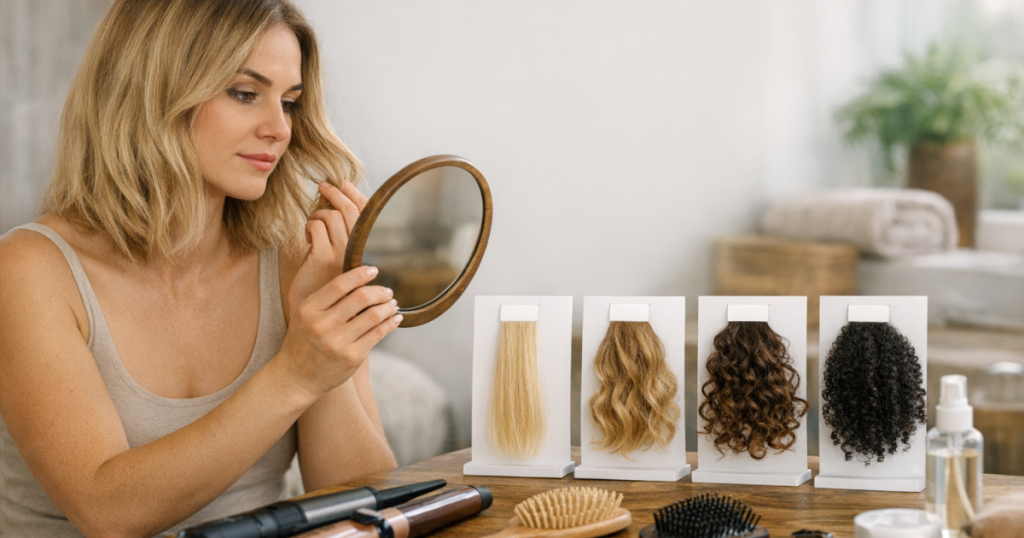
Buying a styling tool before you identify your hair type is how many routines become harder than they need to be. A brush that glides through fine straight hair can pull at dense curls; rollers that create lift on medium hair may disappear into thick, low-porosity lengths. The useful starting point is not a perfect label, but a clear picture of how your hair behaves when it is clean, dry and not over-styled.
Hair type is not one thing. It is a mix of curl pattern, strand thickness, density, porosity, scalp behaviour and current condition, and each part changes what a tool needs to do.
At a glance
- Curl pattern tells you whether your tools need to smooth, define, stretch or support shape.
- Strand texture affects how much tension, grip and product your hair can comfortably handle.
- Density affects section size, drying time, roller hold and whether a brush reaches the roots.
- Porosity affects how quickly hair takes in water and styling products, which matters for heatless setting and frizz control.
- Your real routine should be built around your hair’s behaviour, not only a type chart.
Start with freshly washed, product-light hair
The most useful hair-type check happens after washing, conditioning and letting your hair dry with minimal styling interference. Heavy creams, strong gels, straightening, tonging and aggressive brushing can disguise your natural pattern, so keep the test simple.
After washing, gently squeeze out excess water, detangle with a suitable comb or brush, then allow the hair to dry without stretching it into a different shape. Once dry, look at the full head rather than one flattering section near the front. Many people have looser pieces around the face, tighter pieces underneath, flatter roots and more movement through the mid-lengths.
If you need a broader framework for pattern matching, the guide to matching tools to straight, wavy, curly and coily hair is a useful next step after you have done the basic checks below.
The four checks that matter most
1. Curl pattern: straight, wavy, curly or coily
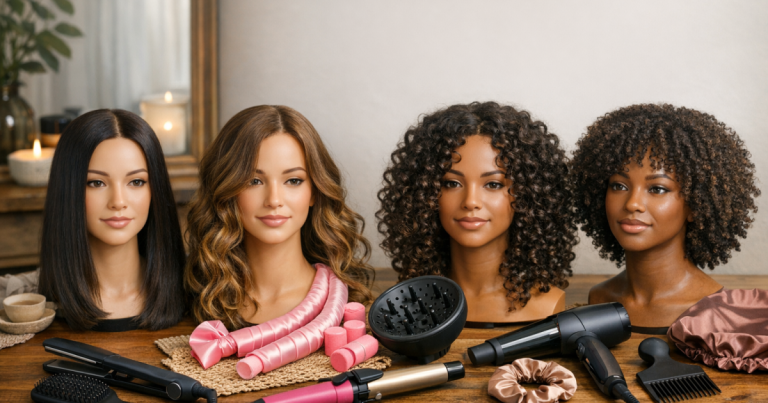
Curl pattern is the visible shape your hair forms when it dries naturally. Straight hair tends to fall without an obvious bend. Wavy hair forms loose S-shapes. Curly hair forms more defined loops or spirals. Coily hair forms tight curls, coils or zig-zag patterns, often with more shrinkage.
This matters because tools create tension differently. Straight and gently wavy hair often responds well to smoothing brushes, blow-dry brushes, Velcro rollers and heatless rods that add bend. Curly and coily hair usually needs tools that respect clumping and reduce unnecessary separation, such as wide-tooth combs, flexible detangling brushes, sectioning clips and satin or silk accessories that limit friction.
Do not treat curl pattern as the whole answer. A fine 2B wave and a dense 2B wave may need completely different brush sizes and sectioning strategies. A loose curl that is high porosity may need more gentle handling than a tighter curl with strong, resilient strands.
2. Strand texture: fine, medium or coarse
Strand texture means the thickness of each individual hair, not how much hair you have overall. Fine hair has a smaller strand diameter and can be easily weighed down. Medium hair is more balanced. Coarse hair has a thicker strand and may feel stronger or more wiry between the fingers.
To check it, compare a single shed hair against a piece of regular sewing thread. If the hair is much slimmer and hard to feel between your fingers, it is likely fine. If it feels similar to the thread, it is probably medium. If it feels thicker or more substantial, it may be coarse.
For tool choice, fine strands usually need lightweight tension and tools that do not flatten the roots. Coarse strands often need more smoothing support, wider sections only when the tool can handle them, and enough setting time for heatless shapes to hold. Medium strands sit between the two, but can lean either way depending on density and porosity.
3. Density: how much hair is on your head
Density is about the number of strands, not the thickness of each strand. You can have fine but dense hair, or coarse but low-density hair. This distinction is one of the biggest reasons styling tools disappoint.
Look at your scalp in natural light when your hair is dry. If your scalp is easy to see without parting much hair, you may have lower density. If you need to move a lot of hair to see the scalp clearly, your density is probably higher. A ponytail can also give clues, but it is not perfect because curl pattern and strand texture change how bulky the hair feels.
Low-density hair often needs root lift, lighter brushes and rollers that do not drag the style down. High-density hair usually needs stronger sectioning, more time, wider combs, larger working areas and tools that can reach through the hair rather than smoothing only the surface. For a deeper breakdown, read the guide to hair texture versus density when choosing brushes, dryers and rollers.
4. Porosity: how your hair handles moisture
Porosity describes how readily your hair absorbs and releases moisture. Low-porosity hair often takes longer to become fully wet, can resist products sitting evenly, and may take longer to dry. High-porosity hair may soak up water quickly, dry fast, feel rougher, or lose a smooth finish sooner.
Rather than relying on one popular test, look for repeated behaviour. Does water bead on the surface before your hair feels wet? Do masks and conditioners seem to sit on top unless you use warmth and patience? That can suggest lower porosity. Does your hair drink in conditioner but still feel dry later? Does colour-treated or lightened hair become frizzy quickly? That may suggest higher porosity or condition-related damage.
Porosity matters for heatless styling because damp-setting relies on the hair moving from damp to dry in a controlled shape. Low-porosity hair may need smaller sections and more drying time. High-porosity hair may need a smoother base, gentler detangling and protective fabrics to reduce frizz. The comparison of low-porosity and high-porosity hair styling tools explains those differences in more detail.
How those findings translate into tool choices
Once you have a realistic hair profile, tool decisions become less random. The aim is not to own every tool type; it is to choose tools that work with your natural behaviour instead of fighting it.
- Fine, straight or softly wavy hair: look for lightweight detangling, gentle root lift and tools that create shape without heavy tension. Velcro rollers, soft heatless curling rods and flexible brushes can make more sense than very dense bristle brushes that flatten volume.
- Fine but curly hair: prioritise curl clumping and low-friction detangling. A wide-tooth comb, flexible detangling brush and satin wrap may be more useful than a smoothing brush that breaks up definition.
- Thick, wavy hair: sectioning matters. Larger heatless tools can create relaxed bends, while smaller sections help the shape set more evenly. A brush needs enough reach to detangle beyond the top layer.
- Dense curls or coils: choose tools that reduce snagging and preserve pattern. Wide teeth, flexible bristles, section clips and smooth fabrics are more important than tools designed mainly for fast surface smoothing.
- Low-porosity hair: allow more time for damp styles to dry fully. Tools that trap too much moisture may leave the style limp if removed early.
- High-porosity or colour-treated hair: focus on friction control, gentle detangling and finishing methods that do not rough up the cuticle further.
Common mistakes that lead to the wrong tool
The first mistake is buying for the finish you want without checking the starting point. Wanting sleek hair does not automatically mean a straightener is the most useful upgrade; if your main issue is frizz from rough detangling, a better brush, comb or drying method may have a bigger impact.
The second mistake is copying someone with a similar curl pattern but different density. Two people can both have wavy hair, yet one needs root-lifting rollers while the other needs smoothing, sectioning and longer setting time.
The third mistake is ignoring condition. Bleached, colour-treated, heat-styled or weather-exposed hair can behave more porous than its natural type. If your ends react differently from your roots, choose tools for the most fragile area, not the easiest area.
The fourth mistake is using one tool for every stage. Detangling, smoothing, shaping, setting and protecting overnight are different jobs. A brush that is good for distributing conditioner in the shower may not be the right tool for a polished blow-dry effect or a heatless curl set.
A simple hair-type note to keep on your phone
Before buying anything new, write a short note in this format: pattern, strand texture, density, porosity clues, main styling goal and biggest frustration. For example: “Loose waves, fine strands, medium density, takes ages to dry, wants volume, roots go flat.” That note is far more useful than only saying “wavy hair”.
Then match the tool to the job. If the goal is volume, ask whether the tool lifts roots without dragging fine hair down. If the goal is smoothness, ask whether it reduces friction without over-flattening. If the goal is curl definition, ask whether it preserves clumps. If the goal is heatless shaping, ask whether your hair will dry fully in the section size the tool creates.
Questions people ask
Can my hair be more than one type?
Yes. It is common to have straighter sections near the crown, wavier pieces underneath, or tighter curls around the hairline. Choose tools for the areas that are hardest to style, then adapt section size for the rest.
Should I identify hair type when it is wet or dry?
Check both, but make the final judgement when it is dry and product-light. Wet hair can look stretched, while dry hair shows shrinkage, frizz, density and the real pattern you need tools to work with.
Does hair type change over time?
It can. Hormonal changes, colour, heat styling, hard water, damage, length and haircut shape can all affect how hair behaves. Re-check your type if familiar tools suddenly stop giving the same result.
What matters more: curl pattern or porosity?
For shape, curl pattern matters. For product absorption, drying time and frizz control, porosity matters more. Styling tools usually work best when you consider both together.
Do heatless tools work for every hair type?
They can work across many hair types, but timing and sectioning make the difference. Fine hair may need less tension, dense hair usually needs smaller sections, and low-porosity hair often needs longer to dry fully.
Key takeaways
The most reliable way to choose styling tools is to read your hair’s behaviour, not just its label. Curl pattern shows the shape, texture shows strand strength, density shows how much tool reach you need, and porosity shows how your hair responds to moisture and setting time.
Once you know those details, buying becomes calmer and more accurate. You can skip tools that fight your hair, focus on the jobs your routine actually needs, and build a styling kit that supports your real texture rather than someone else’s results.