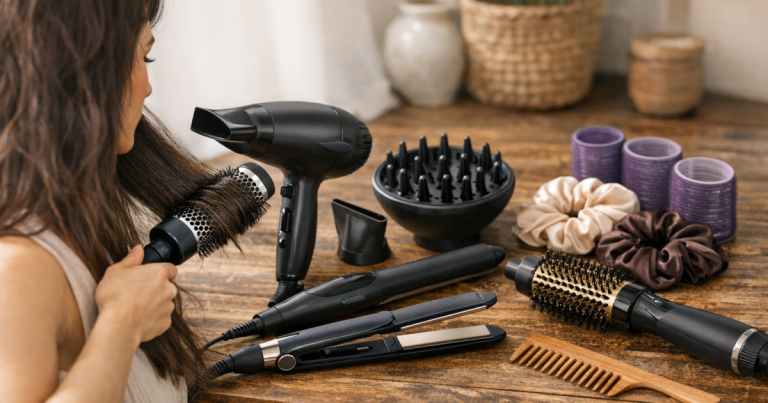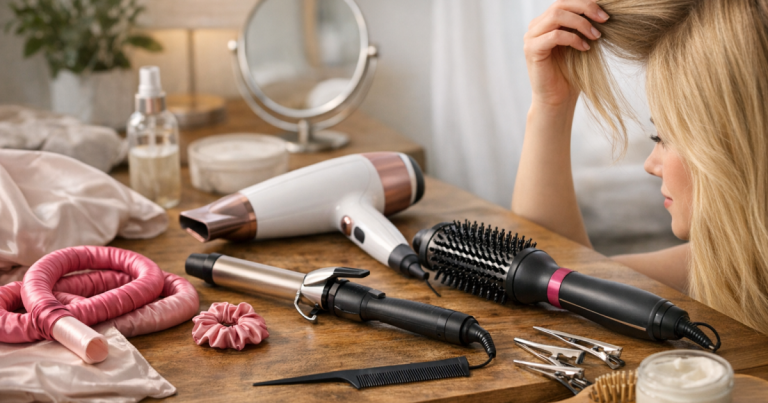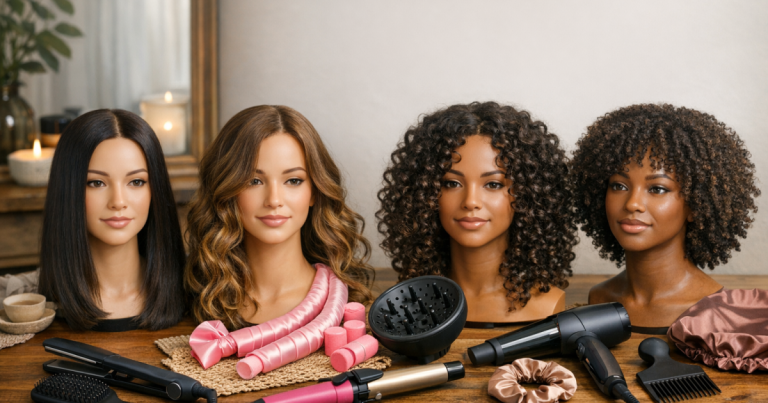
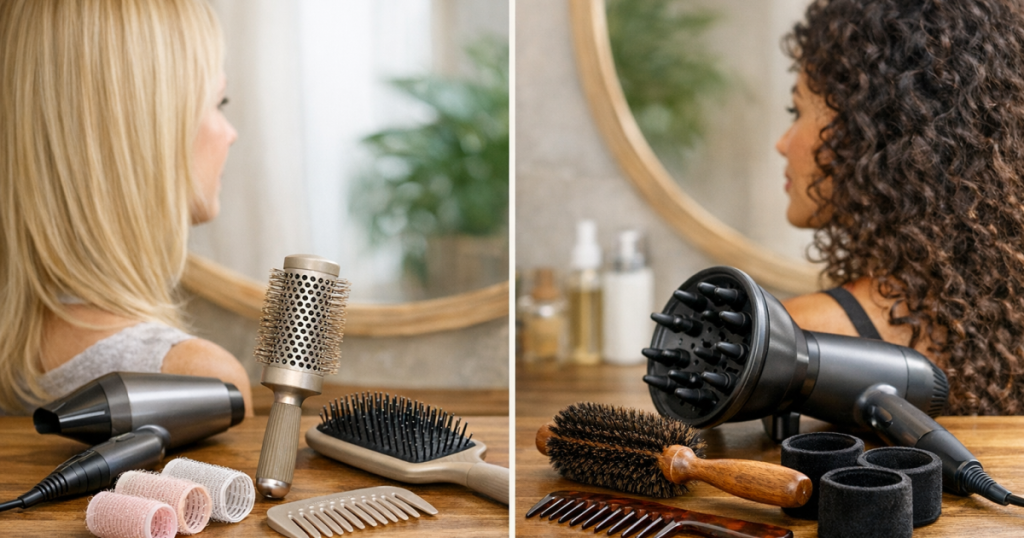
A brush that glides beautifully through one person’s hair can drag, frizz or collapse another person’s style. That is why hair texture vs density matters: texture describes the feel and pattern of each strand, while density describes how many strands are growing on your head. Styling tools work best when they match both, not just the label you normally use for your hair.
Most people know whether their hair is fine, thick, straight, wavy or curly, but tool problems usually appear in the overlap. Fine hair can be dense. Coarse hair can be low-density. Curly hair can be fragile at the ends but heavy at the roots. Once you separate texture from density, it becomes much easier to choose a brush, dryer or roller that gives shape without unnecessary tension, heat or bulk.
The big picture
Texture is about strand character. Fine strands feel silky or flyaway and are easily weighed down. Medium strands tend to hold shape without much drama. Coarse strands feel stronger, may resist bending, and often need more smoothing or moisture support. Curl pattern also sits within texture: straight, wavy, curly and coily hair all react differently to brushing, airflow and roller tension.
Density is about coverage. Low-density hair shows more scalp when parted, ponytails feel slimmer, and styles can fall flat if tools are too heavy or sections are too large. High-density hair feels abundant, takes longer to dry, and often needs stronger sectioning so the underneath layers are not left damp or uneven.
The useful part is that neither factor is “better”. They simply ask for different styling decisions. A fine, high-density head of hair may need a lightweight dryer with controlled sectioning. A coarse, low-density curl pattern may need gentle detangling, minimal brushing once dry and rollers placed strategically for volume rather than all-over fullness. For wider routine planning by hair type, the site’s guide to heatless routines for fine, thick and curly hair is a helpful next step.
How brushes behave on different textures and densities
Brushes are where texture and density often get confused. People blame the brush for causing frizz, pain or flattening, when the real issue is usually bristle spacing, cushion strength, detangling direction or the moment the brush is used.
Fine hair with low density
Fine, low-density hair usually needs light contact. Dense boar-style brushes can polish the surface, but they may also pull natural oils down too quickly and make roots look flat. Flexible detangling brushes tend to be safer for wet hair, provided you start at the ends and work upwards. Avoid aggressively brushing from the crown when hair is wet, as fine strands stretch more easily.
For daily styling, choose tools that do not over-compress the hair. A small vent brush can lift roots during drying, while a soft paddle brush can smooth lengths without creating a helmet-like finish. If your hair looks transparent at the hairline, use the brush to direct hair rather than repeatedly tugging for volume.
Fine hair with high density
This combination is common and often misunderstood. The ponytail may feel thick, yet each strand is delicate. A brush must reach through the hair without ripping through knots. Flexible pins and good sectioning matter more than brute force. The Tangle Teezer The Ultimate Detangler is a recognisable example of the flexible-detangling category, though the right fit depends on scalp sensitivity, handle preference and how easily your hair knots.
Fine, dense hair can also puff out if brushed dry, especially when wavy. Detangle before styling, then use hands, a wide-tooth comb or a light finishing brush only where needed. If you want bend, rollers or a low-heat dryer routine will usually give a cleaner result than repeated brushing.
Coarse, thick or high-density hair
Coarser strands can handle a firmer brush, but the scalp still should not feel scraped. Look for longer pins, generous spacing and a brush shape that can work in sections. High-density hair benefits from dividing into at least four sections before detangling or blow-drying; otherwise, the top layer looks styled while the inner layers stay tangled or damp.
Round brushes can smooth coarse hair well, but diameter matters. A very large round brush may polish lengths but do little at the root. A medium barrel gives more control around the crown and hairline. If tension is needed, apply it in small sections rather than yanking through a large piece of hair.
Curly and coily textures
Curly hair is not automatically thick, and coily hair is not automatically dense. The safest rule is to detangle when hair has slip, usually with conditioner, leave-in or a detangling spray, then avoid unnecessary dry brushing unless you are deliberately creating a brushed-out shape.
For defined curls, brush choice depends on the finish. A flexible detangling brush is for removing knots. A styling brush with controlled rows can help clump curls. The Denman D3 Original Styler is a well-known example used by many curl stylers, but it can create too much tension for some fragile or low-density curl patterns. Technique matters as much as the tool: smaller sections, wet styling and gentle tension usually give better definition than dragging through half-dry curls.
Dryers: airflow, heat and section size
A dryer is not just about power. For at-home styling, the better question is how controllable the airflow feels on your texture and how effectively it reaches through your density. Too much blast can rough up fine or curly hair; too little airflow can leave thick hair damp at the roots for hours.
Fine, low-density hair usually needs precision more than force. A concentrator nozzle, medium airflow and root-lift technique can create movement without blasting the hair flat. Keep sections light and avoid over-drying the ends. If volume disappears quickly, finish by cooling the roots before touching the hair.
Fine but dense hair needs a different approach. The strands may be fragile, but the hair mass holds water. Rough-dry gently until the hair is no longer dripping, then section before smoothing or shaping. This reduces the temptation to keep passing heat over the same surface layer while the underneath remains damp.
Thick, coarse and high-density hair generally needs more organised drying. Work from lower layers upwards and use clips to keep wet hair away from finished sections. A concentrator helps smooth; a diffuser helps preserve waves and curls. For readers deciding whether their routine should lean more heatless or heated, the breakdown of heatless or heated styling for curls, waves and volume explains the trade-offs clearly.
Curly and coily hair often benefits from diffusing rather than direct blasting. Low or medium airflow helps reduce frizz, while heat choice depends on hair condition and patience. Hover-diffusing sets the outer shape with less disruption; pixie-diffusing can add lift but may disturb curls if moved too much. Low-density curls often need root placement more than full-volume drying, while high-density curls need time and section access so the inner layers dry evenly.
A premium dryer such as the Dyson Supersonic Hair Dryer is a familiar example of a tool built around controlled airflow and attachments, but the principle applies across price points: check nozzle fit, diffuser size, weight in the hand and whether the settings are gentle enough for your hair condition.
Rollers: volume, bend and root control
Rollers are often described by size, but density and texture decide how well they actually work. The same large roller can create a soft curtain-fringe bend on fine hair, barely mark coarse hair, or collapse under too much dense hair if the section is too wide.
Fine, low-density hair usually does best with lightweight rollers and smaller sections. Oversized rollers may create lift at the root, but they can also leave the lengths too straight if the hair does not have enough grip. Velcro rollers can be useful, but remove them slowly and avoid forcing them out of tangled ends.
Fine, high-density hair often needs more rollers, not necessarily bigger ones. If too much hair is wrapped around one roller, only the outer layer takes shape. Smaller sections allow the hair to cool or set more evenly. This is especially important for fringes, crown lift and face-framing layers.
Coarse hair may need stronger setting support. That could mean using rollers on slightly damp hair and allowing a longer setting time, or blow-drying a section first and letting it cool around the roller. Avoid assuming heat is always the answer; coarse hair often responds well to tension, moisture balance and sufficient time.
Curly hair can use rollers for stretching, smoothing or shaping, but not every curl pattern likes Velcro. Foam, satin-covered or smooth plastic rollers may be kinder for textured hair that snags easily. A product such as Kitsch Satin Heatless Curling Set represents the soft heatless category rather than a traditional roller set, and it is most useful when the goal is bend or loose waves rather than tight root control.
Where advice gets contradictory
The phrase hair texture vs density becomes especially useful when common advice clashes. One person says, “Use a paddle brush for thick hair.” Another says, “Never brush curls.” Both can be right in context and wrong when applied too broadly.
For example, a paddle brush may be excellent for dense, straight hair before blow-drying, but it can disrupt a low-density wave pattern if used after styling. A diffuser can protect curl shape, but on very low-density hair it may make the outline look too airy unless the roots are clipped or directed. Velcro rollers can boost fine hair, but they may snag fragile highlighted ends if removed carelessly.
Condition also changes the answer. Colour-treated, heat-stressed or chemically processed hair may behave like a more delicate texture even if it is naturally coarse. If ends are splitting, stretching or matting, choose gentler detangling and less repeated heat before chasing a more polished finish. Styling tools should support the hair you have today, not the hair you remember having before damage, hormones, illness, stress or seasonal shedding changed the feel.
A simple matching method
Start with density at the scalp, then texture through the lengths. That order helps because density affects sectioning, drying time and how much tool coverage you need, while texture affects tension, smoothness and frizz control.
- Low density and fine texture: use lightweight brushes, smaller rollers at the crown, controlled airflow and minimal product weight.
- Low density and coarse texture: focus on smoothing without flattening; use gentle tension, medium sections and root placement to avoid gaps.
- High density and fine texture: section carefully, detangle gently and avoid assuming stronger tools are safer just because the hair looks thick.
- High density and coarse texture: prioritise sectioning, longer brush pins, stronger airflow control and enough setting time for rollers to make an impression.
- Curly or coily with any density: decide first whether you want definition, stretch, volume or softness, then choose the tool that supports that finish.
If you are building a small styling kit, it is usually more useful to own fewer tools that match these patterns than to collect every trending brush or roller size. A flexible detangling brush, a dryer with useful attachments and a roller option that suits your set time can cover more looks than a drawer full of poorly matched tools. For broader tool planning, see the guide to hair styling tools by goal and hair type.
What stands out
The smartest styling choices come from reading your hair in two layers. Density tells you how much hair a tool must work through. Texture tells you how much tension, heat, grip or smoothing the strands can tolerate. When both are considered, brushes stop feeling random, dryers become easier to control, and rollers create a shape that looks intentional rather than accidental.
For fine hair, avoid heavy-handed tension and oversized sections. For thick or dense hair, make sectioning non-negotiable. For curls and coils, protect the pattern unless your aim is to stretch or reshape it. For mixed hair types, treat the hairline, crown and underneath as separate zones. That is often the difference between a tool that technically works and a routine that works reliably at home.
Quick Buying Links
Hair Texture
That is why hair texture vs density matters: texture describes the feel and pattern of each strand, while density describes how many strands are growing on your head.
Density: Choosing Brushes, Dryers and Rollers
Worth considering if its strengths better match your needs.