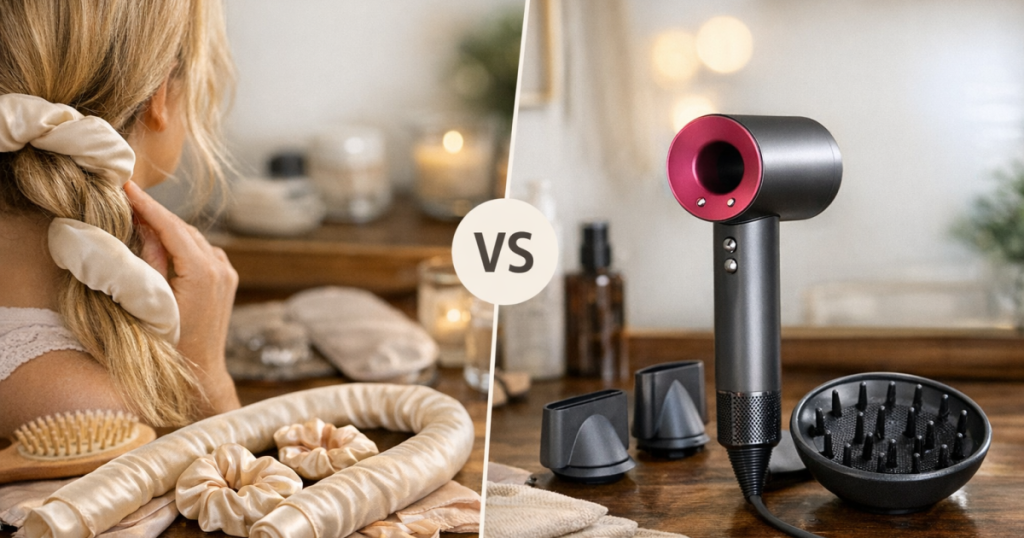
Choosing between a heatless curling set and a premium dryer is really a choice between overnight shape and faster, more flexible styling. The Kitsch Satin Heatless Curling Set and Dyson Supersonic Hair Dryer solve different problems, so Kitsch vs Dyson is not a straight contest over which tool is more powerful. It is about whether your routine needs gentle curl setting, controlled drying, frizz smoothing, root lift, or a mixture of all four.
The big picture
The Kitsch set is for creating curls or waves without direct heat. It suits people who can style in advance, prefer a softer finish, or want to reduce how often they use hot tools. It is low-tech, compact and most useful when you already have time for your hair to set.
The Dyson Supersonic Hair Dryer is a premium drying tool. Its main value is speed, smoother drying control and versatility with different styling attachments. It is better suited to people who regularly wash, dry and style their hair at home, especially if damp hair takes ages to dry or frizz appears before the style is finished.
- Main styling result: Kitsch is for heatless waves and curls; Dyson is for drying, smoothing, diffusing and building a blow-dried base.
- Best routine fit: Kitsch works around overnight or pre-planned styling; Dyson works around wash days, morning styling and quick resets.
- Hair condition angle: Kitsch avoids direct heat; Dyson still uses heat but is designed for controlled drying rather than clamp-style styling.
- Skill level: Kitsch needs wrapping practice and enough setting time; Dyson needs sectioning and attachment choice for the best result.
- Biggest limitation: Kitsch will not dry your hair; Dyson will not create a set curl pattern in the same way as an overnight heatless rod.
Where the Kitsch Satin Heatless Curling Set stands out
The Kitsch Satin Heatless Curling Set is at its best when your goal is shape rather than drying. It typically appeals to people who want loose curls, soft waves or a polished bend through the mid-lengths and ends without using a tong or straightener. The satin finish is also helpful because it reduces some of the friction you can get from rougher fabrics while hair is setting.
For fine hair, the appeal is obvious: less direct heat and less risk of flattening the roots with heavy styling. Fine hair can, however, slip out of heatless wraps, so the result depends on tension, product choice and how damp the hair is when wrapped. A light styling spray or mousse can help hold the shape, but heavy creams may make fine hair collapse.
For medium to thick hair, the Kitsch set can create a pretty, soft finish, but it needs enough time. Dense hair may need to be mostly dry before wrapping, otherwise the inner layers can stay damp and the curl may drop quickly. Very long hair also needs careful wrapping so the ends are secure and not crumpled.
For wavy hair, it can enhance a natural bend without disturbing the cuticle too much. For curly or coily hair, it is less of a curl-defining tool and more of a stretching or shaping option, depending on the starting texture and how the hair is prepped. It will not replace a diffuser for curl pattern definition after washing.
Where the Dyson Supersonic Hair Dryer earns its place
The Dyson Supersonic Hair Dryer makes more sense when drying is the part of your routine that causes the most frustration. If your hair takes a long time to dry, becomes puffy before it is fully styled, or needs a smoother blow-dried base before straightening or curling, a high-quality dryer can change the whole routine rather than just the final shape.
Its strength is flexibility. Depending on the attachment you use and your technique, it can support rough drying, smoothing, diffusing curls, lifting roots or preparing the hair before another styling step. If you want a fuller breakdown of how it performs in everyday home use, the Dyson Supersonic Hair Dryer review goes deeper into the practical styling experience.
Fine hair may benefit from using a dryer because it lets you create lift at the roots before the lengths fall flat. The risk is over-smoothing or over-drying, so fine hair usually needs a gentler approach, smaller sections and lightweight styling products. Thick hair benefits from controlled airflow and a more systematic drying routine, but you still need to section properly rather than expecting the tool alone to do all the work.
Curly hair users should think carefully about attachment choice. A diffuser-style routine is very different from a smoothing routine, and the best result depends on whether you want definition, stretch, volume or a smoother blowout. The Dyson is more adaptable than a heatless curl rod, but it also asks more from your technique.
Side-by-side: what changes in real routines?
- After washing: Dyson is the practical choice because it dries the hair and helps shape the finish. Kitsch is only useful once the hair is suitably dry or lightly damp for setting.
- Before bed: Kitsch is more convenient if you are comfortable sleeping with a wrapped style. Dyson is not part of an overnight setting routine.
- Morning styling: Dyson wins when you have damp hair or need a quick refresh. Kitsch can work only if you set the hair earlier or have time for the curl to form.
- Frizz control: Dyson can help smooth as you dry, while Kitsch can reduce friction during setting. Neither will fix frizz alone if your hair needs better prep, moisture balance or finishing product.
- Volume: Dyson is better for root lift and a blow-dried shape. Kitsch gives movement through the lengths, but it is not designed to lift the roots.
- Curl longevity: Kitsch can give a longer set when hair is prepped well and left long enough. Dyson creates shape through drying technique, but loose blow-dry bends may need product or another tool to last.
- Travel and storage: Kitsch is simpler to pack. Dyson is a more substantial tool, so it suits people who will use it often enough to justify the space.
Which hair types should lean towards Kitsch?
Choose the Kitsch Satin Heatless Curling Set if your hair already dries reasonably well and your main aim is to add shape without using direct heat. It is a strong fit for straight to wavy hair that holds a bend, shoulder-length or longer cuts, and anyone who prefers a softer curl rather than a sharp tonged finish.
It is also a sensible choice if your styling goal is to reduce heat frequency rather than remove every other product or tool from your routine. Many people still need a detangling brush, a lightweight styling product or a silk wrap to protect the finished shape overnight. The heatless set is the curl-making step, not the whole routine.
If your hair is very short, heavily layered around the face, extremely slippery, or reluctant to hold curl, the learning curve can be more noticeable. You may need to test how dry the hair should be before wrapping and whether smaller sections give a better set. If you are not sure how your texture behaves, start with the basics in how to identify your hair type before buying styling tools.
Which hair types should lean towards Dyson?
Choose the Dyson Supersonic Hair Dryer if drying is the step that currently slows you down, creates frizz or leaves your style looking unfinished. It is particularly useful for medium, thick or long hair that needs a reliable wash-day routine. It also suits people who switch between smooth blow-dries, natural texture, root lift and pre-styling before another tool.
Fine hair can still benefit, but the case is slightly different. The value is not just drying power; it is control. Fine hair often needs lift without roughness, so the right airflow direction, distance and product amount matter. If you mainly air-dry and only want occasional waves, the Kitsch set may be the more relevant purchase.
For curly and coily hair, the Dyson is the stronger option if you need to dry roots, set definition with a diffuser, or stretch hair before a smoother finish. It will not automatically make curls more defined; your washing, conditioning, styling product and drying method still decide the result.
Frizz, shine and finish: the real deciding factor
If frizz is your biggest issue, do not choose purely by brand prestige or heatless appeal. Frizz can come from rough drying, humidity, brushing the wrong way, product mismatch, dryness, damage or simply your natural texture. The Kitsch set may help by limiting friction while the curl forms, but it cannot smooth wet hair into a polished blow-dry. The Dyson can help dry hair in a more controlled way, but it still needs the right attachment and technique.
If shine is your goal, think about the condition of the hair surface. A satin heatless wrap can help curls look softer because the hair is not clamped between hot plates. A good dryer can help the cuticle sit flatter when used with controlled direction and sectioning. For a wider decision framework, use how to match styling tools to frizz, shine and definition before spending on another tool.
When buying both actually makes sense
These two tools are not direct duplicates. In a complete at-home routine, the Dyson can handle wash-day drying and smoothing, while the Kitsch set can create overnight shape on already-dry or lightly damp hair. That combination makes sense if you style regularly, want to reduce tong or straightener use, and like having both polished blow-dry options and softer heatless curls.
Buying both is less compelling if your routine is very simple. If you wash and air-dry most of the time, then only want occasional waves, start with Kitsch. If you rarely wear curls but always struggle to dry your hair neatly, start with Dyson. The better investment is the one that solves your most frequent styling problem, not the one that looks more impressive on a dressing table.
Helpful questions
Can the Kitsch Satin Heatless Curling Set replace a hair dryer?
No. It shapes hair but does not dry it in the way a dryer does. It works best on hair that is dry enough to set properly without staying damp inside the wrap.
Is the Dyson Supersonic Hair Dryer too much for fine hair?
Not necessarily, but fine hair needs a controlled routine. Use lighter products, avoid over-drying the ends and focus on root lift rather than blasting the lengths.
Which is better for reducing heat exposure?
The Kitsch set is the better option for avoiding direct heat while creating curls. The Dyson still uses heat, although it is designed for controlled drying rather than clamped heat styling.
Which one is better for thick hair?
Dyson is usually the more practical first upgrade for thick hair because drying time and section control matter. Kitsch can still work for waves, but dense hair needs enough setting time.
Can I use the Kitsch set after drying with the Dyson?
Yes. Many routines work best that way: dry the hair first, leave it slightly prepped and smooth, then wrap it for heatless shape once it is no longer wet.
The practical recommendation
For a one-tool upgrade, the Kitsch vs Dyson decision is simple: choose the Kitsch Satin Heatless Curling Set if you want soft curls, lower heat reliance and an affordable-feeling styling step that fits around evenings or overnight setting. Choose the Dyson Supersonic Hair Dryer if your bigger problem is drying, smoothing, root lift or making wash days easier to manage.
If your budget and routine allow only one, prioritise frequency. A heatless curling set is brilliant when you will actually wrap your hair and give it time. A premium dryer earns its place when you use it after most washes and need repeatable results across different styles. For many homes, Dyson is the stronger everyday tool; Kitsch is the clever add-on for curl shape without reaching for hot tongs.
Quick Buying Links
Kitsch Satin Heatless Curling Set
The Kitsch Satin Heatless Curling Set and Dyson Supersonic Hair Dryer solve different problems, so Kitsch vs Dyson is not a straight contest over which tool is more powerful.
Dyson Supersonic Hair Dryer
The Kitsch Satin Heatless Curling Set and Dyson Supersonic Hair Dryer solve different problems, so Kitsch vs Dyson is not a straight contest over which tool is more powerful.