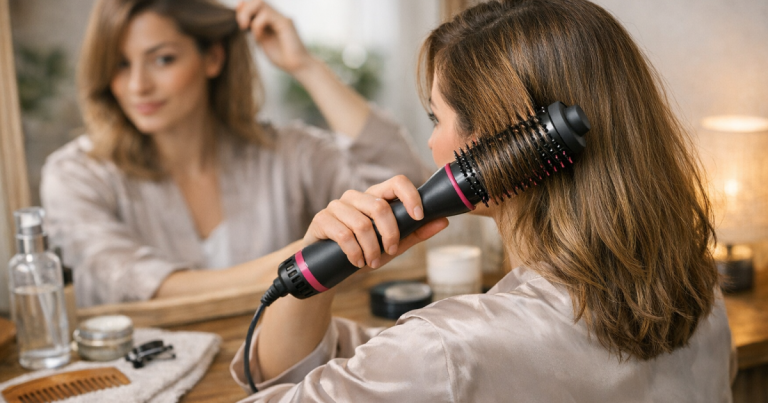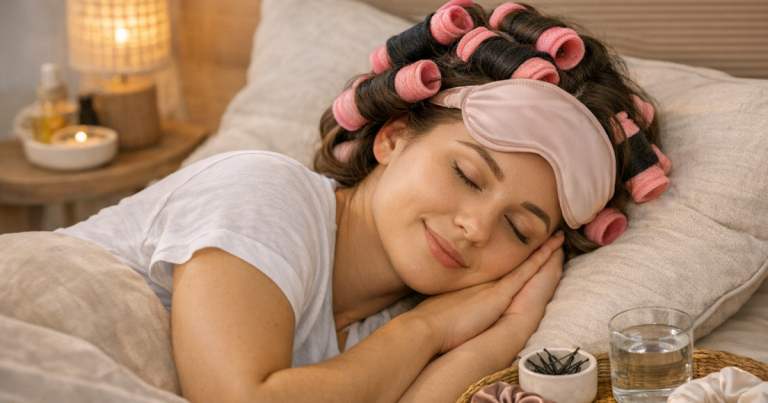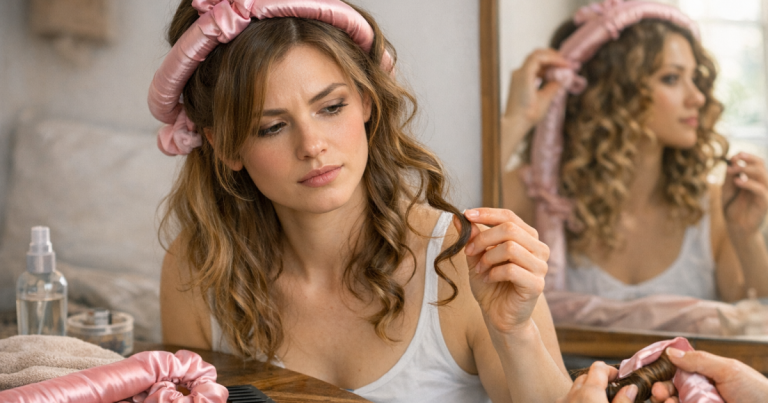
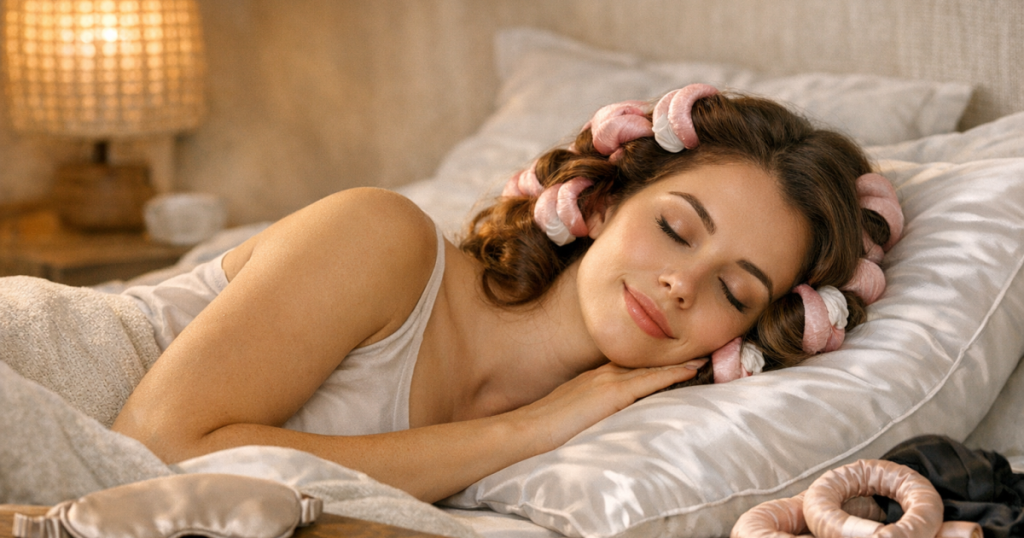
The trick when you sleep in heatless curls is not to make them immovable; it is to give them enough space, dryness and soft support to hold their shape. Most flattened curls happen because the set is too damp, tied too tightly, or pressed directly between your head and the pillow.
A good overnight routine should feel secure but not rigid. You want the curl former, rod, roller or wrap to stay in place while the finished curl pattern is protected from friction and heavy pressure.
At a glance
- Start drier than you think: hair should be barely damp or fully dry with light styling product, not wet.
- Lift the set away from pressure points: keep rods, socks or curling ribbons high enough that you are not lying directly on the curl bends.
- Use soft, low-tension securing: avoid tight elastics that leave dents or flatten the ends.
- Protect the surface: a silk or satin bonnet, wrap or pillowcase reduces friction and keeps the curl clumps neater.
- Match the method to your hair: fine hair needs less weight; thick hair needs better section control; shorter styles need more root protection.
Step 1: Set the curls so they can survive the night
Overnight curl preservation starts before your head touches the pillow. If the hair is too damp, the outer layer may dry into a compressed shape while the inside remains soft and collapses. For most hair types, towel-dried hair should be left to air-dry until it feels only slightly cool to the touch before you wrap it.
Fine or low-density hair usually does best with a very light misting rather than a full damp set. Too much moisture makes the curl look limp by morning, especially around the crown. If you use flexi rods and your hair tangles easily, section size and removal technique matter as much as the sleep position; this guide to using flexi rods without tangling fine hair is a useful next step.
Thick, coarse or high-density hair can take slightly more moisture, but it still needs even distribution. Avoid wrapping chunky sections that feel different from root to tip: dry on the surface and damp underneath is a common reason curls flatten at the roots and puff at the ends.
Step 2: Choose an overnight position that protects the curl shape
Think about where your head actually rests. If your curl former sits at the back of your head and you sleep on your back, you are likely to crush the set. If you sleep on one side, the lower side often comes out smoother and flatter than the upper side.
For a central curling rod or robe-belt method, place the rod slightly higher on the head rather than low at the nape. The aim is to keep the bulk above or around the crown so it is not trapped under the heaviest part of your head. For side sleepers, a loose top placement often protects both sides better than a low side braid or tight bun.
If you use individual rods or rollers, avoid placing the largest pieces exactly where your head meets the pillow. Around the hairline, temples and nape, smaller sections sit more comfortably and are less likely to shift. This is especially helpful if you have a bob, layered cut or face-framing pieces that lose shape quickly.
Step 3: Secure the ends without denting them
The ends are usually the first part of an overnight curl to look odd in the morning. They can spring out straight, crease under an elastic, or dry into a hook shape if they are tucked unevenly.
Use soft hair ties, satin scrunchies or the fabric ties that come with your heatless curler, and keep the tension gentle. The securing point should hold the section in place, not clamp it. If you need an elastic to stop the ends escaping, place it over fabric or use a spiral-style tie with care so it does not cut a hard line into the curl. For a closer look at whether this type of tie works well for overnight sets, read the Invisibobble Original Hair Tie review for heatless styling.
For longer hair, roll the final few centimetres neatly around the curler before securing. For blunt ends, smooth them with a touch of leave-in cream or a drop of lightweight oil before wrapping, using less than you would for a daytime finish. Too much product can weigh down the curl by morning.
Step 4: Use a bonnet, wrap or pillowcase for friction control
Friction does not always destroy the curl completely; more often, it roughens the outside so the curl looks larger, less defined and slightly fuzzy. A satin or silk surface helps the set move with your head rather than catching against cotton bedding.
A bonnet works well if your curls are fully contained and you do not mind a little root compression. A scarf or wrap can be better if you need to guide the hair upwards, but tie it lightly at the front or side rather than tightly across the hairline. If bonnets slide off, try placing the opening slightly behind the hairline and tucking the nape in last.
A silk or satin pillowcase is the lowest-effort option and is useful even when you do not use a bonnet. It will not hold a loose set in place by itself, but it reduces the friction that turns careful heatless curls into fluffy bends.
Step 5: Adjust the method for your hair type
Fine or easily flattened hair
Keep the set light. Use fewer heavy accessories, smaller amounts of product and a higher placement at the crown. If fine hair goes flat at the roots, do not wrap the first few centimetres too tightly against the scalp; leave a little lift so the root does not dry plastered down.
Thick or long hair
Section control is the priority. Large sections can look impressive when wrapped but often dry unevenly overnight. Divide the hair so each section has a similar thickness, then secure the weight high enough that it does not pull the curl down while you sleep.
Wavy or curly hair
Work with the existing pattern rather than brushing it completely smooth first. Lightly detangle, add moisture only where needed, and wrap in the direction your hair naturally wants to curl. A bonnet is particularly useful because it helps keep curl clumps together.
Short hair, bobs and layers
Shorter pieces need more deliberate placement because they escape easily. Use smaller sections near the face and nape, and avoid bulky rods directly behind the head. If your bob needs smoothness as well as lift, keep the top sections elevated rather than flattened under a scarf.
Morning removal without losing the work
Do not pull the set out while you are still half asleep. Unwrap slowly, starting with the securing ties and then releasing the hair in the reverse direction of the wrap. If a curl feels slightly damp, leave it alone for a few minutes before separating it; touching it too soon can turn it soft and shapeless.
Once everything is out, shake at the roots with your fingertips rather than brushing through immediately. Separate only the curls that need softening. If the crown has compressed, a couple of large Velcro rollers at the top while you get ready can restore lift without redoing the whole style. The technique is explained in more detail in this tutorial on getting lift at the roots with Velcro rollers.
If the ends are too curled, smooth them with warm hands and a tiny amount of serum or oil. If they are too straight, mist your fingers lightly, twist the ends around them, and let them dry completely before separating.
Common reasons curls go flat overnight
- The hair was too wet: wet hair is easier to mould, but it is also easier to squash.
- The curler sat in the wrong place: anything placed under the back or side of your head will be compressed.
- The set was too tight at the root: tight wrapping can remove volume, especially on fine hair.
- The securing tie dented the curl: hard elastics can create bends that are difficult to disguise.
- The hair was over-conditioned: rich masks and heavy oils can make overnight curls drop faster.
- The morning separation was too rough: brushing too soon can turn defined curls into stretched waves.
FAQ
Is it better to sleep with heatless curls wet or dry?
Barely damp or dry is usually better than wet. Hair that is too wet may not dry fully overnight and can flatten where it is pressed against the pillow.
How do I stop the roots going flat while I sleep?
Keep the curling tool slightly lifted from the scalp and avoid wrapping the first few centimetres too tightly. In the morning, loosen the roots with fingertips before separating the curls.
Can I sleep on my side with heatless curls?
Yes, but place the bulk of the set higher or more towards the crown so you are not lying directly on it. A satin pillowcase helps the set glide rather than drag.
Why do my curls look good at night but drop by morning?
The most common causes are too much moisture, sections that are too large, heavy product, or accessories pulling the curl down overnight. Smaller, drier sections usually last better.
Should I brush heatless curls after sleeping in them?
Only if you want a softer wave. For more definition, separate with fingers first, then use a wide-tooth comb or brush only through areas that need blending.
What stands out
To sleep in heatless curls without flattening them, focus on three things: the hair must be dry enough to set, the curl shape must not sit directly under your head, and the surface around it should be soft and low-friction. The right routine is not the tightest one; it is the one that protects shape while letting your hair keep movement and lift.