Thick hair can make heatless waves look beautifully full, but it can also hide damp patches, create uneven bends and leave the underneath straighter than the top. The trick is to section thick hair in a way that gives every layer the same tension, drying space and styling time. Think less about making tiny sections and more about making balanced sections that suit your density, length and wave tool.
At a glance
- Start with fully detangled hair so each panel wraps smoothly instead of bunching.
- Use four to six main sections for most thick hair, then split each section as you wrap.
- Keep each subsection similar in thickness, not just similar in width.
- Make the lower layers slightly smaller if your underneath hair is dense or slow to dry.
- Check roots, ends and tension before leaving the style to set.
Step 1: prep the hair before you make sections
Sectioning works best when the hair is already smooth enough to separate cleanly. If thick hair is knotty, puffy or unevenly damp, even careful parting will not fix the finished shape. Start by detangling from the ends upwards, then smooth through the mid-lengths and roots once the ends move freely.
Hair should usually be dry or lightly damp, not wet. Wet thick hair can take too long to set, especially when wrapped around a satin rod, ribbon, foam roller or robe-tie style tool. If you prefer a firmer set, mist the lengths lightly rather than soaking them, and avoid leaving the roots wetter than the ends.
For a smoother base, use a small amount of styling cream, mousse or lightweight oil only where your hair needs it. Too much product can make dense sections feel heavy, which can pull waves down before they have properly formed. If frizz appears during prep, use the method in detangling hair before heatless styling without frizz before you start wrapping.
Step 2: choose the right section map for your density
There is no single perfect grid for thick hair. The best map depends on how much hair you have at the crown, nape and sides. To section thick hair for even heatless waves, aim for panels that feel similar in bulk when held between your fingers.
For medium-thick hair
Use four main sections: left front, right front, left back and right back. This works well if your hair is thick but not extremely dense at the nape. Clip each quadrant away, then take smaller subsections from each as you wrap.
For very thick or coarse hair
Use six sections: two at the nape, two through the middle and two at the crown or front. The nape often needs its own smaller sections because it is where hair can stay damp, flatten against the neck or come out straighter than the visible top layers.
For thick hair with layers
Separate by layer length as much as by position. Shorter face-framing pieces should not be forced into the same wrap as long back sections, because they can slip out or create a bend in the wrong place. Clip shorter layers forward and wrap them with lighter tension.
Step 3: part cleanly, then clip with purpose
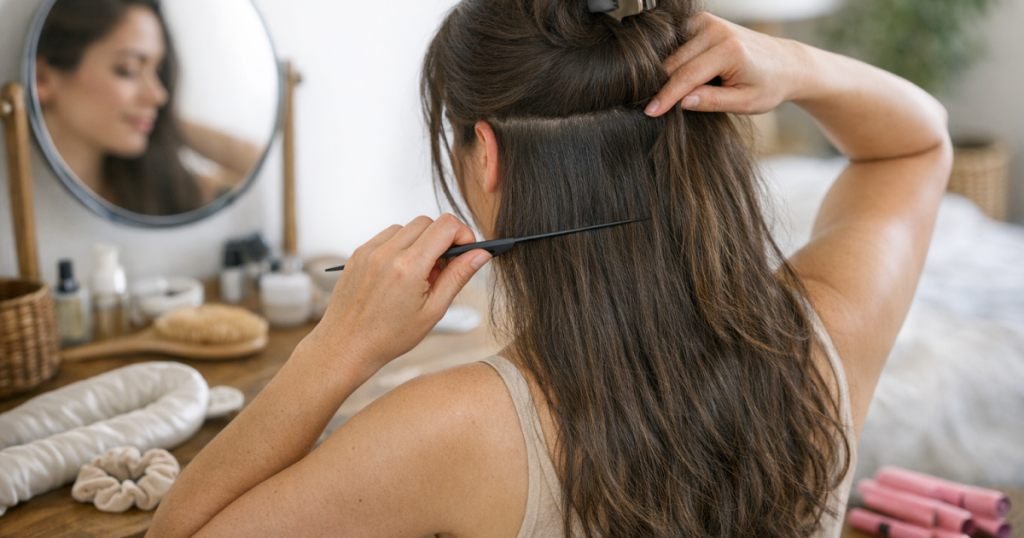
Use your fingers for soft, natural-looking waves or a tail comb for more precise control. A centre part down the back is often easiest for overnight heatless waves, but a slightly off-centre back split can help if one side of your hair is noticeably heavier.
Clip sections away firmly enough that they stay put, but not so tightly that they create dents at the root. Flat duckbill clips, sectioning clips or claw clips can all work. For thick hair, clips need to hold the whole panel without twisting it into a rope, because twisted hair is harder to wrap evenly.
- Start at the nape: lower layers need the most attention because they are easy to miss.
- Match subsection bulk: a narrow but very dense piece may need splitting again.
- Keep the hair flat: smooth each subsection before wrapping so the wave pattern is cleaner.
- Work symmetrically: if the left side has three wrapped pieces, the right side usually needs three too.
Step 4: make each subsection suit the tool
Heatless waves look patchy when one piece is wrapped tightly and the next is too thick to set. As a guide, each subsection should be narrow enough to lie flat on the tool without stacking over itself. For many thick hair types, that means pieces around 2 to 4 cm wide, adjusted by density rather than measured rigidly.
For a satin curling rod or ribbon
Take smaller pieces near the front and crown, where uneven waves are most visible. Wrap away from the face for a softer, salon-style finish, or alternate direction if you want a more tousled result. Keep adding hair in consistent amounts as you move down each side.
For rollers
Use smaller sections at the nape and larger ones only where the hair is less dense. A roller that feels overloaded will usually give a loose bend rather than a defined wave. Ends should sit smoothly around the roller, not crumple underneath it.
For braids or rope twists
Do not rely on one or two large braids if your hair is very thick. Four braids or twists often give a more even result because the inner hair can dry and set properly. Keep each braid tension consistent from roots to ends.
If your waves tend to drop quickly even when the sectioning looks neat, the issue may be prep, drying time or product weight rather than the section map. The holding tips in getting heatless curls to hold in thick hair are useful once your wrapping technique is already consistent.
Step 5: check tension before you leave it to set
Tension should feel secure, not tight. If the roots are pulled sharply, the style can feel uncomfortable and the wave may start too high or kink near the scalp. If the wrap is too loose, thick hair can expand as it dries and lose the pattern.
Run through these checks before bed or before leaving the style to set during the day:
- Root check: the roots should be smooth but not stretched flat against your scalp.
- Middle check: the thickest part of the section should be touching the tool evenly.
- End check: ends should be tucked or secured smoothly so they do not dry frizzy or flick out.
- Balance check: both sides should have similar section sizes and wrapping direction unless you deliberately want an undone finish.
- Dryness check: if any section feels wet rather than lightly damp, unwrap and blot before resetting.
Examples for different thick hair types
Dense, straight hair that resists waves
Use six main sections and keep subsections fairly small. Straight thick hair often needs more setting time because it wants to return to its natural shape. A light mousse through the mid-lengths can help, but avoid heavy oils before wrapping.
Thick wavy hair with frizz-prone ends
Keep the sectioning moderate rather than tiny. Very small sections can create too much texture and make the ends look busy. Smooth each piece with your hands before wrapping, and use a silk or satin layer while setting if friction makes your hair puff up.
Thick curly or textured hair stretched into waves
Work in smaller, well-moisturised sections and make sure each piece is evenly smoothed before it goes around the tool. The aim is not to pull the hair straight, but to guide it into a softer wave pattern without roughing up the cuticle.
Long, heavy hair
Focus on weight distribution. Long thick hair can drag waves down, so avoid huge sections even if they look tidy at first. Wrap from high enough to support the shape, and secure the ends carefully so the final few centimetres do not dry differently from the rest.
Common sectioning mistakes that cause uneven waves
- Making sections equal in width but not density: the back of the head often has more hair than the front, so it may need extra divisions.
- Ignoring the underneath layer: if the nape is left too bulky, it can stay straighter and make the whole style look unfinished.
- Wrapping damp and dry pieces together: the damp hair sets differently and may also stop the dry hair from holding its shape.
- Using too much product at the roots: heavy roots can flatten the wave before it forms.
- Rushing the takedown: thick hair needs to feel fully dry and cool before you unwrap it.
When a more structured heatless tool helps
If your main struggle is keeping sections controlled, a structured kit can be easier than a freehand ribbon or loose braids. Spiral-style tools, for example, guide the hair into a defined shape and make it more obvious when a section is too thick. They are not automatically better for every hair type, but they can help if your waves turn out irregular because your wrapping varies from piece to piece.
For a closer look at that style of tool, see the Curlformers Spiral Curls Kit review. It is particularly relevant if you want more uniform spirals rather than loose, brushed-out waves.
Questions people ask
Should thick hair be sectioned wet or dry for heatless waves?
Lightly damp is usually better than wet. Thick hair can hold moisture inside the section, so wet wrapping may leave the inner layers unset by morning.
How many sections do I need for very thick hair?
Most very thick hair needs six main sections, then smaller subsections as you wrap. If a piece feels bulky between your fingers, split it again.
Why are my top layers wavy but the underneath is straight?
The underneath sections are probably too large, too damp or not wrapped with enough contact against the tool. Start at the nape and make those pieces smaller.
Can sectioning make heatless waves last longer?
Yes. Even sections dry and set more consistently, which helps the wave pattern hold. Product choice and takedown technique still matter, but sectioning is the base.
Should I brush out thick heatless waves?
Use your fingers first. A brush can expand thick hair quickly, so only brush if you want a softer, fuller finish and your hair is completely dry.
What to remember
Even heatless waves on thick hair come from controlled, balanced sectioning rather than simply using more clips or tighter wraps. Start with detangled hair, divide by density, make the nape smaller if needed, and keep each subsection smooth from root to end. Once the sections feel equal in bulk and the hair has enough time to set, the finished waves should look more consistent through the top, sides and underneath.