Fine hair can look beautifully bouncy with Dyson Airwrap barrels, but it usually needs a lighter hand than medium or coarse hair. The aim is not to overload the section with product or tension; it is to give the airflow a small, clean piece of hair to wrap, dry and cool before you touch it.
The biggest difference is restraint: less moisture, less product, smaller sections and more cooling time. That combination gives fine hair shape without making it limp, fluffy or sticky.
The short version
- Start on hair that is damp rather than wet; around mostly dry usually gives fine hair better hold and less collapse.
- Use smaller sections than you think, especially around the crown and face-framing layers.
- Choose a narrower barrel for a more defined curl, or a wider barrel for a soft bend that may drop faster.
- Use a lightweight heat protectant or mousse sparingly, keeping heavier creams and oils away from the roots.
- Let each curl cool fully before brushing, combing or shaking it out.
Why fine hair needs a different approach
Fine hair refers to the diameter of each strand, not the amount of hair on your head. You can have fine hair that is sparse, fine hair that is dense, or fine hair that looks full but loses curl quickly because each strand has less natural structure.
With an air-styling barrel, fine hair tends to show three common issues: the curl falls within minutes, the ends look wispy, or the roots go flat while the mid-lengths curl. These problems are usually caused by using sections that are too large, starting too wet, applying too much styling product, or disturbing the curl before it has cooled.
Detangling also matters. Fine strands can snag easily, and rough brushing before styling can create flyaways that the airflow then exaggerates. If this is a regular problem, use the same gentle prep principles you would use to detangle hair before styling without adding frizz.
Step 1: Prep with lightness, not layers of product
Start with clean or freshly refreshed hair if your roots become oily quickly. Fine hair often loses lift when there is too much conditioner, leave-in cream or oil near the scalp, so keep richer products on the very ends only.
A useful prep routine is:
- Blot hair gently with a towel rather than rubbing.
- Detangle from the ends upwards with a brush or wide-tooth comb that does not pull.
- Apply a lightweight heat protectant suited to fine hair.
- Add a small amount of mousse or volume spray only if your hair normally drops curl quickly.
- Dry the roots first so they are not left damp and heavy.
If your hair feels coated before you even start, the finished curl will usually fall faster. Fine hair performs best when it feels clean, flexible and slightly grippy rather than silky-slippery.
Step 2: Get the dampness right
Dyson Airwrap barrels work best when fine hair has enough moisture to reshape but not so much that each section takes a long time to dry. If hair is too wet, the curl may look good on the barrel but collapse because the inside of the section has not dried properly. If hair is completely dry and very smooth, the curl may not have enough memory.
For most fine hair, aim for damp lengths and nearly dry roots. If you are restyling second-day hair, mist the mid-lengths lightly with water or a styling spray rather than soaking the hair. The section should feel cool and flexible, not dripping or heavy.
Step 3: Pick the right barrel for the finish you want
A narrower barrel generally creates a tighter curl that relaxes into a longer-lasting wave, which can be helpful for fine hair that drops shape quickly. A wider barrel gives a softer, blow-dry-style bend, but on very fine or very straight hair it may settle into volume rather than a visible curl.
If your hair is long, the difference between barrel widths becomes more noticeable because the weight of the length pulls the curl down. For a deeper breakdown of curl size and finish, read our guide to 30mm versus 40mm Airwrap barrels for long hair.
Barrel direction also changes the result. Curling away from the face gives a polished, open look around the front. Alternating direction through the back can make fine hair appear fuller because the curls do not merge into one flat wave.
Step 4: Section fine hair properly
Fine hair does not always need many layers, but it does need controlled sections. Too much hair on the barrel reduces airflow through the section, while too little can make the ends look stringy. A good starting point is to divide hair into a lower layer, a middle layer and a crown section, then split each layer into left and right.
If your hair is fine but dense, sectioning becomes more important. Use clean clips and work in neat rows so the underneath is not left damp. The same principle applies to denser textures: even sections create even waves, as shown in our guide on sectioning thick hair for more even results.
For face-framing pieces, take narrower sections and reduce the amount of tension. Fine front layers can over-curl quickly, so it is better to style them gently and let them cool in place.
Step 5: Wrap, dry, cool and release
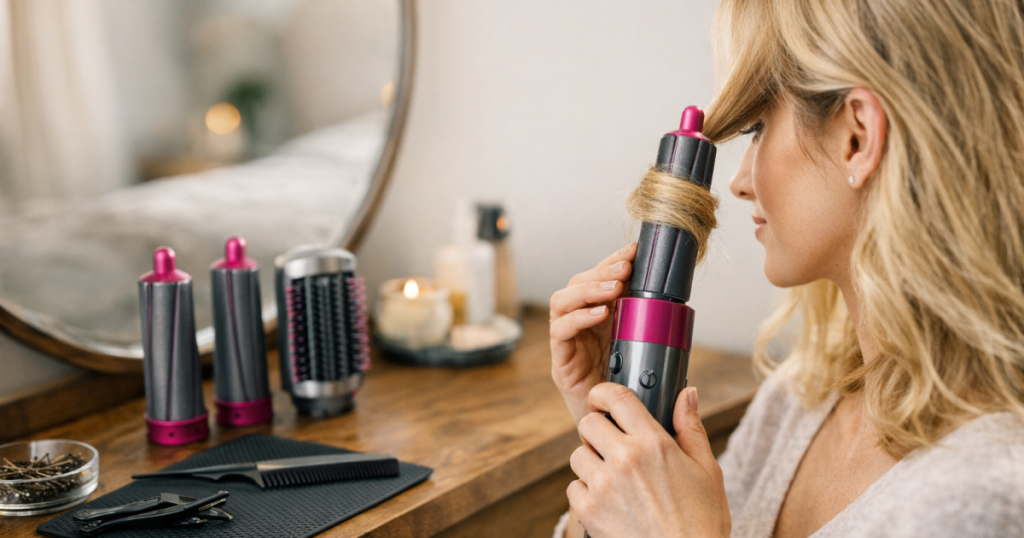
Work from the lower sections upwards. Hold the barrel close enough for the airflow to attract the ends, then allow the hair to wrap around the barrel rather than forcing it tightly by hand. Once wrapped, move the barrel towards the roots without pressing it hard against the scalp.
Use this rhythm for each section:
- Hold the section cleanly by the ends.
- Let the airflow catch and wrap the hair around the barrel.
- Keep the barrel steady while the section dries.
- Use the cool setting or cold shot before releasing.
- Turn off or reduce airflow before pulling the barrel away, so the curl is not blown apart.
Fine hair often needs less tension than you expect. If you pull too hard, the curl can stretch out before it has set. If the ends look frizzy, make sure they are wrapping smoothly and not flicking around the barrel.
Step 6: Set the curl without making it crispy
Once a curl comes off the barrel, leave it alone. You can cup it in your hand for a moment, clip it lightly while it cools, or let it hang in its coil shape. Brushing immediately is one of the fastest ways to lose the result on fine hair.
After every section is cool, use your fingers or a wide-tooth comb to soften the shape. If you want more volume, lift at the roots with your fingertips rather than brushing through from scalp to ends. Finish with a flexible hairspray if needed, using a light mist from a distance so the hair does not become wet or stiff.
For a smoother finish on the ends, use only a trace of oil or serum, rubbed between your palms first. Too much shine product can flatten the curl and make fine hair look separated.
Troubleshooting common fine-hair Airwrap problems
The curl drops within an hour
Use slightly smaller sections, start a little less wet, choose a narrower barrel, and cool each curl for longer before touching it. A tiny amount of mousse can help, but too much product will weigh the hair down.
The roots look flat
Dry and lift the roots before curling the lengths. Avoid conditioner, oil or styling cream near the scalp. When you section the crown, over-direct the hair slightly upwards so it cools with more lift.
The ends look fluffy
Check that the ends are detangled and wrapping neatly. If they are too dry, mist lightly before styling. If they are overloaded with product, the barrel may not smooth them evenly.
One side curls better than the other
This is usually angle and direction rather than the tool itself. Watch whether you are holding the barrel vertically on one side and diagonally on the other. Match your section size and barrel direction as closely as possible.
Common questions
Should fine hair be wet or dry before using the barrels?
Damp is usually best. Fine hair should not be dripping wet, and the roots should be close to dry so they do not collapse after styling.
Do fine hair types need mousse with the Airwrap?
Not always. Use mousse if your hair is very straight or drops curl quickly, but choose a lightweight formula and apply less than you would for a traditional blow-dry.
Is a smaller barrel better for fine hair?
Often, yes. A smaller barrel gives a more defined curl that can relax into a soft wave, while a larger barrel may give fine hair more of a loose bend.
Can I use the barrels on short fine hair?
Yes, provided the section is long enough to wrap securely. Keep sections narrow, use gentle tension and focus on the mid-lengths rather than forcing very short ends around the barrel.
How do I stop fine hair looking too styled?
Let the curls cool first, then loosen them with fingers rather than a brush. Alternate curl directions through the back and keep the front pieces softer for a more natural finish.
In brief
The Dyson Airwrap can work beautifully on fine hair when you adjust the method rather than copying a thick-hair routine. Start cleaner and lighter, keep the hair only damp, use smaller sections, cool every curl properly and avoid brushing until the shape has set. The result should be soft movement with lift, not overloaded curls that fall flat before you leave the house.