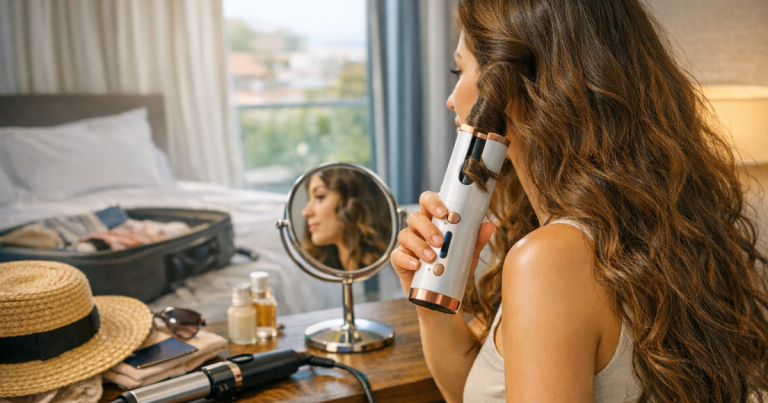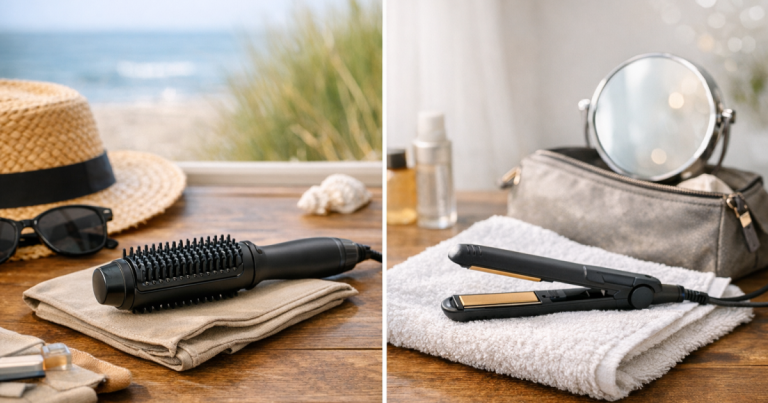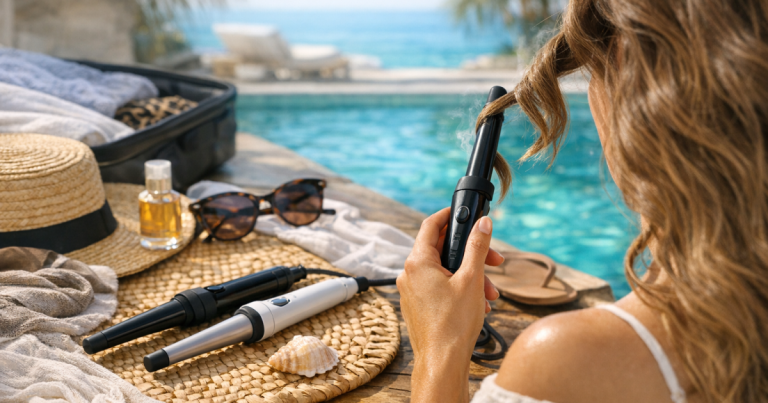
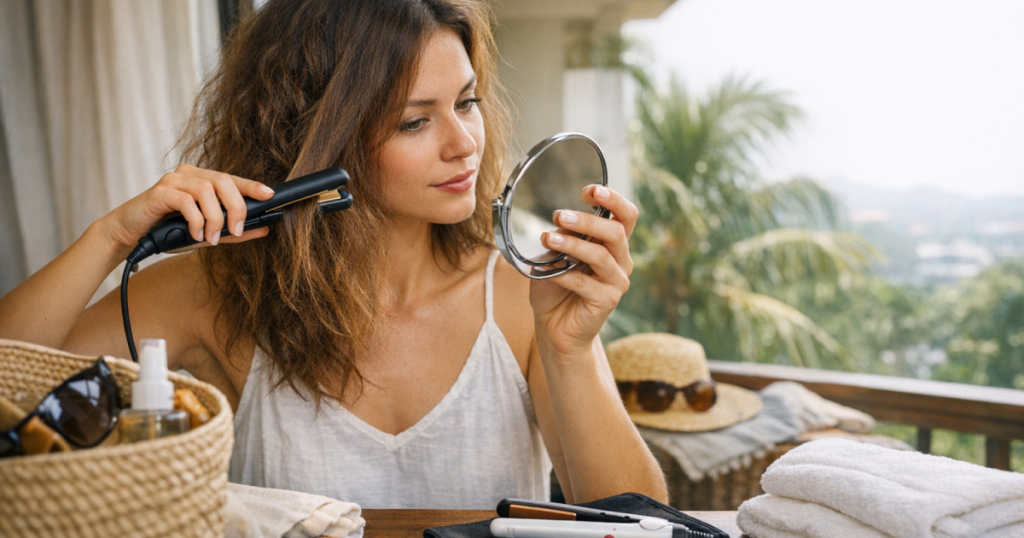
Humid weather is where sleek styling gets tested: hair absorbs moisture from the air, the cuticle lifts, and carefully smoothed sections can turn fluffy within minutes. Used well, mini straighteners can help control frizz around the hairline, fringe, parting and ends, but they are not a full fix for every hair type or every climate.
The most realistic way to use a compact iron is as a targeted touch-up tool, not as your only defence against humidity. Prep, section size, heat discipline and finishing product matter just as much as the tool itself.
At a glance
- Small straightening irons are best for localised frizz: baby hairs, fringe pieces, short layers, face-framing sections and flicked-out ends.
- They struggle on long, thick, dense or very curly hair if you try to smooth the whole head.
- Humidity control starts before heat: conditioner, careful drying and a light anti-frizz finish give the plates something smoother to work with.
- On holiday, they make sense for quick hotel-room touch-ups, but you should check voltage compatibility and plug requirements before packing any heated tool.
- For curls, coils or waves, a compact iron is usually better for tidying specific pieces than changing the whole shape of the style.
Why humid weather makes frizz harder to control
Frizz in damp air is not just a styling failure. Hair is porous to different degrees, and when the air is humid, strands can take in moisture unevenly. That uneven swelling disrupts the outer cuticle, which makes the surface look rougher and less uniform.
Heat can temporarily smooth the hair fibre by pressing sections flat, but it does not make hair immune to moisture. If the hair is already dry, damaged, over-lightened or product-heavy, a quick pass with a hot tool may make the surface look better for a while, then leave it more prone to puffiness later in the day.
This is why a small iron can look brilliant on a fringe before breakfast and feel less impressive after a walk by the sea, a rainy commute or a warm restaurant. The tool helps with shape and polish; the rest of your routine helps the result last.
Where mini straighteners genuinely help
Mini straighteners are most useful when the frizz is concentrated in small, visible areas. Think of the short hairs around the temples, the top layer near your parting, a cowlick in a fringe, or the ends of a bob that kick out in damp air. These areas are awkward with full-size plates and often do not need a complete restyle.
They are less convincing as a whole-head smoothing tool. The smaller plate area means more passes, more time and more opportunity to overheat the same strands. If your hair is long, very dense or coarse, a compact iron may still have a place in your bag, but it should be treated as a finisher rather than the main event.
Real compact tools readers often come across include ghd Mini Styler and Cloud Nine The Micro Iron. They are useful examples of the category, but always verify the current plate size, heat settings, voltage information and manufacturer guidance yourself rather than assuming every compact tool behaves the same way.
How to use a compact straightener for humid-weather frizz
1. Start with properly dry hair
Do not use straighteners on damp hair unless the manufacturer specifically says the tool is designed for that purpose. For normal straightening irons, hair should be fully dry before the plates touch it. In humidity, even slightly damp roots or underlayers can expand quickly and make the finished style look fuzzy.
After washing, dry the roots well and smooth the surface with your preferred brush or drying method. If your hair is porous or heat-stressed, your wash-day base matters. A repairing conditioner can help the hair feel smoother before styling; our Moroccanoil Moisture Repair Conditioner review looks at whether that type of formula makes sense for heat-damaged lengths.
2. Use heat protection, then keep products light
A heat protectant is sensible whenever you are using hot plates. Apply it as directed, let the hair dry fully if the product is wet, and avoid layering too much oil, wax or heavy cream before straightening. Overloaded hair can separate, smoke, feel greasy or lose movement.
For humid weather, a light anti-frizz spray or smoothing cream before drying often works better than trying to fix everything at the end. The aim is to create a flexible, smoother surface rather than a stiff helmet of product.
3. Work in tiny, deliberate sections
Small plates need small sections. If you feed too much hair through at once, the outer hairs may be smoothed while the inner hairs stay puffy. For a fringe, split the hair into two or three narrow sections. Around the hairline, isolate only the pieces that are visibly frizzing rather than clamping the entire front section repeatedly.
Move slowly enough that one pass can do the work, but not so slowly that you scorch or flatten the hair unnecessarily. If your straightener has adjustable heat, use the lowest effective setting for your hair type and condition.
4. Focus on the surface, not the whole head
In humid weather, the top layer is what people usually notice first. Smooth the parting area, temples, fringe and ends, then stop. Chasing every slightly uneven strand can make hair look limp and can increase heat exposure without making the style more weatherproof.
For a sleeker ponytail or bun, run the tool only over the face-framing pieces and the top surface before styling. For a bob, use it to tuck the front sections or polish the ends. For layered hair, target the shortest layers that swell first.
5. Let the hair cool before stepping outside
Hair sets as it cools, so do not straighten and immediately walk into muggy air. Give the touched-up sections a minute or two to settle. A flexible finishing spray, a tiny amount of serum on the palms, or a humidity-resistant styling product can help, but use less than you think you need.
If the weather is very damp, accept a softer finish. Trying to force glass-like hair in heavy humidity often leads to more heat, more product and a style that collapses anyway.
Hair-type guidance: when it works and when to skip it
Fine hair
Fine hair often responds well because there is less density for the plates to control. A compact iron can tidy a fringe, smooth the crown and refine the ends without dragging down the whole style. The risk is over-flattening: too many passes can remove volume and make the roots look oily sooner.
Use very small sections, avoid clamping close to the scalp unless you need to correct a kink, and finish with your fingers rather than brushing everything flat. If your main issue is fine hair losing shape rather than surface frizz, air-styling may be a better route; our guide on using Dyson Airwrap barrels on fine hair explains a softer approach.
Medium, straight or wavy hair
This is the easiest category for compact touch-ups. If your hair is not especially dense, a small iron can smooth the visible outer layer and sharpen the ends quickly. It is particularly handy for collarbone cuts, fringes, bobs and layered styles that misbehave around the face.
For natural waves, avoid straightening random sections too perfectly unless that is the look you want. A poker-straight fringe against softly waved lengths can look mismatched, so keep the pass light and follow the natural direction of the style.
Thick or coarse hair
Thick hair needs more patience. A compact iron can polish the hairline and ends, but it is unlikely to replace a full-size straightener for a complete smooth finish. If you try to tackle dense sections with tiny plates, you may end up repeating passes and creating dryness without much extra control.
Use it after your main styling method, not instead of it. Blow-dry as smoothly as you can, then refine the areas that puff up first. For very coarse hair, sealing the style with the right finishing product may make more difference than using a smaller plate tool aggressively.
Curly and coily hair
Curly and coily hair is more likely to revert in humid conditions, especially if it has been stretched or straightened. A compact iron can neaten edges, short face-framing pieces or a fringe, but it will not reliably hold an entire straight style in damp air without a full smoothing routine.
If you are travelling and wearing your natural texture, a diffuser, clips and curl-friendly styling products may be more useful than trying to straighten frizz away each morning. For holiday packing decisions, read whether a travel diffuser is enough for curly hair abroad.
Bleached, fragile or heat-damaged hair
Be conservative. Frizz on fragile hair is often linked to porosity and breakage, so pressing it flat every day can make the surface look smoother short term while worsening the problem over time. Keep heat for visible touch-ups, lower the temperature if your tool allows, and avoid repeated passes on the same pale or brittle pieces.
For this hair type, the best humidity strategy is usually a mixture of repair-focused care, gentle drying, protective styling and occasional heat, rather than daily straightening.
Travel checks before you pack one
A compact straightener is appealing for weekends away, hand luggage and gym bags, but travel adds a few practical checks. Look at the manufacturer’s voltage information for the exact model, not just the brand. If you are going abroad, check whether you need a plug adaptor and whether the tool is suitable for the local mains supply.
Let heated tools cool fully before packing them, and use a heat-resistant mat or pouch if the manufacturer provides one or recommends one. In small hotel rooms, keep the plates away from towels, bedding and product spills. For UK staycations, the main benefit is convenience: a smaller tool takes less space and is easier to use for quick fringe or hairline fixes before heading out.
Common mistakes that make frizz worse
- Straightening too much hair: compact plates are not efficient on large sections, so the finish can become uneven.
- Repeating passes on the same front pieces: this can make fragile baby hairs look smooth temporarily, then weaker and fuzzier over time.
- Using heat on product-heavy hair: too much serum, oil or hairspray before straightening can leave hair sticky or dull.
- Skipping the drying stage: damp roots and underlayers will expand in humidity no matter how polished the surface looks.
- Expecting rain-proof results: humid-weather styling is about reducing puffiness, not making hair immune to moisture.
Fast answers
Are mini straighteners better than full-size straighteners for frizz?
They are better for precision, not for speed or whole-head smoothing. Use them for fringes, hairlines, short layers and ends. For long or thick hair, full-size plates are usually more efficient for the main style, with a compact iron reserved for detail work.
Can they stop hair going frizzy all day?
Not on their own. They can smooth visible frizz, but humid air can still make hair swell or revert. The result lasts longer when hair is fully dry, lightly protected, carefully sectioned and finished with an appropriate anti-humidity product.
Are they good for short hair?
Yes, short hair is one of the strongest uses. Pixie cuts, bobs, fringes and cropped layers are easier to control with small plates because you can reach close areas without flattening the rest of the style.
What stands out
Mini straighteners can control frizz in humid weather when the job is small and specific. They are excellent for polishing the pieces that frame your face, correcting a fringe, tidying the parting and refreshing short styles while travelling.
They are not a magic shield against moisture, and they are not the most efficient tool for dense, long or highly textured hair. Treat them as a compact finishing step alongside good conditioning, proper drying and realistic humidity expectations, and they become much more useful.