A hotel bathroom, unfamiliar water and limited luggage space can make wash day feel less predictable than it does at home. A travel diffuser for curly hair can be enough abroad when your curls dry easily, your dryer is compatible with local voltage, and you are not relying on it to rescue an under-planned routine.
Using a diffuser abroad means connecting a powered hair tool to mains electricity. Voltage conversion, plug compatibility and damaged cables should be dealt with according to the manufacturer’s instructions and local electrical safety requirements; faulty tools should be assessed by a qualified professional.
What to know first
A compact diffuser is usually a drying aid, not a complete curl solution. It helps disperse airflow so curls are less blasted out of shape, but the result still depends on your cut, product layering, water quality, climate, drying time and the dryer it is attached to.
- It can be enough for loose waves, fine curls and low-density hair if you can dry in sections without rushing.
- It may be only part of the plan for dense curls, long hair, high-porosity hair or tight coils that need more drying time.
- It is less reliable if you are depending on a hotel hairdryer, as shape, nozzle size and airflow can vary widely.
- It works best when paired with a simple routine: detangle, apply product evenly, scrunch or define, then dry patiently.
When a travel diffuser for curly hair is enough
A travel diffuser is enough when your main problem is controlling airflow rather than creating curl from scratch. If your hair already forms a clear wave, curl or coil pattern after washing, the diffuser’s job is to help that pattern dry without too much frizz or stretching.
For 2A to 2C waves, a compact diffuser can work well if you use a light hold product and avoid touching the hair while it is wet. Waves tend to collapse if they are over-handled, so the biggest win is gentle airflow and keeping the head position consistent while drying.
For 3A to 3B curls, it depends more on density and length. Shoulder-length curls with medium density are often manageable with a travel diffuser, provided you dry in layers and allow time for the roots. Long, heavy curls may dry nicely at the ends but stay damp at the crown, which can lead to flatter roots later in the day.
For 3C to 4C curls and coils, the diffuser can still be useful, but it is rarely the whole answer on its own. Coils often need careful product distribution, sectioning and enough time for the inside layers to dry. If you normally dry with a full-size diffuser at home, a small bowl or sock-style attachment may feel slow, especially in a humid destination.
Check the dryer before you trust the diffuser
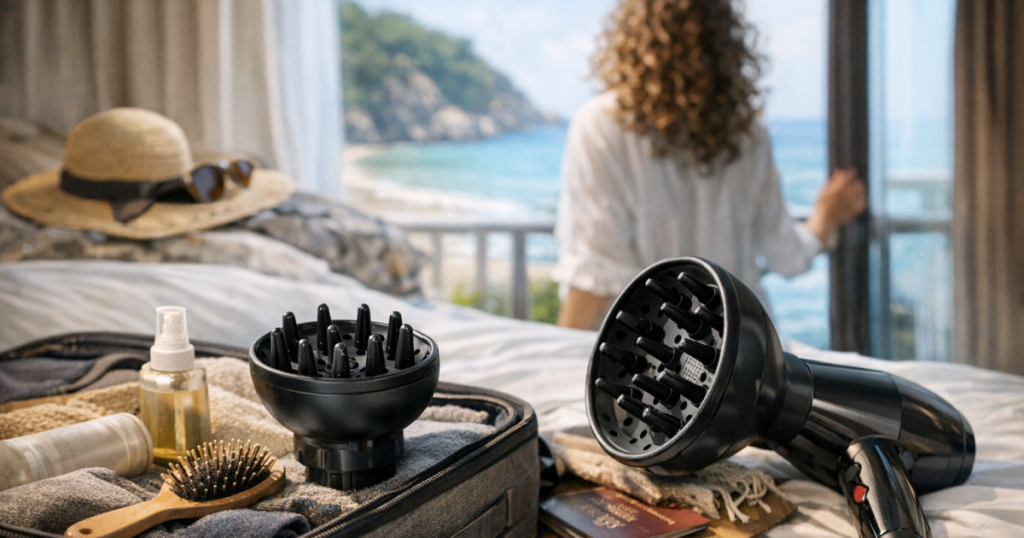
The diffuser is only as useful as the dryer it fits. If you are packing an attachment rather than a dryer with its own diffuser, check the attachment style before you travel. Universal diffusers can be helpful, but “universal” does not mean every hotel dryer will suit it. Some hotel dryers are wall-mounted, unusually shaped, fixed with wide nozzles or too short to hold an attachment comfortably.
Before relying on your setup, do these checks at home:
- Fit: attach the diffuser to the dryer you plan to use and make sure it sits securely without wobbling or slipping.
- Airflow: test whether the air spreads gently or still blasts through one narrow area.
- Heat control: confirm you can use a low or medium setting rather than only hot, forceful air.
- Drying time: time a normal wash day so you know whether your compact setup is realistic before an early checkout or evening booking.
- Packing shape: consider whether a rigid bowl diffuser takes up too much space, or whether a collapsible option compromises too much on control.
If you are weighing up whether to pack one styler rather than separate drying and shaping tools, the guide on whether one compact multi-styler can replace separate travel tools is a useful companion to this decision.
How climate changes the answer
Curly hair abroad is often less about the tool and more about the environment. A diffuser that works perfectly at home can feel underwhelming in a hot, humid climate because the hair takes longer to set and the cuticle may swell before the cast has formed. In dry heat, the opposite can happen: the ends may dry quickly while the inner layers still need time.
For humid destinations, use the diffuser to set the roots and the outer shape first, then let the final dampness air-dry without touching. A stronger hold gel or foam may help your curls keep their shape, but avoid loading the hair with heavy products if you know your roots collapse easily.
For dry climates, focus on even product distribution and avoid using the hottest airflow just to speed things up. Curly ends can become rough if they are dried too aggressively, especially after sun, sea water or pool water. A small amount of leave-in conditioner or a light oil on dry ends can help, but keep the roots clean if volume matters to you.
Match the method to your curl type
Fine waves and loose curls
Fine hair usually needs lift without too much product weight. Tilt your head, cup the ends in the diffuser and bring the bowl towards the scalp before switching the airflow on. Hold for short bursts, then move to another section. If you use air-styling barrels rather than a diffuser for some trips, the fine-hair technique in using Dyson Airwrap barrels on fine hair explains how to avoid overworking delicate lengths.
Medium-density curls
Medium-density curls usually respond well to a balanced routine: apply product in sections, scrunch out excess water with a microfibre towel or cotton T-shirt, then diffuse without constantly changing direction. The aim is to set the curl clumps before they are disturbed by wind, humidity or friction from travel clothing.
Thick curls and dense coils
Dense hair needs more structure before drying. Create smaller sections, make sure product reaches the inner layers and dry the roots deliberately rather than only cupping the ends. If the underneath stays wet, the shape can puff out later even if the surface looked finished in the hotel mirror. The same sectioning logic used for heatless styling can help here; see how to section thick hair for even heatless waves and adapt the approach for drying.
A simple abroad-friendly diffuser routine
Use this routine when you want a realistic holiday wash day without turning the bathroom into a full salon setup.
- Start with soaking-wet hair: apply your curl cream, gel, mousse or leave-in while the hair is still wet enough for product to spread evenly.
- Blot, do not rough-dry: squeeze with a microfibre towel or soft cotton fabric to remove drips without breaking curl clumps.
- Set the parting early: hotel mirrors and weak lighting can make styling awkward, so decide your parting before the hair starts drying.
- Diffuse the roots first if volume matters: lift sections gently and dry close to the scalp on a controlled setting.
- Cup the ends next: bring curls into the diffuser bowl and hold still rather than bouncing the attachment around.
- Stop before full dryness if frizz starts: many curls behave better if you diffuse to around mostly dry, then let the final moisture settle naturally.
- Break the cast later: wait until the hair is dry before scrunching out crunch, otherwise the shape can soften too soon.
When it is not enough on its own
A compact diffuser is likely to feel limited if your curl routine already takes a long time at home. It may also struggle when you are travelling for an event and need predictable results at a set time. In those situations, build in a backup rather than hoping the attachment will do everything.
Good backup options include heatless setting overnight, a silk or satin wrap to protect curls between wash days, a small detangling brush for product distribution, or a plan for refreshing rather than fully washing. For short trips, it can be easier to style before travelling, protect the hair while sleeping, and use the diffuser only to revive the roots or dry a small refreshed section.
Also be realistic about shared accommodation. If you are staying with friends, camping, travelling between cities or using a tiny hotel bathroom, a long diffusing session may not fit the day. A compact tool is convenient only if the routine around it is convenient too.
Things readers ask
Can I rely on a hotel hairdryer with my diffuser?
Sometimes, but it is the least predictable option. Hotel dryers vary in shape, power feel, heat settings and whether they are fixed to the wall. If curls matter for a specific occasion, bring a setup you have tested rather than assuming the attachment will fit.
Is air-drying better than diffusing abroad?
Air-drying can work well in warm climates, but it gives less control over roots and frizz while the hair is wet. Diffusing is better when you need to set the shape quickly, reduce dripping, or stop curls being disturbed by wind, collars and travel movement.
Should I pack a full-size diffuser instead?
Pack the full-size version only if your curls genuinely need it and you have luggage space. For many people, a compact diffuser plus a strong routine is enough for casual holiday hair. For thick, long or event-ready curls, the full-size option may be worth the space if it fits your compatible dryer.
What to remember
A travel diffuser can be enough for curly hair abroad, but only when the whole routine is realistic: compatible dryer, controlled airflow, sensible product layering, enough drying time and a plan for the climate. Fine waves and loose curls usually need the least equipment. Dense curls, long lengths and tight coils need more sectioning, patience and often a backup styling plan.
Before you pack, test the exact dryer and diffuser combination at home, time your routine, and decide whether you need a refresh plan, a heatless overnight option or more protection while sleeping. The right answer is not simply whether the diffuser is small enough for your suitcase; it is whether it gives your curl type enough control when you are away from your usual bathroom.