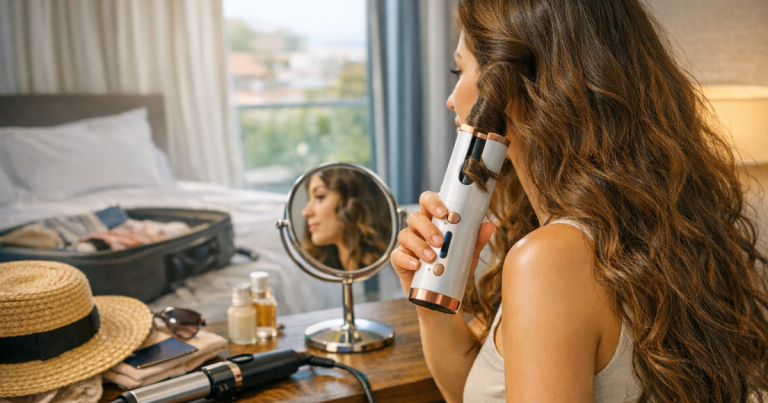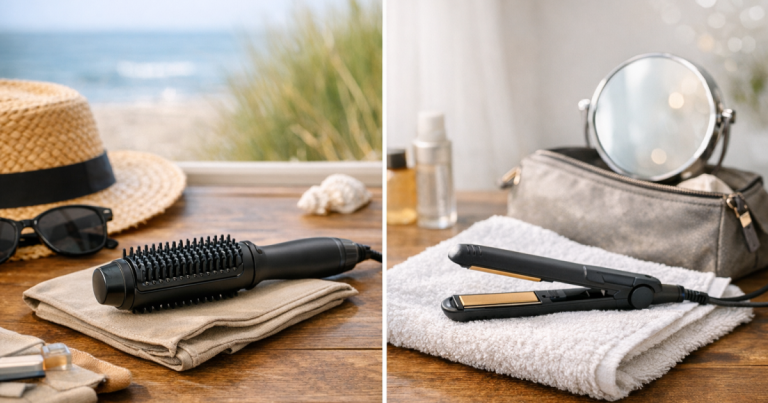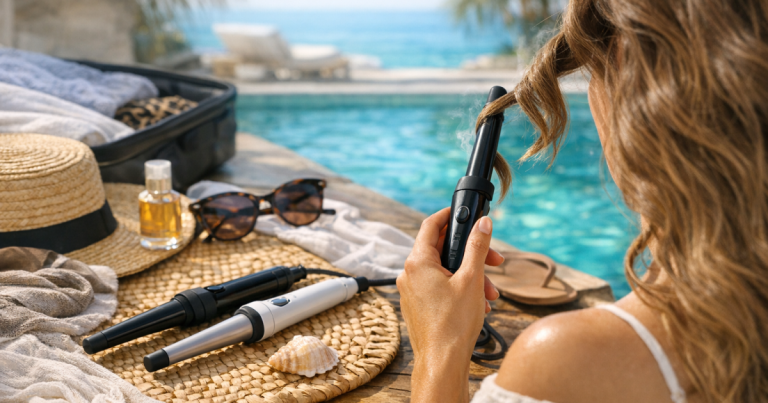
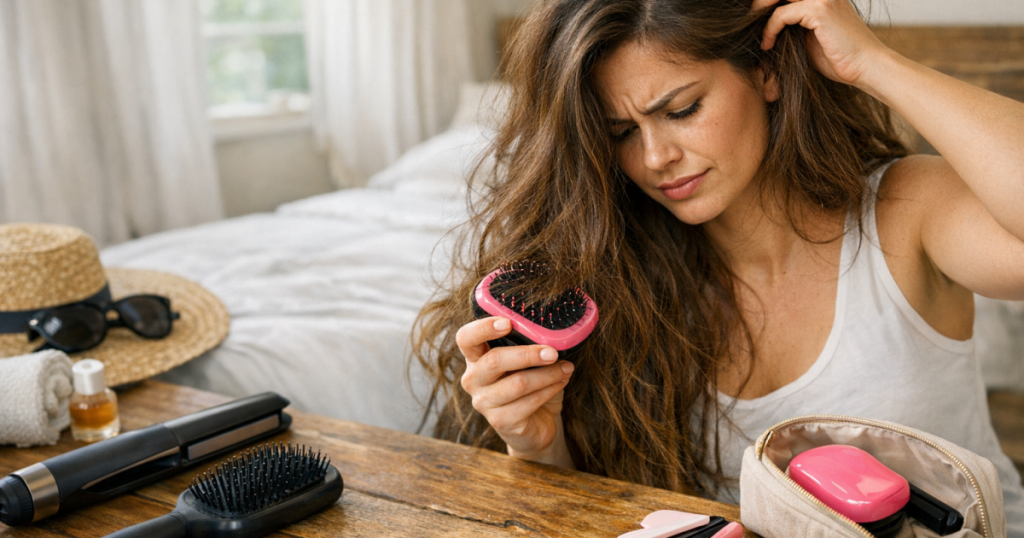
Mini wands, short-barrel straighteners and travel-sized heatless rods can be brilliant for fringes, face-framing layers and quick refreshes. The reason compact stylers often disappoint on long or dense hair is not that they are weak by default; it is that the working surface, section capacity and wrapping time are all scaled down while your hair volume is not. Once you understand that mismatch, it becomes much easier to adjust your technique, pack a different tool, or switch to a heatless method that suits your hair better.
At a glance
- Long hair needs more wrapping length, more cooling time and more controlled tension than a mini tool can always provide.
- Dense hair often fails because the section is too thick for the tool, even when each strand is fine.
- Short barrels, narrow plates and small rollers can create uneven bends because only part of the section is being styled properly.
- Heatless compact tools can work well, but they need dampness, tension and section size to be matched carefully.
- The quickest fix is usually not more pressure or more heat; it is smaller sections, better prep and a more realistic styling plan.
Why smaller tools hit their limit
A compact styler has less contact area. On a curling wand, that means less barrel length for the hair to wrap around. On a mini straightener, it means narrower plates and shorter passes. On a travel roller or rod, it means less surface for the hair to spread across while it dries or sets.
That matters because hair does not style as one flat sheet. The outside strands may touch the tool properly, while the inner strands sit insulated in the middle of the section. With long or dense hair, this creates the familiar result: polished ends, vague mid-lengths, puffy roots, or a curl pattern that looks neat on top but drops underneath.
The issue becomes even more obvious away from home. Holiday hair is often exposed to humidity, hard water, sea air, sun cream residue and rushed drying time. A small tool that feels fine for a quick fringe tidy at home may struggle when asked to reset a full head of waist-length, thick or textured hair in a hotel room.
The hair-type reasons compact stylers struggle
Fine hair, but lots of it
Fine dense hair is one of the easiest types to underestimate. Each strand may respond quickly, but the total volume means sections become bulky fast. A compact tool can leave the top layer smooth while the inner layer stays fluffy or slightly damp. If your curls drop within an hour, the problem may be section depth rather than lack of hold.
Coarse or high-density hair
Coarser strands often need more time under tension to change shape. With a small tool, you may be tempted to clamp harder, repeat passes, or wrap larger sections to save time. That usually makes the finish less even. The hair needs controlled contact, not rushed pressure.
Curly and coily hair
Curly and coily hair brings shrinkage, spring and layered density into the equation. A short barrel or narrow rod can create a tight bend at the end of the section while the root and mid-length remain stretched differently. If you are working heatlessly, drying time and tension are even more important. For a deeper look at why different textures respond so differently, the guide to slip, stretch, shrinkage and hold is a useful next step.
Long layers and grown-out shaping
Layered hair does not wrap evenly unless the shortest and longest pieces are controlled together. On a compact barrel or short rod, shorter layers can spring out while longer pieces overlap too many times. That is when you see awkward flicks, bent ends or one polished face-framing section beside a much looser back section.
A step-by-step way to tell if the tool is too small
1. Check how much hair is sitting on the tool
Take the section you would normally style and reduce it by half. If the smaller section styles more evenly, the tool is not necessarily failing; the original section was too deep for its surface area. As a simple test, try a section around 2 to 3 cm wide and shallow enough that light can pass through it when you lift it away from the head.
2. Watch the middle of the section, not the ends
Ends are usually the easiest part to curl, bend or smooth because they are thinner and make better contact. The mid-length is the truth-teller. If the ends look done but the middle remains puffy, stretched or inconsistent, your tool is not reaching enough of the hair at once.
3. Count how many wraps you are forcing
Long hair wrapped repeatedly over itself on a short barrel creates uneven heat or uneven setting. The first layer touches the barrel or rod; the outer layers sit on hair, not on the styling surface. This can produce a curl that looks strong at the bottom and weak through the upper lengths. With heatless rods, it can also leave hidden damp spots that collapse later.
4. Notice whether styling time doubles
A compact tool is meant to save space, not always time. If you need so many tiny sections that a quick style turns into a full restyle, the tool may not match the job. This is common for long dense hair when trying to create uniform waves rather than touching up a few visible pieces.
5. Check the roots separately
Many travel-friendly tools are easier to use on ends and face-framing pieces than close to the scalp. Dense roots need lift, tension and clean sectioning. If roots stay bulky while the ends look styled, separate the root issue from the curl or smoothing issue. You may need clips, a brush, or a different drying approach before the compact tool has any chance of working neatly.
How to make a compact tool behave better
Prep the hair so the tool is not doing all the work
Hair that is tangled, overloaded with product or unevenly damp will make a small tool feel worse. Detangle first, then decide whether you are styling from dry, nearly dry or lightly misted hair. For heatless methods, slightly damp hair can help shape memory, but dense hair should not be wrapped so wet that the inner layers cannot dry.
Work in zones, not random sections
Divide the hair into practical areas: underneath, crown, sides and front. Style the underneath first, because it is usually the densest and least forgiving. Clip away anything you are not actively working on. This keeps section size honest and stops long hair from merging back into finished pieces.
Use smaller sections without making them too skinny
Very tiny sections can look stringy on long hair, particularly if you want soft waves rather than defined ringlets. Aim for sections that are shallow rather than excessively narrow. In other words, reduce thickness from scalp to surface, not just width from left to right.
Let the shape cool or set before touching it
Whether you use heat or a heatless tool, the shape needs time to settle. Long hair has more weight pulling on the bend, so brushing or finger-combing too soon can undo the work. Clip curls loosely while they cool, or let heatless wraps dry fully before removing them.
Where compact tools still make sense
Small styling tools are not pointless for long or dense hair; they simply need a narrower role. They are often excellent for smoothing a fringe, fixing bends around the hairline, refreshing the top layer, adding polish to face-framing pieces, or creating a few intentional waves rather than a full uniform set.
They also make sense when luggage space matters. If you are choosing between heatless rods, travel curlers and other packable options, the trade-off is usually space versus section capacity. The comparison of heatless curling rods and travel curlers for holiday hair explains that travel decision in more detail.
For many readers, the best use of a compact tool is as a finishing tool rather than the main styling method. For example, you might sleep in a satin heatless curling rod to create the overall shape, then use a mini straightener or small wand only to refine the front pieces. That gives you a styled finish without asking the smallest tool in your kit to handle the heaviest work.
When heatless compact methods are the better answer
Heatless methods can be more forgiving for long or dense hair because they can hold larger shapes over a longer setting period. But they still follow the same rules: the section must not be too thick, the hair must dry or set evenly, and the tool must be long enough to control the length.
A long satin rod may suit soft waves on medium to long hair, while multiple flexi rods can give better control on shorter layers or thicker sections. Velcro rollers can help with root lift and smoothness, but very dense hair may need several rollers rather than two oversized sections. A silk hair wrap can protect the finished shape overnight, although it will not create a curl pattern by itself unless the hair has already been shaped.
The key is to match the method to the outcome. If you want loose bends, you need room for the hair to spread. If you want definition, you need enough individual rods or rollers to avoid overcrowding. If you want smoothness, start with detangling and controlled tension rather than relying on the final pass.
Common fixes for long or dense hair
-
If curls look uneven: reduce section depth, wrap with flatter tension, and avoid stacking hair over itself too many times.
-
If waves drop quickly: allow more cooling or setting time, and avoid brushing until the shape has stabilised.
-
If roots stay bulky: section horizontally, clip the upper hair away, and style the underneath before the visible top layer.
-
If ends flick out: keep the ends aligned as you wrap, or use a roller or rod that gives the ends somewhere smooth to sit.
-
If styling takes too long: use the compact tool only on visible areas and choose a larger or heatless method for the full head.
Helpful questions
Can a mini straightener work on long thick hair?
It can work for touch-ups, fringes, travel emergencies and smaller visible sections. For a full smooth finish on long thick hair, the narrow plates usually mean more passes and more sectioning, so it may feel slow and inconsistent.
Are travel curlers suitable for dense hair?
They can be, provided you use enough of them and keep sections shallow. Dense hair usually struggles when too much hair is wrapped onto too few curlers, especially if the hair is still too damp underneath.
Why does the top layer style better than the underneath?
The top layer is often thinner, easier to see and easier to tension. The underneath tends to be denser and more compressed, so it needs cleaner sectioning and more patience.
Should long hair always avoid compact stylers?
No. Compact stylers can be very useful when their role is realistic. They are better for refining, refreshing and travel touch-ups than for styling a full head of long dense hair from scratch.
Why it matters
When a small tool struggles, it is easy to blame your hair for being difficult. More often, the tool is simply being asked to handle more length, density or texture than its size allows. Adjusting the section depth, giving the style time to set, and choosing heatless support where appropriate can make the same routine feel much less frustrating.
If you are rethinking your styling setup, start with the result you want and the behaviour of your hair rather than the size of the tool alone. The guide to matching styling goals and tools to your hair type can help you decide whether your next step should be better technique, a different heatless method, or a more suitable at-home styling tool.