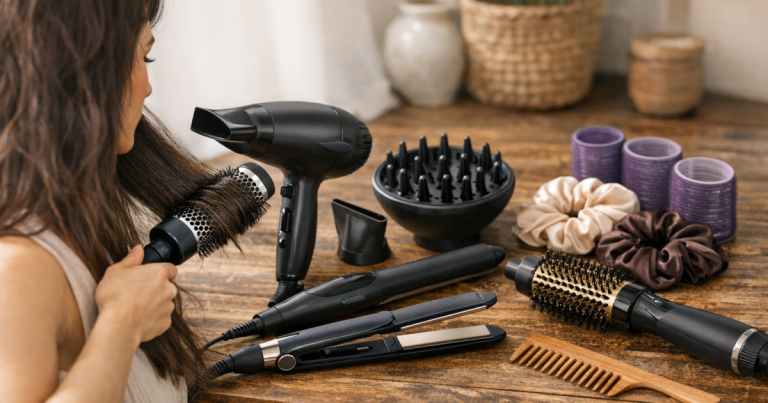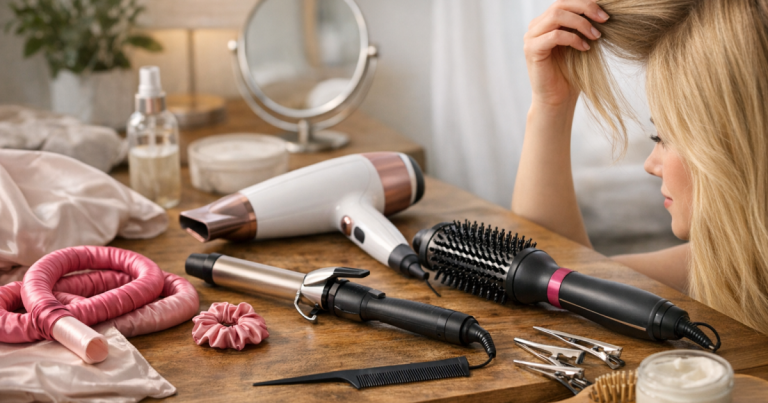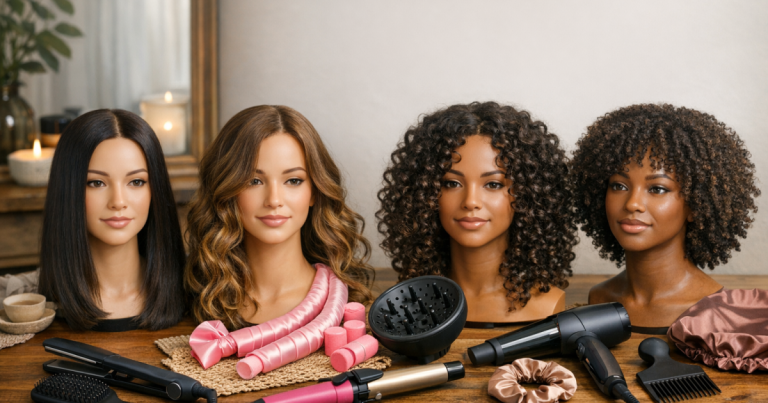
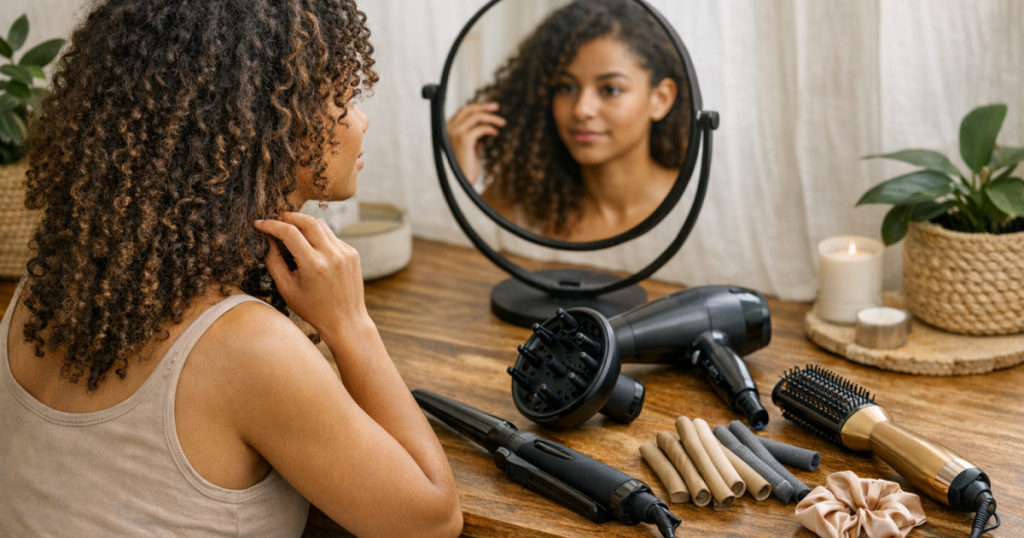
Mixed-texture hair rarely behaves as one uniform head of hair: you might have flatter roots, looser waves at the crown, tighter coils at the nape, or straighter pieces around the face. The most useful mixed-texture hair tools are the ones that let you work in zones rather than forcing every section into the same finish.
That usually means choosing tools with gentle tension, flexible section control and enough size or grip to handle your densest area. A tool that works beautifully on your looser pieces can still rough up, stretch out or under-style the tighter parts.
The short answer
For mixed textures, the safest starting point is a small set of adaptable tools: a wide-tooth comb or flexible detangling brush, sectioning clips, a diffuser, soft heatless curlers or rods, Velcro rollers for roots, and a styler with adjustable heat if you use heat. The aim is not to make every section identical; it is to create a balanced finish without overworking the most fragile or shrink-prone areas.
Look at your hair in zones: front hairline, crown, mid-lengths, nape and ends. If one zone needs smoothing, another needs lift, and another needs definition, one all-over tool will usually disappoint. Mixed patterns respond better to layered styling: detangle first, set or stretch where needed, then refine individual sections.
Why mixed textures need a section-by-section approach
Mixed-texture hair can happen naturally, but it is also common after colour, heat styling, hormonal changes, protective styling, chemical processing or growing out damage. The difference may be obvious, such as 2C waves over 3C curls, or subtle, such as fine straight pieces around the face with thicker waves underneath.
The challenge is that each texture reacts differently to slip, stretch, shrinkage and hold. A loose wave may collapse under heavy cream, while a tighter coil may need more moisture and control to stay defined. A straightened front section may take shape quickly, while the nape needs more time, tension or product distribution. For a deeper breakdown of those behaviour differences, the guide to how slip, stretch, shrinkage and hold change by hair type is a useful next step.
Tool choice matters because tension and contact time are not neutral. A small hot brush may glide through fine face-framing pieces but snag in dense curls. A narrow curling wand may create polished spirals on straighter sections but make tighter areas look uneven if the curl size fights your natural pattern. A heatless rod may hold well on damp wavy hair but need smaller sections on coily areas to dry and set properly.
Tools that tend to work well across mixed patterns
Wide-tooth combs and flexible detangling brushes
Detangling is where mixed textures often go wrong. The looser sections may seem ready for a brush, while tighter or denser areas still need slip and patience. A wide-tooth comb is useful for working conditioner or leave-in through wet hair without forcing one texture into another. A flexible detangling brush can also help, provided it does not pull aggressively at the tighter zones.
Real examples include the Denman D3 Original Styler, which many people use for smoothing and curl clumping, and the Tangle Teezer Naturally Curly, which is designed with curly and textured hair in mind. Do not assume either will suit every section of your hair automatically. Check how much tension it creates, whether it separates your clumps too much, and whether you need to use it only on wet, conditioned hair.
Sectioning clips
Clips are not glamorous, but they are one of the most important tools for mixed textures. They stop you from brushing, drying or curling large uneven areas together. If the crown is loose but the underneath is dense, clipping lets you treat each area on its own timing.
Use clips to divide by behaviour rather than by neat salon quadrants. For example, keep the straighter front pieces separate from the curlier sides, or separate the nape if it shrinks more strongly. This makes your styling more consistent without demanding a perfectly uniform curl pattern.
Diffusers for curls, waves and uneven shrinkage
A diffuser can be excellent for mixed waves and curls because it supports shape while reducing the blast that can disturb curl clumps. It is especially useful when one section frizzes easily and another falls flat. Work with low to moderate airflow where possible, and avoid pushing every section upwards in the same way if your patterns are different.
For looser top layers, hover-diffusing can preserve volume without creating a fluffy surface. For tighter underneath sections, cupping small areas can encourage definition. If the ends are porous or heat-styled, stop before they feel parched rather than drying every section to the same degree.
Heatless rods, satin curlers and soft rollers
Heatless tools suit mixed-texture hair when the goal is to blend different patterns softly rather than impose a sharp, uniform finish. Soft rods, satin curling rods and flexible rollers can help straighter or looser pieces sit closer to curlier areas. They are particularly useful for face-framing sections that refuse to match the rest of the head.
The key is section size. Looser pieces may need slightly smaller wraps to hold shape, while dense curls may need smaller, well-smoothed sections so the tool does not sit on the surface. Damp hair often sets better than soaking wet hair, especially in the UK where indoor drying time can vary with season, heating and humidity.
Where volume tools fit in
Mixed-texture hair often has conflicting volume needs: flat roots at the crown, fuller sides, and bulky or shrunken underneath layers. Velcro rollers can help lift the top without disturbing curlier lengths, particularly on fringes, crowns and face-framing layers. They are less useful if you try to roll thick, wet, curly sections that need definition rather than root lift.
Use them selectively. A few rollers at the crown can create a more balanced silhouette, while leaving the curlier underneath sections alone prevents puffiness. If root lift is your main issue, the tutorial on setting Velcro rollers for long-lasting volume explains placement and hold in more detail.
When hot tools can help, and when they make things harder
Heat tools can be useful for blending mixed textures, but they need restraint. Adjustable heat, larger plates or barrels for dense hair, and attachments that reduce pulling are more important than chasing the sleekest finish. If the tool only works when you apply high tension, it may leave the tighter or more fragile areas looking stretched, dry or uneven.
Hot brushes can smooth looser or straighter sections quickly, but they can struggle when the roots are dense or the curl pattern is tight. Curling wands can polish front pieces, yet they may create a curl shape that clashes with natural coils. Straighteners can blend textures, but repeated passes over the same problem areas are usually a sign the tool, prep or section size is not right.
If your mixed texture includes coily sections, comb-style airflow attachments may be worth understanding before you buy or borrow a multi-styler. The review of the wide-tooth comb attachment on coily hair gives useful context on tension, stretch and realistic results.
Tool choices by common mixed-texture scenario
Wavy on top, curlier underneath
Use a diffuser for the curlier underneath sections and lighter root-lift tools on top. Avoid brushing everything together once dry, as the underneath texture may expand while the top loses shape. Heatless rods can help the top layer mimic the movement underneath.
Straighter front pieces with curly or coily lengths
Face-framing sections often need their own styling plan. Small heatless rods, pin curls or a low-heat curling tool can encourage those pieces to bend without repeatedly smoothing the rest of the hair. Keep products lighter at the front if it gets greasy quickly.
Dense roots with looser ends
Prioritise sectioning clips, a strong but gentle detangling stage, and tools that can reach the root without snagging. Compact stylers often struggle here because they cannot maintain even tension through dense areas. Style the roots first, then refine the ends separately.
Heat-damaged ends with natural regrowth
Choose low-tension tools and avoid relying on heat to make the two textures match every wash day. Soft rollers, satin rods and careful product distribution can help the ends sit more naturally while the regrowth keeps its shape. Regular trims can also make tools behave more predictably.
Checks before you commit to a styling routine
- Section size: if one area never sets or smooths, the section is probably too large for that texture.
- Tension: mild tension can help stretch or smooth; excessive pulling can disturb curl pattern and increase breakage.
- Drying time: dense or low-porosity areas may need longer before removing heatless tools.
- Product weight: fine waves may collapse under products that coils tolerate well.
- Tool scale: very small tools can be slow and uneven on long or dense hair, while oversized tools may miss shorter layers.
- Finish goal: decide whether you want definition, stretch, smoothness, lift or blending before picking the tool.
FAQ
Can one tool work for all mixed-texture hair?
Sometimes, but it depends on how different your textures are. A diffuser, wide-tooth comb or flexible heatless curler is more likely to work across zones than a rigid hot tool that needs identical tension everywhere.
Should mixed-texture hair be styled wet or dry?
Wet or damp styling usually helps definition and blending, especially for waves, curls and coils. Dry styling is better for refreshing specific pieces, adding root lift or polishing a few uneven sections.
Are heatless tools better than hot tools for mixed textures?
Heatless tools are often gentler and better for gradual blending, but they need enough drying or setting time. Hot tools can refine quickly, but they are easier to overuse on the sections that resist styling.
How do I stop the straighter pieces looking separate?
Style them as their own zone. Use smaller rods, pin curls, a light curl cream or a brief low-heat touch-up so those pieces follow the surrounding movement rather than sitting flat.
Why does my underneath section never match the top?
The underneath often has more density, shrinkage or friction from clothing and sleep. It may need smaller sections, more slip, longer drying time or a different tool from the crown.
Key takeaways
Mixed textures need styling tools that adapt: sectioning clips, gentle detangling tools, diffusers, soft heatless curlers and selective volume tools tend to be more forgiving than one-size-fits-all stylers. The best routine is usually a combination of methods, not a single miracle tool.
Use mixed-texture hair tools to solve specific zone problems: lift at the crown, definition underneath, blending at the front, or smoothing through uneven ends. Once you stop treating the whole head as one texture, your tools become easier to judge and your results look more intentional.