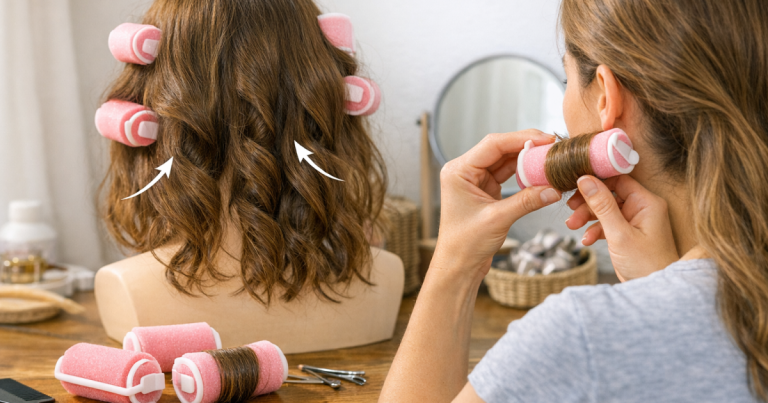
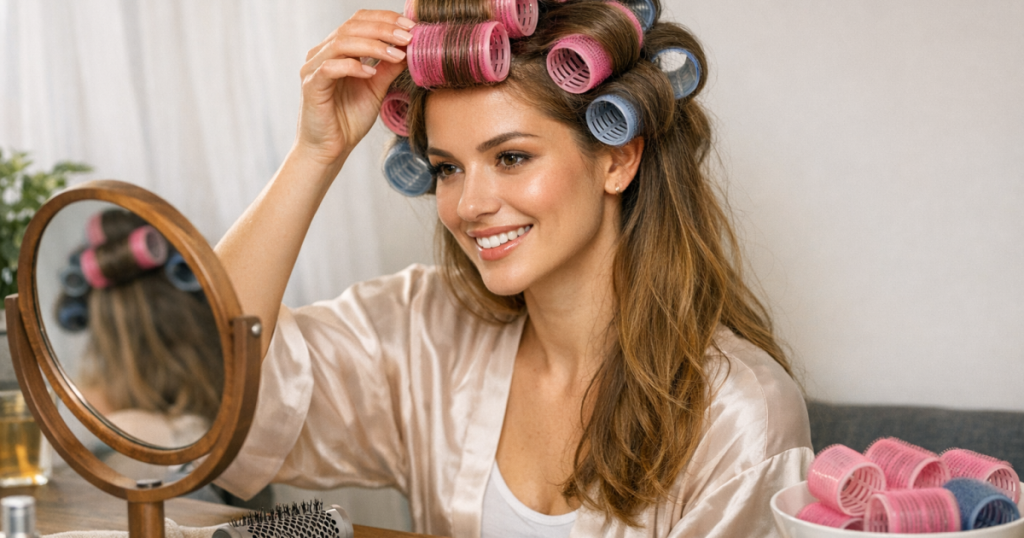
Velcro rollers for volume work best when the hair is almost dry, lifted at the roots and cooled completely before you remove them. The trick is not simply rolling more tightly; it is choosing the right section size, direction and setting time for your hair type.
Used well, they can give soft crown lift, curved ends and a fuller blow-dry effect without clamping the hair between hot plates. Used on sections that are too damp, too wide or too heavy, they tend to sag, crease or drop within the hour.
The short version
- Start with hair that is around 80–90% dry, not soaking wet.
- Use smaller sections than the roller width so the hair can grip and dry evenly.
- Roll the crown upwards and back for lift; roll side sections away from the face for softness.
- Let the rollers cool and set fully before taking them out.
- For fine hair, use lighter tension and a little styling support; for dense hair, use more rollers and smaller sections.
What Velcro rollers can realistically do
Velcro rollers are mainly a shape-setting and volume tool. They are brilliant for root lift, bouncy ends, fringe shaping, curtain layers and soft bend through the mid-lengths. They are not the best route to tight curls or a strong spiral pattern, because the roller surface holds the hair in a smooth curve rather than wrapping it into a narrow coil.
The result also depends heavily on hair type. Fine hair can look noticeably fuller but may collapse if too much product weighs it down. Thick or dense hair often needs more rollers and smaller sections, because one large roller cannot properly support a heavy panel of hair. Naturally wavy or curly hair may need extra smoothing through each section if the aim is polished volume rather than a fluffy finish.
If you often struggle to match your tool to the finish you have in mind, this guide to matching styling goals and tools to your hair type is a useful next step before changing your whole routine.
Start with the right level of dryness
The most common mistake is rolling hair that is too wet. Velcro rollers need the hair to have enough dryness and body to hold its lifted shape. If the roots are damp and heavy, the roller may sit neatly at first but drop as soon as you remove it.
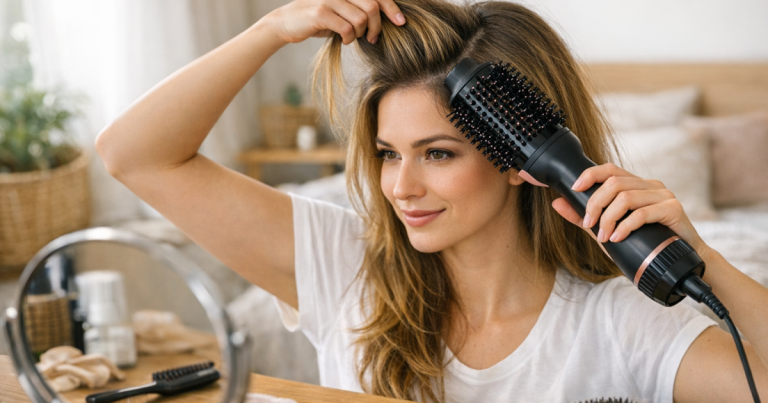
For long-lasting lift, rough-dry or air-dry the hair until it feels mostly dry but still slightly warm or pliable. The roots should not feel cold or wet to the touch. If you are using a hairdryer, direct the airflow upwards at the roots first, then smooth the lengths before rolling.
For heatless styling, let freshly washed hair air-dry until only a trace of moisture remains. This takes longer, but it reduces the risk of setting in a limp or stretched shape. If your hair is very porous and dries quickly at the ends but stays damp near the scalp, focus your drying time on the roots before the rollers go in.
Prep the hair without making it heavy
Good prep gives the roller something to hold, but too much product can make the style fall flat. Aim for light support rather than a stiff coating.
- Fine or silky hair: use a small amount of volumising mousse or root spray, concentrating near the scalp. Avoid rich creams before setting.
- Medium hair: a light leave-in or smoothing spray through the ends can help reduce frizz while keeping movement.
- Thick or coarse hair: use enough smoothing product to control puffiness, but keep the roots cleaner if lift is the priority.
- Dry, heat-styled hair: condition well on wash day, then use only a light styling layer before rollers so the roots do not become overloaded.
Detangle before you section. A snaggy section will not wrap smoothly, and any lump near the root can turn into a dent once the roller is sitting in place.
Choose roller size by the result you want
Bigger rollers create a looser bend and more airy root lift. Smaller rollers create stronger curve, more grip and better support on shorter layers. For most long hair, a mix of sizes works better than using one size all over.
- Large rollers: best for crown lift, long face-framing layers and a blow-dry-style bend.
- Medium rollers: useful for the sides, shorter layers and hair that drops easily.
- Small rollers: helpful around fringes, shorter crown layers or very fine hair that needs a stronger set.
If a roller feels as though it is hanging from the hair rather than sitting firmly against the scalp, the section is probably too large or too heavy. Downsizing the section often fixes the problem more effectively than changing the whole set.
Sectioning that actually holds
Clean sectioning is what separates a soft, lifted result from a set that looks lumpy at the roots. Each section should be slightly narrower than the roller and not much thicker than the diameter the roller can comfortably support.
Start with the mohawk section: the strip from the front hairline through the crown. This area creates the most visible volume. Then move to the sides and back. If your hair is long, clip the unrolled hair out of the way so you are not dragging loose strands into each roller.
For dense hair, resist the temptation to use huge sections to save time. Long or heavy panels need more support, which is also why compact stylers can struggle with long or dense hair. The same principle applies here: if the tool cannot carry the amount of hair you give it, the set will not last.
How to roll for root lift
1. Lift the section straight up
Comb the section smooth and hold it upwards from the scalp. For the crown, lift the hair slightly forward before rolling back. This over-direction encourages the root to dry and cool in a raised position rather than lying flat.
2. Place the roller at the ends
Lay the ends neatly over the roller. Tuck them smoothly so they do not fold back on themselves. Bent ends are usually caused by rushing this part or rolling a section that is wider than the roller.
3. Roll with steady tension
Roll down towards the scalp with firm, even tension. The roller should sit close to the root, but it should not pull painfully or drag the hairline. If the roller needs a clip, use one to support the weight rather than relying on the Velcro surface alone.
4. Set the direction deliberately
Roll the top section away from the face for a lifted, brushed-back finish. Roll side pieces away from the face for a soft salon-style sweep, or under for a rounder, more classic bend. Around a fringe, use smaller rollers and less tension so the front does not spring up too high.
5. Let everything cool and settle
Leave the rollers in until the hair is fully cool and dry. Ten minutes may be enough for a quick refresh on fine hair, but longer is usually better for hair that is thick, long or freshly washed. Removing rollers while the roots are still warm is one of the fastest ways to lose volume.
Adapting the method for your hair type
Hair behaviour matters as much as technique. Slip, stretch, shrinkage and hold all affect how rollers sit and how long the result lasts. For a deeper explanation, read how hair type affects slip, stretch, shrinkage and hold.
- Fine hair: use lightweight rollers, small-to-medium sections and minimal product. A little root support is useful, but heavy serum before setting can flatten the result.
- Silky straight hair: add grip with a light mousse or texture spray before rolling. Let the set cool fully, then avoid over-brushing.
- Thick hair: use more rollers and smaller sections. Clip each roller if it feels unstable, especially through the crown and back.
- Long hair: concentrate on root lift and curved ends rather than expecting the full length to curl. Very long sections may need to be rolled in smaller panels.
- Layered hair: match roller size to layer length. Short layers usually need smaller rollers so the ends wrap cleanly.
- Wavy or curly hair: smooth each section first and decide whether you want volume with texture or a more polished blown-out finish.
Removing rollers without collapsing the shape
Do not pull the rollers straight down through the hair. That can rough up the cuticle, create frizz and stretch out the lift you have just set.
Instead, unroll each roller in the same direction it went in. Start at the bottom sections and finish with the crown. Let the hair fall naturally for a minute before styling it into place. This short pause helps prevent you from brushing out the shape while it is still settling.
Use your fingers or a wide-tooth comb to arrange the hair. For maximum height, place your fingertips at the roots and gently lift rather than raking through the lengths. If you use hairspray, mist lightly from a distance and focus on the roots and outer shape, not the whole head.
Why your roller volume drops
- The hair was too damp: the set looked good while rolled but never properly dried into shape.
- The sections were too large: the roller could not support the weight, so the roots fell flat.
- You skipped cooling time: warm hair is still flexible and will relax quickly.
- The product was too rich: oils, creams or heavy leave-ins near the root can reduce lift.
- The roller direction fought your cut: layers, fringes and cowlicks often need smaller sections and more deliberate placement.
FAQ
Should Velcro rollers be used on wet or dry hair?
They work best on hair that is mostly dry. Wet hair is too heavy and may not dry evenly inside the roller, which makes the volume drop quickly.
How long should I leave Velcro rollers in?
Leave them in until the hair is completely cool and dry. Fine hair may set quickly, while long, thick or dense hair usually needs longer.
Do I need clips with Velcro rollers?
Use clips if the roller feels loose, heavy or unstable. Clips are especially useful at the crown, on long hair and on dense sections.
Why do my ends look bent after using rollers?
The ends were probably folded or uneven when wrapped. Smooth the ends over the roller first, then roll slowly with steady tension.
Can Velcro rollers replace a blow-dry?
They can refresh and shape a blow-dry effect, but they do not create the same tension as a round brush. For best results, start with hair that has been dried with some lift at the roots.
Main points
Long-lasting roller volume comes from controlled sectioning, near-dry hair, root lift and enough cooling time. The more your hair slips, stretches or weighs itself down, the more you need smaller sections, secure clips and lighter product at the roots.
Once the rollers are out, style gently. Finger-lifting the roots, arranging the shape before brushing and using a light finishing mist will preserve the soft, full look much better than pulling through the hair straight away.