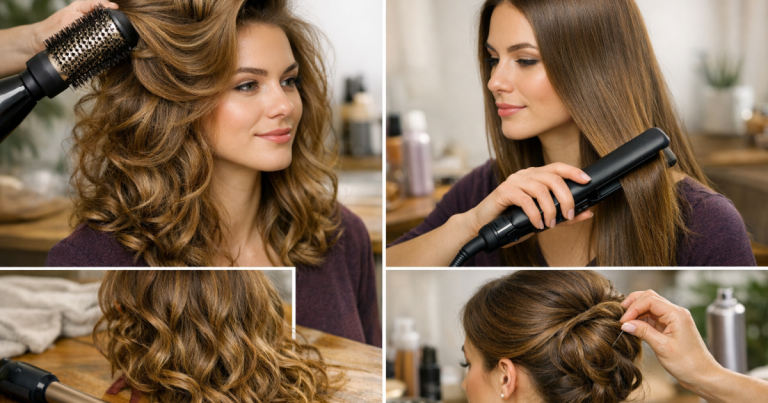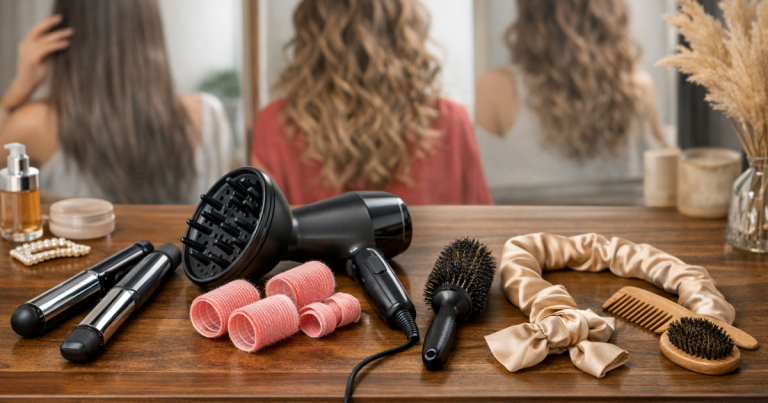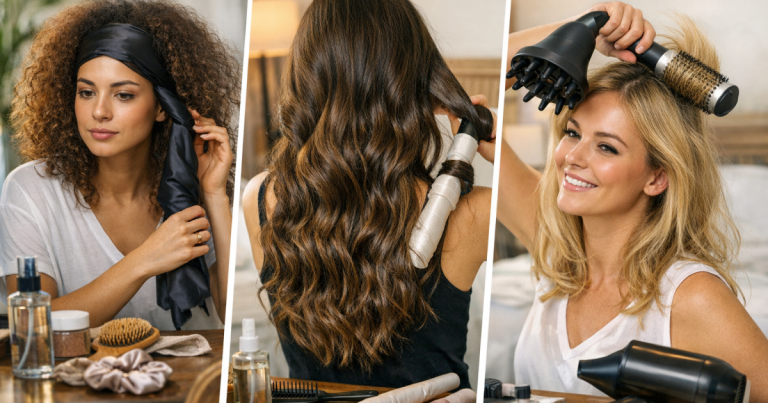
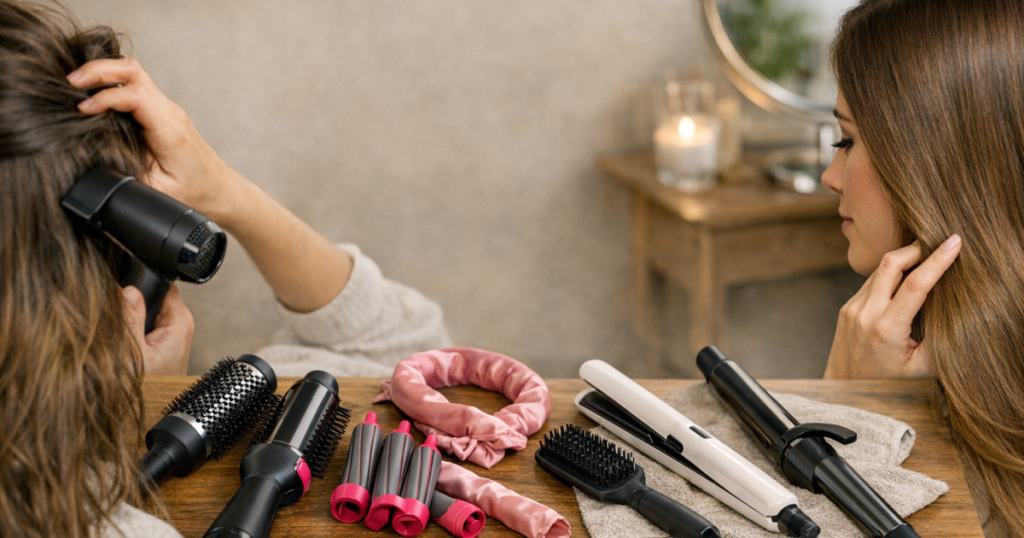
A great style usually fails in one of three places: flat roots, puffy lengths or ends that will not sit where you want them. That is why choosing hair tools works better when you split your hair into zones, rather than expecting one brush, wand or roller to solve everything from scalp to tip.
The tool that gives lift at the crown is rarely the same one that polishes long layers or defines short, textured ends. Start with the finish you want in each section, then factor in density, curl pattern, length and how much heat your hair tolerates.
The short version
- For roots: prioritise lift, direction and access. Velcro rollers, root clips, round brushes and narrow concentrator nozzles are useful because they work close to the scalp.
- For lengths: prioritise control and even tension. Paddle brushes, wide-tooth comb attachments, blow-dry brushes and heatless wraps help shape the main body of the hair.
- For ends: prioritise bend, polish and placement. Curling wands, flexi rods, small rollers and smoothing brushes are better for flicks, tuck-under ends and defined curves.
- For fine hair: avoid tools that over-compress the roots or drag the ends flat. Light tension and smaller sections usually work better.
- For thick, dense or coily hair: choose tools with enough size, grip and spacing to move through the hair without snagging or only styling the surface.
Why roots, lengths and ends need different tools
Hair behaves differently depending on where you are styling it. Roots are controlled by growth direction, scalp oil, cowlicks and how quickly the hair collapses after drying. Lengths show bulk, texture, frizz and movement. Ends reveal damage, layering, dryness and whether a style looks polished or unfinished.
This is why a tool can be brilliant for one job and disappointing for another. A large round brush may create a bouncy salon-style curve through shoulder-length hair, but it can be awkward at very short roots. A satin heatless curling rod may give soft waves through the lengths, yet it will not create the same targeted crown lift as well-placed rollers. A straightener can smooth ends quickly, but it may make fine roots look flatter if used from the scalp down.
If your hair has more than one texture, the zone approach becomes even more useful. Straighter roots with wavier ends, looser front sections with tighter back sections, or heat-damaged pieces mixed with natural curl all need slightly different handling. For a deeper breakdown by curl pattern and mixed texture, see what styling tools suit mixed-texture hair.
Root goals: lift, control and shape from the scalp
Root styling is about direction before definition. If the hair dries flat against the head, the rest of the style has less movement, even if the lengths are curled beautifully. The best root tools either hold the hair up while it cools or dry the root in the direction you want it to sit.
For volume at the crown
Velcro rollers are one of the most practical at-home tools for root lift, especially on fine, medium-density or layered hair. They work by lifting sections away from the scalp while the hair cools or sets. Use larger rollers for soft fullness and smaller rollers where the hair needs more grip or height. The important detail is placement: lift the section up and slightly forward before rolling back, so the root is encouraged to stand away from the scalp.
Root clips can help curly and coily textures that lose height while drying. They are placed near the scalp to support the root without stretching out the rest of the curl. They are particularly useful around the crown, parting and front hairline.
For sleek roots
If your goal is smoothness rather than lift, a dressing brush, paddle brush or fine-to-medium comb can help guide the roots into place while drying or setting. On wavy, curly or coily hair, avoid forcing a very fine comb through dry roots unless the hair has already been stretched or detangled, as this can create frizz or breakage. A boar-style smoothing brush may polish the surface, but it will not necessarily control dense roots underneath unless you work in sections.
For fringes, cowlicks and face-framing pieces
Small round brushes, compact rollers and pin clips are better than large tools here because they give more precision. Dry or set the root in the opposite direction to the way it wants to fall, then let it cool before arranging it. For stubborn cowlicks, styling the root while damp tends to work better than trying to correct it once dry.
Length goals: smoothness, stretch, waves or body
The lengths are where tool choice has the biggest visual impact. This section of the hair determines whether the style reads as glossy, airy, defined, beachy, stretched or full. It is also where density matters most: a tool that glides through fine hair may skim over thick hair without properly shaping the layers underneath.
For smooth, stretched lengths
Paddle brushes and vented brushes are helpful for straight, wavy and loosely curly hair when the aim is a smooth blow-dry effect. Dense curls and coils usually need wider spacing, more slip and smaller working sections. Wide-tooth comb attachments can help stretch textured hair while keeping more control than a standard brush head, provided the hair is detangled and sectioned first.
Hair oil can support smoothness, but it should not be used as a shortcut for tool control. A small amount on mid-lengths and ends can reduce a dry look; too much near the roots can make the style collapse. If sleekness is your main goal, read how to use hair oil before straightening without greasiness before adding more product.
For soft waves without obvious ringlets
Heatless rods, robe-style curlers, large rollers and loose braids all shape the lengths without clamping the hair. They suit readers who want movement rather than a crisp curl. Fine hair usually needs less product and a lighter wrap so it does not set into dents. Thick hair often needs slightly damp sections, even tension and enough time to dry fully before removal.
Long hair needs particular attention because compact tools can run out of space or only style the outer layer. If your waves drop quickly, the issue may not be your technique; the tool may simply be too small for your length or density. The same principle applies to small hot brushes, mini straighteners and short curling barrels.
For big, bouncy body
Round brushes, large Velcro rollers and blow-dry brushes create body because they combine lift, tension and curve. The larger the barrel or roller, the softer the bend. For shoulder-length hair, medium sizes often create more noticeable shape than very large ones. For long hair, large rollers can give expensive-looking movement, but only if the section is not too wide or heavy.
If your roots go flat but your ends curl well, set the top layers separately rather than rolling every section the same way. Crown sections usually need more lift; side sections often need more direction; underneath layers may need only smoothing.
End goals: polish, bend and definition
Ends are where a style looks intentional or slightly untidy. Dryness, split ends, blunt cuts and layers all change what tool will work best. The aim is not always to curl the ends; sometimes it is simply to make them sit consistently.
For a tucked-under finish
A round brush, heated brush or large roller can curve the ends under on bobs, lobs and long layers. Work with smaller sections than you think you need, especially if the hair is thick. Let the ends cool in the curved position before brushing through, otherwise they may spring out or turn fluffy.
For flicked-out layers
Flicks need a tool that can control the last few centimetres of hair. Small round brushes, medium rollers and slim wands are useful because they target the ends without reshaping the whole length. On short layered hair, flexi rods can also work well, but section direction matters: wrapping every piece the same way can create awkward kicks rather than a soft, blended flick.
For defined curls and coils at the ends
Finger coiling, flexi rods and small rollers help ends that lose pattern faster than the rest of the hair. This often happens where hair is older, drier or previously heat-styled. Add moisture and hold before setting, then avoid brushing the ends out too aggressively. For coily hair, the goal is usually to support the existing pattern rather than stretch every strand into the same shape.
Match the tool to the goal, not just the hair type
Hair type matters, but styling goal matters just as much. Fine straight hair seeking volume has more in common with fine wavy hair seeking volume than with thick straight hair seeking a sleek finish. Use this as a practical map when choosing hair tools for your own routine.
- Flat roots and limp lengths: use root-lifting rollers at the crown, then a large round brush or heatless curler through the lengths. Avoid heavy oils near the scalp.
- Frizzy lengths with dry ends: use a detangling brush or wide-tooth comb while conditioning, then smooth the lengths in sections. Finish with a light oil or cream only where the hair looks dry.
- Defined roots but shapeless ends: keep your root routine, then add flexi rods, small rollers or finger coiling to the last section of hair.
- Thick hair that only styles on the surface: section horizontally and choose larger or more robust tools. A compact styler may not reach the underneath layers effectively.
- Mixed-texture hair: treat looser and tighter areas separately. Use smoothing or stretching tools where needed, but keep curl-supporting methods for sections that lose definition.
Common mistakes that make the wrong tool look worse
The tool is not always the only problem. Technique, section size and timing can make a good tool seem unsuitable.
- Sections are too large: the outer hair gets styled while the inside remains damp, puffy or straight.
- The tool is used on the wrong zone: a large roller may smooth lengths beautifully but fail to grip short roots.
- Hair is too wet for a heatless set: the style may not dry fully, leaving waves stretched out or uneven.
- Hair is too dry for reshaping: roots, fringes and stubborn ends often need a little moisture or setting product to change direction.
- Product is concentrated at the scalp: fine and medium hair can lose volume quickly when oils or creams sit too close to the roots.
For a wider framework that connects finish, texture and tool type, match your styling goals and tools to your hair type before changing your whole routine.
FAQ
Should I use different tools on roots and ends?
Often, yes. Roots need lift or direction, while ends need bend, smoothing or definition. Using one tool everywhere can flatten the crown or overwork fragile ends.
What is the easiest way to add root volume without heat?
Use Velcro rollers or root clips on slightly damp or freshly dried hair, then let the roots cool or set before removing them. Section placement matters more than using lots of product.
Why do my lengths look smooth but my ends look rough?
Ends are older and usually drier, so they show damage and dehydration faster. Use smaller sections, avoid dragging tools repeatedly over the tips, and add a tiny amount of finishing product only where needed.
Are heatless tools enough for thick or dense hair?
They can be, but section size and drying time are crucial. Dense hair usually needs smaller sections, secure tension and enough time for the inner layers to dry or set properly.
Which zone should I style first?
Start with the zone that collapses or resists styling fastest. For many people that is the roots; for textured or layered hair, it may be the ends or face-framing pieces.
What to remember
The most reliable styling routines are not built around a single miracle tool. They are built around what each part of the hair needs: lift at the roots, control through the lengths and polish or definition at the ends. Once you separate those goals, tool choice becomes much clearer.
If your current routine nearly works, do not replace everything at once. Adjust one zone first. Add rollers at the crown, change the way you smooth the lengths, or refine the ends with a smaller setting tool. Small changes usually reveal whether the problem is the tool, the sectioning or the styling goal itself.