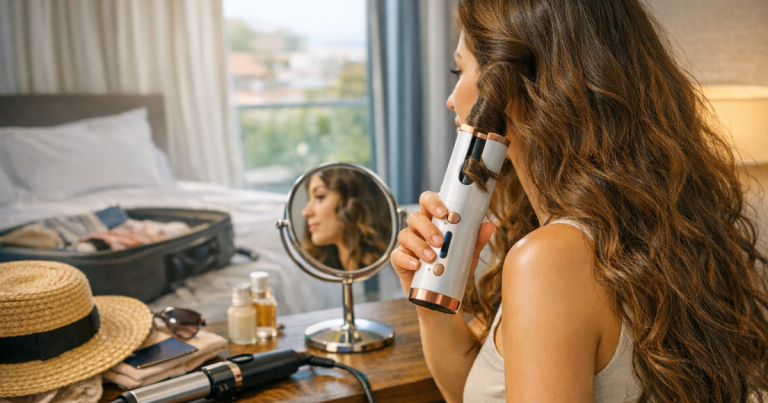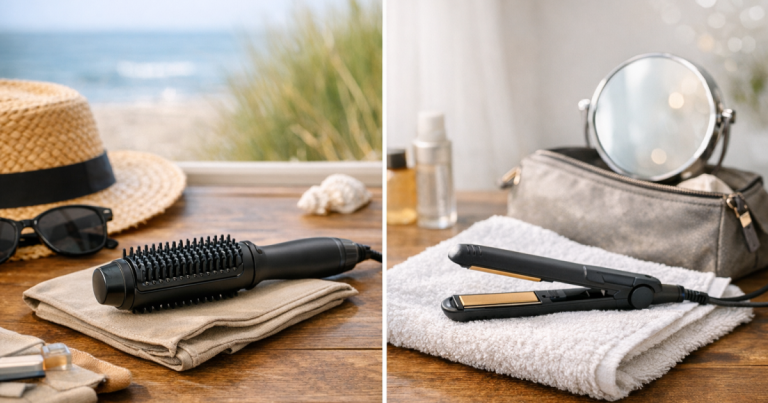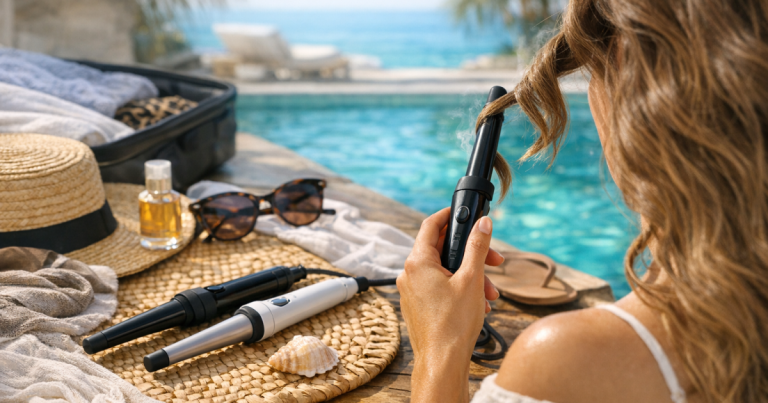
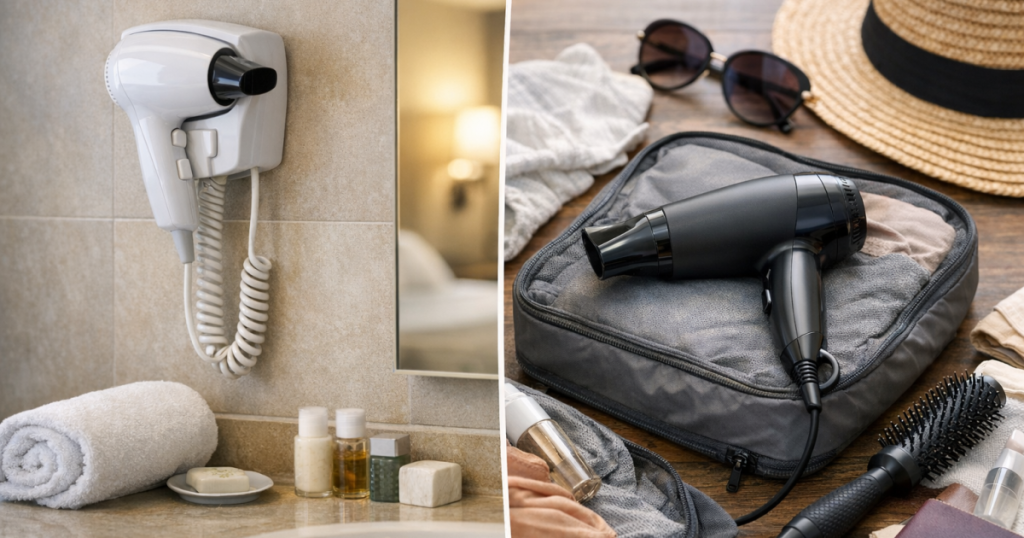
A good blow-dry can unravel fast when the dryer in your room is weak, overheats, or has no nozzle. The real question with hotel hair dryers vs packing your own travel dryer is not which is more glamorous; it is which gives your hair enough airflow, control and reliability for the trip you are actually taking.
What to know first
Use the room dryer when your hair dries quickly, you only need a rough dry, or you are travelling light for a short stay. Pack your own travel dryer when your hair is dense, curly, frizz-prone, slow to dry, shaped by a fringe or layers, or you rely on a diffuser or concentrator nozzle for your normal finish.
The decision is less about whether a travel dryer is “better” in the abstract and more about how much styling precision your hair needs. A basic wall-mounted dryer can be perfectly adequate for fine, short or low-maintenance hair. It can be frustrating for thick hair, waves that need gentle airflow, or a sleek blow-dry that depends on nozzle control and tension.
There is also a packing reality: even a compact dryer takes up space, and some trips are not worth the extra tool. If you are taking hand luggage only, every item has to earn its place. If you are debating a larger styling system rather than a dryer, it is worth reading about whether the Dyson Airwrap is practical for hand luggage before committing luggage space.
Step 1: Match the dryer decision to your hair type
Your hair type is the strongest clue. The same hotel dryer that works for one person can leave another with half-damp roots, rough ends or flat shape.
Fine or short hair
Fine hair usually dries faster, so a built-in dryer may be enough if you are not trying to create a polished blowout. The risk is not always lack of power; it is excess heat with too little control. If the dryer has only one hot setting, keep it moving and stop before the ends feel parched. Fine hair can collapse quickly when over-dried, so use clips at the roots or let the last few minutes air-dry rather than blasting until every strand feels bone dry.
Thick or high-density hair
Dense hair often exposes the weakness of a room dryer. You may get dry surface layers while the underneath stays damp, or you may spend so long drying that your hair becomes fluffy. If your usual routine involves sectioning, a nozzle, and enough airflow to reach the roots, packing your own compact dryer is usually the more predictable choice.
Wavy hair
Waves need airflow that does not blast the pattern apart. Many room dryers do not come with a diffuser, and a strong direct stream can create frizz before the hair has properly set. If your waves behave best with cupping, low disturbance and controlled drying, a travel dryer with a compatible diffuser is worth considering. For technique, use the same principles as a home routine: gentle positioning, minimal touching and drying in stages. The tutorial on using a diffuser on wavy hair without frizz is a useful refresher before a trip.
Curly or coily hair
Curly and coily hair is usually the least forgiving of random dryers. Heat, airflow direction and attachment control all affect definition. If you are wearing your curls natural on holiday and you do not want to rely on a bun or claw clip every day, pack the tool that works with your routine. If luggage space is tight, a heatless overnight method, silk wrap or pineapple routine may reduce how often you need a dryer at all.
Fringes, bobs and shaped cuts
A fringe can be the deciding factor. Even if the rest of your hair can air-dry, a fringe often needs quick, directed airflow to sit properly. A dryer with a concentrator nozzle gives more control around the hairline, cowlicks and short layers. Without one, you may end up using more heat for a less precise result.
Step 2: Check what the hotel dryer can realistically do
If you are already at the hotel, do a quick inspection before washing your hair. This avoids discovering the dryer limitations when your hair is soaking wet and time is short.
- Look for attachments: a concentrator nozzle helps smooth and direct hair; a diffuser is rare but valuable for waves and curls.
- Test the settings briefly: check whether there is a cooler or lower heat option, not just a single hot blast.
- Notice the airflow: weak airflow makes dense hair slow to dry; very harsh airflow can disturb curls and create roughness.
- Check placement: wall-mounted dryers can have short cords, making sectioning awkward at a mirror.
- Feel the temperature: if it becomes uncomfortably hot quickly, use it in short bursts and keep it away from the ends.
Use only the sockets and appliance set-up provided for normal use in the room, and do not plug a hair dryer into a shaver-only socket. If you bring your own dryer abroad, check the manufacturer’s voltage guidance before travel and use the correct plug adaptor for the destination.
When hotel hair dryers are enough
The room dryer can be the sensible choice for a weekend break, a work overnight, or a warm-weather trip where you are not aiming for a salon-style finish. It is also useful if your plan is mostly heatless: wash at night, blot well, apply a light styling product, then finish only the roots in the morning.
It is usually enough when:
- Your hair is fine, short, or naturally quick to dry.
- You only need to remove dampness at the roots.
- You are happy with a natural finish rather than a controlled blow-dry.
- You will be wearing your hair up, braided, clipped back or under a hat for much of the trip.
- You are travelling with very limited luggage space and can accept some styling compromise.
For many people, the best travel hair plan is not “perfect blow-dry every day”. It is choosing a finish that works with the trip: loose texture, soft waves, a low bun, a claw clip twist, or a silk wrap overnight to reduce morning styling.
When packing your own travel dryer is worth it
Pack your own dryer when the finish matters and the wrong tool would change your whole routine. This is especially true for weddings, work events, humid destinations, longer trips, or hair that takes a long time to dry at the roots.
A compact dryer is most useful when it gives you something the room dryer probably will not: a nozzle that fits securely, a diffuser option, better heat choice, easier handling, or a familiar airflow pattern. Named travel models such as ghd Flight+ Travel Hair Dryer, BaByliss Travel Dry 2000 and Remington D1500 Travel Dryer 2000W are examples of the kind of compact tools people often check for holidays, but you should verify current specifications, voltage suitability, attachments and weight before relying on any specific model for a trip.
Do not assume “travel” automatically means ideal for your hair. Some compact dryers save space but feel less comfortable for long drying sessions. Others fold neatly but may not include the attachment your hair needs. If your at-home results depend on a full-size dryer, compare what you actually use at home with what the travel tool includes. For a sense of what a smoother, more controlled home blow-dry tool can offer, the T3 Cura Luxe Hair Dryer review is a helpful reference point.
Step 3: Build a realistic travel drying routine
The best decision is not just whether to pack a dryer. It is how you will dry your hair with the least friction once you arrive.
If you rely on the room dryer
- Wash earlier than usual so your hair can air-dry part-way before heat.
- Use a microfibre towel or soft cotton T-shirt to remove excess water before drying.
- Dry roots first, then mid-lengths, and leave fragile ends until last.
- Use clips to lift sections instead of blasting one large mass of hair.
- Stop when hair is mostly dry and let the last moisture settle naturally if frizz is a concern.
If you pack your own dryer
- Pack only the attachments you truly use, not the whole drawer of extras.
- Keep the nozzle or diffuser in a soft pouch so it does not crack or catch on clothing.
- Check voltage and plug requirements before leaving the UK, particularly for long-haul trips.
- Let the dryer cool before repacking it.
- Pair it with low-bulk helpers: a detangling brush, a few sectioning clips, a silk wrap or a small amount of styling product decanted into a travel container.
For curls and waves, your drying method matters as much as the tool. A gentle routine can make a modest dryer more workable; rough handling can make even a good dryer leave hair fluffy.
Step 4: Use density and texture as the tie-breaker
If you are still unsure, separate density from texture. Texture is the shape or feel of the strand; density is how much hair you have on your head. Fine hair can be dense, and coarse hair can be low-density. That distinction changes the travel decision.
- Fine texture, low density: the room dryer is often enough, but use lower heat where possible to avoid limp or frazzled ends.
- Fine texture, high density: you may need stronger airflow at the roots, even though the individual strands are delicate.
- Coarse texture, low density: control and smoothing may matter more than sheer drying speed.
- Coarse texture, high density: packing your own dryer is usually the safer choice if you want a polished or fully dry finish.
- Wavy or curly with any density: attachment compatibility is the key issue, especially if definition matters.
If those terms get muddled, the guide to hair density versus texture explains how to judge both before choosing styling tools.
Hotel dryer or travel dryer: the practical decision list
Before you zip the case, run through these checks:
- Trip length: one night is easier to compromise on than ten days.
- Weather: humidity, rain and sea air can make controlled drying more useful.
- Events: photos, formal dinners and work meetings raise the stakes.
- Hair wash timing: if you can wash the night before, you may not need much dryer time.
- Attachment needs: diffuser users and nozzle-dependent blow-dryers should be cautious about relying on the room.
- Luggage type: checked luggage makes packing easier; hand luggage forces a stricter edit.
- Back-up style: if your hair can go into a polished bun, braid, claw clip or heatless wave set, you have more flexibility.
A good compromise for many travellers is to skip the dryer for casual trips but pack it for event-heavy or hair-sensitive travel. Another option is to pack heatless support instead: a satin heatless curling rod, silk hair wrap or Velcro rollers can refresh shape without committing to a full blow-dry every morning.
Common questions
Can I rely on a hotel dryer for thick hair?
Sometimes, but it is a gamble. Thick or high-density hair usually needs stronger airflow and more time, so packing your own compact dryer is more reliable if you need fully dry roots.
Is a travel dryer worth it for a city break?
Only if your hair is hard to dry or your plans need a neat finish. For a relaxed two-night trip with easy updos, the room dryer or a heatless routine may be enough.
Should I pack a diffuser?
If your waves or curls lose shape with direct airflow, yes. Check that the diffuser fits your dryer securely; a loose attachment is annoying and can disrupt your routine.
What if my hotel dryer has no nozzle?
Use it for rough drying only, then smooth with a brush, clips or a heatless set. For fringes, bobs or sleek styles, no nozzle usually means less control.
Can I take a hair dryer in hand luggage from the UK?
Hair dryers are generally suitable for hand luggage, but always check your airline’s current cabin baggage rules and size limits before travelling.
What stands out
The room dryer wins on space and simplicity. Your own travel dryer wins on predictability, attachment control and hair-type consistency. Fine, short or low-maintenance hair can usually compromise; dense, curly, wavy, frizz-prone or precision-cut hair benefits from bringing a tool you trust.
The easiest rule is this: if a poor dryer would merely be inconvenient, use the one provided. If it would change your style, extend your routine or leave your hair uncomfortable for the day, pack your own.
Quick Buying Links
Hotel Hair Dryers
The real question with hotel hair dryers vs packing your own travel dryer is not which is more glamorous; it is which gives your hair enough airflow, control and reliability for the trip you are actually taking.What to know firstUse the room dryer when your hair dries quickly, you only need a rough dry, or you are travelling light for a short stay.
Packing Your Own Travel Dryer
The real question with hotel hair dryers vs packing your own travel dryer is not which is more glamorous; it is which gives your hair enough airflow, control and reliability for the trip you are actually taking.What to know firstUse the room dryer when your hair dries quickly, you only need a rough dry, or you are travelling light for a short stay.