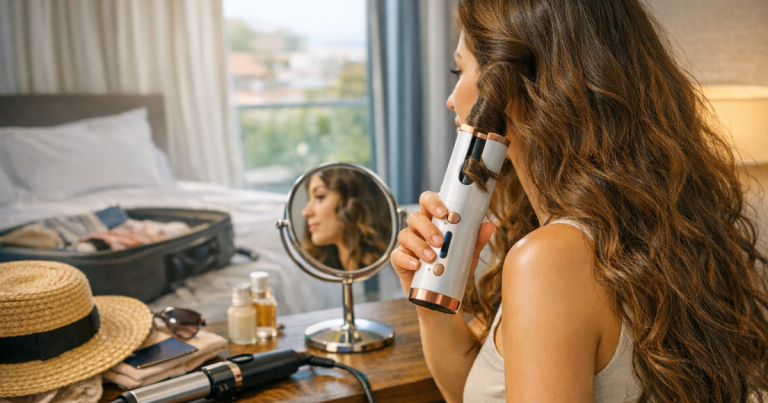
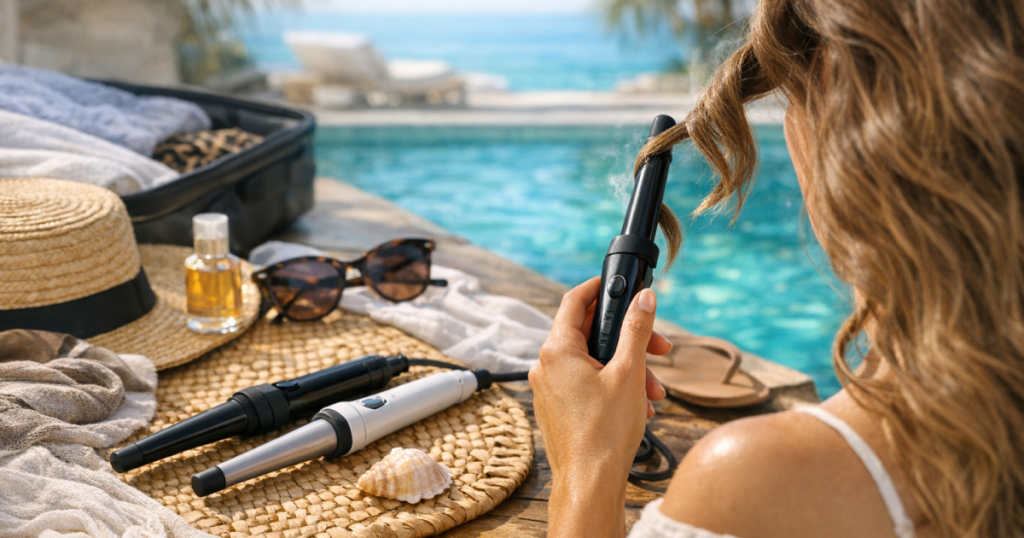
Holiday curls can look glossy in the hotel mirror, then soften into waves before you have reached dinner. If mini curling wands keep dropping your shape by lunchtime, the issue is usually a mix of travel conditions, section size, product build-up and hair type rather than one simple tool failure.
A compact wand can work well away from home, but it gives you less room for error. The shorter barrel, rushed styling time and warmer, more humid environment all make your usual routine behave differently.
The quick explanation
Most holiday curl drop comes from one of five things: hair is not fully dry, the sections are too wide for the barrel, the curl is released before it has cooled, the hair is coated with suncream or heavy conditioner, or the climate is fighting your finish.
- Fine hair often drops because it is too soft, too clean or overloaded with smoothing products.
- Thick hair often drops because each section is too large for a compact barrel to heat evenly.
- High-porosity or colour-treated hair can frizz first, then lose definition in humid air.
- Long layers may look curled at the mid-lengths but fall flat at the ends if the wrapping angle is wrong.
- Hair exposed to salt water, chlorine or hard water can feel rough yet still refuse to hold a polished curl.
What holiday hair does differently
Hair rarely behaves the same on holiday as it does at home. A beach day, swimming pool, air conditioning, airport dryness and local water can all change the way your lengths take shape. Even if you pack your usual heat protectant, you may be styling over suncream residue around the hairline, leave-in conditioner from the pool bag or a richer mask used to rescue dry ends.
Humidity is the biggest disruptor for many people. It encourages the hair fibre to absorb moisture from the air, which can swell the strand and soften the curl pattern you have just created. Low-porosity hair may resist product and take longer to dry underneath, while high-porosity hair may drink in moisture quickly and expand. If this sounds familiar, the guide to high and low porosity hair is useful for understanding why the same tool can give different results from one person to another.
Where mini curling wands struggle most
Mini curling wands are designed for convenience, not for styling large amounts of hair at speed. That does not make them pointless, but it does mean your technique needs to be more precise. A compact barrel gives you less surface area to wrap long or dense sections, so the hair at the root, middle and ends may not all receive the same contact time.
The problem is most obvious on thick, coarse or long hair. If you wrap a wide section around a small barrel, the outer layer of hair may warm while the inner layer stays under-styled. The curl looks finished when you release it, but it has no internal structure, so it stretches out quickly.
On fine hair, the opposite can happen. A small wand can create a tight curl at first, but if the hair is too silky, freshly conditioned or brushed out too soon, the shape slips into a loose bend. The curl has been formed, but it has not been supported.
Step 1: start with hair that is genuinely dry
Holiday styling often happens in a rush, which is why damp roots and slightly cool mid-lengths are so common. Hair can feel dry on the outside while still holding moisture inside, especially after swimming, washing in humid weather or using a rich leave-in product.
Before using a hot wand, run your fingers through the underneath layers at the nape and behind the ears. These areas dry more slowly and are often the reason curls collapse from underneath. If they feel cool, clammy or heavy, wait longer or rough-dry fully before curling. Heat styling over damp hair can also make the finish puffier and less predictable.
Step 2: make your sections smaller than you think
A travel wand needs narrower sections than a full-sized barrel. As a rough guide, the section should sit flat on the barrel without bunching or overlapping heavily. If the hair stacks on top of itself, only the outside is doing the work.
- For fine hair, use slim sections but reduce unnecessary brushing afterwards so you do not loosen the shape immediately.
- For medium-density hair, work in clean horizontal layers and clip away anything you are not curling.
- For thick hair, divide the head into more layers than you would at home and focus on even heat contact rather than speed.
- For long hair, curl the mid-lengths first, then guide the ends around the barrel rather than leaving them straight by accident.
If your long layers always flick out or look unfinished, adjust the wrapping pattern rather than adding more heat. The curling wand technique for long layers breaks down how to avoid flat ends while keeping the finish soft.
Step 3: change the hold time, not just the heat
Many people try to fix dropped curls by turning the heat up. Sometimes the better fix is slower, neater styling. The curl needs enough time on the barrel to form, then enough time off the barrel to cool in shape. If you pull it straight, brush it immediately or tuck it behind your ear while it is warm, you are training it to fall.
After releasing each curl, catch it in your palm for a few seconds, or clip it loosely while you work through the next sections. This is particularly helpful for soft, fine or freshly washed hair. On coarse hair, cooling helps the curl set before humidity starts to expand the surface.
Use the temperature range recommended for your tool and hair type rather than assuming hotter is better. Fragile, bleached or chemically processed hair needs more caution, while thick resistant hair may need smaller sections more than it needs extra heat.
Step 4: check what is sitting on your hair
Holiday hair often has more residue than you realise. Sun protection, facial SPF, body oil, salt spray, pool water, dry shampoo and richer conditioners can all migrate into the hair. Some residue makes hair too slippery to hold a curl; other residue makes it rough, sticky or frizzy.
If your curls look good for ten minutes then wilt, think about your product layers. A light heat protectant and a flexible hold product are usually more useful than a heavy finishing oil before styling. Oils and glossing products tend to work better after the curl has cooled, and even then only through the ends.
- If hair feels coated, use a proper wash before styling rather than adding more product.
- If hair feels fluffy, add a small amount of lightweight leave-in before drying, not right before curling.
- If hair feels too soft, skip heavy conditioner near the roots and use a little styling foam or texture spray through the lengths.
- If hair feels brittle after sun or swimming, prioritise conditioning and choose a looser style rather than repeatedly re-curling the same sections.
Step 5: match the finish to the climate
A polished, brushed-out curl is harder to keep in humid or windy weather than a slightly more structured wave. If you are going from a UK routine to a warmer destination, aim for a stronger set at the start and let it relax naturally. That might mean curling a little tighter than you want the final result to look, then separating with fingers rather than a brush.
For beach evenings, pinning the front pieces while they cool can make more difference than carrying a bigger tool. For city breaks, where hair may be exposed to air conditioning indoors and damp air outdoors, a flexible hold hairspray can help without creating a stiff finish. For pool days, heatless styling overnight may be the kinder choice because you are not repeatedly applying heat to hair that has already been through sun and water.
Hair-type fixes that make the biggest difference
Fine or silky hair
Fine hair needs grip, not weight. Wash with lighter products, avoid heavy masks before a curl day, and use a small amount of mousse or texture spray before drying. Let every curl cool completely before touching it. If the curl still falls, try curling on day-old hair rather than freshly washed hair.
Thick or coarse hair
Thick hair needs patience and section control. A mini barrel can work around the face and top layers, but the underneath needs smaller sections and clean parting. Clip the hair up as you go so the finished curls are not stretched by unstyled hair sitting on top of them.
Wavy, curly or frizz-prone hair
Do not fight the natural pattern too hard on holiday. Smooth the surface first, then refine selected pieces with the wand. Curling every strand can make the finish expand in humid air, whereas defining the face frame and top layer often looks more natural and lasts better.
Bleached, highlighted or fragile hair
Holiday conditions can make fragile hair feel drier, so keep the routine simple. Use heat protection, avoid repeated passes, and choose a softer wave if the hair is already rough from swimming or sun exposure. A silk wrap or loose bun overnight can preserve shape without another full styling session.
Travel checks before you pack the tool
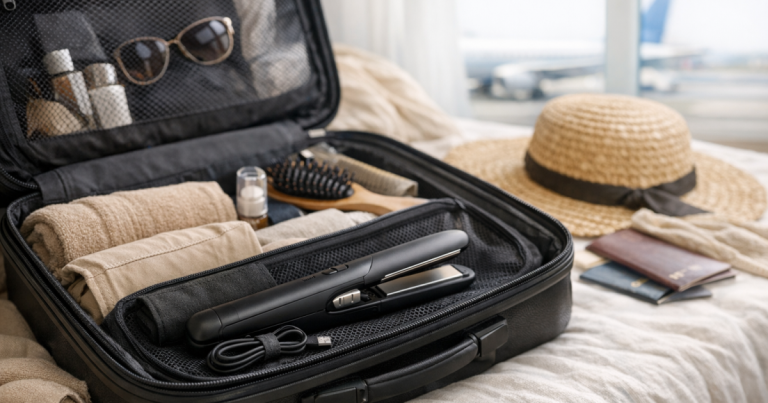
Before packing any compact hot tool, check the information printed on the handle, plug or manufacturer guidance. If you are travelling outside the UK, confirm voltage compatibility and whether you need the correct travel adaptor for the destination. A plug adaptor does not automatically make an incompatible tool suitable for use abroad.
If you are taking cordless styling tools, airline and airport rules can be more specific than they are for standard plug-in tools. Check the current guidance before you fly; the explainer on rules on cordless straighteners in hand luggage is a useful starting point for understanding the kinds of restrictions that can apply to heated travel tools.
Questions people ask
Why do my curls drop faster abroad than at home?
The most common reasons are humidity, different water, sun and swimming exposure, and changes to your product routine. Hair that is slightly damp, coated or over-conditioned will usually lose curl faster, even if the wand works well at home.
Is a smaller barrel better for holiday curls?
A smaller barrel can help create a tighter starting curl, which may relax into a wearable wave. It is not automatically better, though. If your sections are too large or your hair is very long, a small barrel can leave the curl unevenly formed.
Should I brush curls out straight away?
No. Let the curls cool first. Brushing while the hair is still warm is one of the quickest ways to soften the shape. Use fingers for a relaxed finish, then brush lightly only when the curl has fully set.
The big picture
Mini curling wands drop curls on holiday hair because the routine around the tool changes: hair is exposed to moisture, residue, heat, water and rushed styling. The fix is not simply to buy a hotter tool or keep re-curling. Smaller sections, fully dry hair, lighter product layers and proper cooling time usually make the biggest difference.
For most holiday routines, the smartest approach is a mixed one: use the compact wand for face-framing pieces and polished touch-ups, then rely on clips, wraps, plaits or heatless setting overnight to preserve shape. That gives you better-looking hair with less effort, less damage risk and far fewer suitcase regrets.