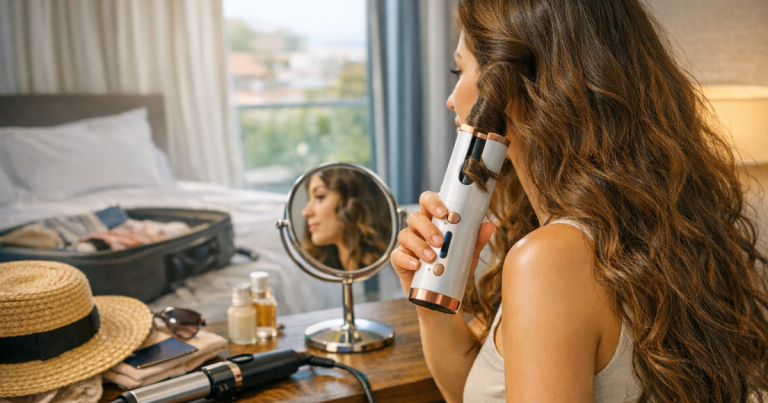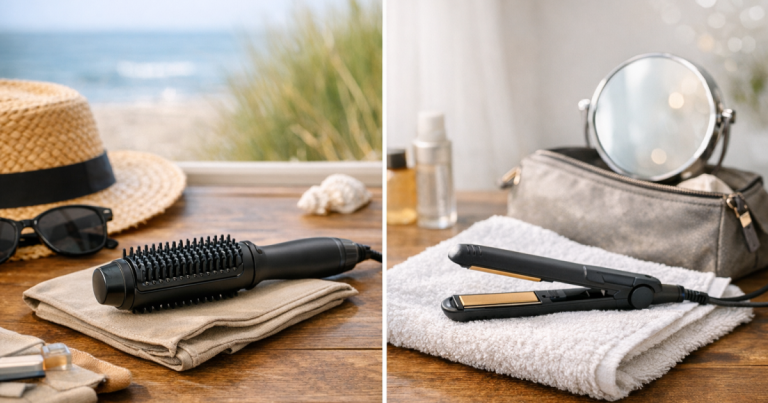
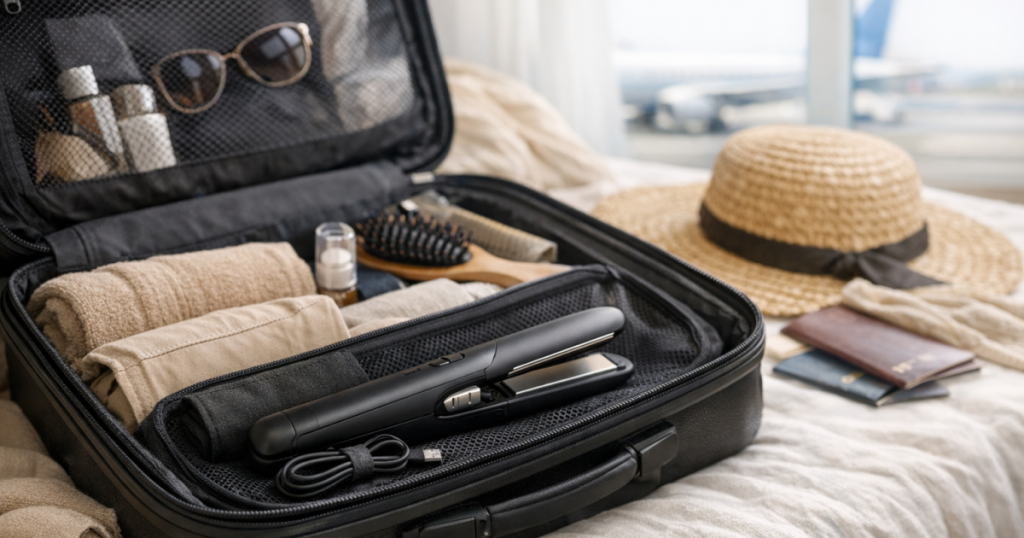
The rule for cordless straighteners in hand luggage is usually yes, but only when the battery or fuel type meets airline and airport security rules. The detail matters because a lithium-powered straightener, a gas-powered styler and a compact plug-in mini straightener are treated differently when you fly.
For most beauty travellers, the safest approach is to pack the tool in your cabin bag, keep the instructions or battery information accessible, protect it from switching on accidentally, and check your airline’s current restrictions before you leave for the airport.
The short answer before you pack
Most cordless hair straighteners can travel in hand luggage when they are for personal use and comply with battery or fuel limits. However, security staff and airlines can still refuse an item if the battery rating is unclear, the heating element is not protected, the tool cannot be prevented from turning on, or the airline has stricter rules than the airport’s general guidance.
- Lithium battery cordless straighteners: commonly allowed in cabin baggage, provided the battery rating is within permitted limits and the device is protected from accidental activation.
- Gas or butane cordless stylers: more restricted; many rules allow only one for personal use, with a safety cover fitted and no spare gas refills packed.
- Plug-in travel straighteners: usually simpler from a security point of view because they do not contain a built-in flight-restricted battery, but you still need the correct plug adaptor and voltage compatibility for your destination.
- Checked luggage: do not assume the hold is the better option. Lithium batteries and heat-producing devices can be more tightly controlled in checked bags than in the cabin.
Step 1: Work out what type of cordless straightener you own
Start by checking whether your tool is battery-powered, gas-powered or simply a small plug-in model. This is the step that decides which travel rule applies.
A lithium-ion model, such as the Dyson Corrale or BaByliss 9000 Cordless Straightener, needs battery checks before flying. A gas-powered styler needs fuel and safety-cover checks. A compact plug-in straightener is not truly cordless, even if it is marketed for travel, so it is usually handled more like a normal electrical hair tool.
Look at the product label, manual, manufacturer travel page or original box. You are looking for words such as lithium-ion, Wh, watt-hours, mAh, voltage, gas, butane, cartridge or flight mode. If the information is not visible on the tool, take a screenshot of the manufacturer’s travel guidance before you go. That can make the security conversation easier if you are asked what the device contains.
Step 2: Check the battery rating, not just the brand name
For lithium-powered cordless straighteners, the important figure is usually the watt-hour rating, often written as Wh. Many airline lithium battery rules are based on this number, rather than whether the item is a hair tool, a camera or another personal electronic device.
As a broad travel principle, small consumer lithium batteries are often permitted in cabin baggage when they fall within standard airline limits, while larger batteries may need airline approval or may not be accepted. Do not rely on a social media answer or a retailer listing if the airline asks for a watt-hour figure. The airline’s own dangerous goods guidance is the rule that matters on the day.
If the label shows voltage and amp-hours rather than watt-hours, the calculation is usually voltage multiplied by amp-hours. If the battery is listed in milliamp-hours, divide by 1,000 first to convert it to amp-hours. If that sounds like too much faff the night before a flight, use the manufacturer’s published travel information instead and check it against your airline’s battery policy.
Once you are past the 200-word mark, it is worth saying the key phrase plainly again: cordless straighteners in hand luggage are generally more acceptable when the battery details are easy to prove and the device cannot heat up by accident.
Step 3: Pack it so it cannot switch on
A cordless straightener is a heat-producing tool, so airport staff are not only thinking about the battery. They also need to know the heating plates are protected and that the device will not turn on inside your bag.
- Switch it off fully before packing, rather than leaving it in standby or travel-lock mode alone.
- Use the heat-resistant pouch or protective cap supplied with the tool if it has one.
- Keep the power button away from pressure points, such as the edge of a packed wash bag or hard cosmetics case.
- Do not pack it while warm after last-minute styling; let the plates cool fully before it goes into your luggage.
- Keep charging cables tidy so they are not wrapped tightly around the plates or hinge.
If your straightener has a removable flight tag, battery isolator or specific travel mode, follow the manufacturer’s instructions exactly. Do not guess, because different cordless tools use different systems. The same word, such as “travel lock”, can mean different things depending on the brand.
Step 4: Treat gas-powered cordless stylers differently
Some older or specialist cordless hair tools use gas or butane instead of a rechargeable lithium battery. These are not handled in the same way as rechargeable straighteners.
Airline rules for gas-powered curling tongs and stylers commonly focus on personal use, fitted safety covers and restrictions on spare cartridges. In practice, that means you should travel with only the allowed device, ensure the heating element is covered, and leave replacement gas refills out of both hand and checked luggage unless your airline explicitly permits them. Many travellers are caught out by the spare cartridge rather than the tool itself.
If the tool is not essential, a rechargeable or plug-in option is often less complicated than travelling with gas. For a short city break, smoothing the hairline with a mini tool and using rollers, wraps or a soft updo can be much less stressful than negotiating fuel restrictions at security.
Step 5: Match the travel tool to your hair type, not just your bag size
Cabin-bag compatibility is only half the decision. A cordless straightener that is fine for a fringe touch-up may not be the right main styler for thick, long or highly textured hair, particularly if you want a very sleek finish every day of the trip.
Fine, fragile or colour-treated hair
For fine or fragile hair, the main question is whether you need straighteners at all. Travel days, sun exposure, hard water and repeated restyling can leave hair feeling more brittle. If your aim is soft polish rather than a glassy finish, a silk wrap, loose heatless bends or careful blow-dry smoothing may be kinder. If you do straighten, use small sections, avoid repeated passes and prioritise a tool you can control comfortably.
Wavy hair
Wavy hair often benefits from a mixed approach. You might pack the cordless straightener for fringe, crown or face-frame smoothing, then keep the lengths in their natural pattern. If frizz is your main worry, drying technique can matter more than straightening. For travel routines where you are deciding between packing a dryer, relying on accommodation tools or air-drying, the advice in hotel hair dryers versus packing your own travel dryer is a useful next step.
Curly, coily or very thick hair
For dense, curly or coily hair, a cordless straightener may work best as a touch-up tool rather than your full styling plan. It can help smooth a parting, fringe, leave-out section or short layers, but it may be less realistic for a full sleek style unless your tool, prep and time allowance genuinely suit your hair. For many trips, stretching the hair before travel, using protective styling, or choosing a heatless set can be more reliable.
Short hair, fringes and layered cuts
This is where cordless straighteners make the most sense. Short crops, bobs, fringes and face-framing layers often need precision more than long styling time. A compact cordless tool can tidy bends from sleeping, smooth a cowlick or refresh the front pieces before dinner without unpacking a full styling kit.
Step 6: Decide whether heatless styling is the better travel plan
If your airline’s battery wording is vague, your tool has unclear labelling, or you are flying with only a small personal item, heatless styling may be the easier route. A satin heatless curling rod, soft rollers, a silk hair wrap or a detangling brush can give shape and polish without battery questions at security.
The finish will be different, so set expectations. Heatless methods tend to give bend, bounce, wave or stretched smoothness rather than the sharp, sealed look of straightening plates. If you are trying to choose the finish before choosing the tool, read heatless versus heated styling for your desired finish and plan around the result you actually want in your holiday photos.
At the airport: what to keep accessible
Put the straightener somewhere you can reach it without unpacking your entire case. You may not be asked about it, but if you are, a calm and organised answer helps. Keep the device, charging cable and any manufacturer travel information together.
- Have the airline battery policy saved offline in case airport Wi-Fi is patchy.
- Keep a screenshot of the manufacturer’s travel instructions or battery rating.
- Use a pouch that lets security staff identify it as a hair tool rather than a loose electronic item.
- Do not argue that another traveller took the same tool through a different airport; rules and enforcement can vary by airline, route and staff decision.
- For connecting flights, check the strictest airline on your route, not only the first carrier.
For UK travellers, it is also sensible to check the departure airport’s security guidance and your airline’s dangerous goods page close to travel. Airline policies can change, and airport staff make the final decision at screening.
When a cordless straightener is not worth the luggage space
Even when it is allowed, a cordless straightener may not earn its place in your cabin bag. If you are going somewhere humid, swimming daily, wearing your hair up, or travelling with very limited liquids and styling products, the result may not last long enough to justify the space.
Think about your real itinerary. A wedding abroad, work trip or event-heavy weekend may make a cordless straightener useful. A beach holiday, festival, hiking break or family trip with rushed mornings may be better suited to low-maintenance styling. If you want broader tool planning by texture, hold and finish, styling tools by hair type gives a clearer framework than packing by size alone.
Things readers ask
Can I put cordless straighteners in checked luggage instead?
Sometimes, but it is not the safer default. Lithium batteries and heat-producing devices are often more restricted in the hold, and spare lithium batteries are generally expected to travel in the cabin. Check your airline’s exact rule before packing a cordless styler in checked luggage.
Will airport security confiscate my cordless straighteners?
They can if the item does not meet the rules, the battery or fuel type is unclear, the heating element is not protected, or the airline does not allow it. Clear labelling and correct packing reduce the risk, but they do not override airline or security decisions.
Are mini straighteners easier to fly with?
Mini plug-in straighteners are often simpler because they do not contain a built-in lithium battery or gas cartridge. They still need to be suitable for the destination’s voltage and plug setup, and you should let them cool fully before repacking.
Can I use cordless straighteners on the plane?
No. Hair straighteners should not be used during the flight. Pack them switched off and protected, and save styling for after you land.
The big picture
Yes, cordless straighteners can usually go in hand luggage, but the word “cordless” is not enough information. Check whether the tool is lithium-powered or gas-powered, confirm the battery or fuel rule with your airline, protect the heating plates, and make sure it cannot switch on in your bag.
For short styling touch-ups, fringes, bobs and layered cuts, a cordless straightener can be genuinely useful. For fragile, curly, very thick or humidity-prone hair, a heatless or hybrid travel routine may be more reliable. The best packing decision is the one that gets through security smoothly and still suits the way your hair behaves once you arrive.