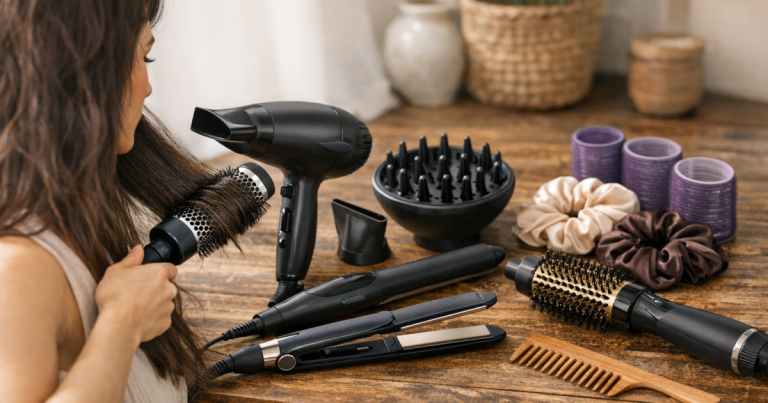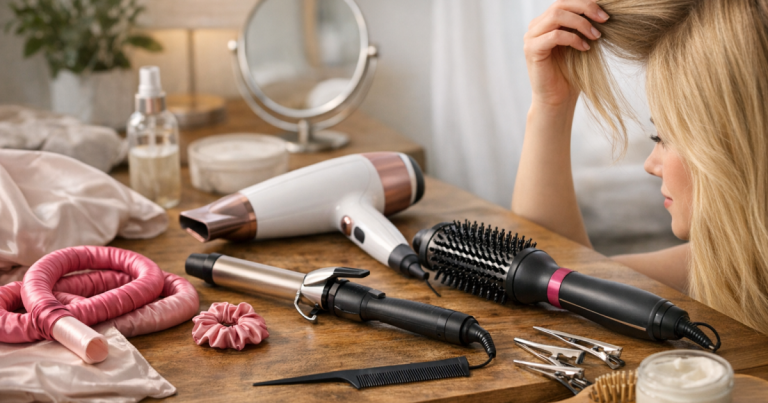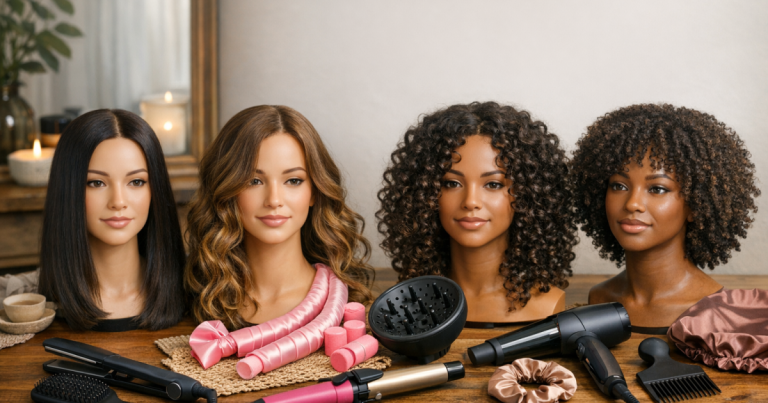
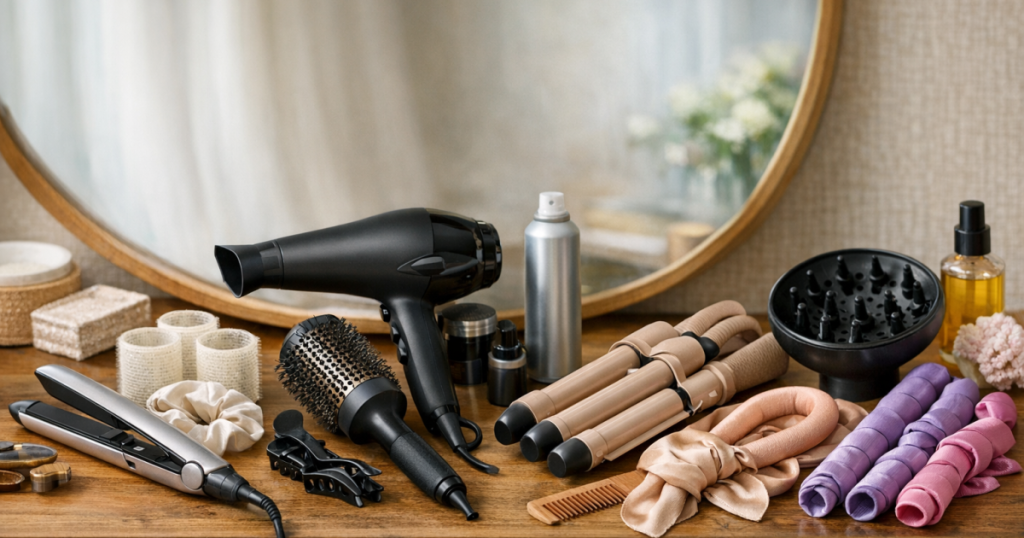
The most useful styling tools by hair type are not always the most powerful, hottest or most expensive ones. Hair behaves differently depending on strand thickness, density, porosity, curl pattern and condition, so the right tool is the one that gives enough shaping power without creating unnecessary frizz, flatness or breakage.
For most at-home styling routines, the decision sits between three levers: heat for reshaping, hold for keeping the finish in place, and heatless methods for reducing stress on the hair. Getting those levers in the right order matters more than owning every tool available.
In brief
- Fine hair usually needs light tools, controlled airflow, low tension and hold that does not feel sticky or heavy.
- Thick or high-density hair needs sectioning, stronger airflow, reliable clips and tools that can reach the underneath layers evenly.
- Wavy and curly hair benefits from diffusers, gentle brushes, scrunch-friendly accessories and hold products that preserve pattern.
- Fragile or colour-treated hair should prioritise heatless shaping, lower heat exposure and snag-free accessories.
- Straight hair that drops quickly often needs root lift, cooling time and lightweight hold rather than more heat.
What your hair type actually changes
Hair type is not just about whether your hair is straight, wavy, curly or coily. Two people can both have waves, yet need completely different tools because one has fine, low-density hair and the other has coarse, high-density hair. Density affects how much airflow or sectioning you need. Texture affects how much tension your hair tolerates. Condition affects how often heat makes sense.
If you are not sure whether density or texture is the bigger factor in your routine, the distinction is worth making before changing tools. The site’s guide to hair density versus texture when choosing styling tools explains why a dense head of fine hair behaves differently from sparse coarse hair.
The practical takeaway is simple: choose the gentlest method that still creates the result you want. If air-drying plus a satin heatless curling rod gives soft shape, you may not need tongs. If your roots collapse within an hour, a round brush or Velcro rollers may be more useful than a straightener. If frizz appears before the hair is dry, airflow technique matters as much as the dryer itself.
Fine hair: lightness, lift and low residue
Fine hair is easily overwhelmed. Heavy creams, high heat and oversized brushes can leave it flat even when the ends look polished. The best approach is usually to build shape at the roots first, then add light hold through the lengths.
Heat options
A compact hair dryer with a concentrator nozzle, a small to medium round brush and a cool-shot function can help fine hair hold volume without overworking the ends. Hot brushes can be useful, but fine hair needs a cautious approach: use them on mostly dry hair and avoid repeatedly pulling the same section.
Hold options
Light mousse, root spray or flexible hairspray usually works better than heavy waxes or dense oils. Apply less than you think you need, then add more only where the style collapses. Fine hair often loses movement when product is spread everywhere.
Heatless options
Velcro rollers at the crown, a loose heatless curling rod through the mid-lengths, or a silk hair wrap overnight can create shape without making the hair look overloaded. The trick is to let the hair dry fully before removing rollers or wraps; even slight dampness can make the lift drop.
Thick hair: control, sectioning and even drying
Thick hair often needs more structure in the routine, not necessarily more heat. The common mistake is drying the outside until it looks smooth while the underneath remains damp. That hidden moisture can make the finished style swell, frizz or lose shape later.
Heat options
A full-size dryer with a narrow nozzle is often more practical than a tiny travel dryer for dense hair because it helps direct airflow through sections. A paddle brush can smooth broad areas, while a round brush adds bend at the ends. For some routines, a multi-styler such as the Shark FlexStyle can be useful because attachments let you switch between drying, smoothing and shaping, but check that the attachments suit your hair length and finish rather than assuming every head will use every piece.
Hold options
Thick hair usually benefits from layered hold: a smoothing cream or leave-in through the mid-lengths, then a flexible finishing spray or light serum only where needed. Too much product near the roots can make dense hair feel heavy and slower to dry.
Heatless options
Large rollers, loose braids, silk wraps and wide heatless rods can help thick hair settle into shape overnight. Use larger sections for a soft blow-dry effect and smaller sections for more defined bends. Secure with snag-free ties rather than tight elastics that leave dents.
Wavy hair: definition without puffiness
Wavy hair sits in the awkward middle: it can look straight when brushed too much, frizzy when blasted with airflow, or limp when overloaded with curl product. The right tools should support the wave pattern rather than forcing it into either a poker-straight or tightly curled shape.
Heat options
A diffuser is often more useful than a concentrator nozzle for waves, provided you use low to medium airflow and avoid disturbing the hair while it dries. Cup the ends, lift towards the scalp and pause rather than moving the dryer constantly. For more detailed technique, see the step-by-step advice on diffusing wavy hair without making it frizzy.
Hold options
Wavy hair often needs enough hold to set the pattern but not so much that it becomes crunchy all day. A light gel or foam can work well if you scrunch out any cast once the hair is completely dry. Brushing after drying is usually what breaks the pattern and creates the halo effect.
Heatless options
A microfibre towel, gentle detangling brush and satin heatless curling rod can all help waves form with less frizz. A brush such as the Denman D3 Original Styler is often used for curl and wave clumping, but technique matters: tension, section size and product slip change the result dramatically.
Curly and coily hair: pattern, moisture and low tension
Curly and coily hair needs tools that protect shape and reduce mechanical stress. Heat is not automatically wrong, but direct heat, rough brushing and tight accessories can quickly disturb the curl pattern or increase breakage, especially on dry or colour-treated hair.
Heat options
Diffusers, hooded dryer attachments and low-tension blow-dry methods are usually kinder than aggressive brushing with high heat. When stretching curls, work in sections and stop once the hair is dry and shaped. Repeated passes rarely improve the finish and can make the hair feel rougher.
Hold options
Cream, gel and mousse all have a place, but the balance depends on curl tightness and density. Looser curls may collapse under rich creams. Tighter curls may need more slip and moisture before hold. Apply product to wet or damp hair in sections so the underneath does not miss out.
Heatless options
Twists, braids, flexi-style rods, satin wraps and silk pillowcases can maintain shape with less daily manipulation. For tying hair up, spiral hair rings such as the Invisibobble Original may reduce harsh creasing compared with tight standard elastics, although hold and comfort will depend on hair density and how tightly you secure it.
Fragile, bleached or breakage-prone hair
Fragile hair needs a different decision order: first reduce friction, then reduce heat frequency, then choose shaping tools that need fewer passes. This applies to bleached hair, chemically treated hair, hair recovering from damage and hair that snaps easily around the hairline.
Heat tools should be used sparingly and with controlled sections. Avoid clamping damp hair, rushing over tangled ends or turning up heat simply because the first pass did not work. If you use straighteners, the method matters as much as the tool; the guidance on using the GHD Platinum+ on fragile hair is a useful example of how to think about prep, sectioning and restraint.
Heatless styling is often the most forgiving route. Silk wraps, satin rods, soft scrunchies and a detangling hair brush can help maintain shape while reducing tugging. A lightweight argan oil hair treatment may help add slip and shine to dry ends, but use a small amount and keep it away from roots if your hair gets greasy quickly.
Straight hair that will not hold a style
Straight hair can be resistant in a different way: it may look sleek but refuse to keep bend, lift or wave. Adding more heat is not always the answer. The missing step is often cooling time. Hair needs to cool in the shape you want it to keep.
For root lift, use rollers at the crown while the hair cools. For soft bends, clip each section after curling or wrap it loosely around a heatless rod while it sets. For glassy smoothness, use a paddle brush, controlled airflow and a light finishing product rather than layering heavy shine sprays.
Heat, hold or heatless: which should lead?
A useful way to plan styling tools by hair type is to decide which of the three levers should lead your routine.
- Lead with heat when your hair needs reshaping from its natural state, such as smoothing strong kinks, stretching dense roots or creating a polished blow-dry from wet hair.
- Lead with hold when your style forms easily but drops quickly. This is common with fine, straight or soft wavy hair.
- Lead with heatless styling when your hair is fragile, already dry, recently coloured, or styled frequently throughout the week.
- Combine methods when you want longevity: for example, blow-dry roots, set lengths in rollers, then finish with a light hold product.
If your styling goal changes from day to day, a tool-selection framework can help. The guide to choosing tools for soft waves, glass hair or root lift breaks down how the desired finish changes the tool choice.
Common mistakes that make tools seem worse than they are
- Using the same heat setting for every section: finer front pieces usually need less time and tension than the back.
- Skipping sectioning on dense hair: the surface may look done while the interior remains damp or uneven.
- Brushing waves and curls after drying: this often creates frizz rather than polish.
- Using heavy hold on fine hair: too much product can remove the movement you are trying to create.
- Ignoring accessories: clips, rollers, wraps, brushes and hair ties can change the result as much as the main heated tool.
Common questions
Do I need different tools for summer and winter?
Not always, but you may need to change technique. In humid weather, hold and frizz control matter more. In colder months, hair may take longer to dry fully, so styles can drop if you remove rollers or wraps too soon.
Is heatless styling enough for thick hair?
It can be, but thick hair usually needs more time, larger tools or smaller sections. Heatless methods work best when hair is slightly damp rather than wet, then left until fully dry.
Which tool helps fine hair look fuller?
Root rollers, a small round brush and lightweight hold products are often more effective than straighteners. Focus lift at the crown and front hairline rather than adding volume everywhere.
Should curly hair avoid brushes?
No, but timing matters. Many curly routines use a brush during styling on wet, product-coated hair, then avoid brushing once dry to preserve definition.
What is the gentlest everyday accessory?
Soft scrunchies, silk wraps and snag-free spiral ties are usually kinder than tight elastics. The right choice depends on how much hold your hair needs and whether it dents easily.
Final thoughts
The right styling routine is less about owning the newest tool and more about matching heat, hold and heatless support to your actual hair. Fine hair needs lightness. Thick hair needs sectioning. Waves need calm airflow. Curls need pattern protection. Fragile hair needs fewer passes and less friction.
Once you understand that balance, tool choices become simpler: use heat only where it adds something, choose hold that supports rather than stiffens, and keep heatless options in the routine whenever they can achieve the same result with less stress on the hair.