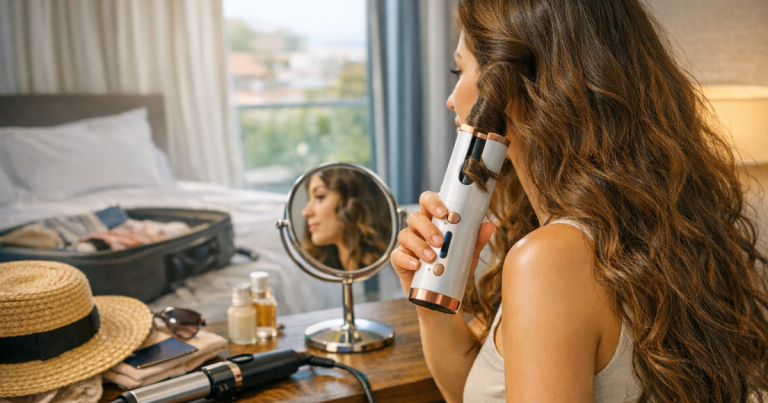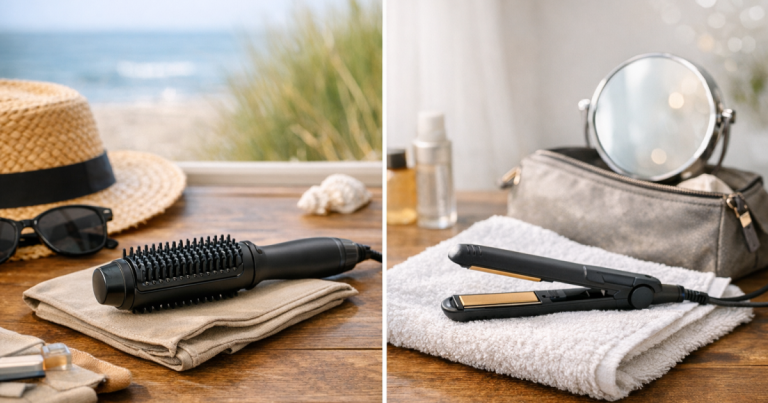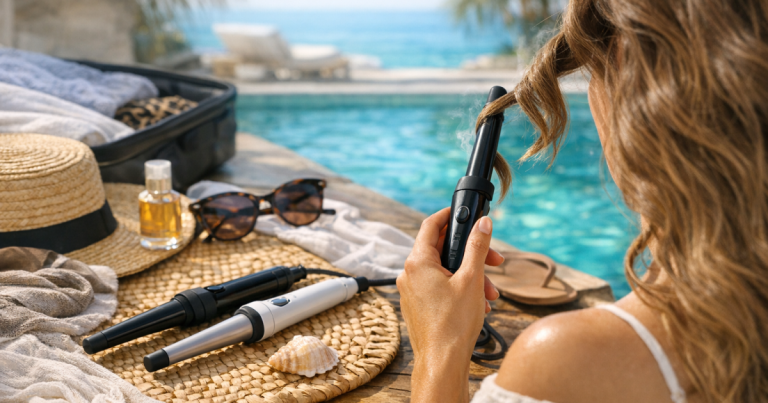
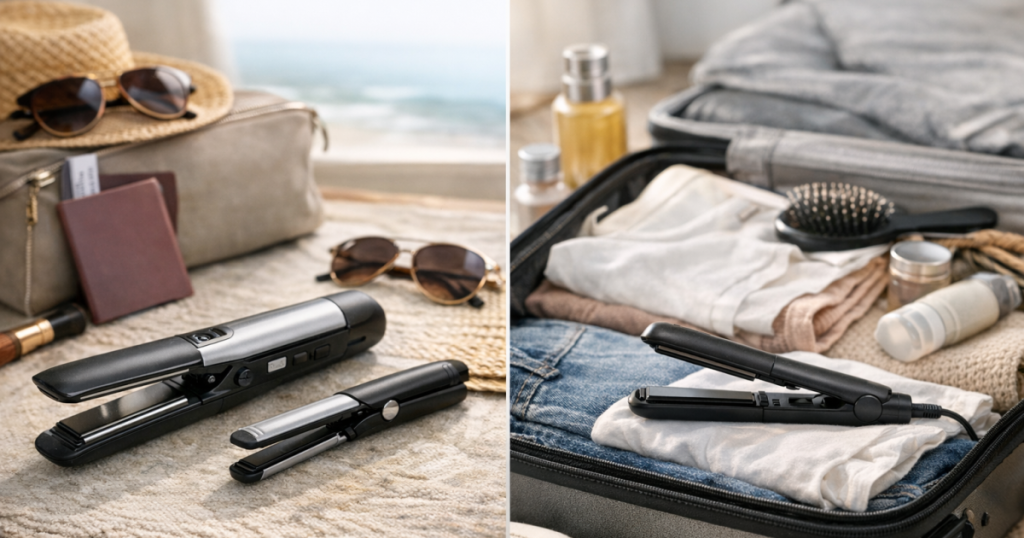
Holiday hair touch-ups are rarely about creating a full salon finish; they are about taming fringe bends, reviving face-framing pieces and smoothing the bits that crease in transit. The real decision with cordless straighteners vs mini straighteners is whether you need cable-free convenience or the steadier feel of a compact plug-in tool.
At a glance
A cordless straightener is the more flexible choice for quick fixes away from a dressing table, such as airport-to-hotel smoothing, post-commute touch-ups or styling in a bathroom with awkward sockets. A mini straightener is usually the more predictable choice if you can plug in and want close control around a fringe, bob, pixie cut or short layers.
- Choose cordless when socket access is unreliable, you need fast fringe or flyaway control, and you are happy to check travel rules before packing.
- Choose mini when you want a compact tool for short hair, detailed sections or reliable plug-in use in UK hotels and holiday accommodation.
- For fine hair, either can work, but plate control, section size and heat discipline matter more than tool size alone.
- For thick or long hair, both are best treated as touch-up tools, not full wash-day straighteners.
How cordless straighteners work for travel touch-ups
Cordless straighteners are designed around freedom of movement. Instead of being tied to a wall socket while you smooth your fringe or ends, you can use the tool where there is a mirror, decent lighting and enough space to section safely. That can be useful in small hotel rooms, shared bathrooms, gym changing areas or when a UK 3-pin socket is not conveniently placed near the mirror.
The trade-off is planning. You need to think about charging, heat availability and airline or rail travel restrictions before you rely on one as your only styling tool. Cordless heated tools may be treated differently depending on their power source and the operator’s rules, so check your airline and airport guidance before packing one in hand luggage or hold luggage.
Real examples readers may see in UK retailers include the ghd Unplugged Cordless Styler, BaByliss 9000 Cordless Straightener and Dyson Corrale Straightener. Do not assume they behave the same: verify the current charging requirements, permitted travel storage, plate size, heat settings and manufacturer guidance for the exact model.
How mini straighteners differ
Mini straighteners are compact, usually corded styling tools with smaller plates and a lighter footprint in your wash bag. They are not automatically weaker or gentler; they simply work on smaller sections. That makes them helpful for precision areas such as curtain bangs, short layers, cowlicks at the hairline and flicked-out ends on a bob.
Because they plug in, mini straighteners can feel more straightforward for hotel use. You are not waiting for a charge, and you do not have to ration styling time in the same way. The limitation is access: if the only socket is across the room from the mirror, or the lighting is poor, the smaller tool will not magically make styling easier.
A familiar example is the ghd Mini Styler, which is often considered for fringes, shorter cuts and detail work. As with any heated tool, check the current product details rather than assuming every compact styler has the same plate width, temperature behaviour or travel compatibility.
Which is better for your hair type?
Fine or low-density hair
Fine hair is the most likely to show dents from sleep, hats, headrests and humidity, so travel touch-ups can be genuinely useful. A mini straightener is often easier to control because you can work in slim sections without clamping too much hair at once. Cordless models can also work well, but avoid repeated passes over the same fragile front pieces.
If your fine hair loses shape quickly after heat styling, focus on prep and cooling time rather than simply turning up the heat. For styling technique beyond straightening, the tutorial on using straighteners for soft waves on fine hair is a useful next step because the same light-pressure approach applies to travel tools.
Short hair, bobs and fringes
Mini straighteners usually have the edge for short hair because the smaller plates can reach close to the root area and follow the shape of cropped layers. They are also easier for flicking out a bob or smoothing a fringe without flattening the whole front section.
Cordless straighteners are still handy if your main issue is a kink at the hairline or a fringe that separates after travel. The key is not to overwork the crown. Smooth the visible bends, let the hair cool, then use fingers or a small brush to loosen the result.
Thick, coarse or long hair
For thick, coarse or long hair, neither tool should be treated as a full-size straightener replacement unless your styling need is genuinely minimal. A cordless model can tidy the top layer and face-framing sections, while a mini tool can refine a fringe or shorter pieces. For a complete sleek finish, you may find either option too slow because small sections take time.
Pack with realism: if your hair usually needs a full-size styler after washing, a compact tool is better for day-two polish, not a total restyle.
Wavy, curly or frizz-prone hair
For waves and curls, travel straighteners are best used selectively. Smooth the roots only if they have puffed up, define the front pieces if they have stretched, or polish the outer layer where friction has caused frizz. Running a small straightener through every section can leave the shape uneven, especially when the rest of the hair still has natural movement.
If your hair is prone to dryness, consider whether a non-heat refresh will do the job first. A little water mist, styling cream on the ends or a satin wrap overnight may preserve more texture than daily heat.
Step-by-step: how to use either tool without over-styling
- Start with dry hair. Do not use straighteners on damp sections unless the exact tool is specifically designed for that purpose and the instructions say so.
- Brush or comb first. Removing tangles helps plates glide without snagging, which is especially important for fine or highlighted hair.
- Work only where needed. Target the fringe, parting, face-framing pieces, ends or top layer rather than re-styling your whole head.
- Use small sections. Compact plates perform better when they are not overloaded. If the hair bunches or drags, the section is too wide.
- Keep passes slow but limited. One controlled pass is usually better than several rushed passes over the same fragile area.
- Let the hair cool before touching. This helps the shape settle, whether you want a smooth bend, a soft flick or a straighter fringe.
- Finish lightly. Use minimal product on travel hair; too much oil, spray or serum can make fine hair collapse by lunchtime.
Fine hair needs particular care with repeated heat, even when the tool is small. If you rotate between hot brushes, straighteners and curling attachments at home, the advice on protecting fine hair when using multi-stylers will help you set sensible limits for holidays too.
Travel checks before you pack
The most sensible tool is the one that suits the journey as well as your hair. Before you pack, run through these checks rather than assuming compact means convenient.
- Socket access: For UK stays, a corded mini straightener may be simple. For overseas trips, check plug compatibility and whether your tool is suitable for the destination’s supply before you travel.
- Luggage rules: Cordless heated tools can be subject to airline restrictions. Check the latest rules for your airline, route and airport.
- Heat protection: Pack a lightweight heat protectant that works on dry hair if you plan to touch up between washes.
- Storage: Allow the tool to cool fully before placing it near toiletries, fabric pouches or synthetic wash bags. A heat-resistant mat or pouch can be useful if supplied or recommended by the manufacturer.
- Routine fit: If you mainly need a smoother fringe, go small and precise. If you style in unpredictable places, cordless convenience may matter more.
Where a mini dryer, rollers or heatless tools may be smarter
Straighteners are not always the best travel answer. If your issue is flat roots, a compact hair dryer or hot brush technique may give a fresher finish than clamping the top layer. If your issue is limp curtain bangs, Velcro rollers can add shape while you do make-up, with no extra heat pass needed.
For readers building a realistic travel kit, the comparison of a mini hair dryer versus a hotel dryer is worth reading before you decide whether your straightener should be the only heated tool in your bag.
Main lessons
Pick a cordless straightener if your priority is flexibility: awkward mirrors, shared spaces, quick fringe fixes and styling away from a socket. Pick a mini straightener if your priority is precision: short hair, bobs, fringes, face-framing layers and reliable plug-in use.
For most travel routines, the smartest approach is not to ask which tool can replace your full home set-up. Ask which one solves the small problem that actually happens when you are away: a bent fringe, frizzy top layer, flicked-out ends or flat face-framing pieces. That answer will usually make the choice obvious.
FAQ
Can I take cordless straighteners on a plane from the UK?
It depends on the tool, power source, airline and route. Check your airline and airport guidance before travelling, and follow the manufacturer’s packing instructions for the exact model.
Are mini straighteners better for hand luggage?
They can be simpler because many are corded and compact, but you still need to pack them safely and check plug compatibility if travelling outside the UK.
Will a mini straightener work on long hair?
Yes, but mainly for touch-ups. It can smooth face-framing pieces, ends or the top layer, but full-head straightening will usually take longer than with a standard-size tool.
Which option is kinder to fine hair?
Neither is automatically kinder. Fine hair benefits from controlled sections, fewer passes, lower-effort styling and good heat protection, whichever travel tool you choose.
Can I use a travel straightener to create waves?
Yes, if the plates and shape allow a smooth turn through the hair. Mini tools create tighter bends, while larger cordless plates may give a softer curve on longer front pieces.
Quick Buying Links
Cordless Straighteners
The real decision with cordless straighteners vs mini straighteners is whether you need cable-free convenience or the steadier feel of a compact plug-in tool.
Mini Straighteners for Travel Touch-Ups
Worth considering if its strengths better match your needs.