Packing a straightener, curling tong or travel dryer is simple until the socket looks wrong and the voltage label suddenly matters. The plug adaptor vs voltage converter decision decides whether your tool merely needs a different pin shape, or whether the electrical supply itself must be changed before you style.
Electrical compatibility checks for damaged plugs, modified cables or unclear voltage labels, and any repair or alteration of a hair tool, should be carried out by a qualified electrician or the manufacturer to comply with local electrical safety standards and the destination’s regulations.
The short answer before you pack
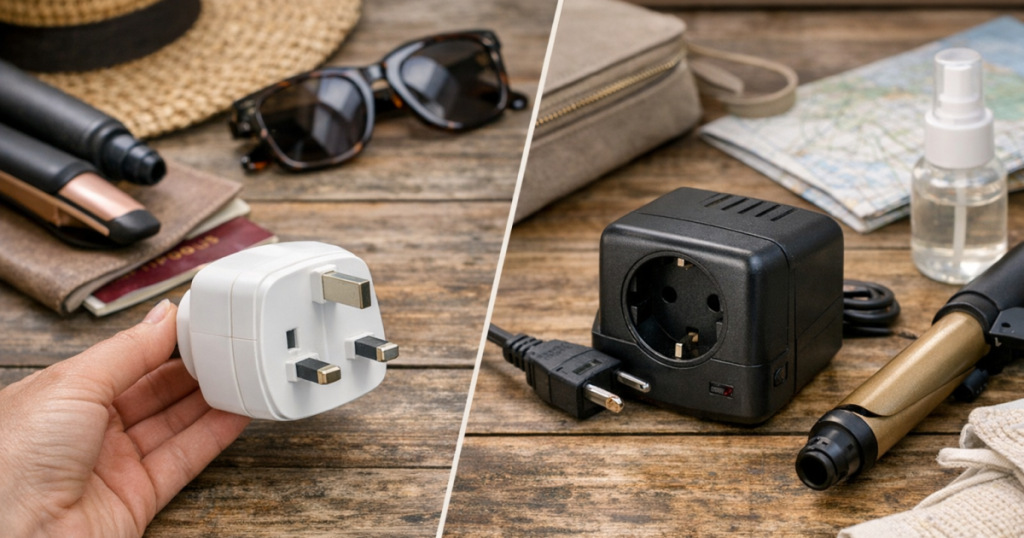
A plug adaptor only changes the shape of the plug so it fits the wall socket. It does not change voltage, heat output or the way your hair tool is powered.
A voltage converter changes the electrical supply to suit a tool made for a different voltage range. That sounds simple, but many hair tools are high-draw appliances, so a converter must be suitable for the tool’s wattage and type. If the converter rating, tool label or manufacturer guidance does not clearly match, do not use that combination.
For most travellers, the neatest solution is either a dual-voltage hair tool used with the correct destination plug adaptor, or a heatless/low-risk travel styling plan that avoids mains voltage issues altogether.
The practical difference between the two
What a plug adaptor does
A plug adaptor is the plastic accessory that lets a UK three-pin plug physically fit another country’s socket shape. It is useful when the voltage range on your tool already matches the destination supply. For example, a tool labelled 100–240V is designed to accept a wide voltage range, so it will usually need only the correct plug adaptor for the socket type.
Do not assume a compact tool is automatically dual voltage. Travel size describes portability, not electrical compatibility. Always read the rating plate or printed label on the handle, plug, cable tag or body of the appliance.
What a voltage converter does
A voltage converter changes voltage up or down. This matters when a single-voltage tool is made for one supply but is being used somewhere with a different supply. A UK-only 220–240V tool may perform poorly in a 110–120V destination, while a 110–120V tool used on a 220–240V supply can overheat or fail quickly.
Hair dryers, hot brushes, curling tongs and straighteners often draw more power than small chargers or beauty accessories. That is why a converter that seems fine for a lower-power item may not be appropriate for a heat tool. Check the tool’s wattage, the converter’s continuous rating, the manufacturer’s instructions and whether the tool uses a heating element, motor, electronic controls, or a combination.
How to check your hair tool in five steps
1. Find the voltage label
Look for a printed rating such as 220–240V, 110–120V, or 100–240V. The exact wording varies by tool, but you are looking for the voltage range, frequency and wattage. If the label is worn away, hidden or unreadable, do not guess.
2. Match it to your destination
Check the local mains voltage for where you are staying, including hotel rooms, cruise cabins and older accommodation. Some destinations use more than one socket type, and some properties have mixed outlets. A universal adaptor can help with pin shape, but it still will not change voltage.
3. Check wattage, not just voltage
If you think you need a converter, compare the tool wattage with the converter’s rating. Hair dryers are the most demanding travel item in many wash bags, because they combine heat and airflow. Straighteners and curling tools can also be unsuitable for basic travel converters if their instructions say not to use one.
4. Look for frequency and manufacturer warnings
Some labels include 50/60Hz, while some tools are more restrictive. If the tool’s instructions warn against use with converters, extension leads or certain adaptors, follow that guidance. A successful test at home with an adaptor tells you nothing about how the tool will behave on a different voltage supply.
5. Decide whether the tool is worth packing
If the checks feel awkward, bulky or uncertain, the most practical answer may be to leave that heated tool behind. A satin heatless curling rod, Velcro rollers, a silk hair wrap or a detangling brush can protect your routine without adding voltage risk. If you usually rely on tongs, the transition is easier when you plan your set size, drying time and product finish before travel; this guide on switching from curling tongs to heatless curls is a useful next step.
Hair-type guidance for travel styling
Your hair type changes how much risk and compromise you can tolerate when a tool does not perform exactly as it does at home.
- Fine or fragile hair: avoid repeated passes caused by a weakly powered tool. If your straightener or tong is not heating consistently abroad, stop rather than increasing tension or styling time. Heatless rollers, a soft wrap or a light smoothing product can often give a better holiday result with less stress on the ends.
- Thick, dense or coarse hair: you may depend on full heat output and a tool that recovers temperature quickly. A mismatched converter setup can be frustrating because styling takes longer and sections need more work. Consider whether a dual-voltage travel dryer plus heatless shaping is more realistic than taking a full-size high-draw tool.
- Curly and wavy hair: diffusing can be the tricky part because it usually involves a dryer and attachment. If you cannot confirm your dryer will work safely, pack for air-drying: microfibre towel, curl cream or gel in travel-compliant sizes, clips for root lift and a silk wrap for sleeping.
- Short hair or fringes: mini tools can be tempting, but compact does not always mean travel-safe. Check the label exactly as you would with a full-size tool, especially for root touch-ups, fringe smoothing or short layered styling.
If you are unsure how much heat your hair genuinely needs to hold shape, read how much heat each hair type needs before deciding which tools deserve space in your case.
Real-world examples: check the label, not the product name
Travel-branded tools can be helpful, but the name alone is not enough. A compact dryer such as the ghd Flight+ Hair Dryer or the Remington On The Go D1500 Compact Hair Dryer should still be checked for the exact voltage, wattage and destination compatibility before you pack it. Packaging, model versions and regional releases can vary, so rely on the label on the actual tool in your hand.
The same rule applies to straighteners, hot brushes, heated rollers and curling wands. If a retailer describes something as travel-friendly, verify whether that means smaller, foldable, lighter, dual voltage, or simply supplied with a storage pouch. Those details are not interchangeable.
When a plug adaptor is enough
A plug adaptor is normally enough when all of these are true:
- Your hair tool is clearly labelled with a voltage range that includes the destination supply.
- The plug adaptor matches the socket type at your accommodation.
- The adaptor is suitable for the tool’s plug and power draw.
- The tool and cable are undamaged, with no loose pins, exposed wire or scorch marks.
- The manufacturer’s instructions do not restrict use abroad or with adaptors.
This is the cleanest travel setup because you are not asking another device to alter the electrical supply. For a beauty routine, it also means fewer bulky items in your wash bag and less uncertainty when you are styling in a rush before dinner, a wedding or a humid day out.
When a converter might be needed
A converter enters the conversation when your tool is single voltage and the destination supply is different. Even then, it is not an automatic green light. The converter must be appropriate for the appliance type and rated comfortably for its wattage. Many travellers decide the converter is not worth the weight, cost, heat-tool limitations or risk of getting it wrong.
Be especially cautious with full-size hair dryers, hot air stylers and tools with digital controls. If your styling result depends on precise temperature control, a mismatched or unsuitable converter is not a beauty shortcut; it can become the reason your hair takes longer, frizzes more, or the tool fails mid-trip.
A lighter packing plan that still gives shape
Start with the style you actually need while away, not the tool you automatically use at home. One city break, beach holiday or work trip may require smooth fringe control and polished ends; another may only need soft waves that last through humidity.
- For soft waves: pack a satin heatless curling rod or bendy rollers and set hair when it is slightly damp or lightly misted.
- For volume: Velcro rollers are light, socket-free and useful at the crown, fringe and face-framing layers.
- For smoother mornings: a silk hair wrap can preserve shape overnight and reduce friction while travelling.
- For polished ends: a tiny amount of argan oil hair treatment can soften dry ends, but check current airport liquid rules and container limits before flying.
- For detangling after swimming or wind: a flexible detangling brush is often more useful than a second heated tool.
For a more realistic packing edit, think in styling goals rather than gadgets. The article on which styling goals one hair tool can realistically achieve helps separate what one compact tool can do from what needs a different method.
Things readers ask
Can I use my UK hair straighteners abroad with just an adaptor?
Yes, if the straighteners are clearly labelled for the destination voltage range, such as 100–240V, and the adaptor fits the local socket. If they are marked 220–240V only, an adaptor alone does not change the voltage.
Are travel adaptors and converters the same thing?
No. An adaptor changes plug shape only. A converter changes voltage. Confusing the two is the most common reason hair tools underperform or become unsafe abroad.
Is a hotel bathroom shaver socket safe for hair tools?
Do not use hair dryers, straighteners or curling tools in shaver-only sockets. These sockets are intended for low-power shavers or toothbrushes, not high-draw styling appliances.
What should I do if my tool smells hot or makes a buzzing sound abroad?
Switch it off, unplug it and stop using it. Do not keep testing it. Use a heatless method or a locally supplied appliance instead.
Is it better to buy a dual-voltage tool for travel?
For regular travel, a clearly labelled dual-voltage tool is usually simpler than carrying a converter. You will still need the correct plug adaptor for the destination socket.
Main points
A plug adaptor solves socket shape; it does not solve voltage. A voltage converter changes electrical supply, but it must match the hair tool’s wattage, appliance type and manufacturer guidance. For many trips, the safest and most compact approach is a dual-voltage tool with the correct adaptor, backed up by heatless styling options that suit your hair type and the finish you want.
Quick Buying Links
Plug Adaptor
The plug adaptor vs voltage converter decision decides whether your tool merely needs a different pin shape, or whether the electrical supply itself must be changed before you style.Electrical compatibility checks for damaged plugs, modified cables or unclear voltage labels, and any repair or alteration of a hair tool, should be carried out by a qualified electrician or the manufacturer to comply with local electrical safety standards and the destination’s regulations.The short answer before you packA plug adaptor only changes the shape of the plug so it fits the wall socket.
Voltage Converter for Hair Tools Abroad
Worth considering if its strengths better match your needs.