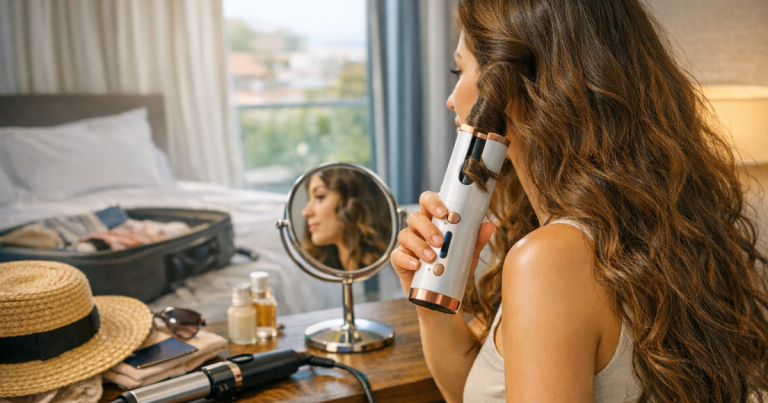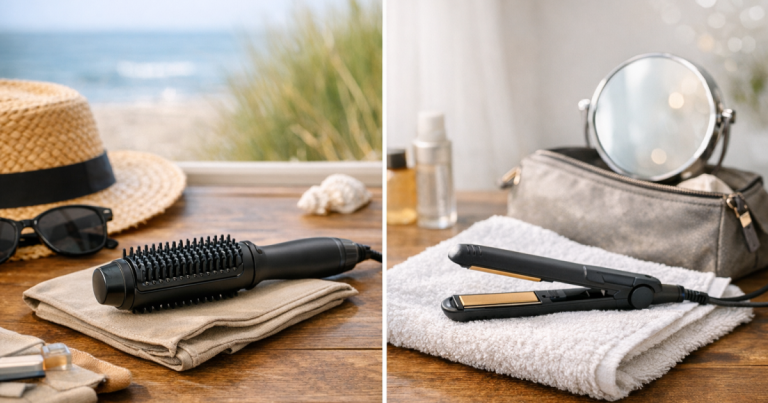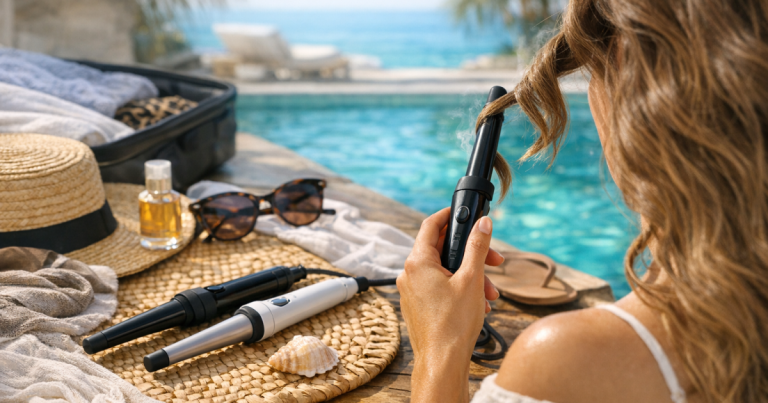
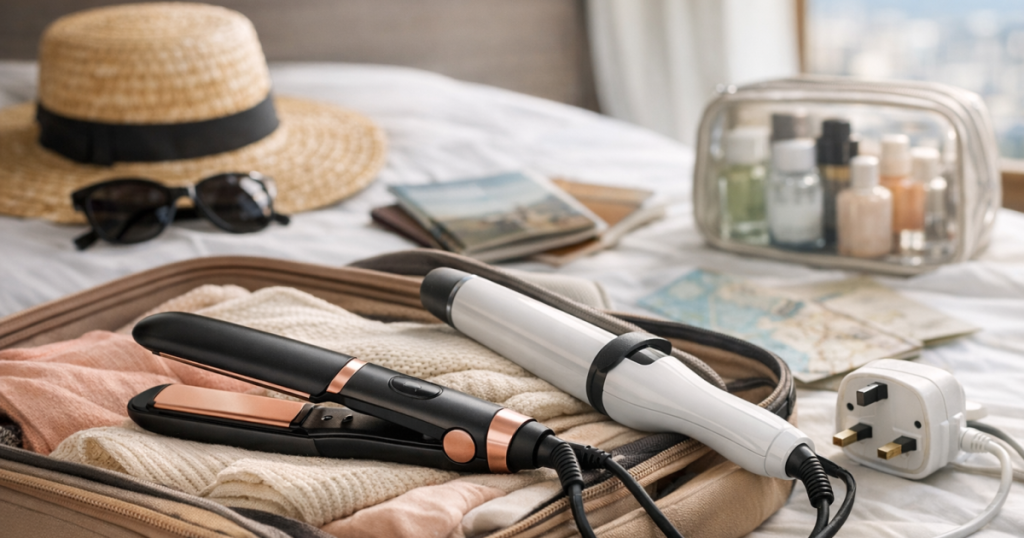
Packing your favourite styler for a holiday is tempting, but dual voltage hair tools are only worth the space when they genuinely match the country’s mains voltage, your luggage allowance and the way your hair behaves away from home. For some travellers, a compact dual-voltage straightener or tong is more reliable than a hotel drawer dryer. For others, heatless prep and a plug adaptor are enough.
Safety note: Repairs to damaged cables, plugs or internal voltage components should be carried out by a qualified electrician to ensure compliance with local electrical safety requirements. A travel plug adaptor does not convert voltage, so the tool’s rating must match the destination before use.
The short answer
A dual-voltage styler is worth packing if you regularly rely on heat for your fringe, roots, smooth ends or defined curls, and you are travelling somewhere with a different mains voltage from the UK. It is less useful if your tool is bulky, your hairstyle can be refreshed without heat, or your accommodation provides a dryer that is good enough for your routine.
- Worth it: precise tools such as mini straighteners, compact curling tongs, hot brushes with the correct rating, and travel dryers that suit your hair type.
- Less worth it: heavy full-size stylers, single-voltage tools, or anything you only use occasionally at home.
- Essential check: the rating label should state an input range that covers the destination, commonly shown as a range such as 100–240V.
- Still needed: the correct plug adaptor for the country you are visiting.
How voltage actually affects your hair tool
The UK mains supply is typically 230V. Many countries use a similar voltage, but destinations such as the United States, Canada and parts of Japan use lower-voltage systems. A single-voltage UK hair tool may not heat properly on a lower-voltage supply, or it may be unsafe on an incompatible supply. A dual-voltage tool is designed to work across a broader input range, but you still need to check the wording printed on the handle, plug, power brick or instruction label.
Do not assume that a premium tool, salon-style dryer or compact travel appliance is automatically travel-ready. Some full-size dryers and high-performance stylers are made for one regional voltage only. Equally, a travel-sized tool is not always dual voltage. The physical size tells you very little; the rating label is what matters.
When dual voltage hair tools earn their place
They are most useful when your hair needs predictable heat to look polished. If your fringe kinks, your bob flicks out, or your roots collapse in humidity, a small compatible tool can be the difference between a two-minute tidy-up and a full restyle. They also make sense for work trips, weddings abroad and city breaks where you want repeatable styling without relying on the bathroom drawer.
Fine or flat hair
Fine hair often needs less heat but more control. A compact straightener, small tong or slim hot brush can help smooth bends, refine face-framing pieces and add lift without packing a full kit. The main risk is over-styling: fine hair can lose shape quickly if you keep reheating the same sections. If you use a multi-styler at home and want to downsize for travel, the same principles apply: use the lowest effective heat, keep passes minimal and avoid clamping fragile ends repeatedly. For a deeper routine, see our guide to protecting fine hair when using multi-stylers.
Thick, coarse or long hair
Thicker hair is where travel tools can feel underwhelming. Mini plates, shorter barrels and lower-output travel dryers may work for touch-ups, but they can be slow for a full head. If you are styling from wet hair daily, a compact dryer only earns its place if it gives you enough airflow for your density and length. Otherwise, you may be better packing sectioning clips, smoothing products and a smaller finishing tool rather than trying to recreate a full salon-style blow-dry in a hotel room.
Curly or wavy hair
For curls and waves, the decision is less about straightening everything and more about controlling frizz, drying time and curl pattern. A dual-voltage diffuser-compatible dryer can be helpful if you normally diffuse, but only if the attachment fits securely and packs sensibly. If your curls respond well to air-drying, a silk wrap, soft scrunchie, lightweight gel or heatless curling method may be a better use of space than a heated tool.
What to check before you pack
Use this quick checklist before putting any heated tool in your case.
- Voltage rating: look for an input range that covers your destination. If the label only lists one voltage, treat it as single voltage.
- Plug shape: dual voltage does not mean universal plug fit. You still need the correct travel adaptor.
- Manual switch: some older travel tools have a voltage switch. Check it is set correctly before use and after packing.
- Heat control: adjustable temperature is useful, especially for fine, colour-treated or fragile hair.
- Size versus job: a mini tool is great for fringes and ends, but slow for dense hair or full-length smoothing.
- Accommodation reality: hotel dryers vary hugely. If drying is central to your routine, do not assume the supplied dryer will suit your hair.
- Condition of the cable: do not travel with a tool that has exposed wires, cracked casing, scorch marks or a loose plug.
If your main concern is whether to rely on what is provided, our mini hair dryer versus hotel dryer comparison breaks down the practical trade-offs for drying speed, control and luggage space.
Heat tool, heatless method or both?
The best travel setup is often a hybrid. Use heatless styling for the bulk of the shape, then pack one compact tool for tidy-up work. For example, you might sleep in a silk wrap or heatless curling rod, then use a travel straightener only on the front pieces. This reduces heat exposure and avoids carrying several tools that duplicate each other.
For smooth styles, a detangling brush, a small bottle of your usual finishing oil decanted safely for travel, and a compact straightener may be enough. For waves, heatless rods or a soft wrap can create shape overnight, while a tong is reserved for the pieces that drop first. For curls, prioritise frizz control, a secure diffuser if you need one, and gentle refresh techniques over daily full restyling.
When they are not worth packing
Skip the heated tool if you are going somewhere very humid and know your usual straightened style will not last, or if your trip is short enough that a wash-and-go routine is realistic. Also leave it at home if the tool is single voltage and the destination is incompatible. Voltage converters are not a neat fix for every hair appliance, particularly high-wattage heated tools, and they add bulk, complexity and another potential point of failure.
It is also worth being honest about your itinerary. A beach holiday, hiking trip or hand-luggage-only weekend may not justify a full styling routine. A wedding abroad, business trip or city break with dinners booked probably does. The right answer is less about owning the most travel-friendly tool and more about packing for the version of your hair you will actually maintain.
Examples of sensible packing setups
Hand-luggage city break
Pack a compact dual-voltage straightener or tong only if you use it for visible touch-ups at home. Add a small brush, sectioning clip and a lightweight finishing product. If you are deciding between portable straightening options, our guide to cordless and mini straighteners for travel touch-ups explains where each format makes sense.
Hot-weather beach holiday
Prioritise frizz management and low-effort texture. A heatless curling rod, silk wrap or loose braid routine may do more for your hair than a styler you will barely use. If you do pack heat, make it one tool with a clear job, such as smoothing a fringe or refining face-framing sections.
Wedding or event abroad
This is where a compatible heated tool can be worth the space. Test the full routine at home first: wash, dry, style, pin or set, then check how long the shape lasts. If your style relies on root lift, curls or polished ends, pack the tool that creates that result most reliably rather than several “just in case” extras.
Key takeaways
Dual-voltage styling tools are worth packing when they solve a specific travel hair problem: unreliable hotel dryers, stubborn fringes, humidity-hit waves, flat roots or event styling. They are not automatically better because they are compact, and they are not a substitute for checking the voltage rating and plug adaptor requirements.
Before you travel, read the rating label, match the tool to your hair type and choose one clear styling priority. If you can get most of the shape with heatless prep and use a small heated tool only for finishing, you will usually save space, reduce heat exposure and still feel polished abroad.