Thick hair can turn a simple blow-dry into a juggling act: one section is damp, another falls into your brush, and the crown never quite gets the lift you wanted. The key difference in duckbill clips vs sectioning clips is control: duckbill clips give clean, flat separation, while sectioning clips provide stronger grip for heavier panels.
For most thick hair blow-dries, the smartest approach is not choosing one and ignoring the other. Use sectioning clips to hold the bulk of the hair out of the way, then use duckbill clips for detail work around the hairline, fringe, parting and cooling sections into shape.
At a glance
- Use sectioning clips when you need strength, hold and fewer dropped sections.
- Use duckbill clips when you need neat lines, flat placement and control close to the roots.
- For very thick, coarse or long hair, sectioning clips are usually the main workhorse.
- For wavy, layered or frizz-prone hair, duckbill clips are useful for gentle placement and cleaner airflow.
- The best blow-dry setup for thick hair often uses both: strong clips for weight, slim clips for precision.
What each clip actually does during a blow-dry
Duckbill clips: neat separation and flat control
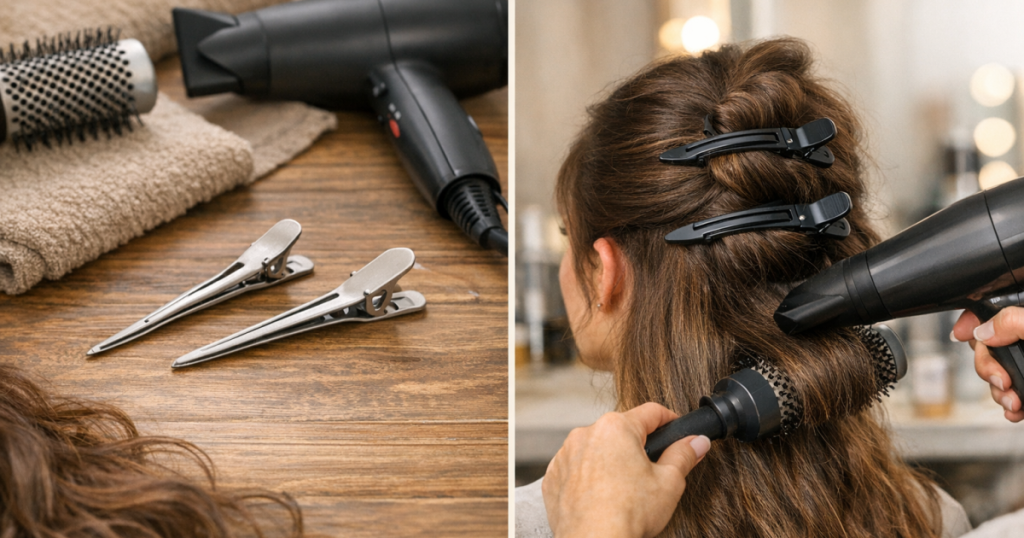
Duckbill clips are long, slim clips with a narrow beak shape. They usually sit flatter against the head than chunky sectioning clips, which makes them helpful for precise partings, pinning away shorter layers and setting the direction of hair as it cools. On thick hair, they are not always strong enough to hold a large damp section on their own, but they are excellent for controlling smaller pieces that would otherwise fall forward.
They are particularly useful around the temples, fringe, crown parting and nape, where a bulky clip can get in the way of your brush or dryer nozzle. If you blow-dry with a round brush, a duckbill clip can keep the next section cleanly separated without creating a bulky obstacle above the section you are working on.
Sectioning clips: grip for density and weight
Sectioning clips, often crocodile or alligator-style clips, are designed to hold more hair. They usually have a stronger hinge and a wider gripping surface, so they are better for lifting away heavy, damp sections while you dry in stages. This matters on thick hair because even a beautifully planned blow-dry can fall apart if the hair you have clipped up keeps sliding down.
They are the better choice for dividing the head into workable zones: nape, sides, crown and top. They are also easier to reposition quickly when your hands are busy with a brush and dryer. The trade-off is that they can leave a temporary dent if you clamp too tightly on nearly dry hair or place them across the surface of a polished section.
Where each clip wins on thick hair
The fairest way to compare duckbill clips vs sectioning clips is to look at the job you need the clip to do, rather than treating them as interchangeable accessories.
- Holding the bulk of damp hair: sectioning clips are more reliable because they grip heavier panels without slipping.
- Creating clean partings: duckbill clips are better because they sit flatter and help keep your section line tidy.
- Working close to the scalp: duckbill clips are less bulky, so they interfere less with brush angle and airflow.
- Controlling layered hair: use sectioning clips for the main weight and duckbill clips to pin shorter layers that escape.
- Setting volume while hair cools: duckbill clips can hold a lifted root or directional sweep more neatly than a chunky clip.
- Speed and practicality: sectioning clips usually win when you need to move quickly through dense hair.
A thick-hair blow-dry setup that actually behaves
Start with hair that has been towel-blotted or air-dried until it is damp rather than dripping. Thick hair takes longer to dry, so clipping soaking-wet sections into tight bundles can slow everything down and make the roots feel heavy.
Divide the hair into four broad zones: nape, left side, right side and crown/top. Secure each zone with sectioning clips first. If your hair is exceptionally dense, split each side into upper and lower panels so you are never trying to dry a section that is too wide for your brush.
Begin at the nape, unclipping only the section you are actively drying. Keep the rest of the hair held high with sectioning clips so it does not fall into your airflow. As you move upwards, use duckbill clips to pin away any shorter layers, face-framing pieces or fringe sections that keep dropping into the brush path.
For root lift, dry each section with the roots lifted away from the scalp before smoothing the lengths. Once a crown or front section is warm and dry, roll it around your brush, slide the brush out carefully, and place a duckbill clip at the base or along the curve to help it cool in the direction you want. For a no-heat finishing option, you can also set Velcro rollers for root lift without heat once the hair is mostly dry.
Hair-type guidance: which clip should lead?
Thick straight hair
Straight, dense hair can look smooth quickly on the surface while staying damp underneath. Sectioning clips should lead because they let you expose smaller, cleaner panels. Use duckbill clips mainly for the front hairline, parting and any sections you want to cool with a bend.
Thick wavy hair
Wavy hair needs enough control to dry evenly, but too much disruption can make the wave pattern fluffy. Use sectioning clips to hold the weight, then duckbill clips to separate the top layers without flattening the wave. If you are switching between diffusing and blow-drying, the same principle applies: control the section without crushing the pattern. For curlier textures, it is worth reading how to diffuse curly hair without creating frizz.
Thick curly or coily hair
For curly and coily hair, clips should support your styling method rather than pull the curl pattern out of place. Sectioning clips are useful for keeping dense areas organised while you dry in quadrants. Duckbill clips are helpful for root clipping, lifting specific areas and keeping shorter pieces out of the face. Avoid clamping curls flat across the surface if you want volume and definition.
Fine but dense hair
Fine hair can still be thick in quantity. In this case, heavy-duty sectioning clips may feel secure but can leave marks more easily. Use lighter sectioning clips for the main panels and duckbill clips for visible areas near the crown and hairline. Keep sections narrow enough that you are not repeatedly going over the same hair with heat.
Common clipping mistakes that make thick hair harder to dry
- Taking sections that are too large: if the underside stays damp, the finished style will collapse faster. Smaller sections dry more evenly.
- Clipping across polished hair: strong clips can dent smooth sections. Clip above or behind the section you have finished, not through the visible surface.
- Using only duckbill clips for heavy hair: they may slide out or force you to over-tighten them, which defeats their purpose.
- Putting sectioning clips too close to the brush: bulky clips can block your wrist angle and stop the brush getting enough tension.
- Ignoring the cooling stage: thick hair often needs time to cool in shape. Duckbill clips can help hold lift or curve while the style sets.
Practical checks before you start drying
Check the hinge strength. A clip should open smoothly, grip securely and release without snagging. If it takes effort to open, it may be annoying during a full blow-dry. If it feels weak, it may not cope with thick damp sections.
Check the edges. Rough seams, exposed metal or sharp teeth can catch on textured, highlighted or fragile hair. This matters more when your hair is damp, as strands are more vulnerable to stretching and breakage.
Check the grip pattern. Teeth are useful for holding weight, but very aggressive teeth can disturb curls or leave marks. Smooth duckbill clips are better for visible areas, while toothed sectioning clips are better for hidden holding work.
Check your dryer setup too. Thick hair puts more pressure on the whole routine, not just the clips. If your dryer struggles to move air through dense sections, even perfect sectioning will feel slow. For travel and compact setups, this comparison of a mini hair dryer vs hotel dryer explains what changes when airflow is limited.
Simple routine: how to use both clips together
- Step 1: Detangle gently, then apply your usual heat protection and styling product for your hair type.
- Step 2: Create broad zones and secure them with sectioning clips, keeping the hair lifted rather than twisted tightly.
- Step 3: Release one lower section at a time and dry from roots to ends.
- Step 4: Use duckbill clips to hold loose layers away from the section you are drying.
- Step 5: At the crown and front, use duckbill clips to hold lift while the hair cools.
- Step 6: Remove clips only once the hair feels dry and cool, then finish with a light touch rather than heavy brushing.
FAQ
Are duckbill clips strong enough for thick hair?
They can be, but usually only for smaller sections, root clipping and detail work. For holding large damp panels, sectioning clips are usually more secure.
Will sectioning clips leave dents in a blow-dry?
They can if you clamp them tightly across hair that is almost dry or already smoothed. Place them on unfinished sections or hidden areas to reduce marks.
How many clips do I need for a thick hair blow-dry?
Most thick hair routines are easier with four to six sectioning clips and a few duckbill clips for the hairline, layers and cooling sections.
Should I use metal or plastic duckbill clips?
Either can work. The most important checks are smooth edges, comfortable tension and whether the clip holds without snagging your hair.
Can clips help my blow-dry last longer?
Yes, indirectly. Clean sectioning helps hair dry evenly, and clipping warm roots or curves while they cool can improve shape retention.
Final thoughts
For thick hair, sectioning clips are the stronger foundation and duckbill clips are the precision tool. Use sectioning clips to manage density, weight and damp panels; use duckbill clips to refine partings, control shorter pieces and set root lift as the hair cools. The combination gives you a calmer blow-dry, fewer dropped sections and a finish that looks more deliberate from root to end.
Quick Buying Links
Duckbill Clips
The key difference in duckbill clips vs sectioning clips is control: duckbill clips give clean, flat separation, while sectioning clips provide stronger grip for heavier panels.For most thick hair blow-dries, the smartest approach is not choosing one and ignoring the other.
Sectioning Clips for Thick Hair Blow-Dries
Worth considering if its strengths better match your needs.