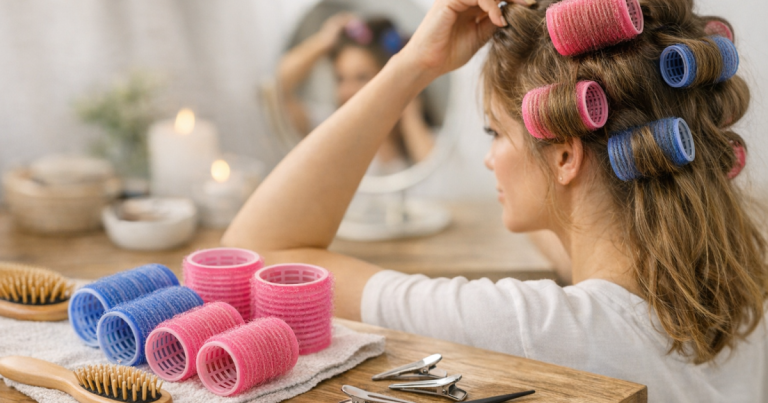

Flat roots can make freshly styled hair look unfinished, even when the lengths are smooth or waved. A heatless root lift with Velcro rollers is one of the simplest ways to add airy volume at the crown, fringe and face-framing layers without reaching for a hot brush or straighteners.
The trick is not just putting rollers in and waiting. The lift comes from section size, roller direction, root tension and how dry the hair is when you set it.
The short version
- Use Velcro rollers on dry or nearly dry hair; damp lengths can collapse before the roots set.
- For lift, place the roller directly under the section and over-direct the hair upwards before rolling down to the scalp.
- Keep sections no wider than the roller and not too thick, so the roots can actually sit around the curve.
- Use larger rollers for soft crown volume and smaller rollers for shorter layers, fringes and more grip.
- Let the roots cool and settle fully before removing the rollers, then loosen with fingers rather than brushing flat.
Why Velcro rollers work for root volume
Velcro rollers create lift by holding the roots away from the scalp while the hair settles into a new shape. Unlike a curling rod, they are not mainly about forming ringlets. Used at the roots, they act more like a temporary scaffold: the hair dries, cools or sets in a raised position, then keeps some of that height when the roller comes out.
This is why placement matters more than the number of rollers. A few well-positioned rollers at the crown and hairline will usually do more for volume than covering the whole head without direction. For most at-home styling, the key areas are the front hairline, the parting, the crown and any flat layers around the temples.
A reliable heatless root lift also depends on product weight. Heavy creams, rich oils and too much serum at the scalp can make rollers slide and leave fine hair looking separated. If you use oil or smoothing product, keep it on the mid-lengths and ends rather than the root area.
Before you start: the quick checks
Hair should be dry, or only lightly misted at the roots
Velcro rollers are best for reshaping and lifting, not drying wet hair from scratch. If your roots are very flat, lightly mist just the root area with water or a lightweight styling spray, then set the roller while the hair is barely damp. The roots should feel flexible, not wet.
Choose roller size by hair length and the lift you want
- Large rollers, around 45 mm or wider: best for soft volume on medium to long layers, especially at the crown.
- Medium rollers, around 30–40 mm: useful for fine hair, shoulder-length cuts and face-framing sections.
- Smaller rollers, around 20–30 mm: better for short layers, fringes, bobs and hair that needs more grip.
If the roller is too large for the section, the hair will not wrap securely at the root. If it is too small, you may get a bend instead of a soft lifted finish.
Work with clean sections
Each section should be roughly the same width as the roller and shallow enough that the roots can curve around it. Thick, deep sections look impressive when clipped up, but they often set only on the outside, leaving the underneath flat.
Step-by-step: setting Velcro rollers for lifted roots
1. Decide where you need height
Start by looking at your hair in its usual parting. Most people need lift in one of three places: the crown, the front hairline or the area just behind a fringe. Do not automatically roll every section backwards. The direction should support the shape you want when the hair falls.
For a centre parting, set one roller on each side of the parting, rolled away from the face. For a side parting, place the first roller on the heavier side and over-direct it slightly across the part before rolling. This helps disguise a flat split at the roots.
2. Lift the section up and slightly forward
Take a clean section, comb or brush it smooth, then lift it upwards so the roots stand away from the scalp. For crown volume, over-direct the section slightly forward before rolling backwards. This creates more lift than rolling the hair in the exact direction it naturally falls.
Keep the ends smooth as you wrap. If the ends fold or catch, they can leave dents when the roller comes out. A light mist of water on the very ends can help them sit neatly, but avoid soaking the whole section.
3. Place the roller under the section
For classic root lift, hold the roller underneath the lifted section, place the ends over the roller, then roll down towards the scalp. The hair should feel snug but not tight. If the roller is pulling at the scalp, the section is either too thick or you are using too much tension.
At the front hairline, rolling away from the face gives a soft, open shape. For curtain fringes, the angle is slightly different because the front pieces need lift and movement at the same time; the method in setting curtain bangs with Velcro rollers is useful if your fringe drops quickly or splits at the parting.
4. Secure without crushing the lift
Velcro rollers often grip on their own, but fine, silky or freshly conditioned hair may need a clip. Use a lightweight sectioning clip or roller clip at the base, placed so it supports the roller rather than flattening the root. Avoid pressing the clip directly over the lifted section, as this can create a crease.
If your roller keeps slipping, the section may be too heavy, too wide or too freshly coated with product. Re-section smaller rather than adding more clips.
5. Let the set fully settle
Leave the rollers in until the misted roots feel completely dry and the hair has had time to cool into place. For a quick refresh, 10–15 minutes may be enough; for finer hair that drops fast, 20–30 minutes usually gives a more reliable result. You can do make-up, get dressed or finish the rest of your routine while the rollers sit.
Fine hair often needs a slightly different finishing routine because brushing can undo the shape quickly. If your main problem is that soft styles disappear within an hour, the tips in making heatless curls last on fine hair also apply to root lift: use less product, set smaller sections and avoid touching the hair too much while it settles.
6. Remove gently and shape with fingers
Unwind each roller in the direction it was rolled rather than pulling it straight out. Pulling can roughen the cuticle, disturb the root and make the finish frizzy. Once all rollers are out, use your fingertips to loosen the roots and settle the parting.
If you need hold, mist hairspray upwards from a short distance beneath the lifted area rather than spraying down from above. Spraying down can flatten the exact volume you have just created.
Placement examples by hair type
Fine or flat hair
Fine hair usually responds best to fewer rollers, smaller sections and very light product. Use medium rollers rather than the largest size, as oversized rollers can sit loosely and fail to lift the root. Concentrate on the crown and the top layer around the parting. Too many rollers can make fine hair fluffy rather than full.
Medium-density straight or softly wavy hair
This hair type can usually handle larger rollers at the crown with medium rollers around the face. Set the top sections backwards for a smooth blow-dry effect, then use your fingers to break up any overly polished shape. If the roots drop by lunchtime, try setting the same sections with a light mist and leaving the rollers in for longer rather than adding more product.
Thick or coarse hair
Thicker hair needs smaller, cleaner sections. Large rollers may look logical, but if the section is too heavy the root will not lift. Work with the top layer only unless you want a fuller, rounded finish all over. A few strategic rollers at the crown often look softer than trying to set dense hair from roots to ends.
Short hair, bobs and layered cuts
Shorter styles need rollers that the hair can wrap around at least once. If the roller is too wide, it will sit on top of the hair rather than gripping it. Use smaller rollers around the crown, fringe and top layers, and roll only the sections that need height. On bobs, be careful not to over-roll the sides unless you want a rounded shape.
Curly or textured hair
Velcro rollers can disturb curl pattern if dragged through the hair, so use them selectively. They are most useful at the roots of stretched, blow-dried or softly diffused hair when you want lift without adding more heat. Remove slowly, support the curl or wave with your other hand, and avoid brushing afterwards.
How to refresh root lift on second-day hair
Second-day roots often need a different approach from freshly washed hair. Oil, product and sleeping position can all weigh down the crown, so start by gently loosening the roots with your fingertips. If needed, use a small amount of dry shampoo at the roots, let it sit briefly, then brush or massage out any residue before setting the rollers.
Mist only the flattened root sections, not the full length. Roll the crown back, the front hairline away from the face and any side pieces in the direction you want them to fall. This keeps the refresh targeted and avoids making the ends puffy. For waves that have also lost shape through the lengths, pair this root method with the refresh routine for reviving second-day waves without rewashing.
Common mistakes that flatten the result
- Using sections that are too thick: the outer hair may set, but the root underneath stays flat.
- Rolling without over-direction: if you roll the section exactly where it naturally falls, the lift will be minimal.
- Setting hair that is too wet: Velcro rollers can become heavy and the roots may dry limp.
- Using rich product at the scalp: oils, creams and heavy leave-ins reduce grip and volume.
- Removing rollers too quickly: the hair needs time to settle into its raised shape.
- Brushing from the roots afterwards: this can smooth away the lift; use fingers first.
FAQ
Can Velcro rollers give root lift without any styling product?
Yes, especially on clean, dry hair with some natural grip. Very fine or silky hair may hold better with a light styling spray at the roots, but avoid heavy mousse or creams if volume is the goal.
Should I use Velcro rollers on wet hair?
Not for root lift. Wet hair takes too long to dry inside the roller and can dry flat or unevenly. Use them on dry hair, or lightly mist only the root area before setting.
How many rollers do I need for root volume?
For everyday lift, three to six rollers are often enough: one or two at the crown, one on each side of the parting and one or two around the front. More rollers are only useful if the sections are still clean and manageable.
Why do Velcro rollers get stuck in my hair?
They usually snag when sections are messy, too wide or removed by pulling straight out. Smooth each section before rolling, avoid tangles at the ends and unwind the roller gently in the same direction it was set.
Will root lift last all day on fine hair?
It can, but fine hair is more affected by humidity, oil and product weight. Smaller sections, lightweight hold and minimal touching give the best chance of keeping the lift through the day.
Key takeaways
Velcro rollers are most effective for root lift when they are used precisely rather than generously. Focus on the crown, parting and front sections; keep the hair dry or only lightly misted; and roll with upward over-direction so the root sets away from the scalp.
For fine hair, use lighter product and smaller sections. For thick hair, reduce section depth so the roller can support the root properly. For short cuts and fringes, choose rollers small enough to grip without forcing the hair into a tight bend. The result should feel soft, touchable and lifted, not stiff or overly styled.