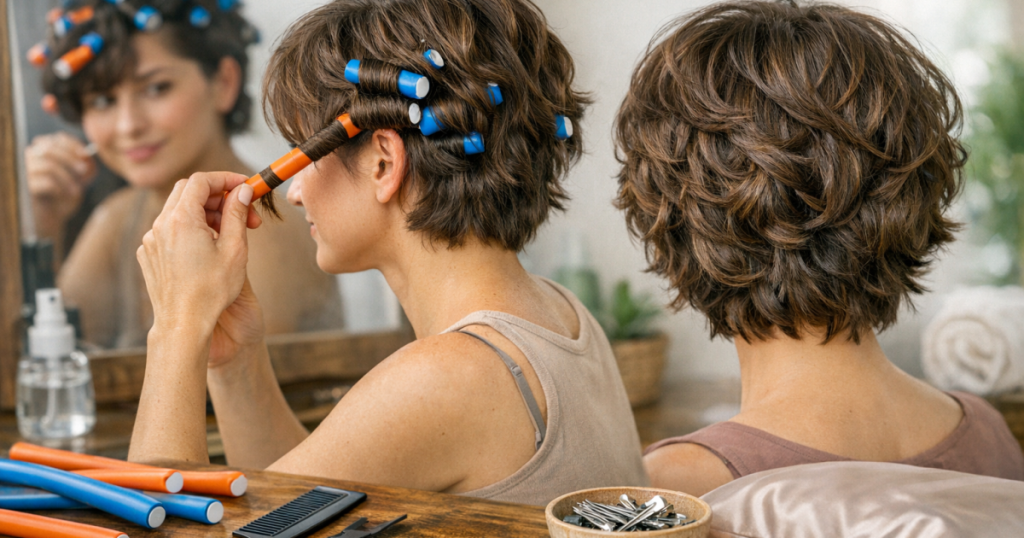
Short layers can make heatless curls look fresh and full, but they can also spring out at odd angles if the rods are too large or the sections are too chunky. The trick with flexi rods on short layered hair is to work smaller than you think, keep the ends controlled, and let each layer set in a direction that suits the cut rather than fighting it.
What to know first
On short layered cuts, flexi rods work best when they are used as a shaping tool rather than a way to create identical ringlets all over. Your shortest pieces may need a slimmer rod, your longest layers may need a slightly larger one, and your front sections usually need softer direction so they do not curl into the face too aggressively.
- Start with hair that is damp, not dripping wet, so it can dry fully around the rod.
- Use smaller sections than you would on long hair; wide sections often leave flat roots and flicky ends.
- Wrap the ends neatly first, then spiral the mid-lengths upwards with even tension.
- Mix rod direction slightly for a softer finish, especially around the crown and sides.
- Do not remove the rods until the inner layers feel completely dry and cool.
Set up the hair before you start wrapping
Flexi rods need a little grip, but too much product can make short layers feel sticky or heavy. After washing, blot the hair with a towel or microfibre wrap until it feels evenly damp. If your hair is already clean, mist it lightly section by section rather than soaking the whole head.
Detangle first, because knots make the ends kick out when you roll them. A brush that moves through damp hair without rough tugging is useful here; if detangling is where your styling normally starts to go wrong, the detangling brush review explains what to notice when a brush is being used before styling rather than just after washing.
For hold, choose product by hair type. Fine hair often needs a light mousse or setting foam applied sparingly through the mid-lengths. Thick, coarse or high-density hair may need a little leave-in conditioner first, then a small amount of styling cream or foam for definition. Very silky straight hair usually needs more hold and less slip; naturally textured hair often needs moisture plus careful smoothing at the ends.
Choose rod thickness by layer length
Short layered hair rarely behaves well with one rod size everywhere. The bottom and side pieces may be too short to wrap around a chunky rod securely, while longer top layers can look overly tight if you use the thinnest rods all over. Think in zones rather than treating the whole head as one length.
For a pixie crop or very short layered cut
Use slim rods on the longest top pieces and avoid forcing very short nape sections that cannot wrap securely. If a piece only bends once around the rod, it may be better finger-shaped with a little product rather than rolled tightly.
For a layered bob
Use slimmer rods at the nape and around shorter face-framing pieces, then slightly larger rods on the crown or longest side layers. This helps stop the underneath from shrinking up too much while keeping the top from going flat.
For a short shag or wolf-inspired cut
Use mixed directions and mixed rod sizes. The aim is movement, not perfect uniform curls. Rolling every section in the same direction can make heavily layered cuts look helmet-like, particularly around the fringe and crown.
Step-by-step: a neat rod set for short layers
1. Part the hair into practical zones
Split the hair into a top section, two side sections and a back section. If your hair is dense, divide the back again horizontally so you are not trying to wrap hidden layers in oversized chunks. Clip away anything you are not working on; short pieces escape easily, and loose hair caught in the rod can create dents.
2. Start at the back where mistakes are less obvious
Take a narrow section, roughly the width of the rod or slightly narrower. Smooth it from root to end with your fingers or a comb. If the ends look dry or fluffy, add a tiny amount of product to the last few centimetres only.
3. Secure the ends first
Place the rod near the end of the section and tuck the ends flat around it before rolling upwards. This is the part that matters most on layered hair. If the tips are not wrapped smoothly at the start, they will dry into hooks, flicks or little straight tails.
4. Spiral rather than stack the hair
For short layers, a gentle spiral wrap usually looks softer than winding the same patch of hair repeatedly on top of itself. Keep the section flat as it travels around the rod, moving along the length of the rod as you roll. This spreads the curl pattern and reduces bulky, triangular volume at the sides.
5. Fold the rod without crushing the root
When you reach the scalp, bend the ends of the flexi rod to hold it in place. Aim for secure, not tight. If the rod pulls at the root, the section may dry with a dent or feel uncomfortable while setting. Around the hairline, angle the rod away from the face for a more flattering, open finish.
6. Let the set dry completely
Short hair can look dry on the outside while the inner wrap is still damp. Before removing the rods, press one or two sections gently and check that they feel dry throughout. If you unravel too soon, the curl will loosen unevenly and the shortest layers may puff instead of forming shape.
7. Remove and separate gently
Unfold the rod, unwind in the opposite direction and avoid pulling the curl straight down. Let the curls sit for a minute, then separate with lightly oiled or product-free fingertips. Shake at the roots only if you want more volume; combing through too early can turn a neat set into frizz.
Adjust the method for your hair type
Hair type changes how much the strands slip, stretch, shrink and hold, so the same rod set will not dry or sit identically on everyone. For a deeper explanation of why some hair drops quickly while other hair shrinks tighter than expected, read how hair type affects slip, stretch, shrinkage and hold.
Fine or straight short layers
Use light product, small sections and slimmer rods where the hair struggles to grip. Avoid heavy oils before setting because they can make the curl collapse. If the finish looks too ringlet-like, separate each curl into two or three pieces rather than brushing everything out.
Wavy hair with layers
Work with your natural wave direction where possible. If a section already bends forward, forcing it backwards can create a kink near the root. A light foam or curl lotion can help keep the wave pattern smooth without making the cut look stiff.
Curly or coily short hair
Expect more shrinkage with slimmer rods. If you want curl definition rather than extra height, use slightly larger rods on the top layers and keep the hair well moisturised before setting. Stretch the section gently as you wrap, but do not pull so hard that the root becomes sore or distorted.
Thick or high-density short hair
Create more sections, not bigger ones. Dense hair needs air to reach each wrap, and thick sections can stay damp in the centre for hours. If your underneath layers dry slowly, roll those first and give them the longest setting time.
Fixes for common short-layer problems
The ends keep sticking out
Your sections are probably too wide, too dry at the tips or not tucked around the rod before rolling. Re-dampen the end, smooth it flat, and start the wrap with the last few centimetres fully controlled.
The sides look too wide
Use a spiral wrap and roll the side sections slightly diagonally rather than horizontally. On layered bobs, horizontal rods at ear level can create width exactly where you may not want it.
The top is curly but the roots are flat
Lift the top section slightly as you roll, then fold the rod so it sits close to the head without pressing the root down. After removing the rods, massage only the roots with fingertips and leave the curl lengths intact.
The curls are too tight
Do not brush them straight away. First, separate each curl with your fingers, then cup and shake the ends. If they still feel too defined, use a tiny amount of lightweight serum or leave-in on your palms and gently stretch the curl shape downwards.
The back looks uneven
Short back layers are hard to judge by feel. Use two mirrors if you can, or keep the nape sections simpler and smaller. It is better to have soft bend at the back than over-rolled curls that spring up into different lengths.
How to make the style last
Once the rods are out, avoid touching the curls repeatedly. If you need more polish, smooth only the surface with your palms. A light mist of hairspray can help fine hair hold, while textured hair may prefer a small amount of oil or cream on the ends to reduce frizz.
At night, protect the shape by loosely covering the hair with a silk or satin wrap, or by sleeping on a smooth pillowcase. For very short layers, do not try to pineapple the hair if it distorts the roots; a soft wrap usually keeps the shape more evenly.
Questions people ask
Should short layered hair be wet or dry for flexi rods?
Damp hair is usually easiest. Wet hair can take too long to dry inside the rod, while dry hair often lacks enough reset to hold a new curl shape.
Can I use flexi rods on a fringe?
Yes, but use a very small section and roll away from the face or slightly to the side. A full forward roll can make a short fringe spring up more than expected.
How long should I leave the rods in?
Leave them until every section is fully dry. Timing varies with hair density, product amount and room conditions, so dryness matters more than a fixed number of hours.
Why do my short layers look frizzy after removing the rods?
The hair may have been too dry at the ends, removed before fully set, or separated too roughly. Smooth the ends before wrapping and unwind each rod gently.
Are flexi rods better than a heatless curling ribbon for short hair?
Flexi rods are usually easier for short, layered pieces because each small section can be wrapped separately. A ribbon-style curler tends to suit longer lengths that can travel around one central form.
Final thoughts
Flexi rods are one of the more adaptable heatless tools for short layered cuts because you can control each section, change direction and vary curl size across the head. The main difference between a polished result and a flicky one is preparation: smooth ends, narrow sections, sensible rod thickness and enough drying time.
If your result still feels inconsistent, the issue may not be the rods themselves but the match between your haircut, hair type and styling goal. The guide to matching styling goals and tools to your hair type is a useful next step if you are deciding whether rods, rollers or another heatless method will suit your routine better.