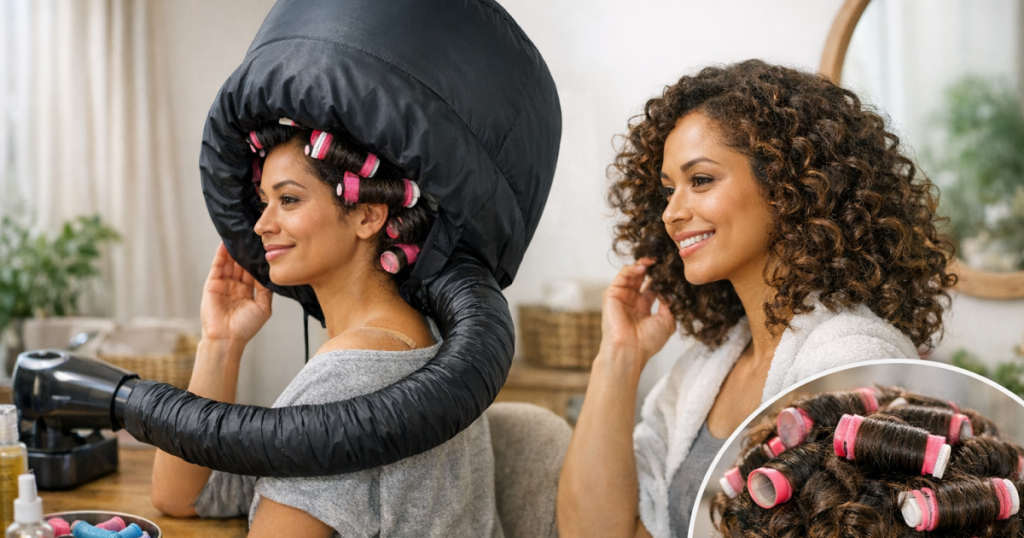
Soft bonnet attachments are brilliant when your roller set looks smooth at the roots but collapses before it is fully dry. A hooded dryer attachment can make curl sets more predictable at home because it surrounds the hair with warm airflow instead of blasting one section at a time. The trick is not just putting it on and waiting; the way you prep, clip, tension and cool the set decides whether you get polished curls or puffy bends.
Think of it as a gentler, hands-free drying method for wet sets, roller sets, flexi-rod sets and some pin-curl shapes. It still uses heat, so the aim is controlled airflow, moderate warmth and enough drying time for the curl pattern to set properly.
What to know first
- A soft bonnet works best when the hair is evenly damp, not dripping wet.
- Large rollers create smoother volume; smaller rollers create tighter curls and more spring.
- Warm airflow helps the set dry, but the cool-down stage helps the shape stay in place.
- Too much product can leave curls sticky or heavy, especially on fine hair.
- The bonnet must have space around the rollers so air can circulate rather than squash the set.
Once you understand the hooded dryer attachment as an airflow tool rather than a shortcut, the results become far more consistent. It can be useful for anyone who finds handheld drying too disruptive, but it is not automatically faster than a normal dryer. Dense hair, long hair, heavy product and tightly packed rollers all slow the process down.
Step 1: Start with the right level of dampness
Curl sets hold best when the hair has enough moisture to be reshaped, but not so much that the dryer has to fight through wet roots for an hour. After washing, blot the hair with a towel or microfibre towel until it feels damp and cool rather than wet. If water is dripping from the ends, your set will take longer and may turn fluffy before it fully dries.
For a refresh set, mist the hair section by section instead of soaking the whole head. This is especially useful for wavy hair, layered hair and fringes, where some areas dry faster than others. If you are using a leave-in conditioner, foam, setting lotion or curl cream, apply lightly and comb through before rolling so the product is distributed evenly.
Step 2: Choose the curl set for your hair type
The attachment can dry several set styles, but the set you choose should match your hair density, length and desired finish.
- Fine or low-density hair: use medium to large rollers, light mousse or setting spray, and avoid heavy creams at the root. Fine hair can lose lift if the bonnet presses the rollers down, so clip carefully and avoid overloading product.
- Thick or dense hair: work in smaller sections and allow more drying time. Large sections wrapped around big rollers may feel dry on the outside whilst the inner hair stays damp.
- Wavy hair: use rollers for root lift and smoother bends, or loose pin curls for a softer finish. If you prefer your natural pattern, diffusing may suit you better; the technique in how to use a diffuser on wavy hair without frizz is a useful next step.
- Curly hair: keep sections tidy and maintain gentle tension as you roll. Too much pulling can stretch curls more than intended, while loose rolling can create uneven bends.
- Layered hair: use smaller sections around shorter layers so the ends tuck in neatly. End papers can help if your tips spring out of the roller.
Step 3: Roll with airflow in mind
A bonnet attachment dries most evenly when air can move around the curl set. Avoid stacking rollers so tightly that the bonnet has no room to inflate. If the bonnet collapses onto the rollers, curls may dry with dents or flattened roots.
Use clean sections and keep the ends smooth before wrapping. Ragged ends are one of the biggest reasons roller sets look frizzy once brushed out. For root lift, roll the section on base or slightly over-directed, then secure it without dragging the scalp. For a softer, more relaxed curl, use less tension and larger rollers.
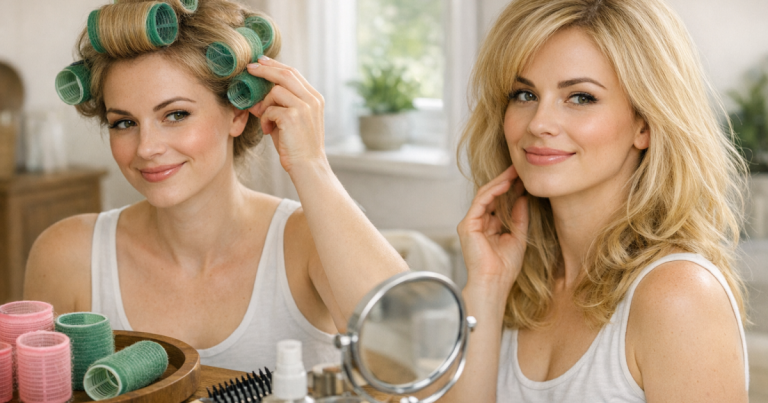
Velcro rollers can add volume, but they are better for smooth blow-dry bounce than very wet sets because damp hair can snag as you remove them. Magnetic rollers, foam rollers, flexi rods and pin curls can all work, but each gives a different finish. If you are deciding whether heat is the right route at all, heatless vs heated styling for your desired finish explains the trade-off between speed, polish and gentleness.
Step 4: Fit the bonnet securely before switching on
Attach the hose to your hair dryer before turning it on, then place the bonnet over the full set. The elastic or drawstring should sit comfortably around the hairline without squeezing your forehead or neck. If the bonnet has an adjustable chin strap, fasten it just enough to stop the bonnet slipping back.
Examples such as the Eleganty Soft Bonnet Hood Hairdryer Attachment and Hair Flair Deluxe Softhood show the general style of soft bonnet design, but compatibility varies. Before relying on any attachment, check that the hose fits your dryer nozzle securely, the bonnet is roomy enough for your roller size, and the airflow openings are not blocked by clips or rollers.
Keep the dryer on a stable surface where the hose is not pulling against the bonnet. If the attachment repeatedly pops off, stop and refit it rather than holding it in place with your hand for the whole drying session.
Step 5: Use moderate heat and steady airflow
Start with a low or medium heat setting and a moderate airflow setting. Very high heat can make the hairline uncomfortable, dry the outer layer too quickly and encourage frizz, especially around the crown and nape. A gentler setting usually gives a smoother result because the set dries more evenly.
For fine hair, begin with the lowest useful warmth and check frequently. For thick hair, you may need longer rather than hotter. For colour-treated, bleached or fragile hair, keep the temperature comfortable and avoid sitting under heat for longer than necessary. A heat protectant can be useful, but it should not make the hair wet again or leave the set slippery.
If one area is taking longer, do not simply increase heat across the whole head. Instead, pause, feel the roots carefully, and adjust the roller placement or bonnet position so air can reach that section.
Step 6: Check dryness properly
The most common mistake is removing the rollers when the outside feels dry but the root or inner wrap is still damp. That produces curls that look promising for ten minutes, then drop or frizz. After an initial drying period, switch the dryer off, lift the bonnet, and touch several areas: the crown, nape, temples and the thickest roller sections.
A set is ready when the hair feels dry at the root and through the rolled section. If it feels cool, clammy or slightly spongy, give it more time. Dense hair often needs staged checking because the top layers dry before the underneath. If you use setting lotion or a strong-hold foam, the hair may feel a little firm; that is different from dampness.
Step 7: Cool the set before taking it down
Cooling is not optional if you want the curl to last. Once the hair is dry, switch to a cool setting if your dryer has one, or remove heat and let the rollers sit for several minutes before unrolling. Hair is more shapeable when warm, so taking rollers out immediately can soften the curl before it has settled.
Remove rollers gently in the direction of the curl. Do not yank Velcro, unwind flexi rods too quickly or pull pin curls straight down. Let each curl fall into your hand, then leave it alone for a minute before separating.
Step 8: Finish without ruining the shape
For a polished set, use your fingers first. Separate curls where they naturally split, then lift the roots lightly. If you want a brushed-out wave, use a soft brush and work slowly from the ends upward. Stop before the shape turns cloudy; over-brushing is hard to rescue without re-dampening.
- For fine hair, finish with a light mist of flexible hairspray rather than oil at the roots.
- For thick hair, smooth a tiny amount of serum or lightweight oil over the outer layer if the ends look dry.
- For curls that need definition, twist individual pieces around your finger instead of brushing the whole set.
- For extra volume, clip the roots while the set cools, then release and shake gently.
If your hair regularly needs different tools on different wash days, the broader guide to styling tools by hair type can help you decide when a bonnet set, diffuser, hot brush, straightener or heatless method makes most sense.
Common problems and quick fixes
The curls drop quickly
The hair was probably not fully dry, the rollers were removed while still warm, or the sections were too large. Use smaller sections next time, extend the drying time and let the set cool completely before styling.
The roots are flat
The bonnet may be pressing down, or the rollers may be placed too far off base. Try slightly smaller rollers at the crown, clip them more securely and make sure the bonnet has enough room to inflate.
The ends look frizzy
The ends were likely not smoothed before rolling. Use a comb, a light styling product and, if needed, end papers. Avoid dragging dry or tangled ends around Velcro rollers.
The hairline feels too hot
Lower the heat, reposition the bonnet and check that airflow is not concentrated around the forehead or ears. Heat should feel warm and comfortable, never sharp or irritating.
Questions people ask
Can you use a soft bonnet attachment on soaking wet hair?
You can, but it is usually inefficient and more likely to cause frizz. Blot first until the hair is evenly damp, then roll and dry.
Is a bonnet attachment better than a diffuser for curls?
It depends on the finish. A bonnet is better for set shapes such as rollers and pin curls; a diffuser is better for drying your natural wave or curl pattern with less handling.
How long should a curl set take to dry?
It varies with hair density, section size, product and dryer strength. Start checking after 20 to 30 minutes, then continue until the roots and inner wraps feel fully dry.
Can you sleep in the rollers after using heat?
It is usually more comfortable to remove the rollers once the set is dry and cooled. If you want overnight hold, use softer heatless rollers or wrap the finished curls loosely.
Why does my set look good until I brush it?
The curls may be too soft, too warm or not fully dry. Let them cool longer, separate with fingers first, and brush only when you want a deliberately softer wave.
Why it matters
A bonnet attachment can turn a home curl set from guesswork into a repeatable routine, but only when the prep and drying checks are right. Dampness, section size, airflow space and cooling time matter more than rushing to the highest heat setting.
Use it when you want smooth volume, longer-lasting roller curls or a more controlled finish than handheld drying gives. Skip it when you want a quick natural-dry texture, when your hair is overloaded with product, or when your set is too bulky for the bonnet to sit comfortably. The best results come from treating the tool as part of the whole styling system: good prep, neat rolling, patient drying and a careful takedown.