A smooth, bouncy blow-dry can flatten, kink or frizz while you sleep, especially if your hair rubs against cotton bedding. The easiest way to wrap hair overnight is to preserve the direction of the blow-dry: smooth the lengths around your head, secure them lightly, then cover with satin or silk so the finish survives until morning. Start with completely dry hair; damp wrapping can leave bends, puffiness and a stale-feeling root.
The short version
For a sleek blow-dry finish, brush dry hair around the head in one continuous direction, keep the roots flat but not pulled, use flat clips only where needed, then cover everything with a satin or silk scarf. In the morning, release the wrap, let the hair settle for a few minutes, then reshape with your fingers, a paddle brush or a cool dryer shot if needed.
This technique works best when the blow-dry already has polish. If the cuticle feels rough, dry or heat-stressed, wrapping can reduce friction but it will not repair texture on its own. For a care-focused reset before styling, the notes in our Moroccanoil Moisture Repair Conditioner review for heat damage are useful if your lengths feel brittle after frequent hot-tool use.
What you need before bed
You do not need a complicated kit, but the finish depends on using smooth, low-bulk accessories. Gather these before you start:
- A paddle brush or mixed-bristle brush for smoothing the surface.
- A tail comb or wide-tooth comb for sectioning, depending on your hair texture.
- Flat, crease-resistant clips or hairpins for temporary hold.
- A satin or silk scarf, bonnet or wrap that fully covers the hairline.
- A tiny amount of lightweight serum or oil only if your ends need slip.
Avoid thick elastics, claw clips and anything with raised seams. They can create dents that are more obvious than the frizz you were trying to prevent.
Step-by-step: the classic smooth wrap
1. Make sure the hair is fully dry
Run your fingers through the roots, crown and underneath sections. If any area feels cool or damp, give it more drying time before wrapping. Hair that is even slightly damp can set into awkward bends overnight, particularly around the nape and hairline.
2. Choose your direction
Decide whether the hair naturally wants to wrap clockwise or anti-clockwise around your head. Most people find one side sits flatter than the other. If you have a side part, start by brushing the heavier side across the forehead and around the opposite side of the head.
3. Smooth the first side around the head
Use your brush to guide the lengths around the head, keeping the section flat against the scalp. Think of the hair as a wide ribbon rather than a rope. The flatter and broader the section, the smoother the result.
4. Pin only where the hair springs away
Use flat clips or pins at the temple, crown or nape if the hair will not stay in place. Slide them in gently and avoid clamping down hard. You want control, not a visible clip mark.
5. Continue wrapping the remaining lengths
Brush the rest of the hair in the same direction, following the shape of your head. Tuck the ends smoothly so they do not flick out. If your hair is long, you may need to guide the ends around a second time.
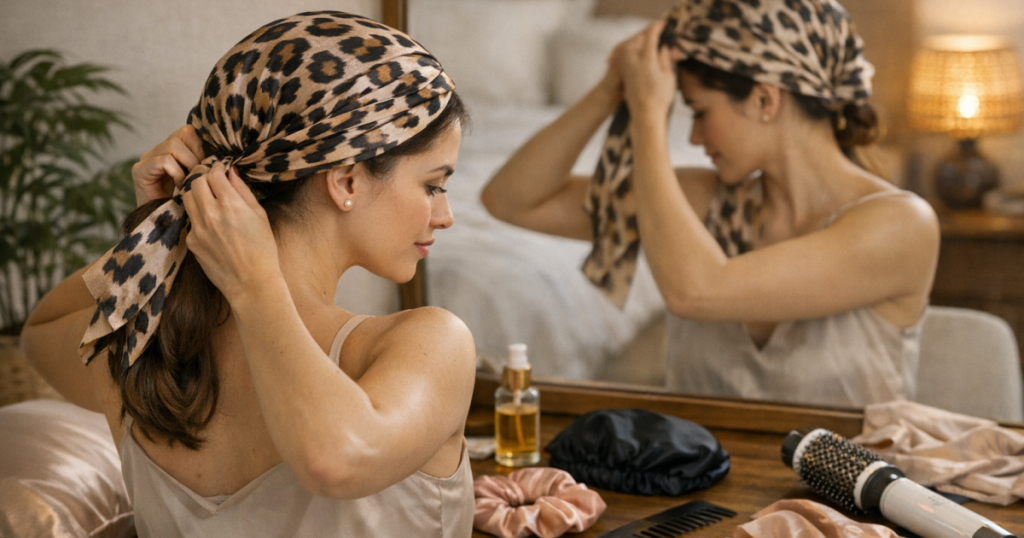
6. Cover with satin or silk
Place the scarf over the wrapped hair and tie it securely enough to stay on, but not so tightly that it compresses the roots. A bonnet can work too, although a scarf often gives a flatter result because it holds the hair closer to the head.
Hair-type adjustments that make the difference
Fine or low-density hair
Fine hair can look sleek quickly, but it also collapses easily. Use minimal product and avoid heavy oil near the roots. If you want volume at the crown, place one or two flat clips slightly lifting the root before covering, or wrap more loosely through the top section. If your smooth finish starts with a hot-air styler, our guide to using Dyson Airwrap barrels on fine hair explains how to get shape without overworking delicate lengths.
Thick or dense hair
Work in wider, controlled sections rather than trying to force all the hair around in one sweep. You may need more pins, especially around the nape. Keep tension even; pulling too hard can make the roots look stretched while the ends remain bulky. If your goal is lift as well as smoothness, wrapping after a roller set may give better body than wrapping a very flat blow-dry. For extra volume technique, see our tutorial on how to use heated rollers on thick hair.
Wavy hair
Wavy hair can be wrapped for a smoother finish, but use a lighter hand. Brush too aggressively and you may create fluff instead of polish. A small amount of smoothing cream through the mid-lengths can help, but keep the crown clean so it does not look greasy by morning.
Curly or coily hair
If the hair has been stretched or blown out, wrap in sections and use your hands to keep the surface smooth as you brush. For tighter textures, a silk or satin scarf with firm coverage is usually more reliable than a loose bonnet. Do not wrap wet curls expecting a blow-dry finish; this method preserves an already stretched or smoothed style rather than creating one from damp hair.
Short layers, fringes and face-framing pieces
Short pieces are the first to kink. Wrap them in the direction you want them to fall, then use a flat clip or a small piece of tissue under the clip to reduce dents. For curtain fringes, split them where they naturally sit and smooth each side away from the face before covering.
Common mistakes that ruin the morning finish
- Wrapping damp hair: this can leave ridges, limp roots and a less fresh feel.
- Using too much serum: shine products can turn heavy overnight, especially on fine hair.
- Tying the scarf too tightly: compression can flatten volume and mark the hairline.
- Skipping the nape: loose underneath sections are often the reason the back looks puffy by morning.
- Using bulky pins: raised clips create dents that need heat or water to fix.
How to refresh it in the morning
Do not brush immediately after removing the scarf. Let the hair drop and settle for a minute or two. Then use your fingers to loosen the shape, followed by a brush only where you need a polished surface.
If the roots are too flat, flip your head forward briefly and massage the crown with your fingertips. For a slight bend at the ends, roll them around your hand while the hair settles. If you need more control, a cool shot from a dryer can help reset the direction without adding more heat styling.
For frizz at the hairline, smooth a tiny amount of serum between your palms and tap it over the surface rather than dragging it through the lengths. If your ends have flipped the wrong way, lightly mist your hands with water, smooth the end, then hold it in the desired curve for a few seconds. Use as little moisture as possible.
When wrapping is not the right method
The best way to wrap hair overnight is when you want a sleek, controlled blow-dry effect. It is less useful if you want beachy texture, root lift from every angle or defined curls. In those cases, a loose bun, large rollers, a curling ribbon or a pineapple-style method may suit the finish better.
It may also be the wrong choice if your scalp dislikes covered styles overnight, or if your hair is very freshly washed and too slippery to stay in place. In that case, wait until the style has settled, then wrap on the second night instead.
FAQ
Can I wrap freshly blow-dried hair straight away?
Yes, but let it cool first. Warm hair is still flexible, so wrapping immediately can flatten volume. Wait until the roots and lengths feel completely cool and dry.
Is a satin bonnet enough for a smooth blow-dry?
A bonnet reduces friction, but it may not control direction as well as a scarf. For the sleekest finish, wrap the hair around the head first, then cover it.
How do I stop my roots going flat overnight?
Keep the crown slightly lifted when you wrap and avoid tying the scarf too tightly. Fine hair may need a quick finger-lift at the roots in the morning.
Should I use oil before wrapping?
Only use a very small amount on dry ends if they look rough. Oil near the roots can make the blow-dry look heavy by morning.
Can I do this on wet hair?
No, not for a smooth blow-dry finish. Wet hair wrapped flat is likely to dry with bends, uneven roots and a less polished texture.
In brief
Overnight wrapping is a low-heat way to make a blow-dry last longer, but the detail matters: dry hair, even direction, light tension and a smooth scarf. Adjust the method for your density and texture, then refresh gently in the morning rather than restyling from scratch.