Layered hair can make heatless curling brilliant or deeply annoying: the shape gives movement, but shorter pieces can escape before the curl sets. This Octocurl Heatless Curler review looks specifically at whether its multi-strap design gives layered cuts enough grip, shape and consistency to justify the effort.
The key question is not simply whether it can curl hair. It is whether it can manage different layer lengths without leaving the top too flat, the ends too curled, or the front pieces doing their own thing.
The short answer for layered cuts
The Octocurl is worth considering for layered hair if your shortest layers are long enough to wrap around a soft strap and stay there with gentle tension. It tends to make the most sense for shoulder-length to long hair, soft long layers, grown-out curtain layers, wavy textures, and anyone who prefers a softer overnight curl rather than a highly polished tonged finish.
It is less convincing for very short face-framing layers, heavily disconnected layers, or cuts where the top layer sits much shorter than the underneath. In those cases, you may find the lower lengths curl well while the shorter sections flick out, loosen early, or need extra pinning. If you are weighing up whether heatless styling can realistically give the finish you like, the broader guide to heatless vs heated styling for your desired finish is a useful next step.
How the Octocurl design behaves on layers
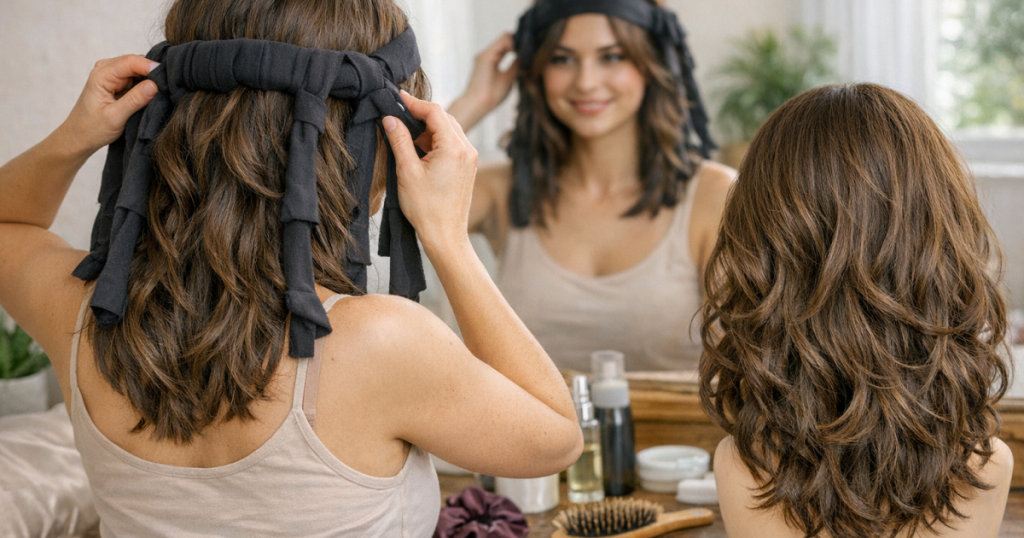
The Octocurl Heatless Curler is a headband-style heatless curler with several soft fabric strips that hang down from the head. Instead of wrapping all the hair around one long rod, you divide the hair into sections and wrap each section around its own strip. That is the part that makes it interesting for layered hair.
Layered cuts often struggle with single-rod heatless curlers because long pieces and shorter pieces are forced into the same wrap direction and diameter. With Octocurl, you can treat each section more individually. Shorter layers can be wrapped with smaller sections, front layers can be angled away from the face, and thicker underneath sections can be kept separate so they are not overpowering the finer top pieces.
The trade-off is setup time. A multi-strap design usually takes more patience than a simple satin curling rod. If you rush the sectioning, layered hair can still look patchy: some pieces will form defined spirals, while others will set into loose bends. The result depends less on the tool alone and more on how evenly you divide the hair.
Step-by-step: making it work on layered hair
1. Start with hair that is barely damp, not wet
Layered hair needs enough moisture or styling product to remember the shape, but too much dampness can leave roots flat and ends limp by morning. Hair should feel slightly cool or lightly misted, not wet to the touch. If your hair takes a long time to dry, start drier than you think and use a light styling cream, mousse or leave-in only where you need hold.
2. Section by layer behaviour, not just by neat partings
Do not divide the hair as though you are creating a salon blow-dry map. Instead, section according to what the layers naturally do. Keep shorter crown layers together in smaller pieces, keep face-framing sections separate, and avoid combining a short top layer with a much longer underneath section. Mixed lengths in one wrap are the main reason layered hair slips out or sets unevenly.
3. Wrap the front more deliberately
Face-framing layers usually need the most attention. Wrap them away from the face for a softer opening effect, and keep the tension light but consistent. If the front pieces are too short to wrap securely, use a small clip to hold the end in place or set that section separately with a small roller. For curtain layers, try wrapping the first turn close enough to shape the mid-lengths, rather than only curling the ends.
4. Keep the ends smooth
Layered ends can look wispy if they are twisted loosely or tucked messily. Smooth each section with your fingers or a detangling brush before wrapping, then make sure the last few centimetres sit flat against the fabric. If your ends are dry, a tiny amount of lightweight oil or serum can help them sit more neatly, but avoid overloading fine hair.
5. Unwrap slowly and separate with care
Do not pull the straps straight down when removing them. Unwind each section in the opposite direction and let the curl fall into your palm. Once all sections are out, separate only where the hair naturally wants to split. Over-brushing straight away can turn layered curls into frizz, especially on wavy or porous hair.
What results to expect by hair type
- Fine layered hair: Octocurl can add visible shape without hot tools, but too much product or dampness can flatten the root. Use smaller sections and keep the wrap loose enough to avoid dents.
- Medium-density layered hair: This is often the easiest match. The separate straps help distribute the hair, while the layers add movement once the curls are shaken out.
- Thick layered hair: It can work, but you need disciplined sectioning. Large sections may not dry fully or may set only on the outside. More straps or smaller wraps usually give a more even result.
- Wavy hair: The tool can enhance natural bend and create more consistent clumps. Use a light hold product and avoid brushing the finished curls too much.
- Curly hair: It may stretch and reshape curls rather than create uniform spirals. Results depend on your curl pattern, porosity and how much definition you want at the root.
- Short layered hair: It is the riskiest match. If many pieces sit above the chin or fall out of a wrap quickly, a roller, brush-styling method or targeted pin curl may be easier.
Where it beats a standard heatless curling rod
The biggest advantage for layered hair is control. A single rod can be quicker, but it asks every layer to behave the same way. Octocurl lets you vary the size, angle and tension of each wrap, which can be especially helpful if your top layers need volume while your underneath lengths need curl control.
It can also be more comfortable for some sleepers because the soft sections are distributed around the head rather than forming one bulky shape. Comfort is personal, though. If you sleep on your side, any overnight curler can feel awkward at first, and you may need to experiment with where the headband sits.
For anyone trying to match tools to hair texture, density and styling habits, the broader guide to styling tools by hair type gives useful context before committing to one routine.
Where it can fall short
Octocurl is not a shortcut to perfectly uniform curls on every layered cut. If your layers are very choppy, the shorter pieces may need clips, extra product or a separate styling step. If your hair is very silky, the fabric may not grip enough without light hold. If your hair is coarse or dense, the wrapped sections may need longer to set than expected.
It also may not be the best match if you dislike sectioning. The tool rewards neat, thoughtful wrapping. If you prefer a quick five-minute routine before bed, a simpler satin rod, loose braid, bun method or velcro rollers around the face may feel more realistic.
Key checks before you decide
- Shortest layer length: Can your shortest visible layers wrap securely around a fabric strip, or do they spring free immediately?
- Desired finish: Do you want soft, wearable curls and bends, or a very smooth, identical curl pattern?
- Drying time: Does your hair usually dry overnight, or does it hold moisture for hours?
- Sleep tolerance: Are you comfortable sleeping with fabric around the head, or do you prefer daytime heatless setting?
- Frizz level: Does your hair need hold and smoothing before wrapping to stop the finished curls puffing up?
- Patience with sectioning: Are you happy to spend a few extra minutes getting the front and crown layers right?
Helpful questions
Will Octocurl work on layered shoulder-length hair?
It can, provided the shortest layers are long enough to wrap and stay in place. Shoulder-length hair with soft layers is usually more promising than a heavily shaggy cut with very short crown pieces. Smaller sections are the key.
Does it create volume at the roots?
It can give movement through the lengths, but it is not primarily a root-lifting tool. If your layers collapse at the crown, position the wrap carefully and avoid starting with hair that is too damp. Some people may still prefer a root clip or roller at the top.
Is it better than brush styling for layered waves?
It depends on the finish. Octocurl is useful for overnight shape with no heat, while brush styling gives more control when hair is damp and you want to define natural bends section by section. If you like the idea of shaping waves without heat, the Denman D3 Original Styler review covers a different approach to curl definition.
In brief
The Octocurl Heatless Curler is worth it for layered hair when your layers are long enough to wrap, your goal is soft movement, and you are willing to section carefully. It is particularly appealing for medium to long layered cuts, wavy textures and anyone trying to reduce regular heat styling without giving up shape.
It is less worthwhile if your layers are very short, your hair slips out of soft tools easily, or you want a fast, perfectly polished result with minimal setup. For layered hair, the tool is not magic — but used patiently, it can be a genuinely useful heatless option.