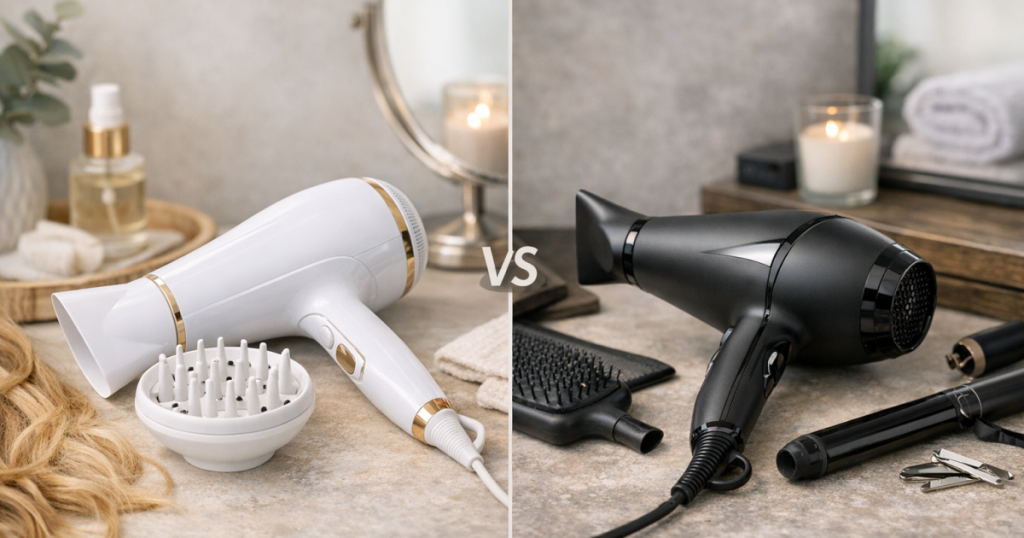
Both dryers sit in the proper home blow-dry lane, but they solve slightly different problems. T3 Cura Luxe vs GHD Air is mainly a choice between a smoother, more feature-led routine and a sturdier, salon-style dryer that keeps things straightforward.
The better buy is not simply the one that feels more premium. It depends on your hair density, how much styling control you want, whether you rough-dry or section properly, and how often you need a polished finish rather than just dry hair.
The big picture
The T3 Cura Luxe Hair Dryer is the more beauty-routine-focused option. It tends to suit people who like controlled styling, smoothing, concentrator work and a dryer that feels built around finish as much as function.
The GHD Air Hair Dryer is the more classic full-size dryer. It feels aimed at people who want a reliable, powerful-feeling home dryer without overcomplicating the routine.
- Choose T3 Cura Luxe if your priority is a smoother, more polished blow-dry and you like having more control over how the dryer behaves.
- Choose GHD Air if you prefer a familiar salon-style dryer feel, a simpler workflow and a robust tool for regular home drying.
- For frizz-prone hair, the winner depends on technique as much as the dryer: use a concentrator, dry down the hair shaft and avoid blasting the cuticle from every angle.
- For waves and curls, diffuser compatibility and gentle airflow matter more than brand prestige, so check the exact attachment options before buying.
Side-by-side: what actually changes on wash day?
Finish and smoothness
T3 Cura Luxe has the stronger case if your end goal is a neat, smooth blow-dry with a round brush or paddle brush. Its appeal is not just drying hair, but making the styling stage feel more deliberate. If your hair puffs up easily, looks dull when rough-dried, or needs a nozzle to behave, T3’s styling-focused approach is likely to feel more aligned with your routine.
GHD Air can still create a smooth finish, especially if you already have good blow-drying technique. It is less about extra styling flourishes and more about delivering the familiar full-size dryer experience: section, direct the nozzle, cool down, move on. If you are used to salon dryers, that simplicity may be a strength rather than a compromise.
Control and learning curve
The T3 is better suited to someone who likes choosing settings carefully and building a blow-dry in stages: removing moisture first, smoothing mid-lengths, then finishing the ends. That can be very useful for highlighted, porous or frizz-prone hair, because too much uncontrolled heat and airflow can make the hair look expanded rather than sleek.
The GHD Air is easier to understand immediately. It does not ask you to rethink your routine, which suits people who want a dependable dryer for everyday use. If you are replacing an older full-size dryer and simply want a better-feeling version of what you already know, GHD may be the more comfortable jump.
Drying speed versus styling polish
Very thick or long hair often tempts people to choose whichever dryer promises the fastest result. In real life, speed depends heavily on towel-drying, section size, nozzle use and how wet your roots are when you start. Both dryers can fit a proper home routine, but the T3 leans towards styling control while the GHD leans towards straightforward drying power.
If you regularly leave your hair to air-dry halfway and then finish with heat, either can work. If you start from soaking wet hair and want a bouncy blow-dry, you will get better results by sectioning properly than by relying on the dryer alone.
Which hair types suit each dryer best?
For a broader view of tool choice beyond these two dryers, the guide to styling tools by hair type is a useful next step, because hair density and condition often matter more than the logo on the handle.
Fine or flat hair
Fine hair needs lift without being overworked. T3 Cura Luxe may appeal if you want a smoother, more finished look, but fine hair can collapse if you use too much product, too much tension or too much heat for too long. Use smaller sections, lift at the root, then finish with a brief cool shot rather than repeatedly reheating the same area.
GHD Air can be a strong fit for fine hair if you keep the airflow controlled and avoid flattening the roots with a brush too early. Rough-dry the roots first, then style the lengths. If your hair is very fine and shoulder-length or shorter, the simpler feel of the GHD may be enough.
Thick, dense or long hair
Dense hair usually needs a dryer that feels efficient and comfortable to use for longer sessions. GHD Air makes sense if you value a direct, no-fuss drying experience and want something that feels substantial in the hand. It is a sensible option for people who dry large amounts of hair regularly and do not need many extra styling features.
T3 Cura Luxe is worth considering if thick hair becomes fluffy, triangular or unevenly smooth when dried quickly. The extra styling emphasis can help if you are willing to section properly. If you are not, the benefit may be less obvious.
Wavy hair
Wavy hair is where the decision becomes more technique-led. If you usually blow-dry smooth, T3 has the edge for a sleeker finish. If you alternate between smoothing and natural texture, check diffuser availability and fit before choosing either dryer. Waves dislike chaotic airflow, so the right attachment can matter as much as the main dryer body.
For looser waves that frizz around the canopy, dry the roots first, keep the airflow moving downwards when smoothing, and avoid dragging a brush through half-dry waves unless your goal is a straighter blow-dry.
Fragile, bleached or breakage-prone hair
Neither dryer automatically makes heat styling harmless. Fragile hair needs lower, more careful heat use, a heat protectant suited to your hair type, and fewer repeated passes over the same sections. T3’s control-led feel may be more helpful if you are disciplined with settings, while GHD’s straightforwardness works if you keep sessions short and controlled.
If your ends are splitting, snapping or feeling rough, the smartest upgrade may be changing your routine rather than buying the most premium dryer. Blot with a microfibre towel or soft cotton T-shirt, detangle gently, and dry in manageable sections.
Where the T3 Cura Luxe has the advantage
T3 Cura Luxe is the more appealing dryer for someone who treats a blow-dry as styling, not just drying. It is a good fit if you use a round brush, like a smoothed-out finish, or want a tool that feels more tailored to frizz control and polish.
Its biggest strength is the way it encourages a more intentional routine. Rather than blasting the hair until it is dry, you are more likely to work in sections and think about the finish. That matters for medium to long hair, colour-treated hair and hair that looks better with tension and directional airflow.
If you want a deeper product-specific view, the full T3 Cura Luxe Hair Dryer review looks at how it fits into a smooth home blow-dry routine.
- Best for: smooth blow-dries, frizz-prone lengths, polished everyday styling and users who like more control.
- Less ideal for: people who always rough-dry quickly and will not use concentrators or sectioning clips.
- Check before buying: current UK retailer details for included attachments, controls, returns policy and warranty terms.
Where the GHD Air has the advantage
GHD Air is a strong choice if you want a dependable full-size dryer that feels familiar from the first use. It is not trying to be the most feature-heavy option; its appeal is that it keeps the job clear and direct.
This makes it especially attractive for households where more than one person uses the dryer. It suits users who want simple controls, a traditional dryer feel and enough versatility for everyday drying, smoothing and basic brush styling.
For a closer look at its strengths and limitations as a home dryer, read the dedicated GHD Air Hair Dryer review.
- Best for: regular home drying, thick or long hair routines, simple controls and a salon-style feel.
- Less ideal for: users who want a more beauty-tech feel or lots of styling-focused extras.
- Check before buying: nozzle contents, compatible accessories and whether the size and weight suit your routine.
Common buying mistakes with these two dryers
- Assuming a premium dryer fixes poor technique: A concentrator nozzle, sectioning and drying direction still make the biggest visible difference.
- Ignoring your usual finish: If you mostly wear hair natural, diffuser compatibility may matter more than smoothing performance.
- Buying for maximum power alone: Very strong airflow can roughen the cuticle if you point it upwards or constantly disturb the hair.
- Forgetting comfort: A dryer that feels too heavy or awkward for your arm will not encourage careful styling.
- Overusing heat on fragile hair: Better control helps, but repeated heat on the same sections still increases the chance of dryness and breakage.
FAQ
Is the T3 Cura Luxe better than the GHD Air for frizz?
T3 Cura Luxe is the stronger choice if you want a smoother, more controlled blow-dry and are willing to use a concentrator and section your hair. GHD Air can still manage frizz well, but technique matters more.
Which one is better for thick hair?
GHD Air is a safe pick for thick hair if you want a sturdy, straightforward dryer. T3 Cura Luxe may suit thick hair better if it tends to dry fluffy and needs more styling control.
Can either dryer work for wavy hair?
Yes, but check diffuser compatibility before buying if you want to enhance natural waves. For smoothing waves straight, both can work with a nozzle, brush tension and controlled airflow.
Are these dryers worth it if I only dry my hair occasionally?
If you dry your hair only now and then, the GHD Air may feel more practical because it is simple and familiar. T3 makes more sense if you specifically want a polished blow-dry finish when you do use heat.
Do I still need heat protectant?
Yes. A better dryer can improve control, but it does not replace heat protectant, gentle detangling or sensible heat settings, especially on colour-treated or fragile hair.
T3 Cura Luxe vs GHD Air: the practical verdict
Choose T3 Cura Luxe if your priority is a smoother, more styled finish and you enjoy a controlled routine. It is the better match for frizz-prone, colour-treated or medium-to-long hair when you want your dryer to help with polish rather than simply remove moisture.
Choose GHD Air if you want a dependable full-size dryer with a classic salon-style feel and a simpler day-to-day workflow. It is the easier recommendation for shared bathrooms, regular drying and people who do not want to think too much about extra features.
The real deciding question is how you actually dry your hair. If you section, use a nozzle and care about finish, T3 has the more refined appeal. If you want a strong, familiar dryer that gets on with the job, GHD is the more straightforward buy.
Quick Buying Links
T3 Cura Luxe Hair Dryer
The big picture The T3 Cura Luxe Hair Dryer is the more beauty-routine-focused option.
GHD Air Hair Dryer
The GHD Air Hair Dryer is the more classic full-size dryer.