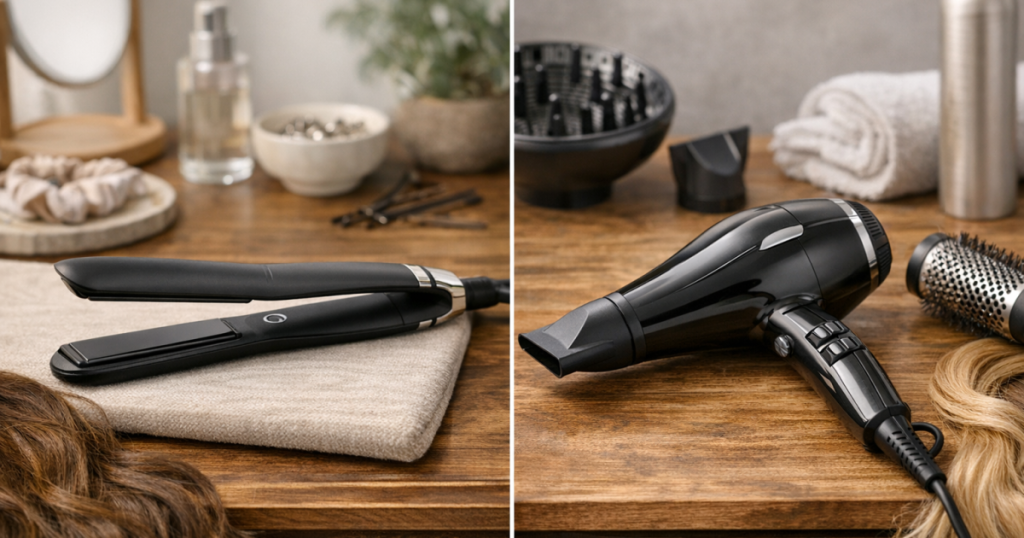
Choosing between a premium straightener and a salon-style dryer is really a question of finish, not which tool is universally better. The GHD Platinum+ vs Parlux Advance Light comparison makes most sense if you start with your normal wash routine: do you need controlled, polished shape after hair is dry, or faster drying with more root lift and styling flexibility from damp?
Both tools can earn a place in an at-home kit, but they solve different problems. A straightener is a finishing tool for smoothing, bending and refining. A dryer is a foundation tool for getting hair from wet to wearable while setting volume, direction and movement. If you only want to buy one, the smarter choice depends on when your current routine feels weakest.
In brief
- Choose the GHD Platinum+ Hair Straightener if your main struggle is frizz, kinks, uneven ends, fluffy second-day hair or a finish that never looks quite polished.
- Choose the Parlux Advance Light Hair Dryer if your main struggle is slow drying, flat roots, damp lengths, inconsistent blow-dries or needing more control before any finishing tool comes out.
- Fine hair usually benefits most from the tool that solves the bigger styling gap: a dryer for volume and root lift, a straightener for sleekness and tidy ends.
- Thick or dense hair is more likely to feel a major routine upgrade from a capable dryer, because drying time and section control can make or break the final look.
- Curly and coily hair should think carefully about styling aim: stretch and smoothness point towards the straightener, while preserving curl pattern means a dryer only makes sense if your setup supports gentle drying and compatible attachments.
The quickest way to decide
If you style from wet after most washes, start by looking at the dryer. If your hair already dries reasonably well but lacks that crisp, salon-like finish, the straightener is the more targeted upgrade.
The GHD Platinum+ Hair Straightener is best thought of as a precision finisher. It is for dry hair, small sections and visible smoothing. It can straighten, curve under ends, create soft bends and neaten hairline pieces that refuse to behave. It is not there to replace a dryer, and it should not be used on wet hair.
The Parlux Advance Light Hair Dryer is a wash-day workhorse. It suits people who want to dry hair efficiently, direct roots, encourage shape with a brush and reduce the need to air-dry for hours. It will not give the same clamped, glassy smoothness as a straightener, but it can make the whole routine easier before you reach the finishing stage.
If you are still unsure whether your hair type points towards a dryer, straightener, roller or heatless option, the wider guide to matching tools to your real hair type is a useful next step before committing to a premium tool.
What each tool is really good at
GHD Platinum+: controlled polish on dry hair
The GHD Platinum+ suits routines where the final 10–15 minutes matter most. It is the tool you reach for when your hair is already dry but looks puffy, bent in the wrong places, frizzy around the parting or untidy at the ends. The biggest appeal is control: you can isolate one section, smooth it, shape it and move on.
It also works well for people who do not always want poker-straight hair. With practice, a straightener can create a soft bevel, a tucked-under bob, face-framing flicks or relaxed S-bends. This makes it more versatile than it first appears, but it still has a polished bias. If your dream finish is airy, undone volume, it may not be the first tool to reach for.
The trade-off is concentrated heat. Even with a quality straightener, repeated passes over the same sections can leave hair feeling dry over time, particularly on bleached, highlighted, fragile or already heat-stressed lengths. The best results usually come from fully drying hair first, using sensible section sizes and avoiding the habit of re-straightening the same pieces every day.
Parlux Advance Light: faster styling from damp
The Parlux Advance Light is more about building the shape of the hair from the start. A good dryer lets you remove moisture, lift roots, direct the fringe or face frame, smooth the cuticle with tension from a brush and set the direction of the finished style. That makes it valuable if your hair looks wrong before it is even dry.
It is especially helpful for anyone who currently waits a long time for hair to air-dry, goes to bed with damp roots, or finds that hair dries into awkward bends. A dryer gives you control earlier in the process. For many people, that means less correction later.
The trade-off is coordination. A dryer does its best work when paired with the right brush, sectioning and nozzle direction. If you blast hair roughly in every direction, you may create more fluff than polish. If you want bounce, you need tension and lift. If you want smoothness, you need controlled airflow down the hair shaft rather than random movement.
Side-by-side: finish, routine and effort
- Starting point: the GHD is for dry hair; the Parlux is for damp-to-dry styling. This single difference should guide most buying decisions.
- Finish: the GHD leans sleek, smooth and refined. The Parlux leans airy, lifted and blow-dried, though it can still support a smoother finish with the right brush technique.
- Best moment in the routine: use the dryer after washing or re-wetting sections. Use the straightener once hair is completely dry and you want final shape.
- Skill level: the straightener is more straightforward for small-area correction. The dryer has a bigger learning curve because your brush, section size and airflow direction all affect the result.
- Hair stress: the straightener applies direct plate contact, so pass control matters. The dryer uses hot airflow, so distance, movement and drying time matter.
- Volume: the Parlux is the stronger choice for root lift and fullness. The GHD can smooth volume down or create bend, but it will not replace a proper blow-dry for lift.
- Frizz control: both can help, but in different ways. The dryer helps set smoother direction from damp; the straightener gives more obvious surface polish at the end.
- Storage and routine fit: a straightener is usually easier to store and quicker for touch-ups. A dryer is more of a wash-day station tool and needs space for brushes and attachments.
Hair-type guidance that actually changes the decision
Fine or flat hair
Fine hair needs care because it can go from styled to limp very quickly. If your fine hair dries flat against the scalp, the Parlux is likely to be more useful because root direction is set while hair is drying. Lifting the roots with a brush and aiming airflow correctly can give a result a straightener simply cannot create.
If your fine hair is naturally smooth but flips out awkwardly at the ends, the GHD may be the better buy. It can polish those sections quickly without requiring a full blow-dry. The key is restraint: small touch-ups, not repeated passes from roots to tips every morning.
Thick, coarse or high-density hair
For thick or dense hair, a strong dryer often changes the whole routine more noticeably than a straightener. Getting hair properly dry at the roots and through the underneath layers helps prevent puffiness, uneven texture and that heavy feeling where the outside is styled but the inside is still damp.
The GHD still has a place if your goal is sleekness, but it may take patience because dense hair needs clean sectioning. If you rush and take oversized sections, the surface may look smooth while the interior keeps its natural bulk. For more help judging whether your issue is strand texture or the amount of hair you have, see the explanation of hair texture versus density when choosing brushes, dryers and rollers.
Wavy hair
Wavy hair can go either way. If you like your natural movement but want less frizz, the dryer gives you options: smooth blow-dry one day, encouraged volume another day, or partial drying before heatless styling. It is more flexible at the foundation stage.
If your waves collapse into random bends and you prefer a neater, more intentional finish, the GHD is useful. It can refine face-framing layers, smooth the crown and add controlled bends without turning the entire style into a full blow-dry.
Curly and coily hair
For curly and coily hair, the decision depends heavily on whether you want to preserve texture or stretch it. A straightener is clearly a smoothing and stretching tool, so it makes sense for occasional sleek styles, silk-press-inspired finishes at home or tidying already stretched hair. It is less suitable as a casual daily tool if maintaining curl health is the priority.
A dryer can be helpful, but only if the overall setup matches the style. Check whether the dryer, nozzle or any compatible diffuser suits the way you dry curls; do not assume every dryer is automatically curl-friendly out of the box. If your routine is built around definition, you may get more from technique, product application and gentle drying habits than from simply buying a more powerful dryer.
Which gives the better salon-style result?
For a sleek salon finish, the GHD has the more obvious visual payoff. It can make ends look neater, reduce surface frizz and create that deliberate, finished shape that reads as polished. It is particularly strong when the haircut already has structure: bobs, lobs, long layers, curtain fringes and sharp face-framing pieces all respond well to precise finishing.
For a salon-style blow-dry, the Parlux has the advantage. Volume, root direction and movement are created while hair dries, not after. If you want a bouncy fringe, lifted crown or smoother lengths with body, the dryer is the tool that gets you closer. A straightener can fake a curve at the ends, but it will not give the same airy root lift as a controlled blow-dry.
Think of it this way: the straightener perfects the surface; the dryer builds the style. If your hair already dries into a good shape, surface perfection may be enough. If the shape is wrong from the start, a straightener is only correcting symptoms.
What to check before buying either one
- Your real routine: if you wash and style twice a week, a dryer upgrade may feel more worthwhile. If you touch up hair most mornings, the straightener may be used more often.
- UK retail details: check the plug type, warranty terms, included attachments and returns policy from the retailer you are using. Listings can vary.
- Heat habits: if you already use heat most days, choose the tool that reduces unnecessary passes or over-drying rather than adding another step.
- Brush pairing: the Parlux needs the right brush to shine. A round brush, paddle brush or vented brush will create different results, so factor that into the routine.
- Sectioning: both tools work better with clips and manageable sections. Thick hair in particular needs patience, whichever route you choose.
- Hair condition: highlighted, bleached, relaxed or fragile hair needs a more conservative approach to heat. The right tool helps, but technique and frequency matter just as much.
Where heatless styling fits into the comparison
This does not have to be an all-heat decision. Many people get the best results by using a dryer or straightener selectively and relying on heatless methods between wash days. A silk hair wrap, satin heatless curling rod, Velcro rollers or a gentle detangling brush can reduce how often you reach for direct heat while still keeping shape in the hair.
If your goal is waves, curls or volume rather than a pin-straight finish, it is worth comparing heated and heatless methods before buying another premium tool. The breakdown of heatless or heated styling for curls, waves and volume can help you decide whether the finish you want truly needs heat every time.
A sensible routine might look like this: dry roots properly on wash day, use heatless rollers or a wrap overnight, then reserve the straightener for fringe pieces or stubborn ends. That approach is often more realistic than expecting one tool to do everything while keeping hair feeling soft.
The GHD Platinum+ vs Parlux Advance Light verdict
Choose the GHD Platinum+ if your main priority is a smooth, polished finish on dry hair. It is the better single purchase for people who already manage drying reasonably well but struggle with frizz, bends, fluffy ends or a finish that lacks refinement. It suits sleek bobs, tidy long layers, face-framing pieces and occasional soft waves created with a straightener technique.
Choose the Parlux Advance Light if your routine falls apart earlier: slow drying, flat roots, damp underneath sections, rough texture after air-drying or blow-dries that never hold their shape. It is the better foundation tool, particularly for thick, dense, wavy or volume-seeking hair. It also makes sense if you want to improve your whole wash-day routine rather than only correcting the surface afterwards.
If you can eventually justify both, buy in the order your routine needs them. Foundation first if drying is the problem; finishing first if polish is the problem. For most readers choosing only one, the Parlux is the more transformative wash-day upgrade, while the GHD is the more satisfying finishing upgrade.
Quick Buying Links
GHD Platinum+ Hair Straightener
In brief Choose the GHD Platinum+ Hair Straightener if your main struggle is frizz, kinks, uneven ends, fluffy second-day hair or a finish that never looks quite polished.
Parlux Advance Light Hair Dryer
Choose the Parlux Advance Light Hair Dryer if your main struggle is slow drying, flat roots, damp lengths, inconsistent blow-dries or needing more control before any finishing tool comes out.
Helpful questions
Can the GHD Platinum+ replace a hair dryer?
No. It is designed for dry hair and should not be used as a drying tool. If your hair is still damp, use a dryer or let it dry fully before straightening.
Is the Parlux Advance Light enough for a sleek finish?
It can create a smoother blow-dry with the right brush and nozzle control, but it will not give the same direct, pressed smoothness as a straightener on dry hair.
Which is better for frizz-prone hair?
If frizz appears during drying, choose the Parlux and improve your blow-dry technique. If frizz appears as surface fluff after hair is dry, the GHD is the more targeted finisher.
Which tool is more useful for short hair?
Short bobs and fringes often benefit from the GHD for neat edges and shape. Crops, layered cuts and volume-focused short styles may benefit more from the dryer.
Should I buy both if I style my hair often?
Only if they solve different jobs in your routine. A dryer builds the base after washing; a straightener refines the dry finish. If one stage already works well, upgrade the weaker stage first.